

It upheld the order directing full payment of pension and other benefits to the widow.
The Court held that pension is a constitutional right and cannot be reduced without proper legal proceedings.
The State has been told to create a grievance system so employees can complain about non-payment.
Case Background
The case arose from a Letters Patent Appeal filed by the District Manager of Bihar State Food and Civil Supplies Corporation Ltd., Begusarai.
The appeal was directed against a judgment dated 25.06.2018 passed by a Single Judge in Civil Writ Jurisdiction Case No.11609 of 2014, filed by Anuradha Devi.
Her husband, late Ashok Kumar Singh, was a government employee.
He was appointed as a Village Level Worker on 14.05.2002 and was later promoted as Block Agriculture Officer, posted at Begusarai Sadar Block on 03.09.2010.
While working at Begusarai Sadar Block, disciplinary proceedings were started against him.
Those proceedings ended in his favour, with no charge being proved.
Subsequently, he was posted with Bihar State Food and Civil Supplies Corporation Ltd. at Sahebpur Kamal.
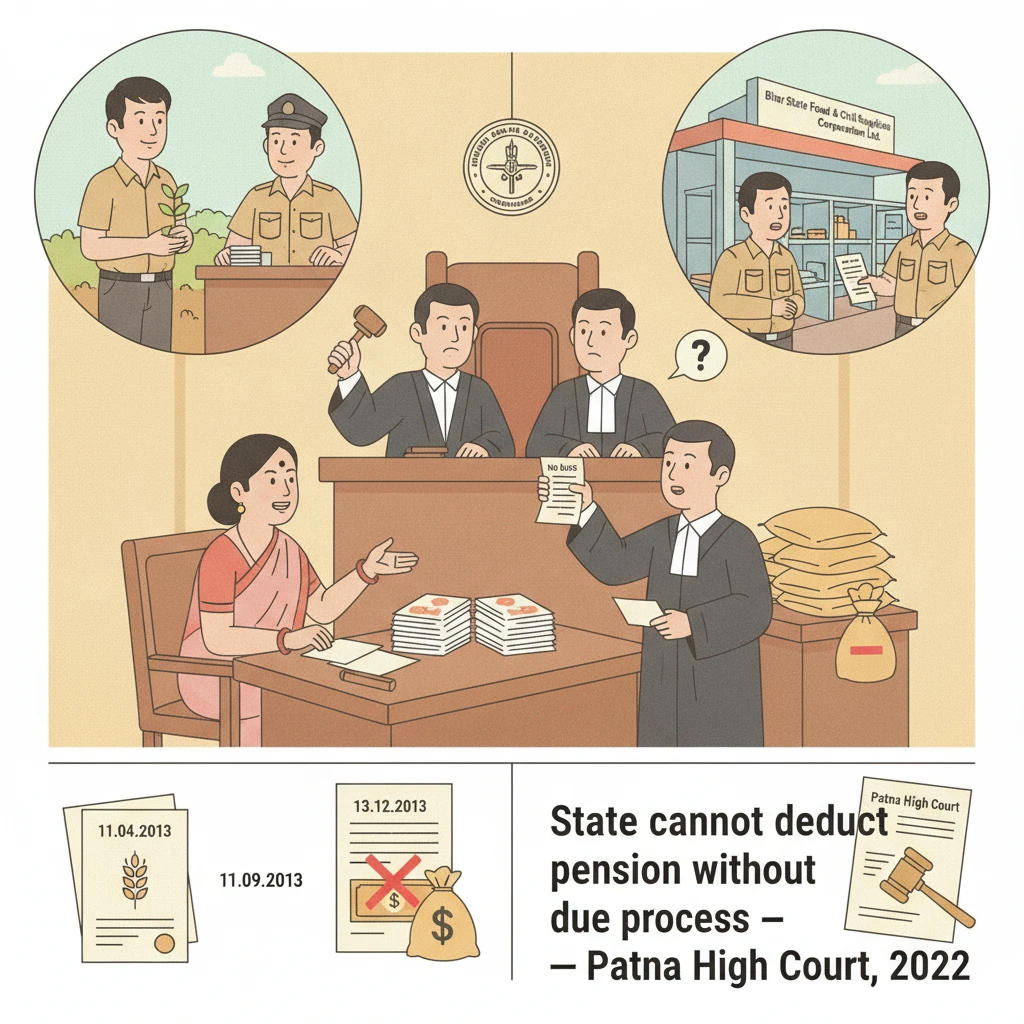
On 11.04.2013, the Block Development Officer, Sahebpur Kamal, issued a notice asking him to make good a shortfall in wheat stored in a government godown under his charge.
The only step taken was this notice; no suspension order or formal departmental proceeding was either contemplated or initiated.
On 11.09.2013, Ashok Kumar Singh died while still in service and while on deputation with the Corporation.
After his death, his widow, Anuradha Devi, applied for disbursement of all retiral dues including pension.
However, by order dated 13.12.2013, she was told that a “no dues” certificate would be issued only after she deposited an amount equal to the cost of 167 quintals of wheat allegedly found short from the godown.
The record showed that Ashok Kumar Singh remained an employee of the State Government, although posted with the Corporation.
The State Government transferred Rs.2,39,812/–, being the cost of 167 quintals of wheat, to the Corporation after deducting this amount from the dues payable to the deceased employee.
As the legal heir, the widow challenged this order dated 13.12.2013 in a writ petition, seeking quashing of the demand and release of the retiral benefits.
The Single Judge allowed her petition, holding that the deduction and withholding of pensionary benefits was illegal.
The District Manager of the Corporation then filed the present Letters Patent Appeal before the Division Bench.
What the Court Examined and Decided
The Division Bench, speaking through the Hon’ble Chief Justice, framed several broad questions.
These included the role of the State as a model employer, the nature of the relationship of trust between State and employee, the right to pension as a constitutional right, and whether retiral dues can be withheld without following due process or without disciplinary proceedings.
First, the Court discussed the concept of the State as a “model employer”.
Drawing from Supreme Court precedents, it noted that a model employer:
- is a promoter of economic justice and must have a social conscience;
- is expected to act fairly in all dealings with employees;
- must conduct itself with high probity;
- must act in a manner consistent with Articles 14 and 16 of the Constitution;
- must not create despair among employees by deceitful or insensitive conduct; and
- must honour the trust reposed by employees, as a part of good governance.
The Court then turned to the nature of pension.
Relying on a series of Supreme Court decisions, it reiterated that pension is the deferred part of the compensation for long years of service.
It is not a charity or bounty.
It is a hard-earned benefit that accrues to an employee and is treated as “property”.
The Bench highlighted that pension provisions are a form of social welfare measure.
Their purpose is to allow a retired government servant to live with dignity in old age.
Therefore, rules related to pension must be interpreted liberally, and authorities must not deny pensionary benefits unreasonably or on mere technicalities.
The Court referred to the landmark Constitution Bench judgment in Deokinandan Prasad v. State of Bihar.
In that case, the Supreme Court had held that pension is a right governed by rules and not a matter of government grace.
The right to receive pension was recognised as a form of “property”, which could not be taken away except by authority of law.
The Bench also cited D.S. Nakara v. Union of India, where a Constitution Bench rejected the old idea that pension is a discretionary payment.
D.S. Nakara explained that pension is both a reward for past service and a measure to protect a retired employee from destitution in old age.
The Court acknowledged that the fundamental right to property under Article 19(1)(f) and Article 31(1) had been repealed by the Constitution (Forty-fourth Amendment) Act, 1978.
However, relying on State of Jharkhand v. Jitendra Kumar Srivastava and State of W.B. v. Haresh C. Banerjee, it pointed out that the right to property continues as a constitutional right under Article 300-A.
Thus, the right to receive pension remains a constitutional right which cannot be taken away without authority of law.
Applying these principles, the Court examined the conduct of the State and its instrumentality in this case.
It agreed with the Single Judge that:
- no departmental proceedings had been initiated against Ashok Kumar Singh regarding the alleged shortage of wheat; and
- withholding of pensionary benefits was contrary to Rule 43(b) of the Bihar Pension Rules.
The Division Bench saw “no infirmity” in the Single Judge’s judgment.
It further emphasised that, before deducting any amount from retiral dues, the State was bound to follow the principles of natural justice.
Instead, the State deducted the amount and paid it to the Corporation without even calling upon the widow to state her position or respond.
On the date of the employee’s death, no departmental proceedings were pending or even contemplated.
There was merely a notice dated 11.04.2013 that non-response may lead to initiation of proceedings.
The Court noted that the record showed that such proceedings never saw “the light of the day”.
In these circumstances, the State had no legal basis to conclude that the deceased was solely responsible for the loss or shortfall of wheat.
Importantly, the Bench observed that it had not been shown that the deceased alone was in charge of the godown and fully accountable for any loss.
The possibility that others might also have been involved in any pilferage was not ruled out on the record.
The Court stressed that pension cannot be stopped in the absence of a specific rule empowering the employer to do so.
Since no such rule existed in this case and no departmental proceedings were pending, the deduction of Rs.2,39,812/– from the retiral dues was unlawful.
Beyond the individual case, the Bench commented strongly on the increasing trend of government authorities becoming “chronic and incorrigible litigants” in pension matters.
Despite clear Supreme Court directions since 1971, authorities continued to withhold pensionary benefits, forcing employees and their families into unnecessary litigation and burdening the courts.
The Court also discussed the State Litigation Policy.
This policy aims to reduce government-induced litigation, save costs, and lessen the load on the judiciary, in line with Article 39-A of the Constitution (equal justice and free legal aid).
The Bench pointed out that when the State delays or denies undisputed monetary dues, employees and their legal heirs have no choice but to approach the courts.
This defeats the very purpose of the Litigation Policy.
Ultimately, the Division Bench dismissed the Letters Patent Appeal.
It confirmed the Single Judge’s directions to release the retiral dues.
It directed the appellant–District Manager of the Corporation–to pay the entire amount to Anuradha Devi within three weeks from 01.02.2022.
If payment was delayed beyond this period, she would be entitled to interest at 12% per annum, and the interest would be recoverable from the salary of the responsible officer.
An affidavit of compliance was ordered to be filed within two months.
Going further, the Court issued systemic directions to the Chief Secretary of Bihar.
It directed the State to create a mechanism for employees to raise grievances about non-disbursement of wages, salaries, and emoluments.
One suggested mechanism was a web portal at the level of the Principal Secretary/Secretary of each department, where employees could lodge complaints.
Such complaints should be processed and answered within a reasonable time.
The Bench observed that this would help in quick redressal of genuine grievances, prevent unnecessary litigation, and improve efficiency in governance through better use of information technology.
It would also build confidence and trust among employees.
The Court made it clear that non-disbursement of monetary benefits, contrary to law, would have consequences.
The amount of interest arising from delayed payment would be recoverable from the “delinquent officer incharge” of such disbursement.
All interlocutory applications, if any, were ordered to stand disposed of.
Why This Judgment Matters
This judgment is significant for government employees and their families, particularly in Bihar.
It reaffirms that pension and retiral dues are not favours from the government but legal and constitutional rights.
Authorities cannot arbitrarily deduct or withhold these amounts, especially after an employee’s death, without proper disciplinary proceedings and clear legal authority.
For widows and legal heirs, the case offers assurance that they cannot be forced to pay alleged shortages or losses from their own pockets merely to secure a “no dues” certificate.
Any such demand must be backed by law and preceded by fair hearing.
For the State and its instrumentalities, the judgment is a strong reminder of their duty to act as model employers and to follow their own Litigation Policy.
Delays or illegal deductions can now trigger personal financial liability for the officers responsible, in the form of interest recovered from their salaries.
The direction to create a web-based grievance redressal mechanism, if effectively implemented, may reduce the need for employees to approach the Patna High Court for basic dues and will promote faster, more transparent resolution of payment-related disputes.
Legal Issues and Answers
Issue: Can the State or its corporation deduct alleged loss amounts from an employee’s retiral dues, including pension, without initiating or concluding departmental proceedings?
Answer: No. The Patna High Court held that in the absence of any departmental proceeding and specific rule authorising such action, pension and other retiral benefits cannot be withheld or reduced.
Issue: Is the right to receive pension a constitutional right that can only be curtailed by authority of law and with due process?
Answer: Yes. Relying on Supreme Court decisions, the Court held that pension is “property” protected under Article 300-A, and cannot be taken away by an executive order or without following principles of natural justice.
Issue: What is the obligation of the State as a model employer regarding timely payment of undisputed dues?
Answer: The State must act fairly, with social conscience and high probity, ensure timely payment of dues, avoid forcing employees or their heirs into unnecessary litigation, and may face consequences including interest recovery from responsible officers for unjustified non-disbursement.
Cases Cited by the Court
- Som Prakash Rekhi v. Union of India, (1981) 1 SCC 449
- Gurmail Singh and others v. State of Punjab and others, (1991) 1 SCC 189
- Balram Gupta v. Union of India and Another, 1987 Supp (1) SCC 228
- State of Haryana v. Piara Singh, (1992) 4 SCC 118
- Bhupendra Nath Hazarika and another v. State of Assam and others, (2013) 2 SCC 516
- State of Jharkhand and another v. Harihar Yadav and others, (2014) 2 SCC 114
- State of Jharkhand v. Jitendra Kumar Srivastava, (2013) 12 SCC 210
- Veena Pandey v. Union of India & Others, 2021 SCC Online SC 1078
- V. Sukumaran v. State of Kerala, (2020) 8 SCC 106
- State of W.B. v. Haresh C. Banerjee and others, (2006) 7 SCC 651
- Deokinandan Prasad v. State of Bihar, (1971) 2 SCC 330
- State of Madhya Pradesh v. Ranojirao Shinde, AIR 1968 SC 1053
- D.S. Nakara v. Union of India, (1983) 1 SCC 305
- State of Punjab v. Iqbal Singh, (1976) 2 SCC 1
- Sudha Devi v. The State of Bihar, LPA No.1777 of 2016, decided on 18.07.2017 (Patna High Court)
- Arvind Kumar Singh v. State of Bihar, 2018 (2) PLJR 933 (Full Bench, Patna High Court)
Case Details
Case Number: Letters Patent Appeal No.1322 of 2018 in Civil Writ Jurisdiction Case No.11609 of 2014
Case Title: The District Manager, Bihar State Food and Civil Supplies Corporation Ltd., Begusarai v. Anuradha Devi & Others
Coram: Hon’ble the Chief Justice; Hon’ble Mr. Justice S. Kumar
Date of Judgment: 01.02.2022
Citation: 2022 (1) PLJR 678
Advocates: For the appellant: Mr. Shailendra Kumar Singh, Advocate; For the respondents: Not specified in the judgment text
Nature of the case: Letters Patent Appeal against the order of a Single Judge in a writ petition concerning deduction and withholding of pensionary and retiral benefits
Link to Judgment: http://Link to Judgment: https://patnahighcourt.gov.in/viewjudgment/MyMxMzIyIzIwMTgjMSNO-vxh–am1–S1S1cEA=
If you found this explanation helpful and wish to stay informed about
how legal developments may affect your rights in Bihar,
you may consider following Samvida Law Associates for more updates.







