
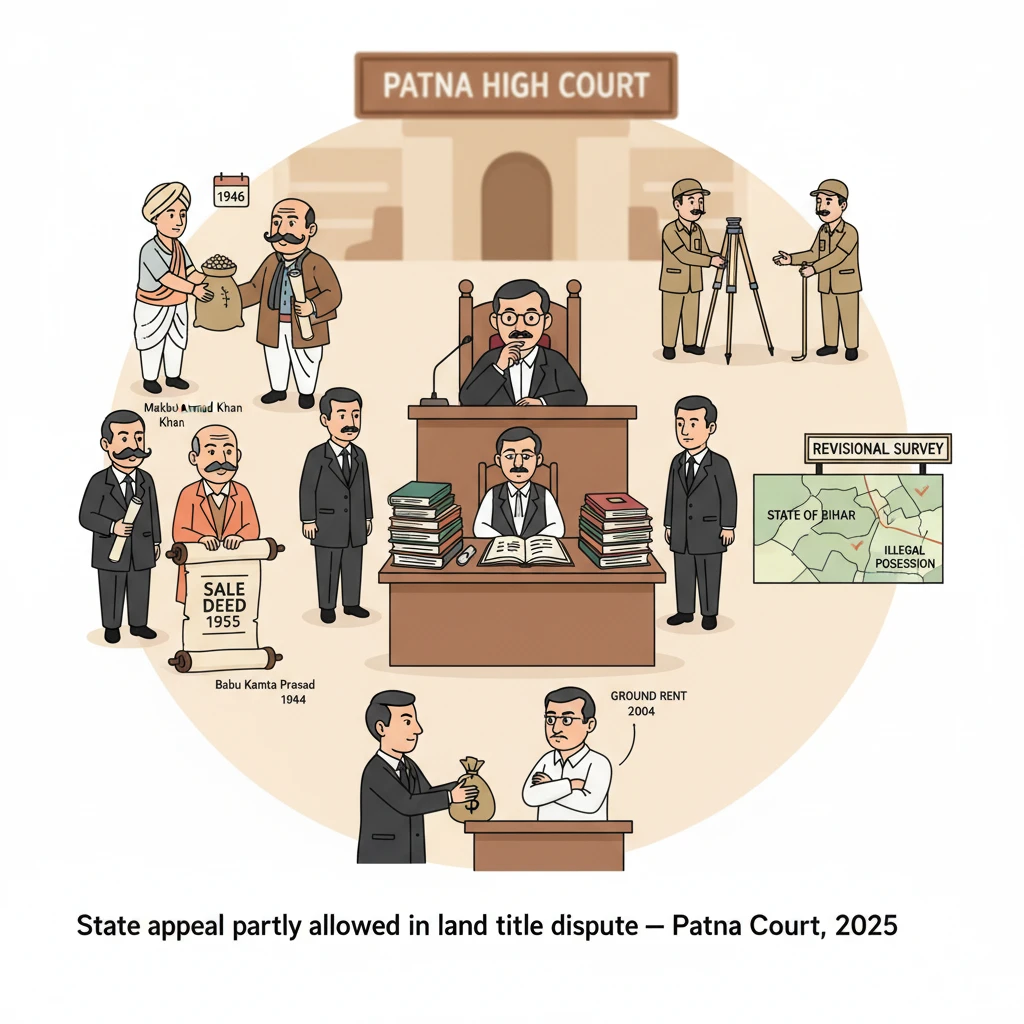
The State challenged a lower appellate court decision that had fully accepted the private party’s title claim.
The High Court held that the plaintiff proved title only over a smaller part of the land, not the entire area claimed.
The decree was modified, and the plaintiff’s title was confirmed only for 4 acres 78 decimals of the disputed land.
Case Background
The dispute concerns agricultural land in village Karmani, Thana No. 793, Tauzi No. 12427 (earlier 4548), District Gaya. The original suit was filed for declaration of right, title, interest and confirmation of possession, along with a prayer for permanent injunction.
The suit was instituted as Title Suit No. 161 of 2009/383 of 2004 by Sanjay Kumar, acting as Power of Attorney holder of one Shivnath Prasad Gupta @ Bhola Prasad, son of late Kedarnath Prasad Gupta. The plaintiffs claimed that their title flowed from old zamindari and raiyati arrangements, including a partition decree, a settlement (Hukumnama), a rent decree, and a registered sale deed.
The plaintiff’s case was that the relevant cadastral survey khata and plots were originally recorded as “Gairmazarua Mokararidar” (Khata No. 49) and “Gairmazarua Aam” (Khata No. 50), and that the ex-landlord, one Babu Kamta Prasad, had obtained a partition decree in Partition Suit No. 22 of 1933. On the basis of the final decree and Pleader Commissioner’s report, certain plots under C.S. Khata Nos. 49 and 50 were allotted to him.
Subsequently, according to the plaintiff, one Makbul Ahmad Khan was recognized as raiyat over part of these lands. When he allegedly failed to pay rent, Kamta Prasad filed Rent Suit No. 619 of 1946, which was decreed in his favour on 19.12.1947. Later, in 1955, Makbul Ahmad Khan is said to have transferred his raiyati interest by a registered sale deed dated 18.08.1955 in favour of Kedarnath Gupta, father of Shivnath Prasad.
The plaintiff further claimed that in addition to this sale deed, ex-landlord Kamta Prasad had issued a written Hukumnama dated 30.06.1944 settling further land in favour of Kedarnath Gupta, followed by Zamindari rent receipts. After vesting of zamindari, a return was said to have been filed in a Compensation case (No. 32798 of 1954-55), showing names of Makbul Ahmad Khan and Kedarnath Gupta as raiyats.
On the strength of these documents and long possession, the plaintiff sought declaration of title and injunction over the Schedule III land (measuring 12 acres 4 decimals), and also prayed that, if dispossessed during the suit, possession be restored.
In the revisional survey, however, the suit land was recorded in the name of the State of Bihar as “Anabad Sarva Sadharan”, with a remark that the land was in “illegal possession” of Kamta Prasad or of Bhola Prasad, depending on the plot. The plaintiff did not, however, seek correction of the revisional survey entry; he instead sought declaration of his title and injunction.
Before the Trial Court, the State (defendant nos. 1 and 2) appeared but did not file any written statement and did not adduce any evidence, oral or documentary. Defendant no. 3 (Mukhiya) also did not seriously contest the plaintiff’s case. The Trial Court framed only one issue: whether the plaintiff had brought the case on its merit or not.
Despite the lack of defence evidence, the Trial Court dismissed the suit on contest, holding, among other things, that important documents like the cadastral survey khatiyan and the partition judgment were not filed, and that the suit was barred by limitation as it was filed long after publication of the revisional survey khatiyan.
The plaintiff appealed in Title Appeal No. 24 of 2011 before the District Judge, Gaya. The lower Appellate Court reversed the Trial Court’s judgment on all major findings. It held that the relevant documents including the cadastral survey khatiyan (Ext. 12B), final decree in Partition Suit No. 22 of 1933 (Ext. 14), and Pleader Commissioner’s report were on record. It further accepted the validity of the Power of Attorney, the sufficiency of evidence of title and possession, and held that the suit was within limitation because the cause of action arose only when the revenue authorities allegedly threatened to dispossess the plaintiff in 2004.
The District Judge thus decreed the suit in favour of the plaintiff for the entire Schedule III land and granted injunction. Against this reversal, the State of Bihar and the Anchal Adhikari, Dobhi Anchal, filed the present Second Appeal No. 179 of 2018 before the Patna High Court.
What the Court Examined and Decided
The Patna High Court, presided over by Hon’ble Mr. Justice Khatim Reza, heard the Second Appeal and formulated three substantial questions of law:
(i) Whether the lower appellate court’s findings based on Ext. 10 (Zamindari return) and Ext. 12 (registered sale deed) were perverse due to wrong reading of these documents.
(ii) Whether the suit was barred by limitation.
(iii) Whether the lower appellate court, while reversing the Trial Court’s decree, failed to meet the Trial Court’s reasons and thus violated Order 41 Rule 31 CPC.
The Court first narrated the plaintiff’s chain of title as pleaded: partition decree in favour of ex-landlord Kamta Prasad, recognition of Makbul Ahmad Khan as raiyat, rent decree in Rent Suit No. 619 of 1946, sale deed dated 18.08.1955 in favour of Kedarnath Gupta, and settlement through Hukumnama dated 30.06.1944 followed by Zamindari rent receipts.
The Court also noted the plaintiff’s assertion that during revisional survey operation, cadastral plots under Khata No. 49 (780, 784, 752, 782) were carved into several revisional survey plots recorded in the name of State of Bihar, with remarks describing “illegal possession” of Kamta Prasad or Bhola Prasad. The plaintiff maintained that the land was never parti or Sarvasadharan but was under his cultivating possession, and that he was threatened with dispossession when he went to pay rent in 2004. The suit was then filed after notice under section 80 CPC.
The High Court recorded that the State had not filed any written statement and no evidence was adduced on its behalf. The Trial Court had nonetheless dismissed the suit, largely on the ground of limitation and alleged non-production of key documents.
The lower Appellate Court, on the other hand, had examined the documentary evidence: cadastral khatiyan (Ext. 12B), final decree in Partition Suit No. 22 of 1933 and Pleader Commissioner’s report (Ext. 14), judgment and decree in Rent Suit No. 619 of 1946 (Ext. 19 & 19(a)), Hukumnama dated 30.06.1944 (Ext. 17), Zamindari return (Ext. 10), and the registered sale deed dated 18.08.1955. It found that these documents supported the plaintiff’s title and possession and rebutted the presumption of correctness attached to the revisional survey entries.
On limitation, the Appellate Court reasoned that the mere adverse entry in revenue records does not give rise to cause of action. The right to sue arose only when there was a clear and unequivocal threat to the plaintiff’s rights, i.e., when the Karamchari allegedly refused to accept rent and threatened dispossession in 2004. Therefore, the suit filed in 2004 was held to be within time.
In the Second Appeal, the State argued that there was a serious discrepancy between the area that Makbul Ahmad Khan legally held as raiyat (about 4 acres 78 decimals, i.e., roughly 6 bighas) as per the Zamindari return (Ext. 10), and the much larger area he purported to transfer by sale deed (11 bighas 2 kathas 10½ dhurs). They contended that the lower Appellate Court had not addressed how the plaintiff could claim title over about 14 bighas of land in Schedule III, when Makbul himself had limited raiyati rights.
The State further argued that revisional survey khatiyan was published in 1976, that the original plaintiff had knowledge of it at least by 1995 (as per Ext. 12), and the suit filed in 2004 was thus barred by limitation. It was also urged that the lower Appellate Court failed to analyse how rent receipts, alleged Hukumnama, and Zamindari returns actually translated into valid title, particularly when Jamabandi in the name of Makbul for the Hukumnama land was not shown and no State rent receipts were filed.
On the other side, the plaintiff-respondents stressed that no written statement or evidence came from the State; that the Trial Court had erred in ignoring the presence of cadastral khatiyan and Zamindari returns on record; and that as per settled law, entries in record-of-rights neither create nor extinguish title but are only rebuttable evidence. They reiterated that the cause of action arose only in 2004 when threat of dispossession was given.
While analysing the matter, the Patna High Court first clarified the limited nature of the suit. It was not a challenge to the revisional survey order or its entries; the plaintiff only sought declaration of title, confirmation of possession and injunction. Relying on Supreme Court precedents such as State of H.P. v. Keshav Ram and Suraj Bhan v. Financial Commissioner, and later decisions like Municipal Corporation, Aurangabad v. State of Maharashtra, T. Ravi v. B. Chinna Narasimha, Bhimabai Mahadeo Kambekar v. Arthur Import & Export Co., Prahlad Pradhan v. Sonu Kumhar, and Ajit Kaur v. Darshan Singh, the Court reiterated that entries in revenue records are only for fiscal purposes and do not confer ownership. Title must be decided by a competent civil court, not by revenue entries.
On limitation (Substantial Question No. II), the Court discussed Articles 58 and 59 of the Limitation Act, 1963 and the Supreme Court decision in Khatri Hotels Pvt. Ltd. v. Union of India. It emphasized that limitation for declaratory suits runs from the date when the right to sue first accrues. Successive violations do not generate fresh limitation periods. In this case, the Court held that the right to sue accrued when the plaintiff was first clearly threatened with dispossession on 01.06.2004, when the Karamchari refused to accept rent and cited the Khata in the name of State of Bihar. The suit filed in 2004 was therefore within limitation. The revisional survey entry itself did not start limitation as it did not affect title by itself.
On Substantial Question No. I, the Court closely examined Ext. 10 (Zamindari return lagit) and Ext. 17 (Return Compensation Case No. 32798/1954-55). It found that these returns mentioned only the raiyati holding of Makbul Ahmad Khan over 4 acres 78 decimals of land in C.S. Khata No. 49 under Tauzi No. 12427, Thana No. 793. The plots shown were:
- Plot No. 780/918 – 2 acres 98 decimals
- Plot No. 780/916 – 1 acre 60 decimals
- Plot No. 780 – 0.20 decimals
These records did not mention any land settled with Kedarnath Gupta through Hukumnama dated 30.06.1944. Yet, the plaintiff’s case was that the ex-landlord had filed return in favour of Kedarnath Gupta as well. The High Court found that this specific assertion was not supported by the documentary returns.
The Court held that since the Return filed under sections 5, 6, and 7 of the Bihar Land Reforms Act was accepted by the State, and there was no evidence of any appeal against such acceptance, Makbul Ahmad Khan’s raiyati right was limited to 4 acres 78 decimals only. He could not legally transfer more than what he held. The sale deed dated 18.08.1955 in favour of Kedarnath Gupta, insofar as it covered land in excess of 4 acres 78 decimals, was thus beyond Makbul’s right.
The High Court noted that the lower Appellate Court had failed to examine this critical discrepancy between Makbul’s legal holding and the area conveyed under the sale deed. It therefore concluded that the plaintiff could succeed only to the extent of Makbul’s established raiyati area of 4 acres 78 decimals in C.S. Khata No. 49, Plot Nos. 780/918, 780/916 and 780, as accepted in the Compensation return and Zamindari laggit.
As for the remaining Schedule III land (12 acres 4 decimals claimed), the Court found that the plaintiff had failed to unequivocally prove title. The sale deed, Hukumnama, and other documents did not fully cover or support title over the entire area claimed. Since the burden of proof lay entirely on the plaintiff, and there were inherent weaknesses in his documents beyond the 4 acres 78 decimals, the Court held that the plaintiff’s claim over the balance land could not be accepted.
On Substantial Question No. III (compliance with Order 41 Rule 31 CPC), the High Court held that although the lower Appellate Court might have misread the documents in part, there was substantial compliance with Order 41 Rule 31. The Appellate Court had framed points for determination, discussed the evidence, and given reasons. Relying on G. Amalorpavam v. R.C. Diocese of Madurai, the Court held that mere wrong interpretation of documents does not mean non-compliance with Order 41 Rule 31, so long as the findings and reasoning can be clearly understood.
In the final analysis, the Patna High Court partly allowed the Second Appeal. It modified the lower Appellate Court’s decree and held that the plaintiff was entitled only to 4 acres 78 decimals in C.S. Khata No. 49, C.S. Plot Nos. 780/918, 780/916 and 780 out of Schedule III, as accepted by the State in the Return Compensation (Ext. 17) and Zamindari return laggit (Ext. 10). The first substantial question of law was answered in favour of the State, while the second and third were answered against the State. The Trial Court was directed to prepare the modified decree.
Why This Judgment Matters
This judgment is important for landholders in Bihar, especially those relying on old zamindari transactions, rent suits, and revisional survey records. It shows that even if the State does not file a written statement and much of the evidence is one-sided, the plaintiff’s documents will still be closely scrutinised.
The Court made it clear that a person cannot claim more land than what his vendor legally held and which is reflected in accepted returns under the Bihar Land Reforms Act. Where the official records show a smaller area of raiyati land, a sale deed for a larger area will not automatically confer full title.
The judgment also reassures genuine long-term possessors that a wrong or adverse entry in revenue records will not by itself defeat their civil title, and it will not start limitation until a real threat to their possession or rights occurs. At the same time, it warns plaintiffs that they must strictly prove their title with consistent records, not just rely on possession and broad claims.
For villagers and small farmers, the case underscores the importance of preserving old documents like zamindari returns, compensation case records, and rent decrees, and understanding that entries in khatiyan are not final on questions of ownership.
Legal Issues and Answers
- Issue: Was the plaintiff’s suit for declaration of title and injunction barred by limitation due to old revisional survey entries?
Answer: No. The Patna High Court held that limitation began when the plaintiff’s title and possession were first clearly threatened in 2004, not from the date of revisional survey entries, and the suit filed in 2004 was within time. - Issue: Could the plaintiff claim title over the entire Schedule III land based on the sale deed, Hukumnama, and zamindari records?
Answer: Only partly. The Court held that the plaintiff proved title only to the extent of 4 acres 78 decimals in C.S. Khata No. 49, C.S. Plot Nos. 780/918, 780/916 and 780, as that was the extent of Makbul Ahmad Khan’s raiyati right shown in accepted returns. Claim over the remaining area failed. - Issue: Did the lower Appellate Court’s judgment violate Order 41 Rule 31 CPC by not properly meeting the Trial Court’s reasons?
Answer: No. The High Court found substantial compliance with Order 41 Rule 31 as the lower Appellate Court formulated points, discussed evidence, and gave reasons, even though some appreciation of documents was erroneous.
Cases Cited by the Court
- State of H. P. v. Keshav Ram, (1996) 11 SCC 257
- Suraj Bhan v. Financial Commissioner, (2007) 6 SCC 186
- Municipal Corporation, Aurangabad v. State of Maharashtra, (2015) 16 SCC 689
- T. Ravi v. B. Chinna Narasimha, (2017) 7 SCC 342
- Bhimabai Mahadeo Kambekar v. Arthur Import & Export Co., (2019) 3 SCC 191
- Prahlad Pradhan v. Sonu Kumhar, (2019) 10 SCC 259
- Ajit Kaur v. Darshan Singh, (2019) 13 SCC 70
- Khatri Hotels Private Limited and Another v. Union of India and Another, (2011) 9 SCC 126
- G. Amalorpavam v. R.C. Diocese of Madurai, (2006) 3 SCC 224
Case Details
Case Number: Second Appeal No. 179 of 2018
Case Title: The State of Bihar through Collector, Gaya & Anchal Adhikari, Dobhi Anchal, District Gaya v. Geeta Devi & Ors. & Mukhiya, Nawadih, Karmauni Panchayat
Court: High Court of Judicature at Patna
Coram: Hon’ble Mr. Justice Khatim Reza
Date of Judgment: 15.05.2025
Citation: 2025(3) PLJR 785
Advocates:
- For the appellants (State and Anchal Adhikari): Mr. Uday Shankar Sharan Singh, GP 19
- For respondent nos. 1.1 to 1.3 (private plaintiffs): Mr. P.N. Shahi, Senior Advocate; Mr. Pankaj Kumar Jha, Advocate; Mr. Sanjay Kumar, Advocate
Nature of the Case: Second Appeal (challenge to first appellate court decree in a title suit for declaration of right, title, interest, confirmation of possession and permanent injunction)
Link to Judgment: Click here to view the official Patna High Court judgment
If you found this explanation helpful and wish to stay informed about
how legal developments may affect your rights in Bihar,
you may consider following Samvida Law Associates for more updates.







