
Case Background
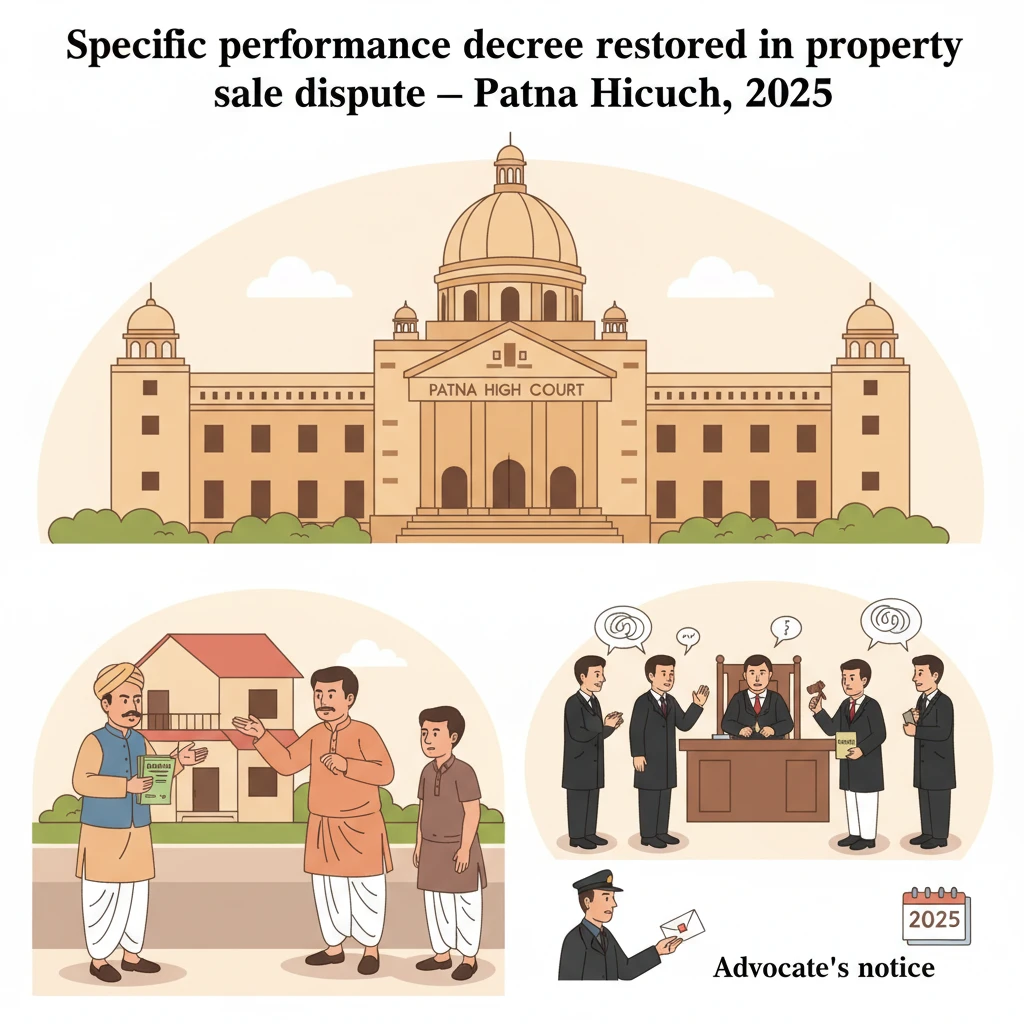
The dispute arose from an alleged agreement to sell a residential property in Katihar. The plaintiff, later appellant in the High Court, claimed that the defendant agreed to sell a double-storeyed house with land measuring 4 kathas 10 dhurs and 14 dhurkis in Katihar town for Rs.50,000.
According to the plaintiff, on 07.05.1988 an agreement for sale (baynama) was executed. The defendant allegedly received Rs.25,000 in cash as advance out of the total price. The agreement was written on non-judicial stamp paper. The original labadinama deed no. 11715 dated 17.08.1970 relating to the suit property was allegedly handed over to the plaintiff. The defendant’s son signed as a witness.
The agreement allegedly provided that the defendant would execute a proper sale deed over the suit property by 07.09.1989 after receiving the remaining Rs.25,000. It also stated that if the plaintiff failed to get the sale deed executed by that date, the earnest money would be forfeited. The plaintiff maintained that he was always ready and willing to pay the balance amount.
The plaintiff stated that he repeatedly requested the defendant to take the balance money and execute the sale deed, but the defendant kept avoiding. Instead, the defendant sent a lawyer’s notice claiming that the amount of Rs.25,000 had been taken as a loan for purchasing a second-hand truck on 12% yearly interest, and that signatures on stamp papers and deposit of the original deed were only security for that loan.
The plaintiff replied through his advocate, denying the loan story and asserting the agreement for sale dated 07.05.1988. He asserted that he was ready and willing to pay the balance Rs.25,000 and called upon the defendant to execute the sale deed. He again issued a notice dated 06.09.1989, saying he would be present at the Katihar Registration Office with the money on 06.09.1989 and expected the defendant to execute the deed by 07.09.1989. The defendant did not appear.
Consequently, the plaintiff filed Title Suit No. 25 of 1989 before the 1st Sub-Judge, Katihar, seeking specific performance of the contract.
The defendant filed written statement, denying any agreement for sale. He said he had only taken a loan of Rs.25,000 from the plaintiff and his brother for purchase of a truck, on 12% interest. According to him, he and his son had signed three blank non-judicial stamp papers and handed over the original sale deed only as loan security. He claimed that the property was far more valuable than Rs.50,000 and that the alleged baynama was forged and fabricated. He further alleged that he had repaid Rs.12,000 in monthly instalments of Rs.1,000, without receipts, and that when he offered to pay the remaining amount and asked for return of the documents, the plaintiff refused. Feeling something was wrong, he approached an advocate who issued a notice to the plaintiff and his brother.
The trial court decreed the suit for specific performance. The defendant then filed Title Appeal No. 08 of 1996 before the District Judge, Katihar. The first appellate court reversed the decree, refused specific performance, and instead directed refund of Rs.25,000 with 12% interest to the plaintiff, to be paid by the defendant within 45 days.
Aggrieved, the plaintiff filed Second Appeal No. 5 of 1999 before the Patna High Court. The respondent did not appear at the final hearing of the second appeal. The High Court, by judgment dated 16.12.2025, decided the matter.
What the Court Examined and Decided
The Patna High Court heard only the counsel for the plaintiff-appellant, as nobody appeared for the defendant-respondent at the final hearing. The Court examined in detail the trial court’s findings, the first appellate court’s reasoning, and the evidence on record.
The trial court had framed six issues. Two main issues were whether there was any contract of sale in respect of the suit property and whether the agreement deed was legal and valid, and whether the plaintiff was always ready and willing to perform his part of the contract.
After analysing oral and documentary evidence, the trial court had held that the agreement for sale bore the signature and thumb impression of the defendant. On that agreement, the defendant had written that he had received Rs.25,000 as bayna (advance). The trial court therefore concluded that a valid agreement for sale of the suit property was entered into on 07.05.1988 and that the plaintiff was always ready and willing to perform his part of the contract. It decreed specific performance, permitting the plaintiff to deposit the balance Rs.25,000 in court within three months and directing the defendant to execute the sale deed, failing which the Sarishtedar would execute it on his behalf.
The first appellate court, while agreeing that the defendant had indeed received Rs.25,000 from the plaintiff and had signed and put his thumb impression on the stamp paper and handed over the original labadinama, reversed the decree for specific performance. It held that the agreement appeared unreasonable because the consideration of Rs.50,000 was too low for the property. It felt it would not be equitable to grant specific performance and therefore set aside the trial court’s decree. Instead, it directed the defendant to refund Rs.25,000 with 12% interest within 45 days.
In the second appeal, the plaintiff’s counsel argued that the first appellate court misread the evidence and wrongly ignored important documents like the baynama (Ext-2) and the expert’s report (Ext-7). It was contended that once the execution of the agreement and receipt of advance were admitted, and the plaintiff had proved his readiness and willingness, the court could not deny specific performance merely because it felt the price was low, especially without any evidence to show the real market value. It was also argued that the appellate court wrongly brushed aside the handwriting and fingerprint expert’s evidence and relied on its own “naked eye” assessment.
The plaintiff had examined seven witnesses, including himself as PW-6 and an expert as PW-5. PW-5, the handwriting and fingerprint expert, stated that he had examined the disputed and admitted signatures and thumb impressions and that they were of the same person. He gave reasons in his report (Ext-7), comparing specimen writings and signatures, and concluded they were by the defendant. Importantly, this expert was not cross-examined by the defendant, and the defence did not produce any counter-expert.
The High Court noted that despite this unchallenged expert evidence, the first appellate court rejected the endorsement on the agreement by its own visual comparison, pointing to differences in letters and the digit “5”. The High Court held that once the expert’s scientific report had proved the signature and endorsement, and there was no contrary expert evidence, the appellate court had no occasion to discard it merely on its own personal satisfaction based on naked-eye observation. The Court termed this approach erroneous.
On readiness and willingness, the first appellate court had said that the plaintiff had not mentioned specific dates when he went with the balance money before issuing the first notice. However, it itself admitted that paragraph 5 of the plaint stated that the plaintiff was always ready and willing and was still ready and willing to pay the balance and get the sale deed executed. Paragraph 6 of the plaint further stated that the plaintiff had several times requested the defendant to receive the balance Rs.25,000 and execute the sale deed, but the defendant avoided.
The High Court referred to this pleading and also to the plaintiff’s oral evidence as PW-6. He deposed that he went many times to the defendant with the remaining consideration and requested execution of the sale deed, but the defendant refused to accept the money and kept avoiding. In cross-examination, he said he had gone 2–3 times with Rs.25,000 in cash taken from his house. The Court held that this evidence clearly showed readiness and willingness, and that the law under Section 16(c) of the Specific Relief Act does not require mention of each specific date. The Court relied on Supreme Court rulings, including AIR 2000 SC 2408, to hold that readiness and willingness must be gathered from the plaint and evidence as a whole, and no particular phraseology or date-specific pleading is mandatory.
The High Court therefore concluded that the first appellate court’s finding on lack of readiness and willingness was contrary to the record and the settled law.
On the issue of alleged inadequacy of consideration, the High Court noted that the defendant’s case was that the property value was far above Rs.50,000 and that the agreement was for a low price. However, in the written statement the defendant had not disclosed what, according to him, was the actual value of the property at the time of agreement. No document or oral evidence was produced to prove the alleged higher value or the value of adjacent land. Despite this, the first appellate court held that the consideration was low and that it would be inequitable to enforce the contract.
The High Court observed that such a conclusion was purely based on the appellate court’s personal satisfaction and not on any evidence. It referred to Explanation II of Section 25 of the Indian Contract Act, 1872, which states that inadequacy of consideration does not make an agreement void, though it may be relevant in examining whether consent was freely given. In this case, there was no material to show that the defendant’s consent was not free, or that the price was unconscionable. Thus the appellate court’s view on low consideration was held erroneous.
The High Court also noted that the first appellate court had not properly dealt with the trial court’s reasons, as required in a judgment of reversal under Order 41 Rule 31 of the Civil Procedure Code. Various Supreme Court and High Court precedents cited by the appellant were referred to, highlighting that an appellate court must consciously apply its mind, record reasons, and engage with the trial court’s reasoning before reversing findings, especially those based on oral evidence.
After analysing the evidence and legal principles, the Patna High Court held that the first appellate court’s judgment and decree were perverse and not based on the materials on record. It restored the trial court’s decree for specific performance.
The Court allowed the second appeal, set aside the first appellate court’s judgment and decree, and directed the defendant to execute the sale deed in favour of the plaintiff within two months of the trial court receiving the High Court judgment, upon receiving the remaining Rs.25,000. If the defendant failed to do so, the executing court was directed to execute the sale deed at the defendant’s cost. No order as to costs was passed; each party was to bear its own costs.
Why This Judgment Matters
This judgment is significant for buyers who pay advance money for purchase of property and later face denial by the seller on the ground that the transaction was only a loan or that the price was low.
The Patna High Court has made it clear that once an agreement to sell is proved through signed documents and supporting evidence, and the buyer shows readiness and willingness to pay the balance, courts should not lightly refuse specific performance merely because they feel the price is low. Without evidence of the actual market value or of coercion, such a view is unsustainable.
The judgment also shows that when expert evidence on signatures and thumb impressions is unchallenged, a court cannot discard it based only on its own visual impression. This is important in cases where one party later alleges forgery or misuse of blank papers.
For litigants, the case underlines the importance of clear pleadings of readiness and willingness and of issuing notices and preserving documents like receipts, notices, and expert reports. It also confirms that a first appellate court must give solid reasons before overturning a trial court’s factual findings.
Legal Issues and Answers
- Issue: Whether the agreement for sale (baynama/Ext-A) was a valid and binding contract for sale of the suit property, supported by proof of execution and payment of Rs.25,000 as advance.
Answer: Yes. The Patna High Court held that the agreement bore the defendant’s signatures and thumb impression, the endorsement of receipt of Rs.25,000 was proved by unchallenged expert evidence, and the original labadinama was handed over. The first appellate court’s contrary view based on naked-eye observation was erroneous. - Issue: Whether the plaintiff had pleaded and proved continuous readiness and willingness to perform his part of the contract as required under Section 16(c) of the Specific Relief Act, 1963.
Answer: Yes. The Court found that the plaint averred that the plaintiff was always ready and willing, that he had repeatedly requested the defendant to take the balance money, and that his oral evidence supported these averments. The absence of specific dates was not fatal, in view of settled Supreme Court law. - Issue: Whether the first appellate court was justified in refusing specific performance on the ground that the consideration was low and in granting only refund of advance with interest.
Answer: No. The Court held that there was no pleading or evidence from the defendant as to the actual value of the property, and Explanation II to Section 25 of the Contract Act makes clear that inadequacy of consideration alone does not render an agreement unenforceable. The appellate court’s view was based on personal opinion, not evidence, and was therefore perverse.
Cases Cited by the Court
- AIR 1983 SC 114 – on the approach of appellate courts while reversing findings of trial courts based on oral evidence.
- (2001) 3 SCC 179 – on the duty of first appellate courts to record reasoned findings and how failure can give rise to substantial questions of law.
- (1996) 10 SCC 51 – on proof of readiness and willingness for specific performance from pleadings and evidence.
- AIR 2000 SC 2408 – on Section 16(c) of the Specific Relief Act and the requirement of averment of readiness and willingness.
- AIR 1997 Patna 67 – on Order 41 Rule 31 CPC and the necessity for appellate courts to deal with trial court reasons in judgments of reversal.
- AIR 1996 Patna 156 – on inadequacy of appellate judgment where reasons and evidence are not properly discussed.
- AIR 1992 Kerala 49 – on inadequacy of consideration not being a ground by itself to deny specific performance under Section 20 of the Specific Relief Act.
Case Details
Case Number: Second Appeal No. 5 of 1999
Case Title: Sri Shankar Lal Agrawal v. Smt. Nirupama Das
Citation: 2026 (1) PLJR 481
Court: High Court of Judicature at Patna
Coram: Hon’ble Mr. Justice Ashok Kumar Pandey
Date of Judgment: 16.12.2025
Trial Court Proceedings: Title Suit No. 25 of 1989, 1st Sub-Judge, Katihar – suit for specific performance of contract decreed on 14.02.1996, decree dated 29.02.1996.
First Appeal: Title Appeal No. 08 of 1996, District Judge, Katihar – judgment dated 24.11.1998 and decree dated 01.12.1998 allowing appeal, setting aside specific performance and granting refund of Rs.25,000 with 12% interest.
Advocates: Mr. Praween Kr. Jaipuriyar, Advocate – for the appellant (plaintiff). Mr. Sabita Kumari, Advocate – for the respondent (defendant) in the High Court (though no one appeared at final hearing).
Nature of the Case: Second appeal under Section 100 CPC arising from a decree in a title suit for specific performance of an agreement for sale of immovable property.
Link to Judgment: Click here to read the full Patna High Court judgment
If you found this explanation helpful and wish to stay informed about
how legal developments may affect your rights in Bihar,
you may consider following Samvida Law Associates for more updates.







