

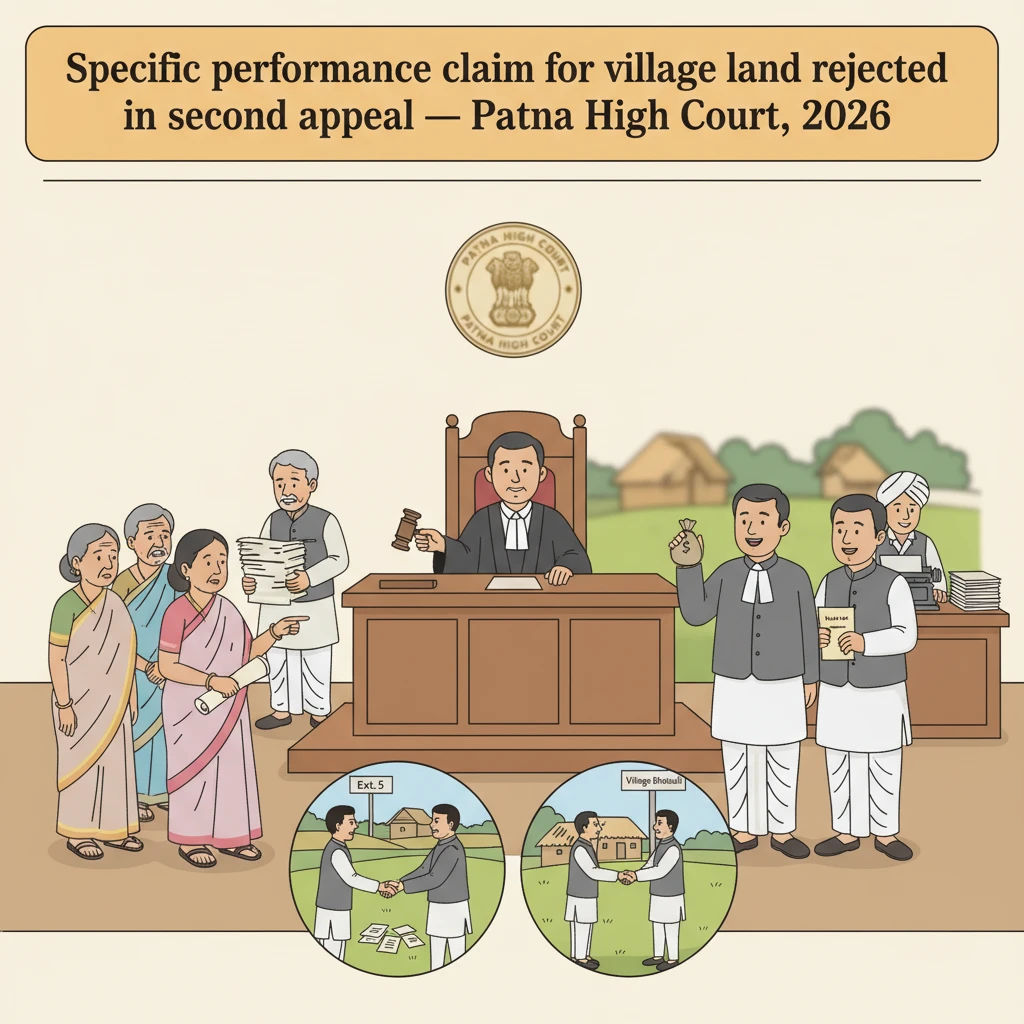
Case Background
Two separate but connected civil suits were filed in 1968 for specific performance of an agreement to sell agricultural land recorded in C.S. Khata No. 75, described in Schedule I of the plaints. The plaintiffs in those suits were later appellants in Second Appeal Nos. 174 and 175 of 1992 before the Patna High Court.
The plaintiffs’ case was that the original landowner (defendant) was in need of money. He allegedly agreed to sell the Schedule I land for Rs. 5,000, executed an agreement for sale on 10.04.1966, took Rs. 500 as advance, and agreed to take the remaining Rs. 4,500 at the time of executing the final sale deed. When, according to the plaintiffs, the defendant did not execute the sale deed despite requests, they filed Title Suit Nos. 32 of 1968 and 30 of 1968 before the Munsif, Buxar.
The defendant denied any agreement to sell. He stated that he had only taken a loan of Rs. 500 from the plaintiffs to purchase land in village Babuganj English, executing a hand note. He alleged that this hand note was later converted into a forged agreement to sell in collusion with the scribe. He further claimed that the suit land was worth not less than Rs. 8,000 and he never intended to sell it.
The trial court framed issues, including maintainability, abatement under Section 4(c) of the Bihar Consolidation of Holdings and Prevention of Fragmentation Act, execution of agreement to sell, cause of action, and entitlement to relief.
By judgment and decree dated 17.12.1977, the Munsif, Buxar decreed both suits. The defendant challenged these decrees through Title Appeal Nos. 04 of 1978 and 05 of 1978 before the Additional District Judge, Buxar.
On 16.04.1992, with decree dated 20.04.1992, the Additional District Judge allowed both appeals. He held that the plaintiffs had failed to comply with Form 47 of Appendix I of the Code of Civil Procedure and Section 16(c) of the Specific Relief Act, 1963, and therefore were not entitled to specific performance. The trial court decrees were set aside.
Aggrieved by this reversal, the plaintiffs filed Second Appeal Nos. 174 and 175 of 1992 before the Patna High Court under Section 100 CPC. Substantial questions of law were framed mainly on whether the first appellate court could rely on Section 16(c) Specific Relief Act and related maintainability without specific pleadings, and whether it could set aside the trial decree mainly on this ground.
What the Court Examined and Decided
The Patna High Court, presided over by Hon’ble Mr. Justice Ramesh Chand Malviya, heard both second appeals together. The central questions were whether the first appellate court had gone beyond the pleadings and whether the plaintiffs had fulfilled the strict legal requirement of “readiness and willingness” for a decree of specific performance.
First, the Court revisited the trial court findings. On the issue of abatement under Section 4(c) of the Bihar Consolidation of Holdings and Prevention of Fragmentation Act, the Munsif held that the specific performance suits did not fall within the limited categories covered by Section 4(c). They were not suits for correction of records, declaration of rights or interests in land, or other rights triable under the consolidation law. The suits were therefore held maintainable, and this reasoning was not disturbed by the High Court.
On the crucial factual issue of agreement to sell, the trial court had relied heavily on the document marked Ext. 5, treated as the agreement for sale. The endorsement was in the defendant’s own hand, and the trial court concluded that it clearly showed the Rs. 500 as advance towards the sale of land, contradicting the defendant’s “loan only” story.
The trial court also took note of an arbitration agreement (Ext. 2) and award (Ext. 1). While specific performance of the arbitration award itself was not in issue, these documents were seen as strengthening the plaintiffs’ version. The trial court discounted several petitions filed by the defendant (Ext. B series) as being post litem motam and noted that in these earlier petitions he had not claimed that he signed on blank paper, suggesting that this defence was an afterthought.
The plaintiffs examined six witnesses to support their case that the defendant received Rs. 500 as part of a land sale agreement. The defendant examined seven witnesses, but the trial court found key defence witnesses (DW-1 and DW-2) unreliable, partly because of prior enmity. It found it unlikely that persons hostile to the plaintiffs would be present during a friendly financial transaction at the plaintiffs’ house. The trial court went so far as to describe the defendant’s story as “cooked up for the purpose of litigation” and it noted that the defendant had already sold almost all his other land in village Bhatauli except the suit land.
On cause of action and entitlement to relief, the Munsif held that the plaintiffs had valid cause of action and were entitled to a decree for specific performance. The defendant was directed to execute the sale deed after receiving Rs. 4,500 and, if necessary, obtaining permission from the consolidation authority within three months, failing which the plaintiffs could have the deed executed through court.
The focus before the High Court, however, was not on re‑appreciating these primary facts but on whether the appellate court was correct in law to deny specific performance due to non‑compliance with Section 16(c) of the Specific Relief Act and Form 47 of CPC.
Counsel for the appellants argued that the first appellate court had not framed proper issues and had travelled beyond the pleadings, because the defendant had not specifically pleaded non‑compliance with Section 16(c). They relied on Supreme Court authorities including Union of India v. Ibrahim Uddin, Kedar Nath Motani v. Prahlad Rai, and T.D. Gopalan v. Commissioner of Hindu Religious and Charitable Endowments, to stress that courts cannot grant relief or decide cases on matters not pleaded, and that appellate courts must deal with the trial court’s reasons before reversing factual findings.
They also contended that their plaints did state that they were ready to pay the remaining consideration, that the money was with them, and that they had requested the defendant several times to execute the sale deed. On this basis, they said Section 16(c) could not be used against them.
On the other hand, counsel for the respondents/defendants argued that in suits for specific performance, Section 16(c) of the Specific Relief Act makes it mandatory that the plaintiff must both plead and prove that he has performed or has always been ready and willing to perform his part of the contract. According to them, the plaints only narrated payment of Rs. 500 and non‑execution of the deed but did not contain a specific averment that the plaintiffs were always ready and willing to perform their part. Nor was such readiness and willingness shown in their oral evidence.
They relied on decisions such as Nawal Kishore v. Kauleshwari Devi (Patna High Court, AIR 1986 Pat 301), an unnamed Supreme Court decision reported in AIR 1990 SC 662, and the Allahabad High Court decisions in Mahmood Khan v. Ayub Khan (1978 All 463) and Rajendra Prasad Rai v. Rajdeva Rai (AIR 1974 All 294). These judgments underline that compliance with Section 16(c) is mandatory and that notice and tender or deposit of the balance consideration are relevant indicators of readiness and willingness.
The respondents further highlighted that, as per the trial court’s own decree, the plaintiffs were required to deposit the balance amount of Rs. 4,500 within the stipulated period after judgment dated 17.12.1977, yet they did not deposit it even within one month. This, they argued, showed lack of continuous readiness and willingness.
After examining the record, the Patna High Court agreed with the first appellate court. The High Court reiterated the settled law that for specific performance, the plaintiff must prove that “all along and till the final decision of the suit” he was ready and willing to perform his part of the contract. It is not enough merely to make a formal statement in the plaint; the conduct of the plaintiff and steps like notice, tender of money, or deposit in court are important.
The Court relied on the Supreme Court decision in Ouseph Varghese v. Joseph Aley, where it was held that a plaint seeking specific performance must conform to Forms 47 and 48 of the First Schedule to the CPC: it must set out the agreement details, assert that the plaintiff asked the defendant to perform and that the defendant failed, and clearly state that the plaintiff has been and still is ready and willing to perform his part. A similar view was cited from Prem Rai v. D.L.F. Housing and Construction (P) Ltd. that absence of this averment means no cause of action for specific performance is made out.
The Court also cited Vijay Kumar v. Om Prakash (2018 SCC OnLine SC 1913), which restated that readiness and willingness must be shown throughout and that specific performance is a discretionary remedy.
On the procedural objection about non‑framing of issues, the Patna High Court referred to Beereddy Dasaratha Rami Reddy v. Manjunath, where the Supreme Court held that omission to frame a particular issue does not vitiate the trial if both parties knew each other’s case and led evidence accordingly. In this case, there was an issue on maintainability, and both parties had argued on compliance with Section 16(c), so the appellate court was not barred from deciding on that point.
The Court also noted a later Supreme Court decision reported in (2011) 12 SCC 18 : AIR 2011 SC 3234, where it was observed that due to galloping inflation and steep rise in property values, long delays in completing a sale may make it inequitable to grant specific performance, especially when the purchaser did not act within the agreed time and the vendor was not responsible for the delay.
From Section 20 of the Specific Relief Act, the High Court reminded that specific performance is discretionary. Even when technically lawful, the court is not bound to decree it. Among circumstances where the court may refuse relief are where enforcement would give the plaintiff an unfair advantage or cause unforeseen hardship to the defendant while non‑performance does not similarly harm the plaintiff.
Applying these principles, the High Court held that the plaintiffs had not produced acceptable evidence of continuous readiness and willingness. There was no documentary material showing they ever sent notice, tendered the balance amount, or deposited it in court within time. Given the long passage of time since 1966 and 1968, the rising land prices, and the absence of prompt action by the plaintiffs, the Court found that granting specific performance now would cause undue hardship to the defendants and unjustly benefit the plaintiffs.
The Court therefore found no legal error, perversity, or patent illegality in the first appellate court’s judgment. It answered the substantial questions of law in favour of the respondents/defendants, holding that the appellate court was entitled to deny specific performance on the basis of Section 16(c) and related legal requirements, and that mere non‑framing of a specific issue did not vitiate its decision.
Consequently, the Patna High Court affirmed the appellate court’s judgment dated 16.04.1992 and decree dated 20.04.1992 in Title Appeal Nos. 04 of 1978 and 05 of 1978. Second Appeal Nos. 174 of 1992 and 175 of 1992 were dismissed without any order as to costs.
Why This Judgment Matters
This judgment is important for villagers and small land buyers who enter into informal or poorly drafted land sale agreements. The Patna High Court has made it clear that simply having an agreement or having paid some advance money is not enough to secure a court order forcing the seller to execute a sale deed decades later.
The buyer must, from the beginning and throughout the case, show clear readiness and willingness to pay the remaining price and complete the sale. This includes proper pleadings in the plaint, evidence of repeated demands, and timely deposit of the balance amount when directed by court.
The judgment also underscores that courts exercise discretion in granting specific performance. If the buyer delays, does not deposit the money, and land prices have risen steeply over time, the court may refuse to compel the sale even if some agreement once existed. This protects landowners from being forced to sell long after the agreed time on old prices when they were not responsible for the delay.
For lawyers and litigants in Bihar, the ruling reinforces the importance of drafting specific performance suits strictly in line with Form 47 CPC and Section 16(c) of the Specific Relief Act and of acting promptly and consistently to prove readiness and willingness.
Legal Issues and Answers
- Issue: Could the first appellate court reverse the trial court’s decree for specific performance on the ground of non‑compliance with Section 16(c) of the Specific Relief Act and Form 47 CPC, even though the defendants had not specifically pleaded this?
Answer: Yes. The Patna High Court held that in a specific performance suit, compliance with Section 16(c) is mandatory. Courts can examine whether the plaintiff has pleaded and proved continuous readiness and willingness, and omission to frame a specific issue does not vitiate the decision when parties knew the rival case and led evidence. - Issue: Had the plaintiffs in fact shown the continuous readiness and willingness required for a decree of specific performance?
Answer: No. The Court found there was no sufficient averment or proof of continuous readiness and willingness, no documentary evidence of tender or notice, and failure to deposit the balance consideration within the time fixed, so specific performance could not be granted. - Issue: Should the court exercise its discretion under Section 20 of the Specific Relief Act to grant specific performance despite the long lapse of time and increased land values?
Answer: No. Considering the galloping increase in land prices, the plaintiffs’ conduct, and the absence of fault on the defendants’ part, enforcing specific performance would cause undue hardship to the defendants and give the plaintiffs an unfair advantage. The appellate court’s refusal of specific performance was therefore justified.
Cases Cited by the Court
- Union of India v. Ibrahim Uddin & Anr., (2012) 8 SCC 148
- Kedar Nath Motani & Ors. v. Prahlad Rai & Ors., AIR 1960 SC 213
- T. D. Gopalan v. Commissioner of Hindu Religious and Charitable Endowments, Madras, AIR 1972 SC 1716
- Nawal Kishore v. Smt. Kauleshwari Devi & Anr., AIR 1986 Pat 301
- Ouseph Varghese v. Joseph Aley, (1969) 2 SCC 539
- Prem Rai v. The D.L.F. Housing and Construction (P.) Ltd., AIR 1968 SC 1355
- Vijay Kumar & Ors. v. Om Prakash, 2018 SCC OnLine SC 1913
- Beereddy Dasaratha Rami Reddy v. Manjunath (as referred in the judgment)
- Supreme Court decision reported in (2011) 12 SCC 18 : AIR 2011 SC 3234
- Mahmood Khan & Anr. v. Ayub Khan & Ors., 1978 Allahabad 463
- Rajendra Prasad Rai & Anr. v. Rajdeva Rai & Anr., AIR 1974 Allahabad 294
- Other Supreme Court decisions referred within Union of India v. Ibrahim Uddin & Anr. (as quoted in the judgment)
Case Details
Case Number: Second Appeal No. 174 of 1992 with Second Appeal No. 175 of 1992
Case Title (Second Appeal No. 174 of 1992): Mahabir Prasad v. Mostt. Dhamuniya Devi & Ors. and Lallan Singh
Case Title (Second Appeal No. 175 of 1992): Vijay Kumar Singh & Anr. v. Mostt. Dhanmuniya Devi & Ors. and Sri Lallan Singh
Court: High Court of Judicature at Patna
Coram: Hon’ble Mr. Justice Ramesh Chand Malviya
Date of Patna High Court Judgment: 17.02.2026
Citation: 2024(2) PLJR 493
Nature of the Case: Second appeals under Section 100 of the Code of Civil Procedure arising from decrees in suits for specific performance of contract
Trial Court: Munsif-I, Buxar in Title Suit Nos. 32 of 1968 and 30 of 1968 (judgment and decree dated 17.12.1977)
First Appellate Court: Additional District Judge, Buxar in Title Appeal Nos. 04 of 1978 and 05 of 1978 (judgment dated 16.04.1992 and decree dated 20.04.1992)
Advocates:
In Second Appeal No. 174 of 1992:
- For the appellant: Mr. Din Bandhu Singh, Advocate; Mr. Satya Deo Kumar, Advocate
- For the respondents: Mr. Yogendra Pd. Sinha, Advocate
In Second Appeal No. 175 of 1992:
- For the appellants: Mr. Din Bandhu Singh, Advocate; Mr. Satyadeo Kumar, Advocate
- For the respondents: Mr. Yogendra Pd. Sinha, Advocate
Final Outcome: Second Appeal Nos. 174 of 1992 and 175 of 1992 dismissed; the appellate court’s judgment and decrees in Title Appeal Nos. 04 of 1978 and 05 of 1978 affirmed; no order as to costs.
Link to the Judgment: Click here to view the full judgment of the Patna High Court
If you found this explanation helpful and wish to stay informed about how legal developments may affect your rights in Bihar, you may consider following Samvida Law Associates for more updates.







