

Case Background
The Government of Bihar has issued several industrial incentive policies over time to attract investment and promote industries. First came the Industrial Incentive Policy, 2006. Later, the Bihar Industrial Incentive Policy, 2011 (BIIP-2011) operated from 01.07.2011 to 30.06.2016.
Under BIIP-2011, new or existing units generating energy from non-conventional sources could get subsidy up to 60% of expenditure on plant and machinery, provided they had not taken benefits under any other Government policy.
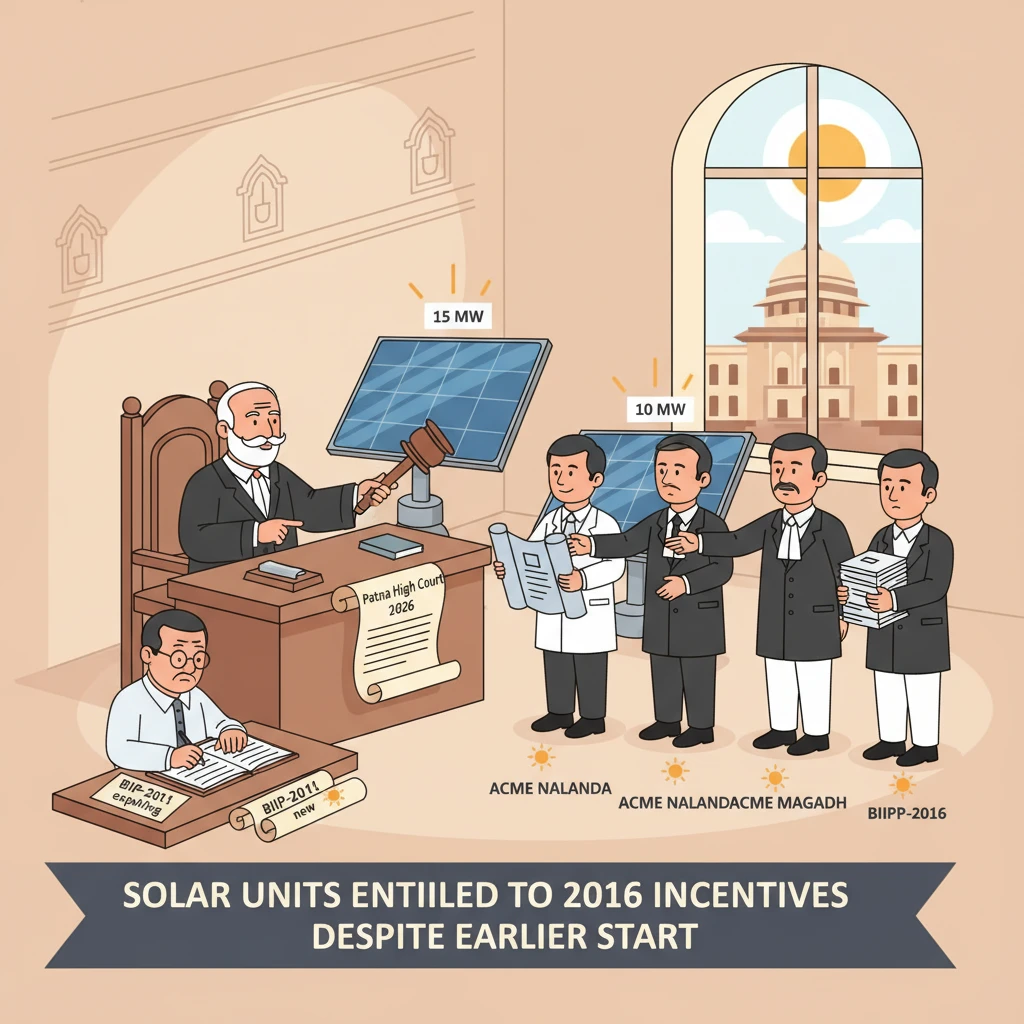
The parent company of the petitioners, ACME Cleantech Solutions Private Limited, participated in a 2014 competitive bid floated by Bihar State Power (Holding) Company Limited for setting up solar projects totalling 100 MW. It emerged successful and received allocation of 15 MW and 10 MW projects.
Two special purpose vehicles (SPVs) were then formed: ACME Nalanda Solar Power Private Limited (15 MW) and ACME Magadh Solar Power Private Limited (10 MW), both to set up solar plants at Block Kakwara, District Banka, Bihar. Power Purchase Agreements were signed with the South Bihar and North Bihar Power Distribution Companies for 25 years.
The State Investment Promotion Board (SIPB) approved the investment proposals. For ACME Nalanda, investment of Rs. 113.33 crores was approved on 23.02.2016. For ACME Magadh, investment of Rs. 71.55 crores was approved on 17.03.2016. Both projects were commissioned on 28.06.2016 and commissioning certificates were issued by the Department of Industries (Technical Development).
On that date the 2011 policy was still in force. It ended two days later on 30.06.2016. It is undisputed that neither unit took any benefit under BIIP-2011.
Later, the State notified the Bihar Industrial Investment Promotion Policy, 2016 (BIIPP-2016) with effect from 01.09.2016. Renewable energy, especially solar, was treated as a priority sector. The policy promised reimbursement of stamp duty and registration fees for new units and interest subvention on term loans, with an upper limit of Rs. 10 crores for interest subvention.
Clause 8 of BIIPP-2016 dealt with transitional provisions. Clause 8(a) covered projects already approved but not yet in commercial production on the effective date, giving them an option to choose between the old and new policies. Clause 8(b) said existing units which had already taken incentives under BIIP-2011 could not seek incentives under BIIPP-2016, though they could continue with benefits already granted.
Meanwhile, the Bihar Industrial Investment Promotion Act, 2016 came into force on 02.09.2016, followed by the Bihar Industrial Investment Promotion Rules, 2016 notified on 28.12.2016. Rule 6 created an integrated clearance system and Rule 7 provided for financial incentives.
Under these Rules, both petitioners applied to SIPB on 15.05.2018 for Stage-I clearance. In the SIPB meeting dated 21.06.2018, Stage-I clearance was granted for investment of Rs. 11,333 lakhs for ACME Nalanda and Rs. 7,543 lakhs for ACME Magadh. Letter dated 05.07.2018 communicated this clearance under Rule 6(2)(i) and stated that the units could apply for other statutory and financial clearances.
On 14.01.2019 SIPB informed the petitioners that after Stage-I clearance and scrutiny of land, DPR, loan sanction and appraisal reports, it had approved the establishment of the units with project costs of Rs. 10,733 lakhs (Nalanda) and Rs. 7,155 lakhs (Magadh), and had granted consent for financial incentives clearance under Rule 6(2)(iv), subject to verification of actual expenditure. The letter clarified that the units fell under the priority renewable energy sector and had approval under Rule 7(2)(iv) of the Rules.
On 01.02.2019 both petitioners applied for reimbursement of stamp duty under BIIPP-2016. On 08.02.2019 they filed applications for interest subvention subsidy under Clause 6.2 of BIIPP-2016.
The Department of Industries extended the operational period of BIIPP-2016 up to 31.03.2025 by Notification No. 883 dated 29.06.2020. Later, by Notification No. 4571 dated 14.10.2022, Clause 8(b) was amended to say that existing units would be eligible to receive subsidy as per the conditions and rates of the Industrial Promotion Policy unless the time limit or unit limitation had expired, and units that had already received incentives under earlier policies would be eligible for incentives in the current policy only for those items they had not received earlier.
On 07.07.2023 SIPB issued Notice No. 1630 calling upon all operational units eligible for any grant or incentive under the 2011 and 2016 policies to submit pending applications with documents on the portal by 31.07.2023.
The petitioners, pointing out that they had already been approved under the 2016 Rules but had not yet received incentives, wrote on 24.07.2023 and then on 27.07.2023 submitted online applications for interest subvention and for reimbursement of stamp duty and registration fee.
SIPB raised repeated queries in August and September 2023, requiring various documents. A meeting was held on 25.09.2023 where the petitioners explained the documents and were asked to submit some in prescribed formats. They also clarified that financial sanction and pollution NOC had been submitted, but the Fire NOC was still awaited.
On 21.10.2023 SIPB rejected the 2023 interest subvention applications of ACME Magadh, citing non-submission of documents. On 25.10.2023 both units filed letters enclosing the required documents and requested SIPB to keep the portal open, stating that Fire NOCs would be submitted when issued. However, SIPB on 03.11.2023 rejected the 2023 interest subvention applications of ACME Nalanda, again for alleged non-submission of documents.
The Fire Department later issued NOCs on 19.12.2023. On 02.01.2024 both petitioners filed fresh applications for interest subvention subsidy. When no subsidy was released, they sent representations on 27.02.2024 and 23.05.2024, including to the Minister and Additional Chief Secretary, seeking release.
On 12.07.2024 SIPB rejected the 2024 applications, this time solely on the ground that commercial operation had started on 28.06.2016, before BIIPP-2016 took effect on 01.09.2016, making them ineligible.
The petitioners sent detailed representations on 15.07.2024 and 03.09.2024 explaining their stand and seeking parity with other units that had been granted benefits under the amended policy. With no relief from the authorities, they approached the Patna High Court in these writ petitions.
What the Court Examined and Decided
The Patna High Court, through Hon’ble Mr. Justice Anil Kumar Sinha, heard both writ petitions together because they arose from the same facts and legal issues. The Court identified three central questions: whether the petitioners were eligible for incentives under BIIPP-2016 after the 2022 amendment; whether Stage-I clearance and financial approval created an enforceable right; and whether rejection of their applications was arbitrary or contrary to the policies and statute.
First, the Court looked closely at the text of BIIPP-2016 and the 2022 amendment to Clause 8(b). Under Clause 4, an “Existing Industrial Unit” is one that had started commercial production before the policy came into force. As both units started production on 28.06.2016, before BIIPP-2016 came into effect on 01.09.2016, they clearly fell in this category.
Clause 8, titled “Carry forward of the existing policy”, was meant to deal with how benefits under earlier policies would continue or shift. Clause 8(a) deals with projects approved but not yet in production when BIIPP-2016 started. Clause 8(b), in its original form, allowed existing units to keep drawing incentives at BIIP-2011 rates till their limits or eligible period ended, but barred units that had taken any incentive under the earlier policy from applying under the 2016 policy.
By Notification No. 4571 dated 14.10.2022, Clause 8(b) was replaced. The amended clause has two parts. The first part is a general enabling rule: existing units will be eligible to receive subsidy as per BIIPP-2016 conditions and rates, unless the time limit or unit limitation has expired. The second part is restrictive: units which have already received any type of incentive under previous policies will be eligible for incentives under the current policy only for those items they did not receive earlier.
The Court observed that the petitioners admittedly had not taken any incentive under BIIP-2011. Therefore the restrictive part of Clause 8(b), which prevents double benefits, did not apply to them. Their case had to be assessed under the general enabling portion. On a purposive reading, Clause 8(b) as amended did not bar existing units like the petitioners from claiming incentives under the 2016 policy. Instead, it clearly created eligibility for such units, limited only where they had already enjoyed incentives earlier.
The State argued that because the petitioners did not apply for incentives during the currency of the 2011 policy, and because their commercial operation pre-dated BIIPP-2016, they could not now claim benefits under the 2016 policy. The Court rejected this view. It noted that Clause 8(b) did not impose any such bar and that the object of the amendment was to ensure equitable treatment of industrial units and to promote industrial growth by enabling eligible existing units to avail incentives under the prevailing policy.
The Court then turned to the legal effect of the approvals granted under the Bihar Industrial Investment Promotion Act, 2016 and the Rules. The Act was enacted to provide a structured statutory framework to promote industrial investment. Under Section 16, Rules were framed providing a multi-stage approval mechanism. Rule 6 set up the SIPB as the competent authority to evaluate proposals, examine eligibility and grant approvals for financial incentives. Rule 7 laid down the scheme for financial incentives.
The Court emphasised that Stage-I clearance in 2018 followed by financial incentive approval in 2019 could not be dismissed as mere administrative formalities. These were statutory approvals issued under the Rules after detailed scrutiny of the projects, their costs, and the sectoral classification.
In the 2019 approval letter SIPB expressly recognized the petitioners as units in the priority renewable energy sector and granted consent for financial incentives clearance under Rule 6(2)(iv) and Rule 7(2)(iv), subject only to verification of actual expenditure at the time of disbursement. According to the Court, this clearly created a vested and enforceable right in favour of the petitioners to have their incentive applications processed and decided in line with the policy and Rules.
The Court referred to settled Supreme Court jurisprudence that industrial incentive policies amount to promises or representations by the State. Once an entrepreneur meets the eligibility conditions and makes investment relying on such policies, benefits cannot be denied on merely technical or procedural grounds.
The doctrine of legitimate expectation, firmly embedded in administrative law, was also applied. When a public authority, by its representations or consistent conduct, creates an expectation in favour of an applicant, that expectation cannot be defeated arbitrarily or without sound reasons. The Court cited the decision of the Supreme Court in State of Jharkhand v. Brahmputra Metallics Ltd., reported in (2023) 10 SCC 634. In paragraph 39 of that judgment, the Supreme Court underlined that public authorities must adhere to their representations, as citizens and businesses plan their affairs relying on them, and a business-friendly climate requires such trust.
In the present case, the Court found that after granting Stage-I and financial approvals, SIPB repeatedly entertained the petitioners’ applications from 2019 onwards, raised queries, called meetings, and required further compliances. Throughout this long process, SIPB never questioned their eligibility based on the commercial operation date. It only raised document-related issues. This conduct, together with the statutory approvals, created a clear legitimate expectation that incentives would be granted once documentation was complete.
The Court also noted Rule 7(4) of the Rules, which it described as mandatory. This rule reflects the legislative intent to remove administrative uncertainty and ensure quick disbursement of sanctioned incentives. It limits post-sanction interference to verifying compliance with the conditions attached to the sanction. In other words, once financial approval is granted, authorities cannot reopen core eligibility on new grounds.
Against this background, the Court held that the later rejection of the petitioners’ claims—first on alleged non-submission of documents despite substantial compliance and later solely on the ground of pre-policy commercial operation—was arbitrary, unreasonable and contrary to the incentive policy and statutory rules.
In paragraph 77, the Court concluded that the petitioners’ units are entitled to incentives under Clause 8(b) of the amended BIIPP-2016. The 2016 policy, read with the amendment, carries forward incentives to existing units. Since the concerned authorities had already granted financial incentive approval, denial of incentives through the impugned letters was held to be arbitrary and violative of the policy and rules.
Accordingly, the Court set aside all the impugned rejection letters, including the letter dated 12.07.2024. It ordered that the petitioners are entitled to interest subvention, and reimbursement of stamp duty and registration fee under BIIPP-2016. The respondents were directed to grant these incentives within a maximum period of three months from the date of receipt or production of a copy of the judgment.
Why This Judgment Matters
This judgment is important for industrial units in Bihar, especially those that started operations around the shift from the 2011 to the 2016 industrial policies.
The Patna High Court has clarified that existing units which did not receive any benefits under old policies can still be eligible under BIIPP-2016 after the 2022 amendment, even if their commercial operation started before 01.09.2016.
The Court has also made it clear that once the State, through SIPB, grants statutory approvals for financial incentives, it cannot later deny benefits on shifting grounds or on narrow technicalities. Authorities must act fairly and honour their own policies and decisions.
For investors, particularly in priority sectors such as renewable energy, the judgment reinforces that the State’s promises in incentive policies are legally meaningful. If an investor has fulfilled eligibility criteria and invested money, the Government cannot lightly walk away from its commitments.
For small and big industrial units alike, this case shows that arbitrary refusal of promised subsidies, despite earlier approvals, can be challenged successfully before the High Court.
Legal Issues and Answers
- Issue: Are the petitioners, whose units began commercial production before BIIPP-2016 came into force, eligible for incentives under the amended 2016 policy?
Answer: Yes. The Court held that under amended Clause 8(b), existing units that have not taken incentives under earlier policies are eligible to receive subsidies under BIIPP-2016, subject to conditions and time limits, and the restrictive part of Clause 8(b) does not apply to the petitioners. - Issue: Did Stage-I clearance and subsequent financial approval under the Bihar Industrial Investment Promotion Rules, 2016 create a vested or enforceable right in favour of the petitioners?
Answer: Yes. The Court held that these approvals, granted after statutory scrutiny, created a vested right to have applications processed and incentives released in terms of the policy. They were not mere administrative formalities. - Issue: Were the rejection letters issued by SIPB arbitrary or contrary to the applicable policies and statutory rules?
Answer: Yes. The Court found that denial of incentives despite earlier approvals and the enabling amendment to Clause 8(b) was arbitrary, unreasonable, violative of the policy and Rules, and contrary to doctrines of promissory estoppel and legitimate expectation. All impugned letters were quashed.
Cases Cited by the Court
- State of Jharkhand v. Brahmputra Metallics Ltd., (2023) 10 SCC 634
- State of Kerela and Ors. v. K.G. Madhavan Pillai and Ors, (1988) 4 SCC 669
- Commissioner of Central Excise, New Delhi v. Hari Chand Shri Gopal, (2011) 1 SCC 236
- A.L. Kalra v. P & E Corporation of India Ltd., 1984 SC 1361
- Sivanandan C.T. v. High Court of Kerala, (2024) 3 SCC 799
- Food Corporation of India v. Kamdhenu Cattle Feed Industries, (1993) 1 SCC 71
- U.P. Awas Evam Vikas Parishad v. Gyan Devi & Ors, (1995) 2 SCC 32
- M/s Sunny Stars Hotels Private Limited v. State of Bihar & Ors, CWJC No. 12104 of 2018
- M/s Leoline Foods Private Limited v. State of Bihar & Ors, CWJC No. 4051 of 2021
- State of Jharkhand & Ors v. Tata Cummins Ltd. & Anr, (2006) 4 SCC 57
Case Details
Case Numbers: Civil Writ Jurisdiction Case No. 63 of 2025; Civil Writ Jurisdiction Case No. 19772 of 2024
Case Titles: ACME Nalanda Solar Power Private Limited v. The State of Bihar & Ors; ACME Magadh Solar Power Private Limited v. The State of Bihar & Ors
Citation: 2026 (2) PLJR 645
Coram: Hon’ble Mr. Justice Anil Kumar Sinha
Date of Judgment: 27.02.2026
Advocates for Petitioners: Mr. Satyabir Bharati, Senior Advocate; Mr. Aniket Prasoon, Advocate; Mr. Brisketu Sharan Pandey, Advocate
Advocate for Respondents (State/SIPB): Mr. Standing Counsel (28)
Nature of the Case: Writ petitions under Article 226 of the Constitution challenging rejection of applications for interest subvention subsidy and reimbursement of stamp duty and registration fee under BIIPP-2016, and seeking declaration of eligibility for incentives.
Link to Judgment: Patna High Court official judgment link
If you found this explanation helpful and wish to stay informed about how legal developments may affect your rights in Bihar, you may consider following Samvida Law Associates for more updates.







