

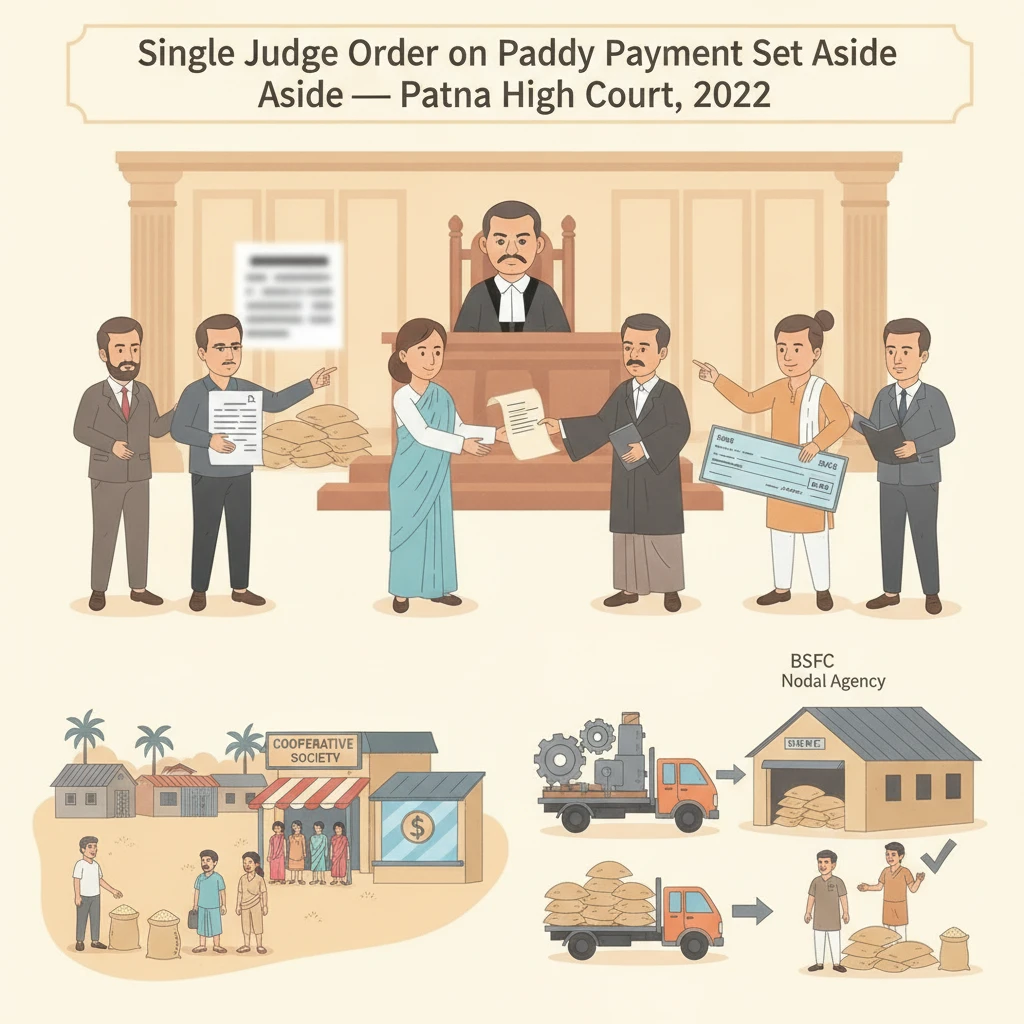
Case Background
This case arises out of a government procurement scheme for buying paddy from farmers during the agricultural season 2014–2015.
Under the scheme, the Bihar State Food and Civil Supplies Corporation Ltd. (BSFC) was the nodal agency for the State of Bihar. It was to purchase paddy from primary agricultural co-operative societies (PACS), Vyapar Mandals and BSFC purchase centres, get it milled into Custom Milled Rice (CMR), and then supply it onward. The main purpose was to benefit farmers and rice millers, not traders.
The respondent co-operative society claimed that it had supplied 13,469.80 quintals of paddy to the BSFC. According to the co-operative, it first received payment for 8,342 quintals of paddy. Later, after persuasion, BSFC allegedly made some more payments.
However, despite these part-payments, the co-operative said that no payment was being made for 3,254.60 quintals of paddy for a long time. Because of this non-payment, the co-operative approached the Patna High Court by filing a writ petition (CWJC No.3837 of 2016).
On 09.03.2016, a learned Single Judge directed BSFC to ensure payment for 3,254.60 quintals of paddy supplied by the co-operative within four weeks of receiving the order. If BSFC failed to pay within that time, it would have to pay the price with interest at 11% per annum from April 2015 until actual payment.
BSFC challenged this order by filing the present Letters Patent Appeal (LPA No.698 of 2016) before a Division Bench of the Patna High Court.
What the Court Examined and Decided
The Division Bench heard Mr. Anjani Kumar, Senior Advocate for BSFC and its District Manager, and Mr. Rajendra Narain, Senior Advocate for the respondents, including the co-operative society.
The Bench first looked at what the Single Judge had relied on. The co-operative had produced purchase-cum-payment vouchers. These showed that paddy had been purchased from farmers and payments had been made through the Bank by the co-operative society by using its overdraft facility. After paying the farmers, the co-operative expected the Corporation to remit money into its account, leaving a margin as commission.
The Single Judge treated these vouchers as definite proof that paddy or CMR had been supplied to BSFC and, on that basis, directed BSFC to make payment, with interest if delayed.
The Division Bench noted that this LPA had initially been tagged with a batch of other LPAs, the lead case being LPA No.881 of 2016. Those appeals also arose from writ petitions by co-operative societies and Vyapar Mandals regarding paddy procurement under the same scheme.
In those other matters, the writ petitioners had sought directions to BSFC to accept paddy procured by them after paying farmers, even though the paddy was being refused because it was supplied beyond the cut-off date fixed under the scheme. The cut-off related to the currency of the scheme, which had apparently expired by the time attempts were made to deliver the paddy to BSFC.
Before that earlier LPA Bench, many co-operatives argued that they had purchased paddy before 31.03.2015 and that their balance stock was backed by enforcement certificates issued by Enforcement Officers. They also claimed to have approached the Court before the cut-off date.
The Division Bench in those earlier LPAs held that enforcement certificates alone were not conclusive proof that the societies had actually purchased paddy from farmers. The scheme was designed for the benefit of farmers, not traders. Hence, a key condition was that when paddy was purchased directly from farmers, they had to be paid immediately by RTGS/NEFT or account payee cheque.
Only after making such payments to farmers could a co-operative expect payment from BSFC, and that too only on the basis of proportionate CMR and the necessary certificates and vouchers.
In many of those cases, evidence that farmers had actually been paid was missing. In some cases, even the supply of paddy to BSFC itself was doubtful.
To balance all interests, that earlier Division Bench devised a special procedure. It directed the constitution of a Committee comprising:
1. The District Magistrate of the concerned district.
2. The Enforcement Officer of the concerned block where the PACS was situated.
3. One Senior Officer from BSFC, to be nominated by its Managing Director.
The Committee was to be assisted by Bank Managers and officers of the Co-operative Banks. Its task was to verify whether purchases were made by co-operatives or PACS after paying farmers as required.
The Committee was asked to complete this verification within a set period. Only after its report could BSFC decide whether payment should be made to the co-operative societies. The Committee also had to record reasons if it rejected any claim. If a society disagreed with the rejection, it could raise its grievance before an appropriate forum, which would then decide according to law.
This arrangement was challenged before the Supreme Court in Special Leave Petition (Civil) Diary No.17509/2019.
The Supreme Court took a broader view. It noted that the main controversy concerned supply of paddy by PACS beyond the cut-off date and the Corporation’s refusal to accept such paddy. The real issue was whether paddy procured during the 2014–15 agricultural season could still be accepted by BSFC or another government agency.
For resolving the dispute, the Supreme Court directed the Central Government and the State Government to give clear suggestions. It ratified the Patna High Court’s arrangement and again directed that such Committees be constituted within one week. These Committees were to complete their exercise within three weeks and submit a report to the Supreme Court.
During those proceedings, one respondent requested that the deadline for acceptance of paddy be extended from 31.03.2015 to 15.04.2015. The State strongly opposed this. However, the Supreme Court, considering the ends of justice, extended the deadline to 15.04.2015. The Committees were instructed to consider all claims using 15.04.2015 as the final date.
The Supreme Court’s final order in that matter had not yet been passed at the time of this Patna High Court judgment.
In the present appeal, the co-operative society argued that, since the Supreme Court had extended the deadline for acceptance of paddy and the co-operative had categorically asserted that all farmers had been paid, there was no reason to interfere with the Single Judge’s order. The co-operative also highlighted that BSFC had not denied the statement that farmers were paid.
The Division Bench, however, did not accept that this was enough. It pointed out that, even if payment to farmers was accepted as true, it still had to be ascertained whether the corresponding paddy had actually been furnished to BSFC so that it could be used for the intended purpose of the scheme.
The Court further held that such disputed factual issues, with sharply different versions from the parties, should not be decided in a writ petition under Article 226 of the Constitution. The Bench noted that apart from bare statements, some supported by affidavits, there was no substantial material before the Single Judge to reach a final conclusion in favour of one side.
According to the Division Bench, the final result of the Single Judge’s order went against the established principles for deciding fact-intensive disputes in writ jurisdiction.
The Bench also took exception to the Single Judge’s approach because similar orders in other writ petitions had already been placed before a Division Bench, which had chosen to refer such matters to the Committee. That decision had been approved by the Supreme Court, which had directed the Committees to take up these matters promptly.
In that backdrop, the Division Bench held that the case of this respondent co-operative should also go before the same kind of Committee. The Committee must examine all aspects, including whether the paddy was supplied within the extended deadline of 15.04.2015 and whether farmers had been adequately compensated.
If the Committee finds that the co-operative’s claim is correct, necessary orders are to be passed to redress its grievance. If the co-operative is aggrieved by the Committee’s decision, it may approach the Supreme Court in the pending batch of SLPs to ventilate its grievance.
On this basis, the Division Bench set aside the order of the learned Single Judge and disposed of the appeal. The Court also expressed an expectation that the Committee would not unduly delay in reaching a final conclusion on the co-operative’s claim.
Why This Judgment Matters
This judgment is important for co-operative societies, Vyapar Mandals and PACS involved in paddy procurement in Bihar during 2014–2015.
It makes clear that when there are serious factual disputes about whether paddy was actually supplied and whether farmers were paid as per scheme conditions, the High Court will not simply order immediate payment in a writ petition.
Instead, such claims must pass through the verification process of the district-level Committee approved by both the Patna High Court and the Supreme Court. This prevents misuse of the procurement scheme and ensures that the real beneficiaries—the farmers—are protected.
For societies genuinely working for farmers and having proper records of payment and supply, the Committee route still keeps open the possibility of relief. However, it also sends a message that documentary proof and adherence to scheme conditions are essential.
Legal Issues and Answers
Issue: Could the High Court, in writ jurisdiction, direct BSFC to pay a co-operative society for alleged paddy supply solely on the basis of vouchers and assertions, despite disputed facts about supply and compliance with scheme conditions?
Answer: No. The Division Bench held that such fact-heavy disputes should not be decided under Article 226 and must instead be examined by the specially constituted Committee.
Issue: How should the co-operative society’s claim for payment for the 3,254.60 quintals of paddy be dealt with after the Supreme Court’s directions and extended deadline of 15.04.2015?
Answer: The claim must be placed before the Committee, which will verify if paddy was supplied within the extended deadline and whether farmers were adequately paid. Relief, if any, will flow from the Committee’s findings, subject to further challenge before the Supreme Court.
Cases Cited by the Court
- The judgment refers to an earlier batch of LPAs led by LPA No.881 of 2016 from the Patna High Court concerning similar paddy procurement disputes.
- It also mentions that the arrangement in those LPAs was challenged before the Supreme Court in Special Leave Petition (Civil) Diary No.17509 of 2019.
- No other specific reported judgments are cited by name in the text provided.
Case Details
Case Number: Letters Patent Appeal No.698 of 2016 in Civil Writ Jurisdiction Case No.3837 of 2016
Case Title: Bihar State Food and Civil Supplies Corporation Ltd. and another v. State of Bihar and others
Coram: Hon’ble Mr. Justice Ashutosh Kumar and Hon’ble Mr. Justice Anjani Kumar Sharan
Date of Judgment: 20.04.2022
Citation: 2022 (2) PLJR 344
Advocates:
- For the Appellants (BSFC and its District Manager): Mr. Anjani Kumar, Senior Advocate; Mr. Nirmal Kumar, Advocate; Mr. Shailendra Kumar Singh, Advocate
- For Respondent Nos. 7 and 8 (Paddy Purchase Centre and Co-operative Society): Mr. Rajendra Narain, Senior Advocate; Ms. Anju Narain, Advocate; Mr. Umesh Kumar Roy, Advocate; Mr. Anant Kumar Sinha, Advocate
- For the Bank: Mr. Bindhyachal Rai, Advocate
Nature of the Case: Letters Patent Appeal against a Single Judge order in a writ petition under Article 226 of the Constitution relating to payment for paddy supplied under a government procurement scheme.
Link to Judgment: Click here to read the full Patna High Court judgment
If you found this explanation helpful and wish to stay informed about
how legal developments may affect your rights in Bihar,
you may consider following Samvida Law Associates for more updates.







