
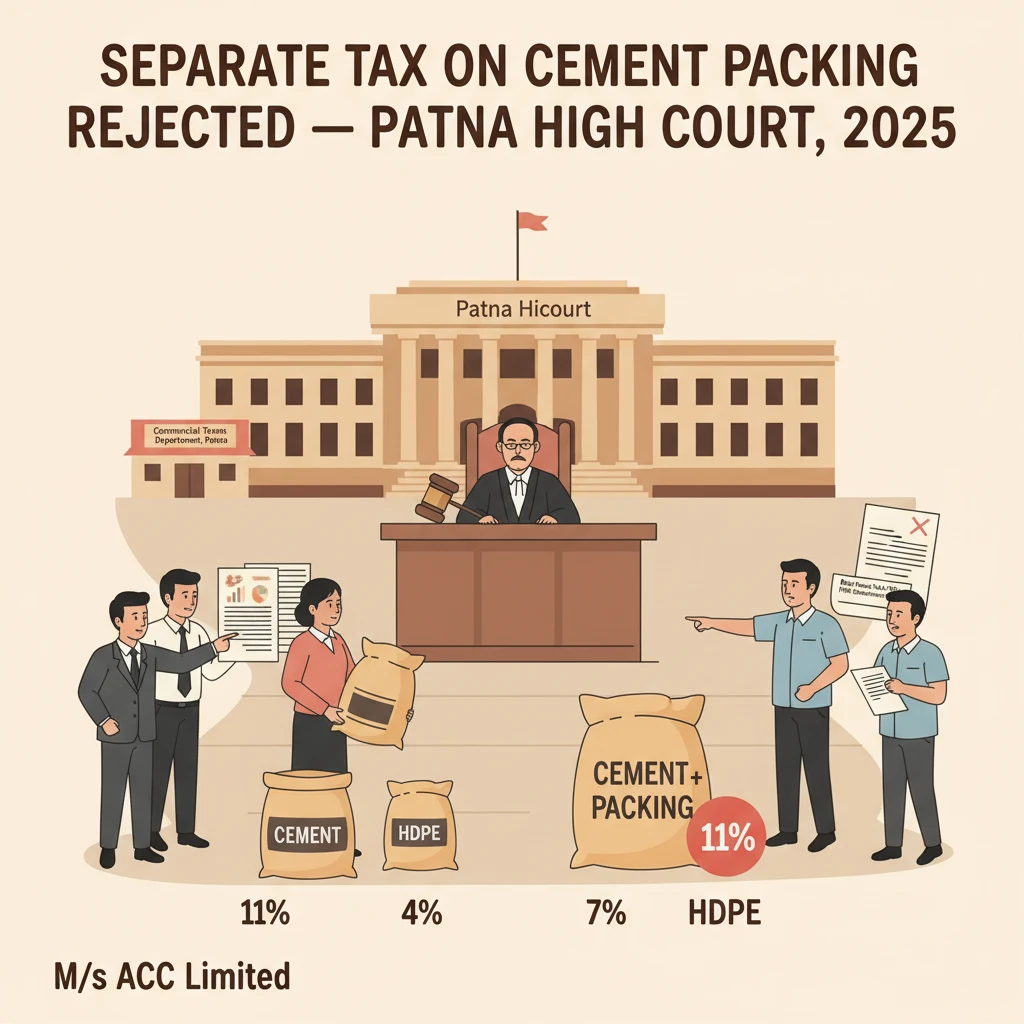
The Patna High Court was asked to decide if a cement company could pay sales tax on cement and on its packing bags at different rates.
The Court held that under the Bihar Finance Act, tax has to be paid on the total sale price, treating cement and its packing as one.
Orders of the assessing officer, appellate authority and Commercial Taxes Tribunal were all upheld.
All five appeals by the company were dismissed, and the tax demand remains.
Case Background
The appeals were filed by a large cement manufacturing company, M/s ACC Limited, incorporated under the Indian Companies Act, 1913.
The company has three cement manufacturing units in Bihar at Sindri, Chaibasa and Khalari, and uses a network of warehouses across the State to distribute cement produced both within Bihar and from factories outside Bihar.
The factories and warehouses are registered under the Bihar Finance Act, 1981. The Commissioner of Commercial Taxes, Bihar, permitted the company to file consolidated returns at the Special Circle, Patna for sales from all these locations.
The dispute relates to assessment years 1996-97, 1997-98, 1998-99, 1999-2000 and 2000-01. For each period, the assessing authority passed assessment orders under Section 17(2)(b) of the Bihar Finance Act, 1981.
The company claimed that it had correctly paid sales tax at 11% on cement and at lower rates of 4% on gunny bags and 7% on HDPE bags used as packing material. It also claimed deductions towards trade discounts.
The assessing authority disallowed the entire claim on trade discount and treated the full amount as taxable at 11%. It also refused to allow separate lower-rate taxation on packing materials and applied the cement rate of 11%.
The company appealed these orders before the Joint Commissioner of Commercial Taxes (Appeal), Central Division, Patna. The appeals were dismissed on both the key issues: trade discount and separate tax on packing material.
Thereafter, the company filed revision cases before the Commercial Taxes Tribunal, Bihar, Patna. The Tribunal, by a common judgment dated 29.09.2022, again rejected the company’s stand on these issues.
Aggrieved, the company approached the Patna High Court through five Miscellaneous Appeals, all directed against this common judgment of the Tribunal.
What the Court Examined and Decided
The Patna High Court, speaking through Hon’ble Mr. Justice Dr. Anshuman (with Hon’ble Mr. Justice Bibek Chaudhuri agreeing), heard all five appeals together because they raised a common legal question.
The central dispute was simple to state but important for tax practice. The company argued that cement and the bags in which it is packed are two different goods. Therefore, according to the company, each should be taxed at its own rate as fixed by law.
The company relied on Section 12 of the Bihar Finance Act, 1981 and on the Schedule of the notification under the Bihar Sales Tax Fifth Ordinance, 1977. Under this scheme, cement attracted 11% tax, gunny bags 4%, and HDPE bags 7%.
The company said it had honestly paid sales tax from time to time at these different rates and that no dues were pending. Its counsel also stressed that no adverse material was found by the tax authorities during inspection or in the books of account.
In their view, the authorities wrongly increased the Gross Turnover (GTO) by denying separate tax on packing material and by treating everything as one sale of cement at 11%.
The company’s counsel argued that the statute itself fixes separate rates. Therefore, disallowing separate tax on packing materials was against the clear language of the law. He submitted that Section 12 is clear and unambiguous and must be applied as written.
To support this method of interpretation, he cited three Supreme Court judgments: Mathuram Agrawal v. State of Madhya Pradesh, M/s Govind Saran Ganga Saran v. Commissioner of Sales Tax & Ors., and Raj Steel & Ors. v. State of A.P. & Ors.
From Mathuram Agrawal, he drew the point that in tax laws the intention of the Legislature must be gathered from the words actually used, and no extra intention can be read into the statute.
From Govind Saran Ganga Saran, he relied on the principle that when the statutory language is clear, the Statement of Objects and Reasons or other external aids should not be used to twist its meaning.
From Raj Steel, he relied on observations that packing material can be taxed separately if it is an independent commodity and is sold separately or of significant value, depending on the contract between parties.
On this basis, the company submitted that its invoices showing tax at 11% on cement and 4%/7% on bags were lawful. It said that a substantial question of law arises: whether the Tribunal was wrong in rejecting separate tax on packing material and cement.
On the other side, the State’s counsel focused on the definition of “sale price” in Section 2(u) of the Bihar Finance Act, 1981. This provision defines “sale price” as the amount payable to a dealer as valuable consideration for the sale or supply of goods.
Explanation 1 to Section 2(u) states that sale price includes any amount charged by the dealer for anything done in respect of the goods at the time of or before delivery to the buyer. Explanation II excludes only cash discounts shown separately and separately charged transport costs.
The State argued that, by this definition, when cement is sold in bags, the value of the bags and any charges for packing done before delivery form part of the sale price of the cement.
To support this stand, the State relied on the Supreme Court’s decision in Commissioner of Sales Tax, U.P. v. Rai Bharat Das and Bros., reported in (1989) 1 SCC 143. The relevant paragraph emphasises that anything which is an integral part of what the dealer does in respect of the goods, and is not supplied under a separate order or specification, can be included in the sale price.
After hearing both sides, the Patna High Court framed the substantial question of law in clear terms. The Court asked whether, under the Bihar Finance Act/Bihar Sales Tax Act, sales tax could be charged separately on gunny and HDPE bags and on cement at different rates (4%, 7% and 11%), or whether the sale price had to be treated as a consolidated amount taxed at 11% irrespective of separate prices shown in invoices.
To answer this, the Court examined the statutory scheme. It recorded that the matter is fully governed by the Bihar Finance Act, 1981, and that sales tax is always levied on the “sale price” of the goods.
The Court reproduced the definition of “sale price” in Section 2(u) and its Explanations. It then applied this definition to the facts before it.
The Court noted that packing of cement in gunny/HDPE bags was done by the dealer at the time of or before the delivery of the goods. From this, it held that there existed an implied agreement to sell the packing material along with the cement.
However, the Court also made an important factual observation: the company had not produced any written contract or agreement showing that cement and bags were sold independently, or that there was any separate bargain for the bags. No such material was placed before either the Assessing Authority or the Tribunal.
In this situation, the Court held that the statutory definition of “sale price” clearly applied. For the purpose of tax, the “goods” in question included cement along with its packing material. Therefore, the sale price was the total amount payable for the cement in bags, not separate sale prices for cement and bags.
Turning to the Supreme Court judgments cited by the company, the High Court held that they did not help its case. Those judgments merely reiterate that clear statutory language must be given its plain meaning.
Here, Section 2(u) is itself clear and specific about what forms part of sale price. Hence, the Court said that its plain meaning “must prevail.”
On this reasoning, the Court concluded that the question whether cement and packing material should be taxed separately “does not arise,” and even if raised, such a position would not be legally correct, especially in the absence of factual evidence from the company.
Finally, the Court answered the substantial question of law against the appellant and in favour of the Revenue. It held that the orders of the Assessing Authority, Appellate Authority and Revisional Authority (Commercial Taxes Tribunal) were fully in accordance with law and required no interference.
All five Miscellaneous Appeals were therefore dismissed, and any pending interlocutory applications were disposed of.
Why This Judgment Matters
This judgment is important for all businesses in Bihar that sell goods packed in bags, cartons or other materials.
The Patna High Court has made it clear that, under the Bihar Finance Act, the tax department can treat packing as part of the main goods if it is done before delivery and there is no clear separate contract for the packing material.
Showing separate prices for goods and packing on the invoice is not enough by itself. Unless there is clear evidence that packing is sold separately, tax will be calculated on the combined price at the rate applicable to the main goods.
For large manufacturers and distributors, this ruling reinforces that careful documentation of contracts and billing is essential if they want to claim separate tax treatment for packing materials.
Legal Issues and Answers
-
Issue: Can a dealer selling cement in gunny and HDPE bags be allowed to pay sales tax separately on cement and on the bags at different statutory rates under the Bihar Finance Act, 1981?
Answer: No. The Court held that the “sale price” under Section 2(u) covers the total amount payable for cement along with its packing, so tax is chargeable on the consolidated price at the cement rate of 11%. -
Issue: Were the orders of the Assessing Authority, Appellate Authority and Commercial Taxes Tribunal rejecting separate taxation of packing materials legally valid?
Answer: Yes. The Court found these orders fully in accordance with law and refused to interfere, dismissing all the company’s appeals.
Cases Cited by the Court
- Mathuram Agrawal v. State of Madhya Pradesh, (1999) 8 SCC 667
- M/s Govind Saran Ganga Saran v. Commissioner of Sales Tax & Ors., AIR 1985 SC 1041
- Raj Steel & Ors. v. State of A.P. & Ors., (1989) 3 SCC 262
- Commissioner of Sales Tax, U.P. v. Rai Bharat Das and Bros., (1989) 1 SCC 143
Case Details
Case Numbers:
- Miscellaneous Appeal No. 14 of 2023 (arising out of Revision Case No. PT-264/2004, period 1998-99, appeal value Rs. 2,30,37,023/-)
- Miscellaneous Appeal No. 8 of 2023 (arising out of Revision Case No. PT-199/2006, period 2000-01, appeal value Rs. 84,10,189.14)
- Miscellaneous Appeal No. 10 of 2023 (arising out of Revision Case No. PT-191/2004, period 1996-97, appeal value Rs. 84,24,092.56)
- Miscellaneous Appeal No. 11 of 2023 (arising out of Revision Case No. PT-192/2004, period 1997-98, appeal value Rs. 48,68,338.40)
- Miscellaneous Appeal No. 15 of 2023 (arising out of Revision Case No. PT-197/2006, period 1999-2000, appeal value Rs. 97,92,738/-)
Case Title: M/s ACC Limited v. The State of Bihar & Ors.
Citation: 2026(1) PLJR 521
Court: High Court of Judicature at Patna
Coram: Hon’ble Mr. Justice Bibek Chaudhuri and Hon’ble Mr. Justice Dr. Anshuman
Date of Judgment: 16-12-2025
Nature of Case: Miscellaneous Appeals under the Bihar Finance Act, 1981 challenging a common revisional order of the Commercial Taxes Tribunal relating to sales tax on cement and packing materials.
Advocates:
- For the Appellant (in all appeals): Mr. Ramesh Kumar Agrawal, Advocate; assisted by Mr. Sanjeev Kumar, Advocate (in Miscellaneous Appeal Nos. 14 and 10 of 2023)
- For the Respondent-State (MA Nos. 14 and 10 of 2023): Mr. Vikash Kumar, SC-11
- For the Respondent-State (MA Nos. 8, 11 and 15 of 2023): Mr. Vivek Prasad, GP-7, assisted by Mrs. Manisha Singh, AC to GP-7
Link to Judgment: Click here to read the full judgment of the Patna High Court
If you found this explanation helpful and wish to stay informed about
how legal developments may affect your rights in Bihar,
you may consider following Samvida Law Associates for more updates.
Meta Description: Patna High Court upholds tax on cement with packing at a single rate, rejecting a cement company’s plea for separate tax on bags under the Bihar Finance Act.
Focus Keyword: cement packing tax Patna High Court
Permalink: patna-high-court-cement-packing-tax-sale-price
Image Alt Text: Exterior view of the Patna High Court building in Bihar.
Image Caption: Patna High Court ruling on sales tax for cement and its packing materials.







