
Case Background
The case started with Keshariya P.S. Case No. 17 of 2013, District East Champaran. The informant, examined later as PW 5 Ranjan Kumar, gave his fardbeyan on 21.01.2013 at 5:15 PM at Magadh Hospital, Rajendra Nagar, Patna.
He gave his statement before a police officer of Kadamkuan Police Station. On its basis, the FIR was registered at Keshariya Police Station and the case was investigated.
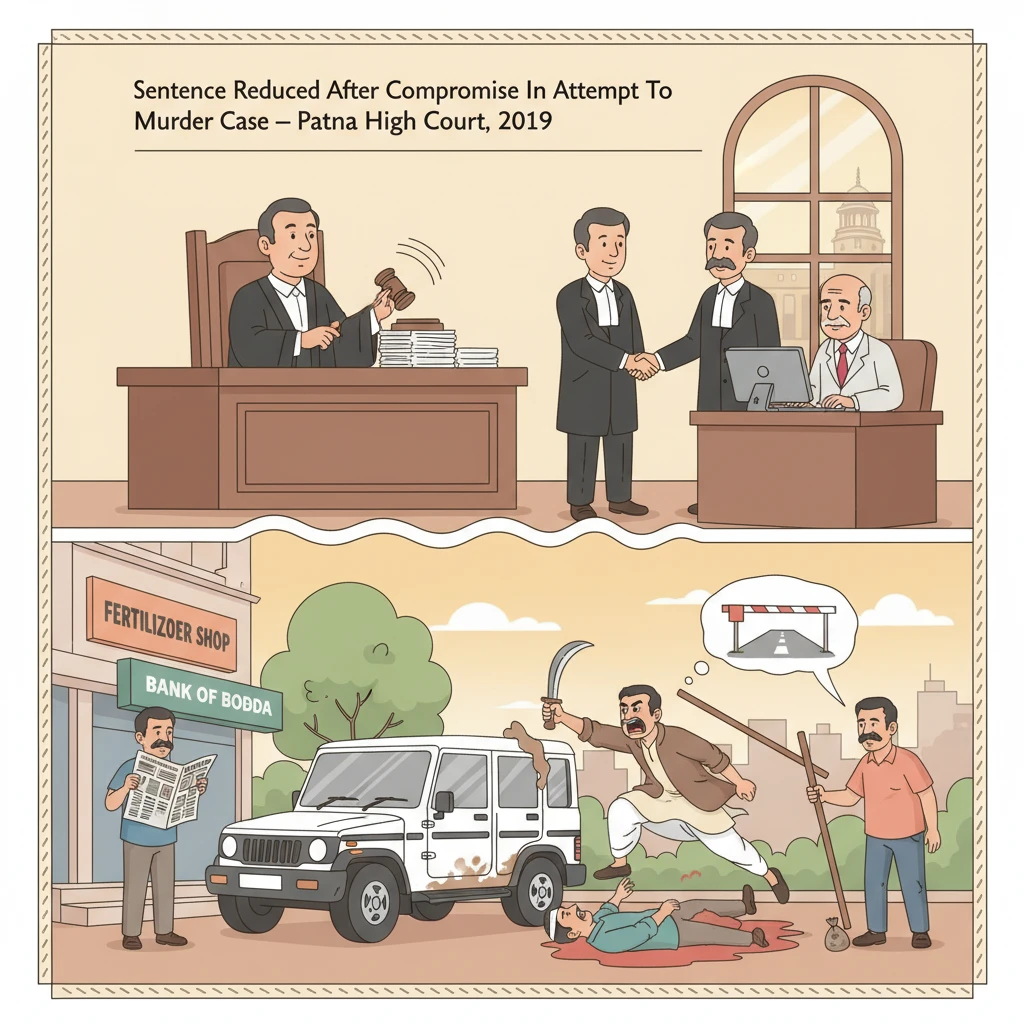
In his fardbeyan, the informant said that on 20.01.2013 he was reading a newspaper in a fertilizer shop at Nayagaon Bazar near the Bank of Baroda. Two other persons, Sudhanshu Kumar and Sandeep Kumar, were also present there.
According to him, the appellant came there in a Bolero jeep, got down armed with a bhujali (a sharp cutting weapon), abused him, and repeatedly struck him on the head and different parts of the body. The informant stated that he fell in a pool of blood and became unconscious.
He further alleged that when he tried to run away he was stopped by another accused, Dhruv Narayan Singh, armed with a lathi, who assaulted him. He also claimed that the accused persons took away Rs. 12,000 from his pocket.
His family members, after receiving information, took him first to Keshariya Hospital. From there he was referred to PMCH, but for better medical facilities, he was finally admitted to Magadh Hospital, where his statement was recorded.
The alleged motive mentioned in the fardbeyan was that he had earlier opposed and frustrated the illegal attempt of Dhruv Narayan Singh to block a road.
After investigation, the police submitted a charge sheet. The case went to trial before the court of the Additional Sessions Judge, VII, East Champaran at Motihari as Sessions Trial No. 340 of 2016/43 of 2016.
By judgment of conviction dated 22.08.2016 and order of sentence dated 23.08.2016, the trial court held the appellant guilty under Section 307 IPC (attempt to murder) and Section 324 IPC (voluntarily causing hurt by dangerous weapons or means).
The trial court sentenced him to seven years’ rigorous imprisonment and a fine of Rs. 10,000 under Section 307 IPC, with three months’ simple imprisonment in default. Under Section 324 IPC, he was sentenced to three years’ rigorous imprisonment and a fine of Rs. 5,000, with one month’s simple imprisonment in default. Both sentences were directed to run concurrently, with set-off for the period already spent in custody.
Challenging this judgment, the appellant filed Criminal Appeal (SJ) No. 723 of 2016 before the Patna High Court.
What the Court Examined and Decided
Hon’ble Mr. Justice Aditya Kumar Trivedi heard the criminal appeal. Nine prosecution witnesses were examined during the trial. They included the informant, eye witnesses, the doctor, and the investigating officer.
The witnesses were: PW 1 Krishna Prasad, PW 2 Lalita Devi, PW 3 Niraj Kumar, PW 4 Diplal Prasad, PW 5 Ranjan Kumar (informant/injured), PW 6 Devendra Prasad, PW 7 Ghanshyam Chandra Kushwaha @ Sushil Kumar, PW 8 Dr. Parsuram Sharma, and PW 9 Onkar Nath Sharma, the investigating officer.
The prosecution also exhibited the signatures on the fardbeyan (Exhibits 1 and 1/A), the injury report (Exhibit 2), supplementary injury report (Exhibit 2/A), formal FIR (Exhibit 3), and endorsement on the fardbeyan (Exhibit 4). The defence did not examine any witness.
In the High Court, the defence did not mainly challenge the conviction on facts. Instead, the focus was on the sentence in light of a later compromise between the parties.
The learned counsel for the appellant argued that although the case had been compromised between the parties and this fact had come on record through the evidence of witnesses, especially PW 5 (the injured informant), the trial court still convicted and sentenced the appellant, relying only on the evidence produced by the prosecution.
Counsel submitted that there was a finding by the trial court itself that the case had been compromised. From the evidence of PW 5 it was clear that he too had compromised the matter with the appellant.
It was argued that though an offence under Section 307 IPC is non-compoundable under Section 320 of the Code of Criminal Procedure, this case did not have any wider adverse impact on society. According to the defence, it was essentially a dispute between individuals, and in such a background the court should show indulgence at least on the question of sentence.
The appellant’s counsel argued that the trial court failed to appreciate this aspect properly. Therefore, even at the appellate stage, the appellant could take this plea and the appellate court had the power to modify the sentence.
To support this stand, the defence relied upon several Supreme Court decisions: Ram Pujan & Others vs. State of Uttar Pradesh, (1973) 2 SCC 456; Mahesh Chand & Another vs. State of Rajasthan, (1990) Supp. SCC 681; Murugeshan & Others vs. Ganapathy Velar, (2001) 10 SCC 504; Jetha Ram & Others vs. State of Rajasthan, (2006) 9 SCC 255; and Ishwarlal vs. State of Madhya Pradesh, (2008) 15 SCC 671.
On the basis of these authorities, it was submitted that even if the conviction is maintained, in view of the compromise and the nature of the evidence and intention of the parties, the sentence could be modified to the period already undergone by the appellant.
The learned Additional Public Prosecutor opposed this line of argument. He pointed out that the trial court’s findings were based on the factual record, including medical evidence which showed the seriousness of the injuries and indicated a murderous intention on the part of the appellant. This medical evidence was backed by supporting oral evidence.
Therefore, according to the State, the compromise should not be allowed to overshadow the factual and legal findings of the trial court. The prosecution submitted that the impugned judgment did not require interference.
The High Court then discussed the law on compromise in non-compoundable offences. It noted that ordinarily, non-compoundable offences are kept outside the scope of compromise under Section 320 Cr.P.C. However, in order to restore harmony and promote mutual understanding, courts have sometimes permitted compromise even in non-compoundable offences.
The Court mentioned that such relaxations are usually considered in cases like matrimonial disputes, commercial disputes, or disputes with no serious adverse impact on society, and not in heinous offences. Even after a full trial resulting in adverse findings, the Supreme Court has held that courts must properly acknowledge the event of compromise at the time of sentencing.
The Patna High Court particularly referred to the Supreme Court decision in Unnikrishnan v. State of Kerala, (2018) 5 SCC 343. In that case, the appellant had been convicted under Section 394 IPC, an offence which is also non-compoundable under Section 320 Cr.P.C.
The Supreme Court in Unnikrishnan examined several earlier judgments, such as Bharat Singh v. State of M.P., Ram Lal v. State of J & K, and Puttaswamy v. State of Karnataka. The consistent view was that, depending on the facts and circumstances, courts had allowed compromise even in non-compoundable offences.
In some of those cases, the Supreme Court maintained the conviction but reduced the sentence to the period already undergone, sometimes imposing a fine in place of remaining imprisonment. The key principle emerging from Unnikrishnan was that, even if an offence is not compoundable under Section 320 Cr.P.C., the court may, in view of a genuine compromise between the parties, reduce the sentence while maintaining the conviction.
Applying this reasoning, the Patna High Court looked at the record of the present case. It noted from the record that the appellant had been in custody since 15.03.2016. Therefore, by the time of the High Court judgment dated 17.05.2019, he had already spent more than three years in custody.
Taking into account the compromise between the parties, the nature of the occurrence as recorded, and the period of custody already suffered, the Court decided to maintain the conviction under Sections 307 and 324 IPC but modify the sentence.
The sentence imposed by the trial court was reduced to the period already undergone by the appellant in custody. In other words, the High Court did not disturb the finding that the appellant committed the offences, but it held that the time he had already spent in jail was sufficient punishment in the circumstances.
With this modification in the sentence, the criminal appeal was dismissed. The Court directed that the appellant, who was in custody, be released forthwith, if he was not required in any other case.
Why This Judgment Matters
This judgment is important for people facing serious criminal charges where later the parties settle their dispute. It shows that even when an offence like attempt to murder under Section 307 IPC cannot be formally compounded, a compromise can still influence the sentence.
For victims and accused persons, it clarifies that the Patna High Court will not automatically cancel a conviction just because of a compromise in serious offences. However, the Court may reduce the punishment if it finds that peace has been restored and the convict has already undergone a substantial period in custody.
For lawyers and trial courts, the judgment underlines the need to place later developments such as compromise on record and to consider them at the stage of sentencing. It reaffirms the Supreme Court’s view that sentencing should be realistic and should take into account the present relationship between the parties.
At the same time, the judgment keeps a clear line: the law on non-compoundable offences remains, and the offence is not wiped out. Only the sentence is adjusted to fit the special facts of the case and the interest of harmony.
Legal Issues and Answers
Issue: Whether, in a non-compoundable offence like attempt to murder under Section 307 IPC, the High Court can reduce the sentence on the basis of a compromise between the parties while maintaining the conviction.
Answer: Yes. Relying on Supreme Court precedents including Unnikrishnan v. State of Kerala, the Patna High Court held that even where an offence is non-compoundable under Section 320 Cr.P.C., the court may, in view of a compromise and the facts of the case, maintain the conviction but reduce the sentence to the period already undergone.
Cases Cited by the Court
- Ram Pujan & Others vs. State of Uttar Pradesh, (1973) 2 SCC 456.
- Mahesh Chand & Another vs. State of Rajasthan, (1990) Supp. SCC 681.
- Murugeshan & Others vs. Ganapathy Velar, (2001) 10 SCC 504.
- Jetha Ram & Others vs. State of Rajasthan, (2006) 9 SCC 255.
- Ishwarlal vs. State of Madhya Pradesh, (2008) 15 SCC 671.
- Unnikrishnan v. State of Kerala, (2018) 5 SCC 343.
Case Details
Case Number: Criminal Appeal (SJ) No. 723 of 2016; arising out of Keshariya P.S. Case No. 17 of 2013; Sessions Trial No. 340 of 2016/43 of 2016.
Case Title: Manohar Lal Singh vs. The State of Bihar.
Coram: Hon’ble Mr. Justice Aditya Kumar Trivedi.
Citation: 2019 (3) PLJR 153.
Advocates: For the appellant: Mr. Y.C. Verma, Senior Advocate; Mr. Archit Rajpal, Advocate; Mr. Ansul, Advocate; Ms. Sagrika, Advocate; Mr. Navneet Kumar, Advocate; Ms. Jayanti Kumari, Advocate. For the State: Mr. Binod Bihari Singh, APP.
Nature of the Case: Criminal appeal (single judge) against conviction and sentence under Sections 307 and 324 of the Indian Penal Code.
Date of High Court Judgment: 17.05.2019 (CAV judgment; CAV date 07.05.2019).
Link to Judgment: Click here to read the full judgment on the Patna High Court website.
If you found this explanation helpful and wish to stay informed about
how legal developments may affect your rights in Bihar,
you may consider following Samvida Law Associates for more updates.







