
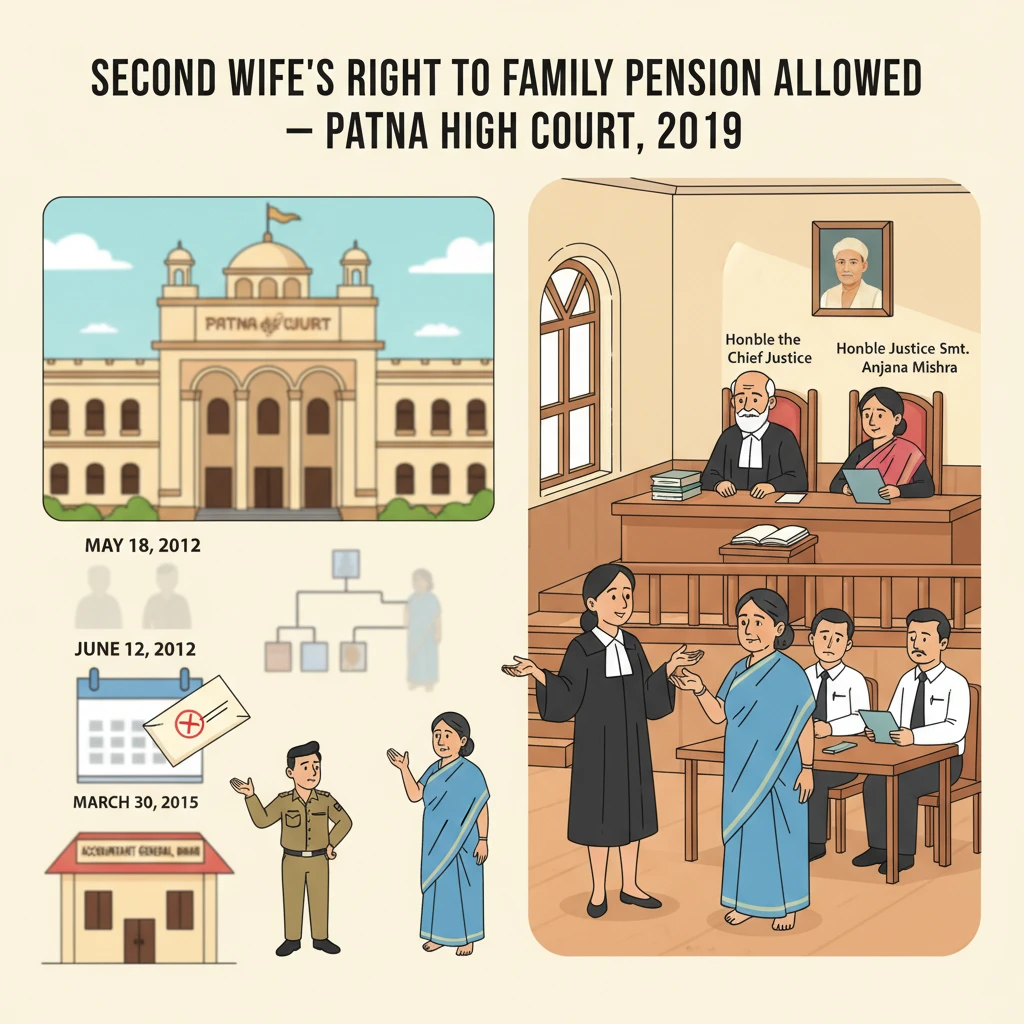
Case Background
The appellant is the widow of a Class IV government employee, Late Surbanshi Ram @ Surbansh Ram. He was serving under the State of Bihar and died on 12 June 2012.
The dispute is about family pension after his death. The appellant applied for family pension as his widow. However, she was treated as the second wife of the deceased employee.
The authorities refused to grant her family pension. A letter bearing No. 44 dated 30 March 2015 was issued, which effectively denied her claim.
She approached the Patna High Court by filing Civil Writ Jurisdiction Case No. 13972 of 2017. The learned single Judge dismissed her writ petition, holding that as a second wife she was not entitled to family pension under the applicable rules.
Aggrieved by this decision, she filed Letters Patent Appeal No. 72 of 2018 before a Division Bench of the Patna High Court. The matter was heard by Hon’ble the Chief Justice and Hon’ble Justice Smt. Anjana Mishra, who delivered an oral judgment on 22 April 2019.
What the Court Examined and Decided
The main question before the Division Bench was whether, in the particular facts of this case, the appellant, described as the second wife, could be denied family pension, especially when the first wife had died before the employee.
The appellant’s counsel argued that the learned single Judge had not properly appreciated the relevant rules in light of the peculiar facts. It was specifically pointed out that the first wife, Lalmuni Devi, had already died on 18 May 2012, which was during the lifetime of the employee.
This date is important because the employee himself died on 12 June 2012. Therefore, on the date of his death, only one widow was alive, namely the appellant. According to the appellant, she was then the sole surviving wife, and there was no rival claimant for the family pension.
To decide the matter, the Division Bench first traced the evolution of the Family Pension Scheme of the State Government. The Scheme was initially promulgated with effect from 1964 and had been revised from time to time.
Under the earlier rules, when a government servant died leaving behind more than one widow, the family pension was to be divided equally among them. This position was reflected in the Finance Department’s Resolution dated 19 April 1990, which contained revised provisions of the Family Pension Scheme.
Later, there was a significant change. The Finance Department issued another Resolution dated 6 September 1996, which amended the earlier position. The judgment reproduces this Resolution in Hindi. The Court carefully read and explained its effect.
From this Resolution, the Court noted that earlier, in cases where an employee had more than one wife, the widows would share the family pension between themselves. However, based on a decision of the Government of India communicated through a letter dated 4 March 1987, the State Government decided to revise its rules.
The 1996 Resolution made it clear that if a government servant contracted a second marriage during the lifetime of his first wife, then the second wife would not be entitled to family pension. However, the illegitimate children from such second marriage would be entitled to family pension benefits, in accordance with the rules.
The Resolution also stated that this change would take effect prospectively, from the date of its enforcement. As regards cases where family pension had already been sanctioned before this change, the benefits already granted would not be withdrawn, but future cases would be decided as per the revised rule.
The basic principle of the 1996 Resolution was that a second wife, where the first marriage was still subsisting and the first wife alive at the time of death of the employee, had no right to family pension. The amendment was aimed at discouraging a second marriage during the lifetime of the first wife.
However, the Division Bench found that the appellant’s case did not fit neatly within this general rule. Here, there was a second marriage, but the first wife predeceased the employee. On the date of death of the government servant, the first wife was not alive. She had also left no children.
This meant that at the time when the right to family pension arose, there was only one surviving widow. The Court emphasised this “peculiar fact” as the central feature of the case.
The Bench reasoned that the 1996 Resolution primarily targeted situations where both wives were alive and the first marriage was subsisting at the time of the death of the employee. In such cases, the second wife, though married, would not get family pension, but her children would.
In contrast, in the present matter, there was no surviving first wife and no children from the first marriage. Therefore, there was no one other than the appellant to claim the family pension. Denying her pension would result in the family pension lapsing altogether, even though there was a widow dependent on the deceased employee.
The Court observed that in these circumstances, an interpretation of the rules that completely excluded the only surviving widow would not be appropriate. There was no prejudice to the Government in granting family pension to the appellant, since it did not contradict the substance of the 1996 Resolution.
The Court held that this was a “peculiar case” requiring different treatment and a purposive interpretation of the Resolution dated 6 September 1996. It stressed that, as on the date of death of the employee, the appellant was the sole surviving widow and wife. Therefore, there was no violation of the Resolution if family pension was granted to her.
The Division Bench also noted that the learned single Judge had not considered this specific factual scenario while dismissing the writ petition. The impugned judgment dated 6 December 2017 did not discuss the impact of the first wife’s prior death and the absence of children from the first marriage on the interpretation of the pension rules.
In light of this, the Division Bench disagreed with the single Judge’s view and concluded that the appellant ought to have been extended the benefit of family pension.
Accordingly, the Court allowed the Letters Patent Appeal. It set aside the judgment of the learned single Judge dated 06 December 2017. The Division Bench then issued a mandamus—that is, a binding direction—to the third respondent, the Superintendent of Police, Jehanabad.
The Superintendent of Police was directed to revisit the matter in light of the facts discussed in the judgment and the relevant Resolution dated 6 September 1996. The Court also specifically quashed Letter No. 44 dated 30 March 2015, which had earlier been issued against the appellant.
Finally, the Court disposed of both the Letters Patent Appeal and the original writ petition in terms of this decision. The effect is that the authorities must reconsider and process the appellant’s family pension claim treating her as the surviving widow, in line with the Court’s interpretation.
Why This Judgment Matters
This judgment is significant for widows of government employees in Bihar, especially those who are described as second wives.
The Patna High Court has made it clear that the rule denying family pension to a second wife cannot be applied mechanically in every situation. Where the first wife has died before the employee and there are no children from that marriage, the second wife, if she is the only surviving widow, can be considered for family pension.
In practical terms, this prevents unfair hardship to widows who depended on the deceased employee. It ensures that family pension, meant as a social security measure, is not denied merely on technical interpretation when no other legal heir is competing for the benefit.
The decision also guides government departments. It tells them that while enforcing the 1996 Resolution, they must examine the actual family situation at the time of the employee’s death, rather than rejecting claims solely on the label of “second wife”.
For families in similar circumstances in Bihar, this ruling offers a clear precedent to seek reconsideration of their pension claims if they were denied only because the claimant was treated as a second wife, despite being the only surviving widow.
Legal Issues and Answers
Issue: Can a widow described as the second wife of a government employee be denied family pension when the first wife died before the employee and left no children?
Answer: No. The Patna High Court held that in such peculiar facts, the second wife, being the only surviving widow at the time of the employee’s death, should be extended family pension, as this does not violate the Finance Department’s Resolution dated 06 September 1996.
Issue: Was the learned single Judge right in rejecting the writ petition solely on the ground that the appellant was a second wife under the pension rules?
Answer: No. The Division Bench set aside the single Judge’s order, holding that the effect of the first wife’s prior death and the absence of any competing claimant had not been properly considered.
Issue: What directions did the Court give to the authorities regarding the appellant’s claim?
Answer: The Court quashed Letter No. 44 dated 30 March 2015 and directed the Superintendent of Police, Jehanabad, to revisit the matter and process the claim in light of the facts and the Resolution dated 06 September 1996.
Cases Cited by the Court
The judgment refers to the Government of India communication dated 4 March 1987 and the Bihar Finance Department Resolutions dated 3 October 1964, 19 April 1990, and 6 September 1996. No separate reported case law citations are expressly relied upon in the text of the judgment.
Case Details
Case Number: Letters Patent Appeal No. 72 of 2018 in Civil Writ Jurisdiction Case No. 13972 of 2017
Case Title: Sumitra Kunwar @ Sunaina Devi @ Sumitra Devi v. The State of Bihar & Ors.
Coram: Hon’ble the Chief Justice Amreshwar Pratap Sahi and Hon’ble Justice Smt. Anjana Mishra
Citation: 2019 (3) PLJR 307
Advocates: For the appellant – Mr. Banwari Sharma, Advocate; Mr. Jay Prakash Singh, Advocate. For the respondents – Mr. Saroj Kumar Sharma, A.C. to A.A.G.-3.
Nature of the Case: Letters Patent Appeal against dismissal of a writ petition seeking family pension, relating to service and pensionary benefits.
Date of Judgment: 22 April 2019
Link to Judgment: Click here to read the full judgment of the Patna High Court
If you found this explanation helpful and wish to stay informed about
how legal developments may affect your rights in Bihar,
you may consider following Samvida Law Associates for more updates.







