

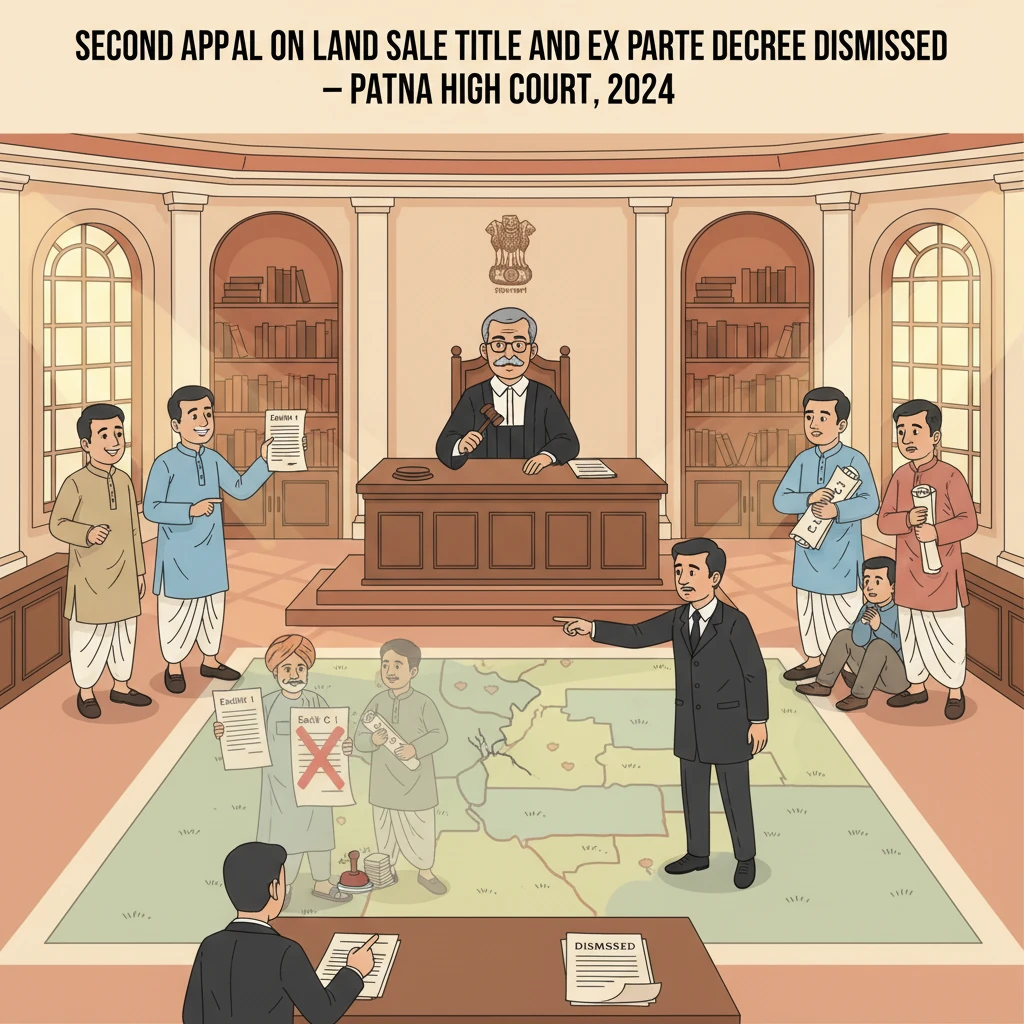
Case Background
This case arises out of a long-standing family and village dispute over agricultural land in village Hawaspur, police station Mansoor Chak, district Begusarai, and connected villages in district Samastipur.
The father of the original plaintiff (respondent in the second appeal), late Budhan Mahto, purchased 10 katha 12½ dhur of land, described as the disputed land, through a registered sale deed dated 22.08.1964 (marked Ext.1) executed by one Sarju Singh. Sarju Singh was an agnate and co-sharer of late Tulsi Singh.
Before this 1964 sale, Tulsi Singh and others, including Sarju Singh, had already executed two registered sale deeds on 07.05.1958 (marked Ext.C and Ext.C/1) in favour of late Rameshwar Mahton, father of the first appellant and a member of the defendant first set in the original suit. Each sale deed covered one bigha 8 katha 18 dhur of land, and together they included the land now in dispute.
The sale deeds of 07.05.1958 were for consideration of Rs. 2000/‑ each. Importantly, in Ext.C/1 it was recorded that title would pass only after payment of the full consideration amount. This condition about payment was central to the later conflict.
According to the plaintiff’s case, Rameshwar Mahton paid Rs. 2000/‑ towards the first sale deed (Ext.C). However, he did not pay the full amount for the second sale deed (Ext.C/1), and therefore, under the terms of that document, title to that portion never passed to him.
Tulsi Singh, one of the vendors and a member of the defendant second set, served two notices on Rameshwar Mahton demanding the unpaid money. The first notice was dated 29.07.1958 and the second dated 18.10.1958. When the consideration remained unpaid, Tulsi Singh and others executed a deed of cancellation on 07.04.1959 in respect of the land covered by Ext.C/1.
Sarju Singh, being a one‑third co‑sharer in that property, subsequently executed the sale deed dated 22.08.1964 (Ext.1) in favour of Budhan Mahto, transferring his one‑third share measuring 10 katha 12½ dhur. That parcel is the suit land.
Later, Rameshwar Mahton and other members of the defendant first set filed Title Suit No. 68 of 1964 for declaration of their right and title over the land comprising Ext.C/1. Budhan Mahto was also made a party to that suit.
According to the plaintiff’s version as noted in the judgment, no summons was ever served on Budhan Mahto. It is alleged that Rameshwar Mahton and Tulsi Singh, acting in collusion, compromised the case behind his back.
In the compromise petition in T.S. No. 68 of 1964, it was recorded that Rameshwar Mahton had paid the consideration money to Tulsi Singh and that possession had been delivered to Rameshwar Mahton. It was further mentioned that Budhan Mahto had received consideration from Rameshwar Mahton and had also delivered possession to him. The plaintiff’s case is that Budhan Mahto had no knowledge of that suit, never appeared, and never agreed to such terms.
When an ex parte compromise decree was passed in T.S. No. 68 of 1964 against Budhan Mahto, he filed an application under Order IX Rule 13 of the Code of Civil Procedure (CPC) to set aside the decree. This was registered as Miscellaneous Case No. 69 of 1969. That application was eventually dismissed.
After dismissal of the Order IX Rule 13 application, the plaintiff and other heirs of Budhan Mahto filed the present title suit, T.S. No. 66 of 1972, seeking declaration of their title and confirmation of possession over plot no. 706 measuring 10 katha 12½ dhur.
In the trial court (Munsif, 2nd Court, Begusarai), the defendants first set, led by the heirs of Rameshwar Mahton, contested the suit. Tulsi Singh and others in the second set did not contest. The trial court, by judgment dated 30.11.1984, decided in favour of the defendants first set.
The plaintiff then filed a misc. title appeal. The 1st Additional District Judge, Begusarai, in M.T.A. No. 02/85/01/89, reversed the trial court judgment by judgment and decree dated 30.09.1991, holding in favour of the plaintiff. Against that appellate decree, the defendants first set preferred the present Second Appeal No. 18 of 1992 before the Patna High Court.
What the Court Examined and Decided
The Patna High Court, presided over by Hon’ble Mr. Justice Nawneet Kumar Pandey, heard the second appeal and framed two substantial questions of law:
First, whether the first appellate court was justified in holding that payment of consideration money was a condition precedent for passing of title under the sale deed dated 07.05.1958 (Ext.C/1).
Second, whether, in view of the earlier ex parte decree passed against the plaintiff and dismissal of the miscellaneous case under Order IX Rule 13 CPC, the present suit was maintainable.
On the first question, the Court closely examined the terms of the 1958 sale deed Ext.C/1 and the surrounding evidence. It was admitted that the whole consideration under Ext.C/1 had not been paid to the vendors.
The High Court noted the notice dated 18.10.1958 sent by Tulsi Singh to Rameshwar Mahton (marked Ext.H). In that notice, Tulsi Singh clearly stated that at the time of execution of the sale deed only Rs. 1500/‑ had been paid and that Rs. 2500/‑ remained due. This documentary evidence contradicted the defence plea that only Rs. 500/‑ remained unpaid.
The Court relied on Section 8 of the Transfer of Property Act, which provides that title normally passes to the transferee as soon as the transfer is completed, except where a different intention is expressed or implied in the instrument. The intention must be gathered from the recitals in the sale deed, where available.
Looking at Ext.C/1, the Court found a specific clause stating that title would not pass until payment of the consideration money. It also recorded that possession would pass only after such payment. Thus, this was not a routine case of part consideration remaining unpaid; it was a case where the parties themselves had clearly made complete payment a condition for transfer of title and possession.
In the meantime, before the condition was fulfilled and before title could pass to the defendant first set under Ext.C/1, one of the co‑sharers, Sarju Singh, executed the 1964 sale deed (Ext.1) transferring his one‑third share to Budhan Mahto. At that stage, in the Court’s view, the title under Ext.C/1 had not yet passed to Rameshwar Mahton and others because the condition of full payment remained unfulfilled.
Thus, on the facts, when Budhan Mahto purchased the land in 1964, the disputed share still vested in the co‑sharers, including Sarju Singh. By executing Ext.1, Sarju Singh validly transferred his one‑third share to Budhan Mahto and title in that share passed to Budhan Mahto.
The appellants relied on a Supreme Court judgment, Bishundeo Narayan Rai and another vs. Anmol Devi and others [(1998) 7 SCC 498], to argue that even if part of the consideration remains unpaid, title still passes under a registered sale deed.
The High Court distinguished that decision. In Bishundeo Narayan Rai’s case, the sale deed itself recorded that vendors had delivered possession to vendees and that vendors could have their names recorded in the Anchal office. These recitals showed a clear intention to transfer title immediately, despite outstanding consideration.
By contrast, in the present case, Ext.C/1 expressly stated that title and possession would pass only after payment of the remaining consideration. Therefore, Section 8 of the Transfer of Property Act, read with this express clause, meant that title would not pass on mere execution and registration.
To reinforce this interpretation, the Court referred to an earlier Patna High Court decision reported in AIR 1931 Patna 236. That decision held that title normally passes on execution and registration of a sale deed even if purchase money is unpaid wholly or partly, except where there is an agreement that the deed will take effect only if the consideration is first paid.
On that legal basis, the High Court agreed with the first appellate court. It held that, in this case, payment of consideration under Ext.C/1 was indeed a condition precedent to the passing of title. Since the full price was not paid and the vendors even issued notices and executed a cancellation deed, title under Ext.C/1 never passed to Rameshwar Mahton and others.
Consequently, when Sarju Singh executed Ext.1 in 1964 in favour of Budhan Mahto, he was competent to transfer his share, and title validly passed to Budhan Mahto.
Turning to the second substantial question, the Court considered whether dismissal of an application under Order IX Rule 13 CPC barred the plaintiff from filing a fresh suit.
The Court observed that in T.S. No. 68 of 1964, the decree was ex parte against Budhan Mahto. He then moved for setting aside that ex parte decree through Misc. Case No. 69 of 1969 under Order IX Rule 13 CPC. That application stood dismissed.
The High Court clarified the limited scope of an Order IX Rule 13 proceeding. In such an application, the court does not go into the merits of the original dispute. It examines only whether summons was duly served on the defendant or whether he had knowledge of the suit. Questions like whether a compromise was fraudulent or collusive, or whether the decree itself is substantively valid, are not addressed in an Order IX Rule 13 application.
The Court held that dismissal of an Order IX Rule 13 application does not, by itself, bar a fresh suit that challenges the decree on grounds such as fraud or collusion and seeks declaration of title and recovery of possession.
The Court drew attention to the CPC’s own scheme. Where the legislature intends to bar a fresh suit, it says so explicitly. For example, when a suit is dismissed in default under Order IX Rule 8, a fresh suit on the same cause is barred under Order IX Rule 9. However, no such bar is created in the case of dismissal of an application under Order IX Rule 13.
Therefore, despite the dismissal of Misc. Case No. 69 of 1969, the plaintiff’s subsequent title suit to challenge the ex parte compromise decree and assert his own title was maintainable in law.
Having answered both substantial questions of law in favour of the plaintiff and against the appellants, the High Court concluded that the first appellate court’s judgment was correct. On this basis, Second Appeal No. 18 of 1992 was dismissed.
Why This Judgment Matters
This Patna High Court judgment is important for land buyers and families involved in village land disputes.
First, it underscores that what is written in a sale deed about payment of price is crucial. If the deed clearly says that title will pass only after full payment, then non‑payment can prevent title from transferring, even if the document is registered. Mere registration is not enough when the deed itself makes payment a condition.
Second, the decision gives reassurance to parties who feel cheated by ex parte compromise decrees obtained behind their back. The Court has clearly said that even if one’s application under Order IX Rule 13 CPC fails, one is still allowed to file a regular suit to challenge a collusive or fraudulent decree and to seek declaration of title.
For villagers and small landholders, this means that missing a hearing or not getting summons, and then losing an Order IX Rule 13 petition, does not always close the doors of the civil court. A properly framed title suit can still be filed in appropriate cases.
Legal Issues and Answers
- Issue: Did title pass to the defendant first set under sale deed Ext.C/1 dated 07.05.1958, despite non‑payment of full consideration?
Answer: No. Because Ext.C/1 expressly made full payment of consideration a condition precedent, and the price remained unpaid, title did not pass to the defendants first set. The co‑sharer Sarju Singh could therefore validly sell his share to Budhan Mahto under Ext.1. - Issue: Was the plaintiff barred from filing the present title suit after dismissal of his application under Order IX Rule 13 CPC against an ex parte compromise decree in T.S. No. 68 of 1964?
Answer: No. Dismissal of an Order IX Rule 13 application does not bar a fresh suit. That application examines only service of summons or knowledge of the suit, not the merits or allegations of fraud. There is no CPC provision preventing a fresh suit in such circumstances.
Cases Cited by the Court
- The Court referred to and distinguished Bishundeo Narayan Rai and another vs. Anmol Devi and others, (1998) 7 SCC 498.
- The Court relied on an earlier Patna High Court decision reported in AIR 1931 Patna 236 regarding passing of title when consideration is unpaid but no condition is attached.
Case Details
Case Number: Second Appeal No. 18 of 1992
Case Title: Ashok Kumar Mahton & Ors. v. Dayawati Devi & Ors.
Citation: 2024 (4) PLJR 287
Coram: Hon’ble Mr. Justice Nawneet Kumar Pandey
Advocates:
- For the appellants: Mr. Sunil Kumar Verma, Mr. Suman Kumar Verma, Mr. Amresh Kumar Mishra
- For respondent nos. 26(AB) & 27(ii): Mr. Ram Vinay Prasad Singh @ Sanjay Singh
- For the respondent: Mr. Shashi Dhar Jha, Mr. Ram Sumiran Singh
Nature of the Case: Second appeal under Section 100 CPC arising from a title suit concerning declaration of title and confirmation of possession over agricultural land, after reversal of the trial court’s decree by the first appellate court.
Date of High Court Judgment: 03.09.2024
Link to Full Judgment: Patna High Court Judgment in SA No. 18 of 1992
If you found this explanation helpful and wish to stay informed about
how legal developments may affect your rights in Bihar,
you may consider following Samvida Law Associates for more updates.







