

Case Background
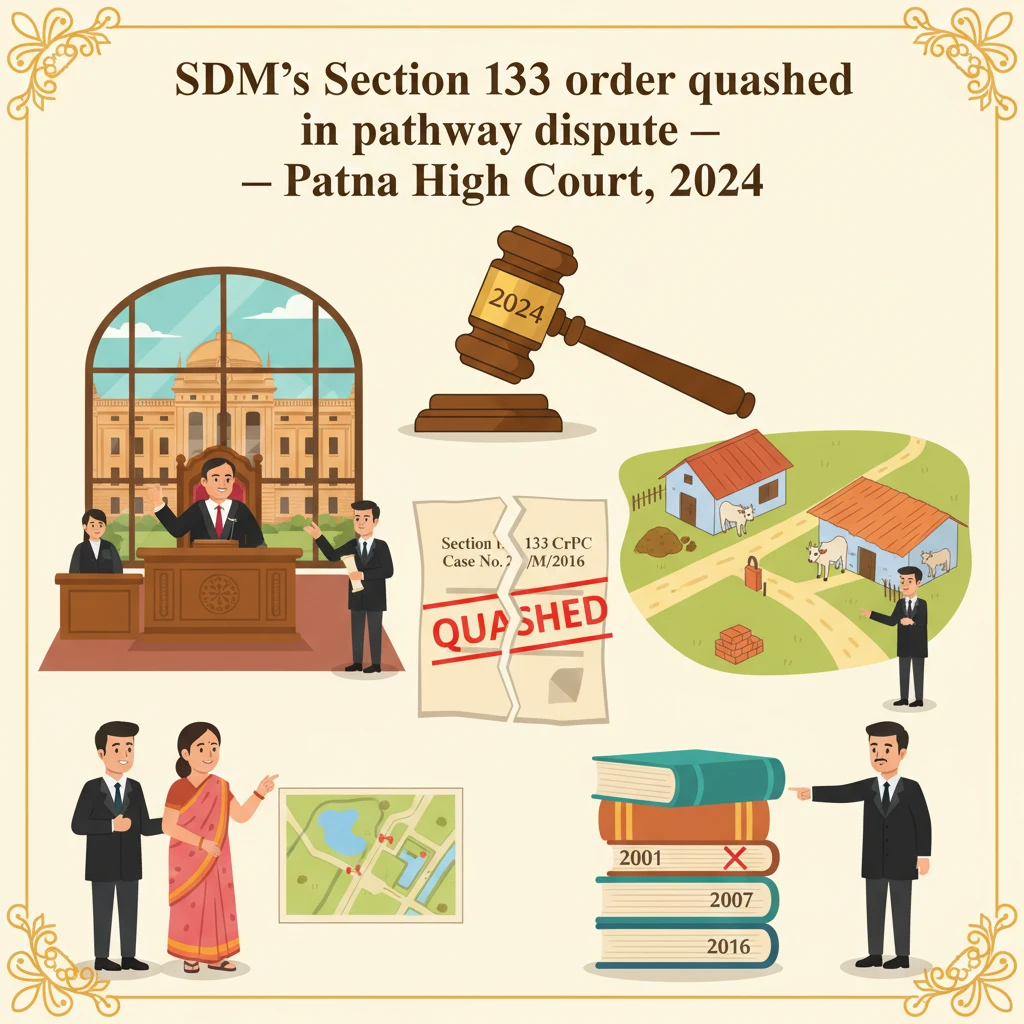
This case arose from a long-running dispute between neighbouring landowners in Bari Khagaul, Khagaul Police Station, district Patna. One side, the petitioners, own a piece of land bearing holding no. 234, Ward No. 16, Circle No. 10, at Mohalla Bada Khagaul, Millat Colony.
According to the police report referred to in the judgment, a tenant of the petitioners runs a khatal (cattle shed) on this land. Animal dung is accumulated in the middle portion and bricks are stored on the western side.
The opposite party no. 5 (the complainant) owns land to the north of the petitioners’ plot. There is an old house on his land in which, as recorded, no one is living. He wants a direct passage over the petitioners’ land to reach the nearby metalled road.
The petitioners say they have already provided a pathway to the complainant from the backside of their land, but they are not ready to allow a pathway through the portion abutting the metalled road. A civil dispute over this claimed pathway and alleged easementary right has been pending between the parties for years.
The complainant filed Title Suit No. 76 of 2001 for a right of way over the petitioners’ land. The trial court dismissed the suit. The complainant then filed Title Appeal No. 93 of 2007 before the District Judge, which was also dismissed. He has now filed Second Appeal No. 101 of 2016 before the Patna High Court, where the matter is still pending.
While this civil litigation was ongoing, the Officer-in-Charge of Khagaul Police Station sent a report to the Sub-Divisional Magistrate (SDM), Danapur, based on the complainant’s grievance. The police suggested that, due to the dispute and possible law and order issues, proceedings under Section 133 of the Code of Criminal Procedure (CrPC) should be initiated.
Acting on this report, the SDM started Case No. 216/M/2016 under Section 133 CrPC and on 28.05.2016 issued a conditional order/notice to the petitioners. They were directed to remove the alleged obstruction/encroachment from the land in question or, in the alternative, to appear and show cause why the order should not be made absolute.
Challenging this notice and conditional order, the petitioners approached the Patna High Court under Section 482 CrPC (which gives the High Court inherent powers to prevent abuse of process of court and to secure the ends of justice).
What the Court Examined and Decided
Hon’ble Mr. Justice Jitendra Kumar heard the matter. The petitioners argued that the SDM’s order under Section 133 CrPC was legally unsustainable because Section 133 can be used only to address public nuisance or obstruction of a public right, not private neighbour disputes.
Their counsel pointed out that even as per the police report:
- The land in question belongs to the petitioners, not the State.
- A tenant runs a khatal there, and animal dung is stored in the middle and bricks on the west side.
- There is no finding that these activities cause any nuisance or obstruction to the public at large.
- The only complaint is that the neighbour wants a pathway over their private land to reach the main road.
It was also stressed that the complainant himself had never alleged that the khatal, animal dung or brick storage caused public nuisance. There was no complaint from “the public at large”; the grievance was only about a private access route.
The petitioners highlighted the pending and past civil proceedings: Title Suit No. 76 of 2001, Title Appeal No. 93 of 2007 and the ongoing Second Appeal No. 101 of 2016. They argued that the complainant, having failed in the civil courts, was trying to use the criminal process under Section 133 CrPC to indirectly secure what he could not get in the civil suit.
On this basis, the petitioners contended that:
- The dispute is purely civil in nature, relating to easement and pathway.
- Section 133 CrPC is not meant to adjudicate such civil rights.
- The SDM’s order was an abuse of court process and should be quashed under Section 482 CrPC.
On the other side, the State and the counsel for opposite party no. 5 supported the SDM’s action. They argued that, due to the accumulation of animal dung and storage of bricks on the petitioners’ land, the SDM had correctly invoked Section 133 CrPC to prevent public nuisance and maintain public order and peace.
Before deciding, the Court reproduced Section 133 CrPC in full. The section enables a District Magistrate, Sub-Divisional Magistrate or specially empowered Executive Magistrate to make a conditional order for removal of obstruction or nuisance from a public place or way, or to regulate trades or activities injurious to the community’s health or comfort, or to deal with dangerous buildings, structures, animals, tanks, wells, etc.
The Court then discussed how the Supreme Court has interpreted Section 133 in previous cases, particularly:
- Kachrulal Bhagirath Agrawal v. State of Maharashtra, (2005) 9 SCC 36; and
- Vasant Manga Nikumba v. Baburao Bhikanna Naidu, 1995 Supp (4) SCC 54.
Relying on these authorities, the Court noted that Section 133 CrPC is part of Chapter X, dealing with maintenance of public order and tranquility. Sections 133 to 143 specifically cover “public nuisance.”
The Supreme Court has clarified that:
- There are two types of nuisance: public and private.
- Public nuisance, defined in Section 268 of the Indian Penal Code, is an act or omission causing common injury, danger or annoyance to the public or to people living nearby.
- Private nuisance affects specific individuals, not the public at large.
- Section 133 CrPC is designed to protect the public as a whole and is not intended to settle private disputes.
- The Magistrate must find clear and reliable evidence of present or imminent danger to the health or physical comfort of the community before issuing orders under Section 133.
The Court emphasised that a lawful and necessary use of one’s own property should not be interfered with unless it is clearly shown to produce legal damage or harm to the community. Proceedings under Section 133 should not, by themselves, become a “nuisance” to the community or a weapon in private battles.
Applying these principles to the facts, the Patna High Court closely examined the police report on which the SDM had relied. It found:
- No allegation that the accumulation of animal dung or storage of bricks caused any public nuisance.
- No statement that the public’s right of way over any public land was obstructed.
- No complaint from the general public about inconvenience or discomfort.
- Even the complainant did not allege nuisance from the khatal, dung or bricks.
The only grievance of opposite party no. 5, as recorded, was that he was not being allowed to access the metalled road through the petitioners’ private land and that he claimed an easementary right for such a pathway. There was also no “public demand” for the pathway; only the complainant wanted it.
On this basis, the Court held that the dispute was clearly private and civil in nature. It related to a claimed right of way over private land, for which the complainant had already approached the civil courts and lost in two rounds, with a second appeal pending.
The High Court concluded that there was “no occasion” for the SDM to invoke Section 133 CrPC in such circumstances. By doing so, the SDM had exceeded his jurisdiction and encroached upon the jurisdiction of the civil court.
The Court criticised this as a “colourable exercise of jurisdiction” and an “abuse of the process of the Court” by the Magistrate. It reiterated that every State authority must act within its own jurisdiction and must not transgress into areas reserved for other forums.
To prevent misuse of the criminal process and to secure the ends of justice, the Court exercised its powers under Section 482 CrPC. It held that the impugned notice, conditional order and the entire proceedings in Case No. 216/M/2016 before the SDM, Danapur, were not sustainable in law and deserved to be quashed.
Accordingly, the Patna High Court allowed the petition and set aside the entire Section 133 proceeding, including the notice and conditional order dated 28.05.2016.
Why This Judgment Matters
This judgment is important for people facing local disputes over passage, boundaries or use of private land. It makes clear that Section 133 CrPC is meant to address public nuisance or obstruction of public rights, not to decide private easement or pathway claims.
Where a neighbour wants a pathway through another’s private land, the proper forum is the civil court. Using police complaints and Section 133 proceedings to pressurise the other side is not acceptable. The Patna High Court has reaffirmed that Executive Magistrates cannot bypass or override ongoing civil litigation by issuing orders on such private disputes.
For villagers and townspeople, this means that:
- Disputes about right of way or easement over private land should normally be taken to civil court.
- Section 133 can be used only when there is a real public nuisance affecting the community at large.
- If authorities use Section 133 in a purely private dispute, such orders can be challenged before the High Court.
The decision also reinforces that every authority must respect jurisdictional limits. Civil courts decide civil rights; Executive Magistrates deal with public order and public nuisance. Mixing these roles can lead to orders being struck down as abuse of process.
Legal Issues and Answers
- Issue: Can an Executive Magistrate invoke Section 133 CrPC to direct removal of alleged obstruction on private land where the dispute is only between neighbouring landowners over a claimed pathway?
Answer: No. The Patna High Court held that Section 133 CrPC applies only to public nuisance or obstruction of public rights. A purely private, civil dispute over easement or pathway—already pending in civil courts—cannot be dealt with under Section 133. - Issue: When can the High Court use its inherent powers under Section 482 CrPC to interfere with Section 133 proceedings?
Answer: The Court can intervene where the Magistrate’s action amounts to colourable exercise of jurisdiction and abuse of process, such as when Section 133 is used to settle private civil disputes and to encroach upon the jurisdiction of civil courts.
Cases Cited by the Court
- Kachrulal Bhagirath Agrawal v. State of Maharashtra, (2005) 9 SCC 36.
- Vasant Manga Nikumba v. Baburao Bhikanna Naidu, 1995 Supp (4) SCC 54.
Case Details
Case Number: Criminal Miscellaneous No. 32558 of 2016; arising out of Case No. 216/M/2016 before the Sub-Divisional Magistrate, Danapur, Patna.
Case Title: Smt. Shakuntala Devi & Ors. v. The State of Bihar & Ors.
Coram: Hon’ble Mr. Justice Jitendra Kumar.
Citation: 2024 (4) PLJR 88.
Advocates: Mr. Choudhary Shyam Nandan, Advocate for the petitioners; Mr. Upendra Kumar, APP for the State; Mr. Suman Kumar Jha, Advocate for private respondent (Opposite Party No. 5).
Nature of the Case: Petition under Section 482 CrPC challenging notice and conditional order under Section 133 CrPC issued by the Sub-Divisional Magistrate, Danapur, Patna.
Date of Judgment: 23.08.2024 (CAV; CAV date 05.08.2024; uploading and transmission date 23.08.2024).
Link to Judgment: Full text of judgment on Patna High Court website
If you found this explanation helpful and wish to stay informed about
how legal developments may affect your rights in Bihar,
you may consider following Samvida Law Associates for more updates.







