

Case Background
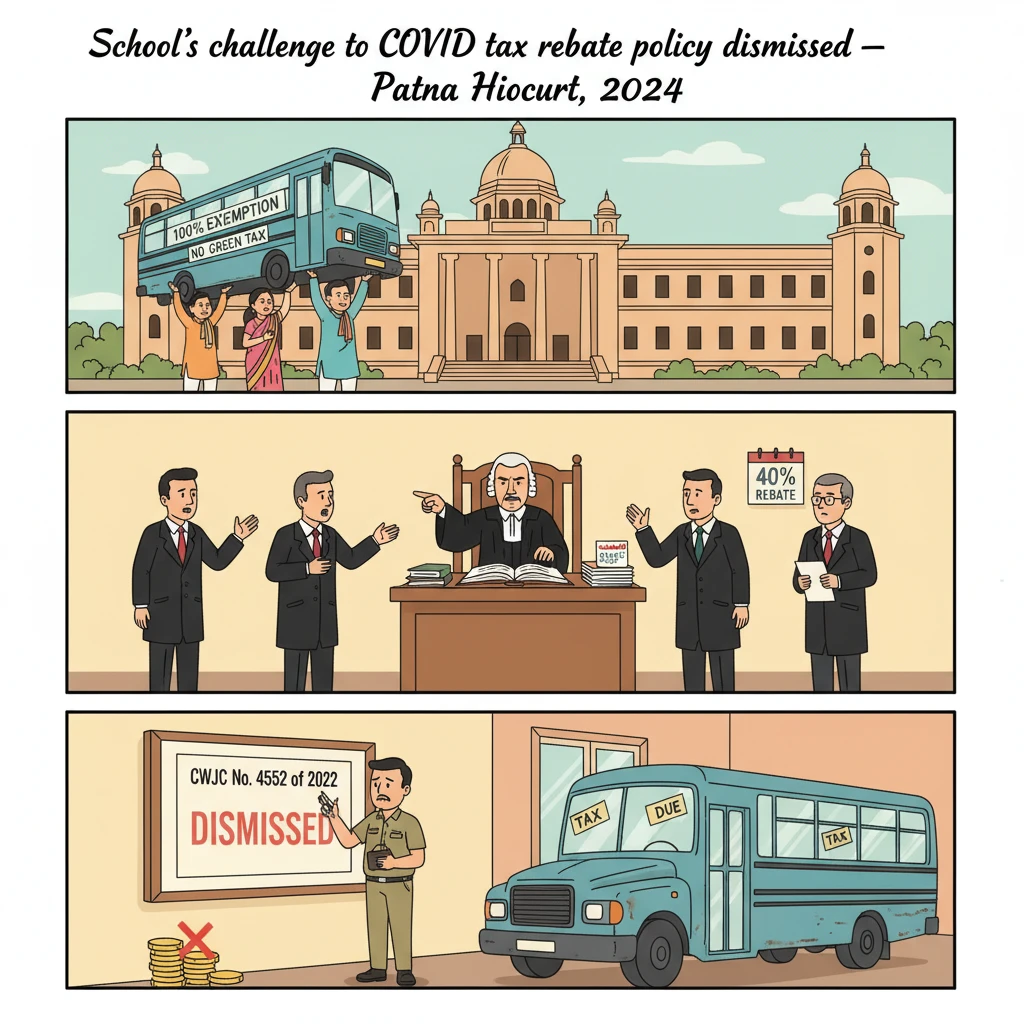
The case arose from the period of the COVID-19 pandemic, when there was a national lockdown and schools across the country, including Bihar, remained closed.
The State of Bihar issued a notification dated 30.06.2020. Under this notification, a 40% rebate was allowed on motor vehicle tax for the period from 21.03.2020 to 30.06.2020. If the tax for this period was paid before 31.07.2020, no penalty was to be charged.
The petitioner is the management of a school that operates school buses. These buses are registered motor vehicles and are liable to pay motor vehicle tax under the Bihar Motor Vehicles Taxation Act, 1994.
According to the petitioner, the buses did not run during the lockdown period because of government-imposed restrictions. Still, they were required to pay tax and, in some cases, penalty. Feeling aggrieved, the school management filed a writ petition before the Patna High Court challenging the limited nature of the rebate and also raising a grievance regarding Green Tax on school buses.
What the Court Examined and Decided
The Patna High Court, through an oral judgment delivered by Hon’ble the Chief Justice on 15.04.2024, considered two main grievances raised by the petitioner.
First, the school challenged the notification dated 30.06.2020. The grievance was that the notification granted only 40% rebate for the limited period from 21.03.2020 to 30.06.2020, and only removed penalty if payment was made before 31.07.2020.
The petitioner argued that since the school buses had not plied during the lockdown, the Government should not have restricted relief to 40% rebate. Their stand was that the entire motor vehicle tax for the period when COVID-19 raged across the country should have been waived.
The petitioner also submitted that no penalty should be imposed even if taxes were paid after 31.07.2020. They sought refund of any tax and penalties that were already paid for that period. In short, they wanted full exemption of tax and penalty for the entire COVID period when the buses were not in use.
The Court began its reasoning by looking at the nature of tax under the Bihar Motor Vehicles Taxation Act, 1994. It noted that the levy of tax is on every owner of a registered motor vehicle. The Act does not require actual use of the vehicle on the road as a condition for tax liability.
The Court pointed out that any registered motor vehicle is liable to pay tax because it is kept ready for use on the roads within the State of Bihar. The legal obligation arises from ownership of a registered vehicle, not from whether the vehicle is actually driven during a particular period.
The Court then examined whether the petitioner had followed the special procedure provided by the Act for seeking relief from tax when a vehicle is not going to be used.
It recorded that the petitioner had not claimed to have sought suspension of registration. Nor had the petitioner made any prior intimation of temporary discontinuance of use of the vehicles.
These steps are specifically provided under Section 17 of the Bihar Motor Vehicles Taxation Act. Under that section, an owner can apply for relief when a vehicle is not going to be used, but such relief depends on meeting the statutory conditions, including prior intimation.
The Court also drew support from Section 14 of the Taxation Act. This section requires any vehicle operating under a permit issued by a competent Transport Authority of another State to pay tax under the Bihar Act if it is to be used or kept for use within Bihar.
From this legislative design, the Court inferred the clear intention that actual physical use of the vehicle is not necessary to attract tax. Keeping a vehicle ready for use within Bihar is enough to trigger the tax liability.
Based on these provisions, the Court held that the mere fact that vehicles remained unused during the lockdown does not, by itself, erase the tax liability. The law already contains specific mechanisms for exemption or suspension, and those mechanisms had not been invoked by the petitioner.
Coming back to the notification of 30.06.2020, the Court described it as a beneficial notification. It granted 40% rebate in motor vehicle tax for the period from 21.03.2020 to 30.06.2020, a time when a national lockdown was in force.
In addition, the notification removed penalty if the tax was paid before 31.07.2020. According to the Court, such a notification was intended to give partial relief to vehicle owners during an exceptional period.
The petitioner, however, was not satisfied with partial exemption and demanded full exemption and refund. The Court categorically held that the petitioner cannot challenge a beneficial notification on the ground that the Government should have been more generous.
The Bench noted that under Section 15 of the Taxation Act, power to grant exemption or rebate lies in the policy domain of the Government. Courts do not decide what percentage of tax rebate should be granted. Once the Government has granted a partial exemption, that decision, in the absence of any illegality, cannot be forced open by demanding total waiver.
The Court further underlined a key principle of tax law: tax is not based on quid pro quo. In simple terms, the State does not have to show direct benefit or service in exchange for every rupee of tax collected. Therefore, the fact that the national lockdown or State orders prevented use of school buses does not automatically remove or suspend the tax liability.
The Court also observed that the Taxation Act itself sets out the conditions and methods by which exemptions can be granted, especially on application made by the registered owner. These statutory routes were not invoked by the petitioner. In such a situation, the Court found no legal ground to interfere with the notification.
The second contention raised by the petitioner related to Green Tax. The school argued that school buses should not be subject to Green Tax.
The Court clarified that exemption of school buses from any tax, including Green Tax, is a matter of policy for the State Government. In its wisdom, the Government had not chosen to grant such an exemption.
The Court explained that Green Tax is levied on registered transport vehicles that are more than 20 years old. The purpose is to address the pollution caused by older vehicles. The age and condition of the vehicle engine, not the nature or status of the passengers, determines the environmental impact.
Therefore, merely because a vehicle is a school bus or carries children from home to school does not reduce the environmental harm caused by an old engine. The levy of Green Tax is based on the “polluter pays” principle, and school buses are not outside its ambit simply due to the kind of passengers they carry.
The Court added that if the petitioner wishes to avoid Green Tax, it would be advisable to purchase new vehicles for transporting children. This would not only reduce pollution but also improve the safety of school-going children.
In conclusion, the Court held that there was absolutely no reason to entertain the writ petition. The challenge to the notification granting 40% rebate failed, as did the challenge to the levy of Green Tax on old school buses. Consequently, the writ petition was dismissed.
Why This Judgment Matters
This judgment is significant for school managements, transport operators, and other vehicle owners in Bihar who did not use their vehicles during the COVID-19 lockdown but still had to pay motor vehicle tax.
The Patna High Court has made it clear that simply keeping a registered vehicle idle, even during a lockdown, does not, by itself, remove tax liability. Owners must follow the specific procedures in the Taxation Act, such as seeking suspension or giving prior intimation of non-use, if they want formal relief from tax.
The decision also confirms that a court will not interfere with a government’s policy choice to grant only partial tax rebate during an emergency. A beneficial notification cannot be attacked in court simply because some people believe the relief should have been larger.
For Green Tax, the judgment clarifies that old school buses are not automatically exempt. The focus is on pollution from ageing engines, not on who travels in the vehicle. School operators using vehicles more than 20 years old should be prepared to pay Green Tax or consider replacing their fleet.
Legal Issues and Answers
- Issue: Can the Patna High Court direct the State of Bihar to grant full exemption and refund of motor vehicle tax and penalty for school buses during the COVID-19 lockdown, beyond the 40% rebate given in the notification dated 30.06.2020?
Answer: No. The Court held that the notification was a beneficial policy decision under Section 15 of the Bihar Motor Vehicles Taxation Act, 1994, and that tax liability exists irrespective of actual use unless statutory procedures like suspension or intimation under Section 17 are followed. The Court refused to interfere or order full waiver or refund. - Issue: Are school buses exempt from payment of Green Tax merely because they carry children?
Answer: No. The Court held that exemption of school buses is within the State Government’s domain and has not been granted. Green Tax applies to registered transport vehicles more than 20 years old, based on the pollution they cause, regardless of passenger type.
Cases Cited by the Court
- No earlier judgments have been cited or relied upon in the text of this decision.
Case Details
Case Number: Civil Writ Jurisdiction Case No. 4525 of 2022
Case Title: Buddha Vikas Samiti, Buddha Colony, Patna through its Secretary Shanti Roy vs. The State of Bihar & Ors.
Coram: Hon’ble the Chief Justice K. Vinod Chandran and Hon’ble Mr. Justice Harish Kumar
Citation: 2024 (2) PLJR 459
Advocates: For the petitioner – Mr. Dinu Kumar, Advocate; Mrs. Ritika Rani, Advocate. For the respondents – Mr. Sarvesh Kumar, Government Pleader 24.
Nature of the case: Writ petition under civil writ jurisdiction challenging a government notification on motor vehicle tax rebate and contesting levy of Green Tax on school buses.
Link to judgment: Click here to read the full judgment of the Patna High Court
If you found this explanation helpful and wish to stay informed about
how legal developments may affect your rights in Bihar,
you may consider following Samvida Law Associates for more updates.







