

Case Background
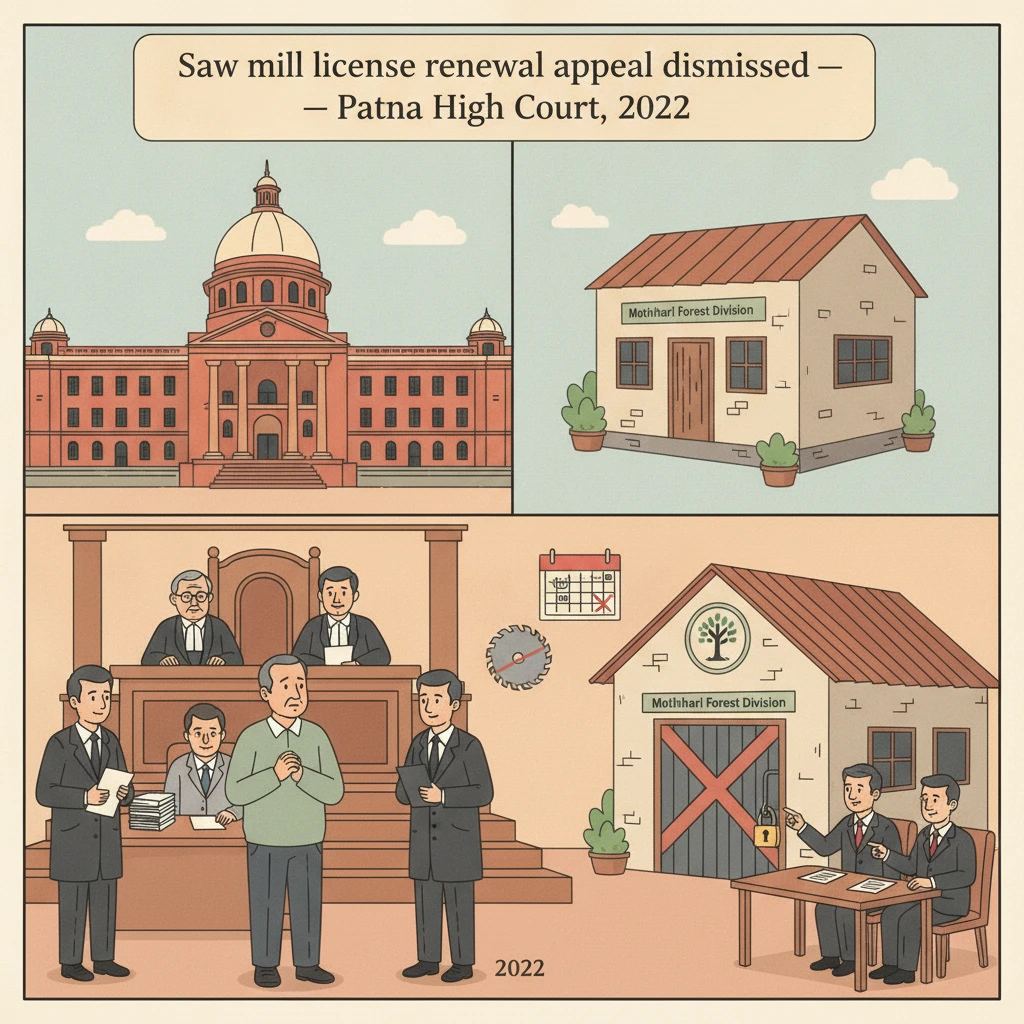
The matter reached the Patna High Court as a Letters Patent Appeal against an order of a Single Judge dated 15.05.2019 in CWJC No.1734 of 2016. The appellant ran a saw mill in the district of Motihari.
He had been issued a licence under the Bihar Saw Mill Regulation Act, 1990. The licence was numbered 18 of 1995 and was valid for one year, up to 31.12.1995. After that, the appellant did not apply for renewal of this licence.
Many years later, the appellant started approaching the High Court. He first filed CWJC No.13134 of 2003. That writ petition was dismissed for non-prosecution. He then filed another writ petition, CWJC No.2576 of 2009. In that case, the High Court directed the licensing authority to look into his grievance and pass necessary orders.
When no effective step was taken, the appellant again approached the High Court by filing CWJC No.3305 of 2014. That writ petition was disposed of on 22.01.2015. The Court held that his case required consideration by a Three Member Committee for renewal of his licence and for fixing his saw mill’s place in the seniority list.
The Court gave the appellant liberty to file a fresh objection before the Committee. He was allowed to submit a copy of his licence and the up-to-date renewal fee. The Three Member Committee, headed by the Principal Chief Conservator of Forest, was directed to hear him and take a decision.
Pursuant to this direction, the Committee examined the matter and passed an order on 22.06.2015. In that order, it declined the request for grant or renewal of licence to run the saw mill in Motihari.
The appellant then challenged the Committee’s order before a Single Judge in CWJC No.1734 of 2016. On 15.05.2019, the Single Judge rejected his claim. Against that rejection, the appellant filed the present Letters Patent Appeal No.681 of 2019 before a Division Bench of the Patna High Court.
What the Court Examined and Decided
The Division Bench heard learned counsel for the appellant. There was no appearance on behalf of the State. The core question was whether the authorities, and later the Single Judge, were wrong in refusing to grant or renew the saw mill licence.
The Bench carefully looked at the findings of the Three Member Committee dated 22.06.2015, and the reasoning given by the Single Judge. The Committee had relied on records submitted by the District Forest Officer, Motihari Forest Division.
From those records, the Committee found that the Motihari Forest Division was created in 2003. Ever since its creation, there was no record of any valid licence in the name of the appellant. There was also no record of any renewal application filed by him from 1996 onwards.
The Committee also recorded that the appellant’s saw mill had been sealed on 20.09.2011. The charge was that it was being run without any valid licence. Prosecution was also launched against him in that connection.
The Bench noted the legal position under the Bihar Saw Mill Regulation Rules, 1993. Under these Rules, any licence issued under the Bihar Saw Mill Regulation Act, 1990 is valid only for one calendar year. It has to be renewed at least one month before its expiry.
In the appellant’s case, the licence granted in 1995 expired on 31.12.1995. There was nothing on record to show that he had applied for renewal thereafter, much less within the required time. In fact, the Committee had found that no attempt was made for renewal for about two decades.
Because of this long gap and absence of any renewal request, the Committee concluded that it was not possible to sustain the claim for renewal of licence. The Division Bench accepted this factual position.
Next, the Bench considered the findings of the Single Judge who had earlier dismissed the appellant’s writ petition against the Committee’s order. The Single Judge had also examined the larger legal framework controlling saw mill licences in Bihar.
The Single Judge had noted that the Hon’ble Supreme Court had been issuing continuing mandamus orders with respect to grant of licences under the Bihar Saw Mill Regulation Act, 1990. Under those directions, the number of saw mills permitted in each district had been fixed.
In the district of Motihari, only 86 saw mills were allowed. Licences and renewals were considered according to a seniority list of saw mills which were in operation. The Single Judge found that saw mills which were actually operating and which fell within this seniority list were granted licences and renewals.
In contrast, in the appellant’s case, there was no record of his seniority position vis-a-vis other saw mills in the district. Since he had not renewed his licence after 1995, and had also been found running the saw mill without a valid licence, his case was not comparable to those in the approved seniority list.
The Division Bench agreed with this approach. It observed that there was no record of the appellant having renewed his licence after 1995. Without such renewal, and without a recognised seniority position, there was no basis to consider him for grant or renewal of licence now.
The Bench also took note of the fact that the saw mill had been sealed and prosecution launched for operating without a valid licence. This further weakened any equitable claim the appellant might have had.
In simple terms, the Court found that the appellant was asking for the benefit of a licence that had long expired and was never renewed, in a legal regime where the number of saw mills was fixed and controlled under Supreme Court directions. Allowing such a claim would be contrary to the statutory rules and the regulated quota system.
On these reasons, the Division Bench held that there was no error in the order of the Single Judge. The appeal was found to be without any merit and was dismissed.
Why This Judgment Matters
This judgment is important for saw mill owners and others running regulated businesses in Bihar. It shows that once a licence expires, it cannot be treated as alive forever.
The Court made it clear that a licence under the Bihar Saw Mill Regulation Act, 1990 lasts for only one calendar year. It must be renewed in time, at least one month before expiry. If there is a long gap with no renewal, one cannot later demand renewal as a matter of right.
The decision also highlights that, due to directions of the Hon’ble Supreme Court, the number of saw mills in each district is limited. Only those saw mills that were in operation, had valid licences, and appeared in the seniority list could get licences or renewals.
For people running such units, this judgment serves as a warning. Operating without a valid licence can lead to sealing of the unit, prosecution, and loss of any chance of future licensing. Courts are unlikely to help when statutory rules and higher court orders strictly control the field.
Legal Issues and Answers
-
Issue: Whether the appellant, whose saw mill licence expired on 31.12.1995 and was never renewed, could claim grant or renewal of licence many years later in Motihari district.
Answer: No. The Patna High Court held that under the Bihar Saw Mill Regulation Rules, 1993 the licence was valid only for one year and had to be renewed in time. As there was no renewal after 1995, no record of seniority, and the saw mill had been run without a valid licence, the appellant’s claim for renewal could not be sustained.
Cases Cited by the Court
- The judgment mentions continuing mandamus by the Hon’ble Supreme Court on saw mill licensing under the Bihar Saw Mill Regulation Act, 1990, but does not specify any particular case name or citation.
Case Details
Case Number: Letters Patent Appeal No.681 of 2019 in Civil Writ Jurisdiction Case No.1734 of 2016
Case Title: Mubarak Hussain @ Md. Mubarak Hussain v. The State of Bihar & Ors.
Coram: Hon’ble Mr. Justice Ashutosh Kumar and Hon’ble Mr. Justice Anjani Kumar Sharan
Citation: 2022(2) PLJR 13
Advocates: For the appellant – Mr. Amarnath Singh, Advocate; Mr. Binod Kumar Mishra, Advocate. For the respondents – None appeared.
Nature of the Case: Letters Patent Appeal against dismissal of a writ petition challenging rejection of request for grant/renewal of saw mill licence.
Date of Judgment: 07.03.2022
Statutory Framework Mentioned: Bihar Saw Mill Regulation Act, 1990; Bihar Saw Mill Regulation Rules, 1993.
Link to the Judgment: Click here to read the full judgment of the Patna High Court
If you found this explanation helpful and wish to stay informed about
how legal developments may affect your rights in Bihar,
you may consider following Samvida Law Associates for more updates.







