
Case Background
A criminal case being Chhatauni P.S. Case No.226 of 2017 was registered in East Champaran district. It was lodged under Sections 406, 409, 420, 467, 468, 471 and 120B of the Indian Penal Code. These sections broadly relate to criminal breach of trust, cheating, forgery, use of forged documents and criminal conspiracy.
The first information report in that police case was lodged by one Ashok Kumar Giri, who is described in the judgment as Senior Branch Manager, Motihari Branch of Life Insurance Corporation of India Ltd. He filed the FIR against several persons, who are arrayed in the writ case as respondent nos. 7 to 14.
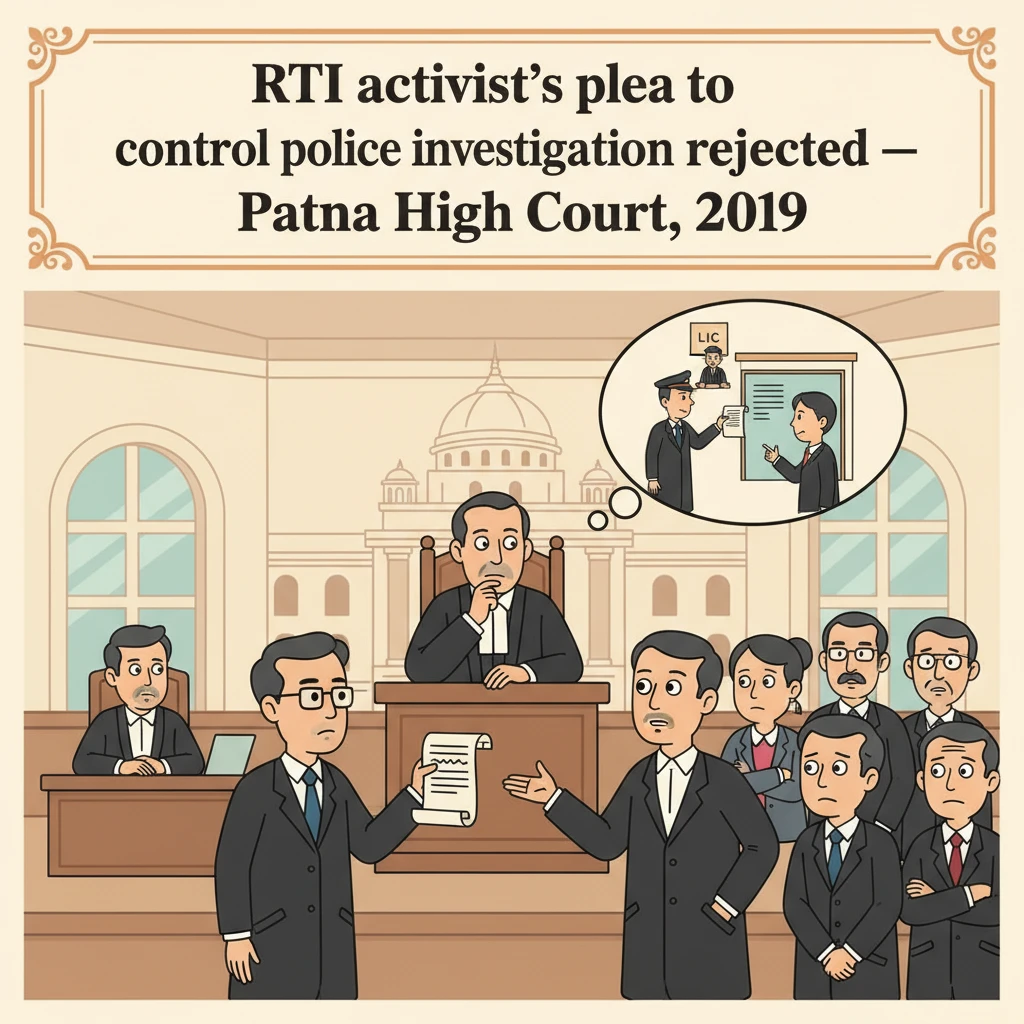
The present petitioner was not the informant in the FIR. He described himself before the Patna High Court as an RTI activist. According to his own case, he had earlier collected some information under the Right to Information Act. He then supplied that information to the Senior Branch Manager, who went on to lodge the FIR.
The police started investigation into the Chhatauni P.S. Case No.226 of 2017. While the investigation was still in progress, the petitioner approached the Patna High Court by filing Criminal Writ Jurisdiction Case No.492 of 2019.
Through this writ petition, he challenged the manner in which the investigation was being carried on, and sought directions against the police and other authorities.
What the Court Examined and Decided
The writ petition came up before Hon’ble Mr. Justice Ashwani Kumar Singh on 12-03-2019. At the outset, the Court noted that the registry had pointed out some defects in the case. These defects were ignored, and the Court proceeded to hear the matter on merits.
The Court heard the learned counsel for the petitioner and the learned counsel for the State. The central question raised from the very beginning was regarding the petitioner’s “locus” — that is, whether he had any legal right to maintain this writ petition concerning investigation of the FIR.
The petitioner’s counsel submitted that the petitioner was an RTI activist. He claimed that he had collected information under the Right to Information Act. According to him, this information was then given to the Senior Branch Manager of the Life Insurance Corporation of India, Motihari Branch.
The Senior Branch Manager, on the basis of that information, lodged Chhatauni P.S. Case No.226 of 2017 against respondent nos. 7 to 14. Because his RTI-based information had, according to him, formed the basis of the FIR, the petitioner argued that he had the right to demand a “proper and fair investigation”.
On this basis, the petitioner asked the Court to issue two main directions. First, he wanted the Court to order the official respondents to conduct what he called a proper and fair investigation and to file charge-sheet against the “culprits”, including respondent nos. 7 to 14. Second, he wanted a direction for arrest of the accused persons in the said police case.
In simple terms, the petitioner tried to step in as a controller of the police investigation. He wanted the High Court to supervise the investigation at his instance.
The State opposed the writ strongly. The learned counsel appearing for the State submitted that the petition was misconceived. The State’s stand was that the petitioner had no locus in the matter. He was neither the informant of the case nor in any legally recognised way connected with the prosecution.
The State further argued that even if the petitioner had supplied some information to the informant, that fact alone did not give him the right to intervene in a police investigation. Criminal investigation, the State pointed out, is supposed to be confidential. Outside persons, who are not the informant or the accused, cannot demand control over it.
The State’s counsel also addressed the petitioner’s specific prayer for arrest of the accused and submission of charge-sheet. She underlined that whether to arrest an accused or not depends on many circumstances gathered during investigation. Merely because a person is named in an FIR does not mean he must be arrested or charge-sheeted.
During investigation, the police may find that the accusation against a named person is not supported by evidence. In such a situation, that person may not be sent up for trial. The State argued that courts cannot be asked to order arrest or filing of charge-sheet simply on the basis of naming in the FIR, especially at the instance of a third party like the petitioner.
After hearing both sides and perusing the record, the Court accepted the State’s arguments. The Court recorded that it found substance in the submissions made on behalf of the State.
The Court then explained the legal position in clear terms. It observed that in a criminal case instituted on the basis of a first information report, the prosecution is to be conducted by the State and not by any private person. This means that the State, through its prosecution machinery, is in charge of taking the case forward.
In this particular case too, the Court stated, the prosecution has to be conducted by a lawyer duly appointed by the State. The petitioner, who was neither the informant nor in any manner connected with the case, could not approach the Court to seek a direction for submission of charge-sheet or for arrest of accused persons.
The Court clearly held that the petitioner had no locus in the matter. It further agreed with the State’s submission that holding investigation into a cognizable offence is the statutory right of the police. At the stage of investigation, the Court has no role to play in deciding how the police should proceed.
The judgment stressed that investigation is always supposed to be confidential. The Court pointed out that it did not even know what materials had been collected during investigation against respondent nos. 7 to 14. Simply because those persons were named in the FIR, it would not be proper for the Court to direct their arrest or to order submission of a charge-sheet against them.
By saying this, the Court highlighted a key protection in criminal law: the FIR is only the starting point. The fate of the accused depends on the evidence found during investigation, not just on the fact that their names figure in the FIR.
In the end, the Court described the entire application as “thoroughly misconceived”. It held that there was no legal basis for the petitioner’s attempt to interfere with the ongoing investigation or to command arrests and charge-sheets. Accordingly, the criminal writ petition was dismissed on 12-03-2019.
Why This Judgment Matters
This judgment is important for RTI activists, social workers and ordinary citizens who often help uncover wrongdoing. It recognises that people may play a role in bringing facts to light. But it also draws a clear line on how far they can go in criminal proceedings.
The Patna High Court has clarified that once a cognizable offence is registered, the investigation is in the hands of the police, and the prosecution is in the control of the State. Private persons, including those who supplied information leading to registration of the case, cannot seek to run or control the investigation through writ petitions.
For victims and informants too, the judgment is a reminder that arrests and charge-sheets are not automatic, even when names appear in the FIR. The police have legal discretion to decide, based on evidence, whether a person should be arrested or sent for trial.
At the same time, the judgment reinforces the principle that courts normally do not interfere in the day-to-day working of police investigations, especially at the stage when facts are still being collected. Such interference is reserved for very exceptional situations, which were clearly absent in this case.
Legal Issues and Answers
Issue: Can an RTI activist, who only supplied information that helped another person lodge an FIR, file a writ petition to demand arrest of accused persons and filing of charge-sheet in that case?
Answer: No. The Patna High Court held that such a person has no locus to seek directions regarding investigation, arrest or submission of charge-sheet in the criminal case.
Issue: Can the High Court direct the police to arrest persons named in an FIR and to submit charge-sheet against them, merely because their names appear in the FIR?
Answer: No. The Court held that investigation of a cognizable offence is the statutory right of the police, is confidential in nature, and decisions on arrest and charge-sheet depend on the evidence collected, not merely on naming in the FIR.
Cases Cited by the Court
- No prior judgments or case law have been cited or relied upon in the text of this decision.
Case Details
Case Number: Criminal Writ Jurisdiction Case No.492 of 2019
Case Title: Lal Babu Ray v. The State of Bihar & Ors.
Citation: 2019 (3) PLJR 117
Coram: Hon’ble Mr. Justice Ashwani Kumar Singh
Advocates: Mr. Prashant Kashyap, Advocate for the petitioner; Ms. Divya Verma, AC to AAG-3 for the State
Nature of the Case: Criminal writ petition seeking directions for fair investigation, arrest of accused persons, and filing of charge-sheet in relation to Chhatauni P.S. Case No.226 of 2017
Date of Judgment: 12-03-2019
Link to Judgment: Official Patna High Court judgment
If you found this explanation helpful and wish to stay informed about
how legal developments may affect your rights in Bihar,
you may consider following Samvida Law Associates for more updates.







