
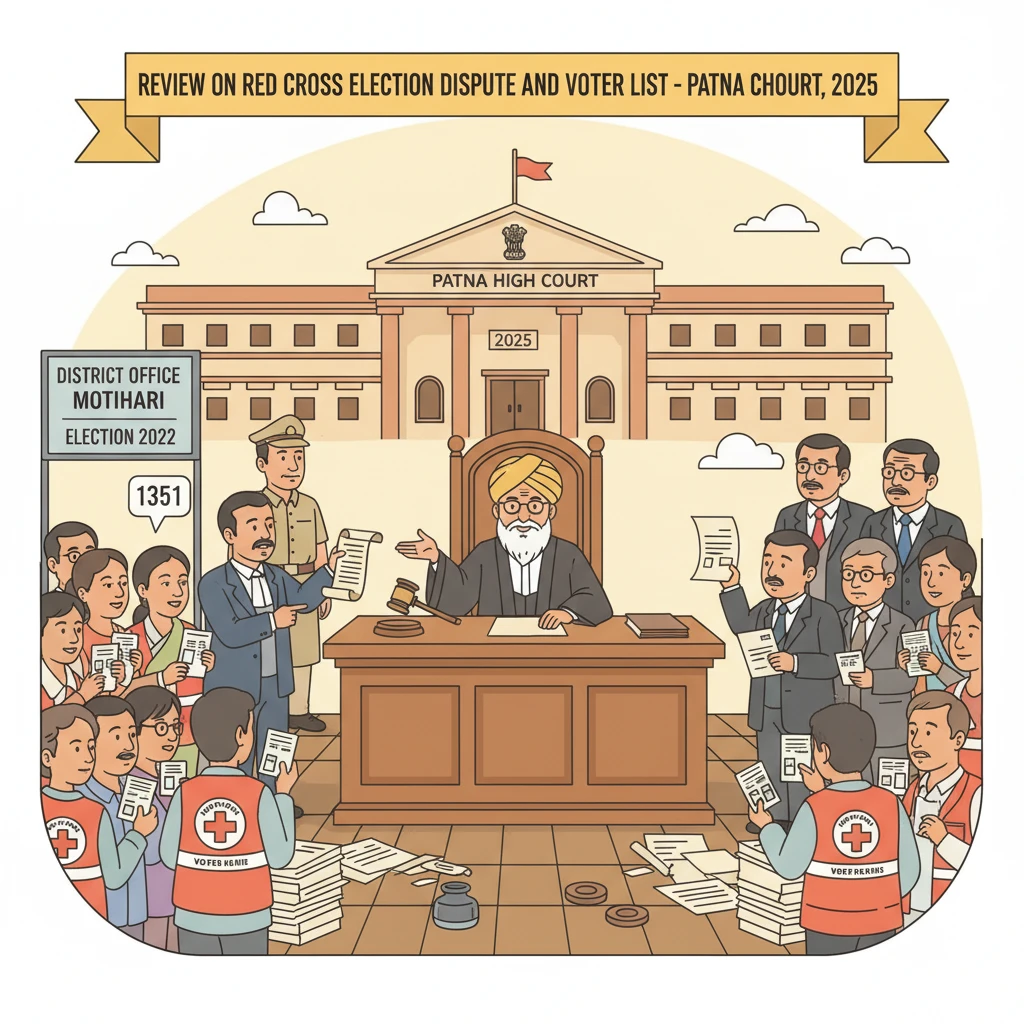
Case Background
The dispute traces back to the election of the Managing Committee of the Indian Red Cross Society, District Branch, Motihari (East Champaran), held on 12.06.2022.
A life member of the East Champaran District Branch filed Civil Writ Jurisdiction Case No. 9954 of 2022 before the Patna High Court. He challenged the 12.06.2022 election, alleging that the District Magistrate and district administration, Motihari, had conducted the election in an unfair and illegal manner. It was alleged that the Indian Red Cross Society Uniform Rules and basic election principles were violated.
In this writ, the Indian Red Cross Society was represented through its General Secretary, State Branch, Patna as respondent no. 12. The elected members of the Managing Committee (Motihari) were impleaded as respondents.
After several hearings, on 11.12.2023, the High Court allowed the writ. It declared the 12.06.2022 election invalid and directed the Red Cross Society to hold a fresh election for the East Champaran (Motihari) District Branch in accordance with its bye-laws and the Indian Red Cross Society Act, 1920.
In 2024, two sets of these Managing Committee members approached the Court in Civil Review No. 16 of 2024 and Civil Review No. 43 of 2024. They sought review of the 11.12.2023 order on several grounds, including maintainability of the original writ and alleged non-disclosure of vital facts about membership approvals.
While these review petitions were pending, the Indian Red Cross Society, Bihar State Branch, decided to hold elections for the Chairman, Vice Chairman, and Treasurer of the new State Managing Committee on 21.07.2025 at 11:00 a.m. at Darbar Hall, Raj Bhawan, Patna. The review petitioners complained that their names and the name of the Motihari District Branch Head’s representative did not appear in the voter list for this State-level election.
What the Court Examined and Decided
The Patna High Court, through Hon’ble Mr. Justice Purnendu Singh, heard both review petitions together, as the issues and grounds were similar.
The petitioners argued that their names and the names of 1351 members of the Motihari District Branch had been wrongfully ignored, both in the earlier litigation and in the current voter list for the 21.07.2025 State-level election.
They raised two main challenges to the earlier writ judgment dated 11.12.2023:
First, they questioned the maintainability of the writ petition under Article 226 of the Constitution. According to them, the Indian Red Cross Society is not a “State” or authority or instrumentality under Article 12 and is not amenable to writ jurisdiction. They also argued that election disputes should be raised through an election petition, not a writ petition.
Second, they claimed that the Court was misled about the timing and approval of 1351 members. They said these members, including themselves, had been enrolled and had paid membership subscriptions well before the election notification, and their membership fees had been sent to the State Branch. They alleged that the writ petitioner and respondent no. 12 (State Branch) concealed this and wrongly projected that these 1351 members were added after the election notification without National Committee approval.
On this basis, they contended that the earlier judgment was passed without hearing these 1351 members, in violation of natural justice, and that the decision seriously prejudiced both the elected Managing Committee and those voters.
The Court first revisited the legal framework for review. It noted that review is permissible when new and important evidence, not available earlier despite due diligence, is discovered; or where there is a mistake or error apparent on the face of the record; or for any other sufficient reason. While Section 114 and Order 47 Rule 1 of the Code of Civil Procedure govern review, the Court emphasised that its powers under Article 226 are equitable and not rigidly confined to those provisions.
The Court then examined the Indian Red Cross Society Act, 1920 and the Uniform Rules, especially Clause 3 of Chapter VI on registration of new members. This clause states that members enrolled by District Branches become members of the Indian Red Cross Society, and District Branches must send monthly lists of new members with 30% of membership subscription to the State Branch and National Headquarters. Certificates are to be issued by the National Headquarters through the State branch once members are duly registered.
Section 5(1) of the Act empowers the Managing Body to frame rules for management, functions, control, and election procedures, with approval of the President. The Court highlighted the strong supervisory control of National Headquarters and State Branch over District branches, citing various Rules (including Chapter III Rule G(e), Chapter VI Rule 1(a), Rule 11(9) and Rule 12).
The Court also referred to a circular dated 08.01.2013 from the National Headquarters, which set out the process for District branch elections: passing a resolution to appoint a Returning Officer, informing voters, preparing and publishing a voters list, and allowing objections.
In the original writ, the Court had found, based on records produced by the Chairman of the State branch, that 2322 members were registered up to 12.06.2022, and 1351 members were proposed to be added from 06.07.2022 as per a revised list, after the election notification. Observing that there was no National Committee approval for these 1351 members, the Court had declared the 12.06.2022 election invalid.
In the review proceedings, the petitioners produced lists showing membership subscriptions. In Civil Review No. 16 of 2024, a list from serial no. 1 to 1351 showed total membership amount of Rs. 13,51,000 and Rs. 4,05,300 sent to the State Branch. In Civil Review No. 43 of 2024, a list ran from serial no. 1 to 3639, but without details of amounts paid to the State branch.
The Court noted that these lists created doubt and did not conclusively show that all such memberships were duly approved through the proper process, as required by the Rules.
On the question whether a writ lies against Indian Red Cross Society, the Court discussed Supreme Court decisions like Century Spinning, ABL International, Unitech, Andi Mukta, the BCCI cases, Ramakrishna Mission, and St. Mary’s Education Society. It emphasised that a writ under Article 226 lies not only against “State” under Article 12 but also against any person or body discharging public duties or public functions. Where public law elements exist, the High Court’s extraordinary jurisdiction can be invoked.
The Court also cited a judgment of the Madhya Pradesh High Court in M/s New Balaji Chemist v. Indian Red Cross Society (M.P. State Branch), which, relying on Supreme Court law, held that such bodies can be amenable to writ jurisdiction where public functions are involved.
However, at the same time, the Court drew a clear line on interfering with election processes once they are underway. It referred to leading authorities like N.P. Ponnuswami, Nanhoo Mal, Jyoti Basu, Gajanan Krishnaji Bapat, K.K. Shrivastava, and Gujarat University. These cases establish that:
• The right to vote and to stand for election is a statutory right, not a fundamental or common law right.
• Election disputes are to be resolved through the specific statutory mechanism, generally by an election petition after the election is over.
• High Courts ordinarily should not interfere under Article 226 with ongoing elections, except in truly exceptional circumstances.
Applying these principles, the Court recognised that the earlier writ judgment dated 11.12.2023 was influenced by incomplete and, in some respects, misleading information from the writ petitioner and the then Chairman of the State Branch. The Court found that the writ petitioner had not approached with clean hands, and that the Chairman’s conduct showed mala fide and abuse of process, especially since he failed to send additional voters’ names to the National Headquarters for approval and stalled the functioning of the Motihari District Branch.
It noted that Motihari Branch was practically non-functional because the voter list was not completed, and yet a State-level election for the Bihar State Branch was scheduled for 21.07.2025 at Raj Bhawan, Patna, without representation of Motihari members, including the representative, Dr. Ajay Kumar.
Balancing all circumstances, the Court concluded that this was an exceptional situation involving abuse of process and risk to “Rule of Law”. However, instead of staying or cancelling the scheduled 21.07.2025 State-level election, the Court adopted a practical solution.
The Court directed that all review petitioners and all other Motihari District members whose names had not been properly scrutinised by the State Chairman should approach the Secretary General, National Headquarters, Indian Red Cross Society, New Delhi within one week. The idea was that, through this route, the National Headquarters could consider including their names in the voter list, thereby facilitating, and not obstructing, the election process.
The Court left it to the Secretary General to decide whether to include the names of the left-out members. If the Secretary General could not approve them before the election date, he or the left-out members could request the Hon’ble Governor (who is ex officio President of the Indian Red Cross Society) to shift the election to another date.
Further, noting the conduct of the present Chairman of the Bihar State Branch, the Court restrained him from performing administrative work during the election process. The order was directed to be communicated to the Hon’ble Governor, Bihar and the Secretary General, National Headquarters.
With these observations and directions, the Court disposed of both Civil Review No. 16 of 2024 and Civil Review No. 43 of 2024.
Why This Judgment Matters
This judgment is important for members and office-bearers of voluntary societies like the Indian Red Cross Society, especially at district and state levels.
First, it shows that even private or charitable bodies can be answerable before the Patna High Court when they perform public functions, particularly regarding fair elections and representation of members.
Second, it highlights that courts are cautious about stopping elections once the process has started. Instead of directly cancelling or staying the 21.07.2025 State-level election, the Court created a route for aggrieved members to seek approval of their membership and participation through the National Headquarters.
Third, the judgment sends a clear message to those in charge of State Branches: they must act fairly, maintain proper membership records, and follow the rules laid down by National Headquarters. Any attempt to misuse process or block particular members from voting can invite judicial scrutiny and personal consequences like suspension from administrative work.
Finally, for ordinary members, the decision explains that if they are wrongly kept out of voter lists or if elections are conducted by breaking approved procedures, they can seek relief, but must use proper legal channels and, where available, statutory remedies like election petitions.
Legal Issues and Answers
- Issue: Can the Patna High Court entertain a writ petition under Article 226 against the Indian Red Cross Society in relation to its elections?
Answer: Yes. The Court held that bodies like the Indian Red Cross Society, when performing public functions and subject to statutory and uniform rules, are amenable to writ jurisdiction under Article 226, even if they are not “State” under Article 12. - Issue: Can the High Court interfere with an ongoing or announced election process through a writ petition?
Answer: Generally no. Citing multiple Supreme Court decisions, the Court reiterated that election disputes should ordinarily be resolved through statutory election petitions after the election. Only in exceptional circumstances, such as grave abuse of process, may the Court craft limited, facilitative directions without derailing the election. - Issue: What relief was appropriate in the review, given allegations of mala fide and exclusion of Motihari members from the State-level election voter list?
Answer: Instead of staying the 21.07.2025 election, the Court directed all excluded Motihari members to approach the Secretary General, National Headquarters, within one week for scrutiny and possible inclusion in the voter list. It restrained the present State Chairman from administrative work and left the election date and member approvals to be handled by the National Headquarters and the Hon’ble Governor.
Cases Cited by the Court
- Century Spinning and Manufacturing Company Ltd. & Another v. Ulhasnagar Municipal Council & Another, (1970) 1 SCC 582
- ABL International Ltd. & Another v. Export Credit Guarantee Corporation of India Ltd. & Others, (2004) 3 SCC 553
- Unitech Ltd. & Others v. Telangana State Industrial Infrastructure Corporation (TSIIC) & Others, (2021) 16 SCC 35
- Andi Mukta Sadguru Shree Muktajee Vandas Swami Suvarna Jayanti Mahotsav Smarak Trust v. V.R. Rudani, (1989) 2 SCC 69
- Board of Control for Cricket in India v. Cricket Association of Bihar & Others, (2015) 3 SCC 251
- Board of Control for Cricket in India v. Cricket Association of Bihar & Others, (2018) 9 SCC 624
- Ramakrishna Mission & Another v. Kago Kunya & Others, (2019) 16 SCC 303
- St. Mary’s Education Society & Another v. Rajendra Prasad Bhargava & Others, (2023) 4 SCC 498
- K.K. Saksena v. International Commission on Irrigation and Drainage & Others, (2015) 4 SCC 670
- Pradeep Kumar Biswas v. Indian Institute of Chemical Biology & Others (citation referred in principle)
- M/s New Balaji Chemist v. Indian Red Cross Society (Madhya Pradesh State Branch) & Another, AIR 2018 (NOC) 804 (M.P.)
- N.P. Ponnuswami v. Returning Officer, Namakkal & Others, 1952 SC 64
- Nanhoo Mal & Others v. Hira Mal & Others, AIR 1975 SC 2140
- Jyoti Basu v. Debi Ghosal, (1982) 1 SCC 691
- Gajanan Krishnaji Bapat & Another v. Dattaji Raghobaji Meghe & Others, (1995) 5 SCC 347
- K.K. Shrivastava v. Bhupendra Kumar Jain & Others, AIR 1977 SC 1703
- Gujarat University v. N.U. Rajguru & Others, AIR 1988 SC 66
- Maheswar Tripathy v. State of Orissa & Others, 1992 (II) OLR 90 (Orissa High Court)
- Puran Singh & Others v. State of Punjab & Others, AIR 1996 SC 1092
Case Details
Case Number: Civil Review No. 16 of 2024 with Civil Review No. 43 of 2024, arising out of Civil Writ Jurisdiction Case No. 9954 of 2022
Case Title (Review No. 16 of 2024): Angad Kumar Singh & Others v. The State of Bihar & Others
Case Title (Review No. 43 of 2024): Ashesh Kumar & Another v. Deepak Kumar & Others
Citation: 2025(3) PLJR 585
Coram: Hon’ble Mr. Justice Purnendu Singh
Advocates (Civil Review No. 16 of 2024):
For the Petitioners: Mr. Lalit Kishore, Senior Advocate; Mr. Mukesh Kant, Advocate
For the State: Mr. Braj Bhushan Mishra, AC to AAG 9
For the Society: Mr. Dhananjay Kumar, Advocate
Advocates (Civil Review No. 43 of 2024):
For the Petitioners: Mr. Venkatesh Kirti, Advocate
For the State: Mr. Braj Bhushan Mishra, AC to AAG 9
For the Society: Mr. Dhananjay Kumar, Advocate
Nature of the Case: Civil review petitions arising out of a writ petition (CWJC No. 9954 of 2022) challenging the validity of an election to the Managing Committee of Indian Red Cross Society, District Branch, Motihari, and consequential issues regarding participation in the Bihar State Branch election.
Date of Judgment: 11.07.2025
link to judgement; https://patnahighcourt.gov.in/viewjudgment/MTEjMTYjMjAyNCMxI04=-Y–am1–h3pOcpHfQ=
If you found this explanation helpful and wish to stay informed about
how legal developments may affect your rights in Bihar,
you may consider following Samvida Law Associates for more updates.







