

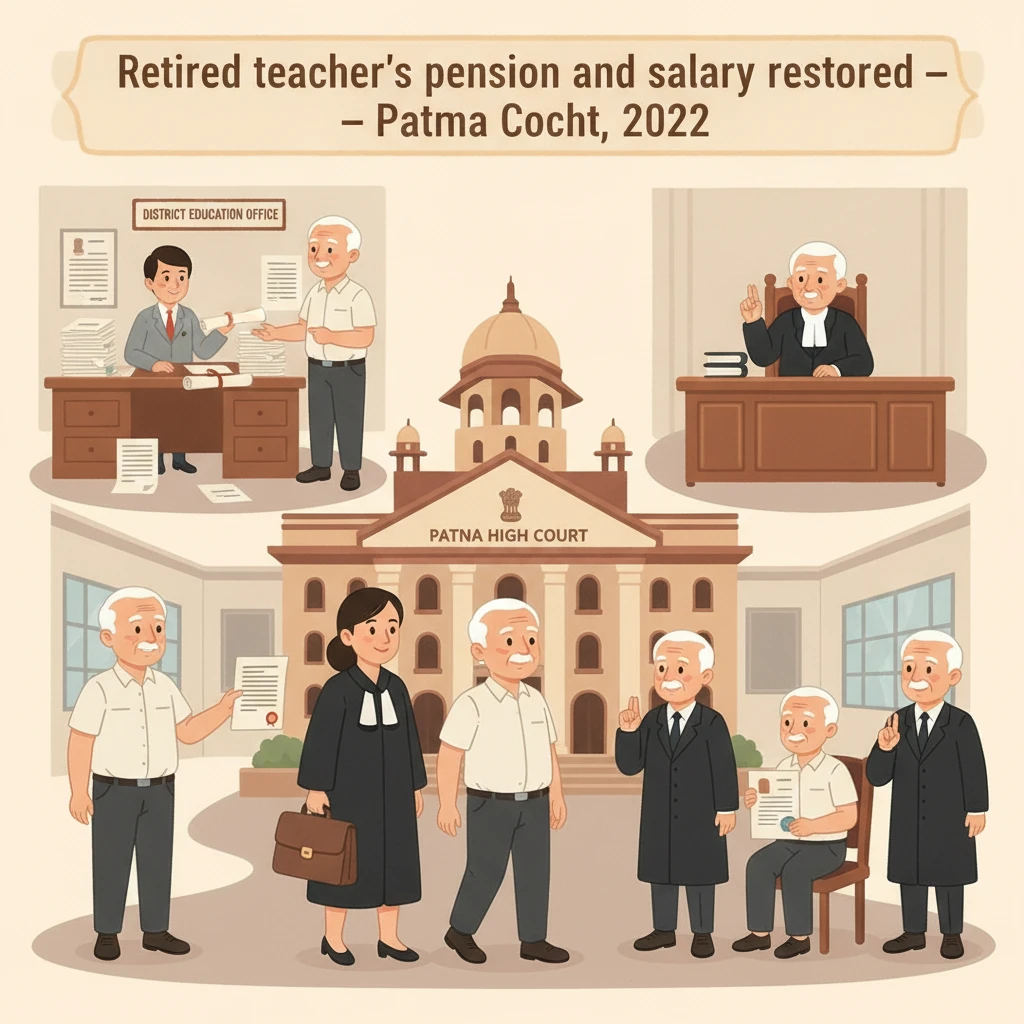
Case Background
The writ petitioner, Surendra Prasad Sinha, was appointed as an Assistant Teacher at Project Girls High School, Nawada on 06.01.1985.
Later, there was a general controversy about appointments made by managing committees of Project Girls High Schools. Pursuant to an order dated 03.01.2006 passed by the Hon’ble Supreme Court in Civil Appeal No. 6676-6681 of 2001 (State of Bihar & others v. Project High School Teachers’ Association & others), a three-member committee was formed to examine such appointments.
On the basis of the committee’s enquiry report, the Director, Secondary Education, Bihar, issued an office order dated 24.06.2008. By this order, the services of the petitioner and others were regularised subject to conditions. One key condition (condition no.3) required the District Education Officer to verify the educational certificates and degrees of the candidates from the concerned Board, Institution or University within two months and report back to the Department. Another condition (condition no.4) said that if any particulars of a candidate were found incorrect, action would be taken, including removal from service.
Subsequently, on 25.07.2012, after receiving an enquiry report from the District Education Officer, Nawada, the Director, Secondary Education, regularised the services of the petitioner on the post of Assistant Teacher with effect from 01.01.1989 and directed that his arrears be paid in five equal instalments.
Meanwhile, there was separate litigation concerning Sogara College of Education, Biharsharif, Nalanda, from where the petitioner had obtained his B.Ed degree. In CWJC No.4560 of 2007 (Md. Adil Rashid & others v. The State of Bihar & others), a Single Judge of the Patna High Court, by order dated 24.10.2011, had directed inclusion of this college in the list of recognised non-government B.Ed colleges for the session 1985-86 and other relevant sessions.
The State of Bihar challenged that order in LPA No.1241 of 2014 (The State of Bihar & others v. Md. Adil Rashid & others). A Division Bench set aside the Single Judge’s order and held that the provisional permission to the institution could be treated as valid only if it had secured affiliation in 1990, which had not happened. The judgment dated 19.05.2015 in that LPA attained finality when the Supreme Court dismissed Special Leave to Appeal (C) No.23619 of 2015 (Md. Bashar Faruque & others v. State of Bihar & others) on 15.09.2015.
Despite this, the petitioner continued to serve as a teacher in the State-run school and ultimately retired on 31.01.2019.
About eight months after his superannuation, the Department initiated proceedings against him under Rule 43(b) of the Bihar Pension Rules, 1950, through memo no.2175 dated 09.10.2019. On the same day, a memo of charges was issued to him vide memo no.2176.
On 14.01.2020, the petitioner filed CWJC No.864 of 2020 before the Patna High Court. He sought a writ directing the authorities to grant and pay all his post-retirement benefits—pension, gratuity, leave encashment, provident fund, group insurance—with all consequential benefits, plus salary dues for February 2018 till his retirement on 31.01.2019, along with statutory and penal interest.
On 20.01.2020, the learned Single Judge directed the State to file a detailed affidavit showing payment of admitted dues and giving reasons for any denial. The State did not file any counter affidavit. Consequently, on 23.06.2020, the writ petition was disposed of with a direction to the District Education Officer, Nawada (respondent no.4) to take a final decision on the petitioner’s claim as per law and to pay the amount found due, with proper calculation, within eight weeks.
The State of Bihar and its officers then filed the present Letters Patent Appeal (LPA No.280 of 2021) challenging the Single Judge’s order.
What the Court Examined and Decided
The Division Bench (Hon’ble the Chief Justice and Hon’ble Mr. Justice Harish Kumar) framed two core questions in the appeal:
First, whether the writ petitioner was entitled in law to the dues he claimed. Second, what responsibilities lie on the State as an employer, and whether those responsibilities had been met in the facts of this case.
The appellants—State of Bihar and its authorities—argued that the petitioner had suppressed a key fact: his appointment was based on a degree from an unrecognised institution, Sogra College of Education, Biharsharif, Nalanda. They further pointed out that a departmental proceeding against him had been initiated and converted into one under Rule 43(b) of the Bihar Pension Rules, and was still pending.
The Court first noted that in the original writ petition, the petitioner had not even asked for quashing of the Rule 43(b) proceeding. His grievance was limited to non-payment of salary from February 2018 till retirement and non-release of retirement benefits.
The Bench then carefully looked at the undisputed facts. It recorded that:
(i) The petitioner was employed in a school run by the State.
(ii) His employment had been continuous over a long period of time.
(iii) His service had been recognised after the authorities certified that he met the conditions set out in the 2008 office order, including verification of his educational certificates.
(iv) By the 2012 office order, the Director, Secondary Education, had regularised his service with effect from 01.01.1989 and ordered payment of arrears.
(v) Despite being given time by the learned Single Judge in the writ proceedings, the State did not file a counter affidavit.
(vi) No objection from the State was on record on the date when the Single Judge passed the final order.
On this foundation, the Court emphasised that remuneration for services rendered is a right which cannot be denied. When the employer delays payment of dues that are not even in dispute or are clearly admitted, such dues must be released promptly.
Referring to a five-Judge Bench decision of the Supreme Court in State of Madhya Pradesh v. Ranojirao Shinde & another, AIR 1968 SC 1053, the Bench recalled the principle that a right to a sum of money is “property”.
The Court went on to underline the importance of pension and retirement benefits in a welfare State. It cited D.S. Nakara v. Union of India, (1983) 1 SCC 305, which held that pension is not a bounty or a matter of grace but a right flowing from the applicable rules. It also referred to Deokinandan Prasad v. State of Bihar and other Supreme Court judgments reaffirming that pension is enforceable as a legal right.
The Bench highlighted that for many retired government servants, pension and allied dues are their sole source of sustenance. Delayed or denied payments strike at their dignity and survival, especially in the “winter” of their lives.
The Court then discussed the concept of the State as a “model employer”. Drawing from decisions such as Som Prakash Rekhi v. Union of India, Gurmail Singh v. State of Punjab, Balram Gupta v. Union of India, State of Haryana v. Piara Singh, Bhupendra Nath Hazarika v. State of Assam, and State of Jharkhand v. Harihar Yadav, the Bench summarised that:
The State must promote economic justice, act fairly and consistently, maintain high probity, avoid deceitful or insensitive conduct, and honour the trust reposed in it by employees. Employers must not create despair or betray employees’ trust; such conduct is contrary to good governance.
The Court also cited State of Jharkhand v. Jitendra Kumar Srivastava and Veena Pandey v. Union of India to reiterate that pension is a hard-earned benefit and a form of property, and V. Sukumaran v. State of Kerala and State of W.B. v. Haresh C. Banerjee to stress that pension provisions should be interpreted liberally as a social welfare measure, not as a mere discretionary payment.
Applying these principles, the Bench examined the conduct of the State in this case. It observed that the State did not come with entirely clean hands. The 2008 order itself required verification of the educational qualifications by the District Education Officer, and the 2012 order proceeded on the basis that these conditions were satisfied. The petitioner, by his writ, only asked for salary from February 2018 and from July 2018 till retirement, which showed that earlier arrears and dues had already been paid.
The Court found it significant that the State had, on two occasions, treated the petitioner as eligible and had regularised his services and paid arrears. It was only later, after his retirement, that the State tried to question his appointment on the ground of an unrecognised degree.
Importantly, the Bench noted that the question of the college’s recognition had already gone through one full round of litigation up to the Supreme Court, ending in 2015. From 15.09.2015, when the Supreme Court finally dismissed the challenge seeking recognition for the college, the State knew the legal status of the institution.
Even with this knowledge, the State continued to take work from the petitioner, allowed him to remain in service, and then waited until 09.10.2019—about nine months after his retirement—to initiate proceedings under Rule 43(b) of the Bihar Pension Rules.
In these circumstances, the Court held that the grounds taken by the State in the LPA could not be sustained. It stated that more than three decades of service as a teacher could not simply be brushed aside, especially when the State itself had been lax in enforcing qualification standards and had twice regularised and honoured the petitioner’s service.
The Bench described it as “surprising” that someone whom the State now claimed had “improper qualifications” had previously passed scrutiny ordered in consequence of a Supreme Court decision and had been duly recognised and paid arrears. This, according to the Court, was not a minor mistake but a serious error in administration which should not be repeated.
Ultimately, the Court concluded that in the interest of justice, the petitioner’s services must be recognised and the money he earned must be paid to him. To accept the State’s present stand would unfairly malign a lifetime of dedication to the noble profession of teaching.
Accordingly, the Division Bench disposed of the appeal with specific directions:
(a) The appeal against the Single Judge’s order dated 23.06.2020 in CWJC No.864 of 2020 (Surendra Prasad Sinha v. The State of Bihar & others) was dismissed.
(b) The pending salaries and retiral dues of the petitioner were directed to be calculated and paid within four weeks from the date of the judgment, along with statutory interest. If this was not done within the stipulated time, additional interest at 6% per annum would be payable.
(c) Any interlocutory application stood disposed of.
Why This Judgment Matters
This judgment is important for government employees, especially teachers and other staff whose appointments may later be questioned by the State on technical grounds.
The Patna High Court made it clear that when the State itself has regularised an employee, verified his qualifications, and taken work from him for decades, it cannot suddenly deny him salary and pension at the time of retirement by pointing to old defects.
The Court reinforced that pension and retiral dues are not charity. They are a legal right and part of the property of the employee. Delayed or withheld payments, particularly after retirement, hurt the employee’s survival and dignity.
The judgment also reminds the State of its duty to act as a model employer—fair, consistent and trustworthy. Administrative lapses by the government cannot be used to punish an employee who has served honestly for a lifetime.
Legal Issues and Answers
Issue: Is a retired teacher entitled to unpaid salary and retiral dues when the State later questions his qualification from an unrecognised college?
Answer: Yes. The Patna High Court held that after decades of recognised service, prior verification of certificates, regularisation orders and continued utilisation of his work, the State cannot withhold his dues on this ground. His salary and retirement benefits must be paid with interest.
Issue: Did the State of Bihar discharge its responsibilities as an employer in handling the petitioner’s case and dues?
Answer: No. The Court found that the State failed in its obligation as a model employer by delaying payment of admitted dues, not filing a counter affidavit before the Single Judge, and belatedly initiating Rule 43(b) proceedings long after knowing the college’s status, all while continuing to use the petitioner’s services.
Cases Cited by the Court
- State of Madhya Pradesh v. Ranojirao Shinde & another, AIR 1968 SC 1053.
- Shantistar Builders v. Narayan Khimalal Totame & others, (1990) 1 SCC 520.
- D.S. Nakara v. Union of India, (1983) 1 SCC 305.
- Deokinandan Prasad v. State of Bihar, (1971) 2 SCC 330.
- State of Punjab v. Iqbal Singh, (1976) 2 SCC 1.
- Som Prakash Rekhi v. Union of India, (1981) 1 SCC 449.
- Gurmail Singh & others v. State of Punjab & others, (1991) 1 SCC 189.
- Balram Gupta v. Union of India & another, 1987 Supp (1) SCC 228.
- State of Haryana v. Piara Singh, (1992) 4 SCC 118.
- Bhupendra Nath Hazarika & another v. State of Assam & others, (2013) 2 SCC 516.
- State of Jharkhand & another v. Harihar Yadav & others, (2014) 2 SCC 114.
- State of Jharkhand v. Jitendra Kumar Srivastava, (2013) 12 SCC 210.
- Veena Pandey v. Union of India & others, 2021 SCC Online SC 1078.
- V. Sukumaran v. State of Kerala, (2020) 8 SCC 106.
- State of W.B. v. Haresh C. Banerjee & others, (2006) 7 SCC 651.
Case Details
Case Number: Letters Patent Appeal No. 280 of 2021 in Civil Writ Jurisdiction Case No.864 of 2020.
Case Title: The State of Bihar & others v. Surendra Prasad Sinha.
Coram: Hon’ble the Chief Justice Sanjay Karol and Hon’ble Mr. Justice Harish Kumar.
Citation: 2022 (2) PLJR 403.
Advocates: For the appellants (State of Bihar and others): Mr. Prabhakar Jha, G.P.-27; Mr. Mukund Mohan Jha (A.C. to G.P.-27). Counsel for the respondent (writ petitioner) is not specified in the judgment extract.
Nature of the Case: Letters Patent Appeal against an order passed in a writ petition seeking payment of salary and post-retirement benefits (pension, gratuity, leave encashment, provident fund and group insurance) with interest.
Link to Judgment: Click here to read the full judgment of the Patna High Court
If you found this explanation helpful and wish to stay informed about
how legal developments may affect your rights in Bihar,
you may consider following Samvida Law Associates for more updates.







