
Case Background
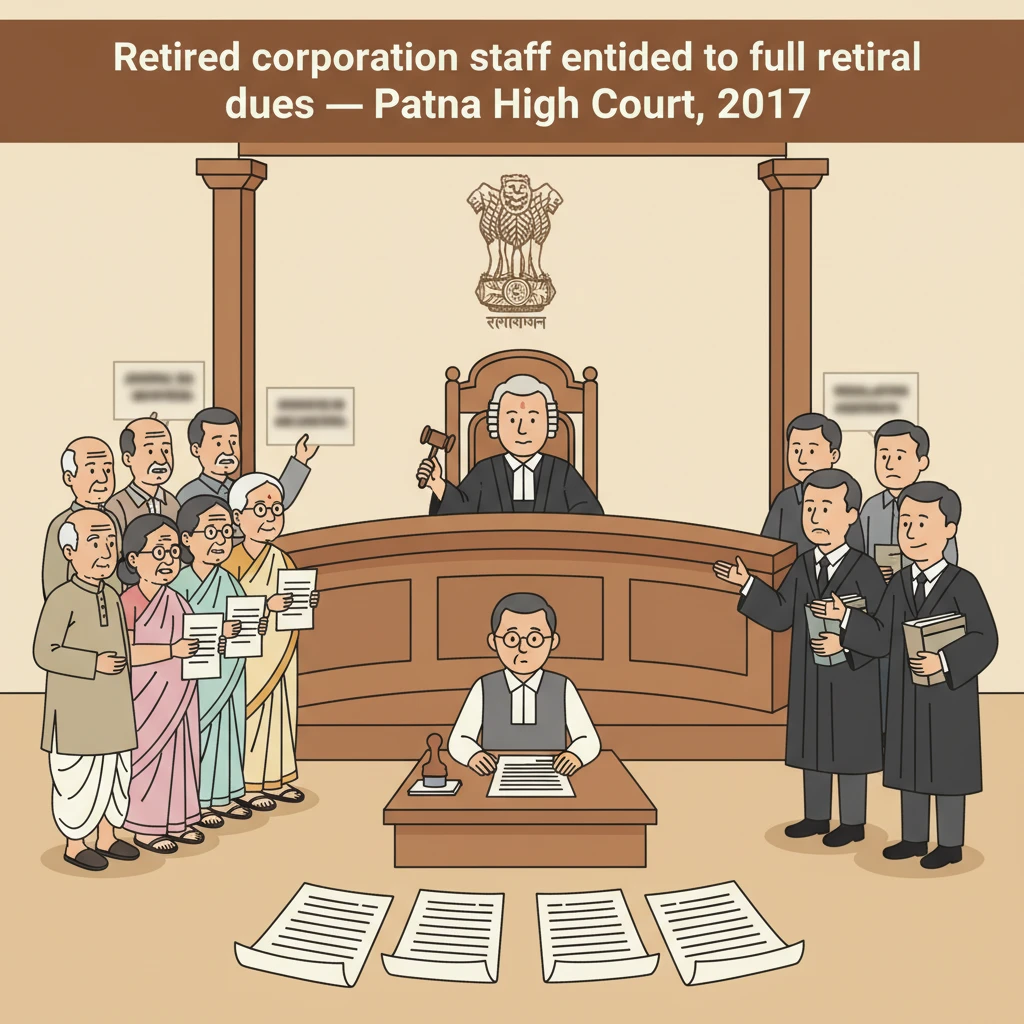
These writ petitions were filed by several employees and ex-employees of Bihar State Financial Corporation. They had been made to retire at 58 years, even though the State Government and the corporation’s own Board had decided to increase the retirement age to 60 years.
On 24.03.2005, the State of Bihar issued a resolution enhancing the age of superannuation of its employees from 58 to 60 years with effect from the date of that order.
Following this, the Board of Directors of Bihar State Financial Corporation, by a resolution dated 25.08.2006, resolved to amend Regulation 19(1) to extend the same benefit to the corporation’s employees.
However, despite its own resolution, the corporation did not implement the increased retirement age. It continued to retire employees on completing 58 years.
The Bihar State Financial Corporation Employees Federation, in a representative capacity, challenged this inaction before the High Court of Jharkhand at Ranchi in W.P.(S) No.5777 of 2006. The learned Single Judge dismissed the writ petition on 12.02.2007.
Aggrieved, the Federation filed L.P.A. No.83 of 2007 before the Jharkhand High Court. During the pendency of this appeal, the corporation continued to superannuate employees at 58 years. On an interlocutory application, the Division Bench on 27.01.2009 clarified that any superannuation made in the meantime would be subject to the result of the appeal.
On 22.04.2009, the Division Bench allowed L.P.A. No.83 of 2007. It held that the Government of Bihar’s refusal to accord sanction for enhancement of the age of superannuation of corporation employees was unjustified. The State of Bihar was directed to accord sanction within 30 days.
The Federation then filed Civil Review No.56 of 2009 seeking clarification. On 20.05.2009, the Jharkhand High Court clarified that the sanction for enhancement of age from 58 to 60 years would apply to the employees who had attained the age of superannuation.
The corporation challenged the L.P.A. judgment before the Supreme Court by filing a special leave petition. The Supreme Court dismissed the SLP in limine on 01.10.2009.
Meanwhile, employees who were made to retire during the pendency of the L.P.A. and the SLP filed Contempt Petition M.J.C. No.754 of 2009 before the Jharkhand High Court. While granting time to file show cause, that Court directed the corporation not to retire any employee until attainment of 60 years.
After dismissal of the SLP, the petitioners reported back for duty by submitting joining reports. When the corporation refused to accept these, the petitioners sent their joining reports by post.
On 19.04.2010, the corporation issued a standing order deciding to enhance the retirement age from 58 to 60 years with effect from 25.08.2006. After this, the petitioners, who had not yet completed 60 years, were allowed to rejoin and were finally allowed to retire on attaining 60 years.
However, for the period during which they were illegally kept out of service between 58 and 60 years, they were not paid salary. Some employees approached the Patna High Court by filing CWJC No.1324 of 2011 and analogous cases seeking payment of salary for this period. On 29.08.2011, the Court directed the corporation to pay salary for the entire period they were kept out of job before attaining 60 years and to complete payment within eight weeks.
One of the present petitioners, Vibhutinatha Jha, was not a party in CWJC No.1324 of 2011. He filed CWJC No.19316 of 2011, which was disposed of on 04.11.2011 on the same terms.
The corporation challenged the order dated 29.08.2011 in LPA Nos.1656 of 2011 and 1816 of 2011. The Division Bench dismissed these appeals in limine on 07.09.2012. The Supreme Court also declined to interfere and dismissed the SLP, and the order of the Patna High Court attained finality on 11.01.2013.
Thereafter, the corporation issued Office Order No.07 of 2012/13, Memo No.1012 dated 04.03.2013. Under this order, ex-employees who had been retired at 58 years but would have attained 60 years prior to the enhancement order, and those who resumed duties in the intervening period, were allowed admissible salary and allowances (except conveyance allowance) for the period they were out of service.
The corporation claims that all admissible dues in terms of this Court’s earlier order in Yogeshwar Prasad Singh’s case (CWJC No.1324 of 2011) were paid. The petitioners, however, contended that their retiral dues, particularly leave encashment and gratuity, were not fully paid. They filed separate representations, which were rejected by the Managing Director or Deputy Manager (P&A) on different dates.
These writ petitions before the Patna High Court arose out of the rejection of those representations and the alleged short payment of retiral benefits.
What the Court Examined and Decided
The Patna High Court, per Hon’ble Mr. Justice Ashwani Kumar Singh, heard four writ petitions together: CWJC No.8203 of 2014, 8696 of 2014, 9671 of 2014 and 5358 of 2017. All petitioners were employees of Bihar State Financial Corporation who had faced premature retirement at 58 years and were later reinducted and allowed to retire at 60 years.
Though various prayers were made in the writs, during arguments the petitioners confined their challenge to two points only:
First, they claimed they had been paid a lesser amount of leave encashment. When they were first forced to retire at 58 years, encashment of earned leave was paid then, calculated on their then pay scale. After the enhancement of retirement age and their rejoining, they finally retired at 60. The leave earned after rejoining was paid separately, largely calculated on the newer, higher scale.
They argued that leave encashment is, in law, to be calculated on the date of retirement, up to a maximum of 300 days, on the basis of the last pay drawn. In their view, there can be only one retirement date in service law, i.e., when they actually retired at 60 years. Therefore, the entire earned leave up to 300 days should have been recalculated on the last pay drawn at 60 years, not at 58 years on the old scale.
Second, the petitioners claimed they had been paid a lesser amount of gratuity. When they were initially retired at 58 years, the maximum ceiling of gratuity payable was Rs. 3,50,000. Later, by the time they actually retired at age 60, the maximum limit under the Gratuity Act had been raised to Rs. 10,00,000.
They said that though they received the enhanced gratuity at the time of actual retirement, the corporation deducted a “loss of interest” component from the fresh gratuity amount. This deduction was made to adjust for the earlier payment of Rs. 3,50,000 at age 58. According to the petitioners, such deduction was unjust because the earlier premature retirement was entirely the corporation’s unilateral and illegal act, and they had committed no fault.
On behalf of the corporation, it was argued that all claims had already been settled strictly in terms of this Court’s earlier orders in Yogeshwar Prasad Singh’s case. Individual representations were said to have been carefully examined and rightly rejected.
The corporation pointed out that the amounts paid towards leave encashment and gratuity at the time of retirement at 58 years were never refunded by the petitioners when they later rejoined. Therefore, according to the corporation, only the “balance” leave encashment and “balance” gratuity were payable on the basis of the revised scale, after deducting what had been paid earlier and adjusting for interest. It was also stated that any deductions made from the second installment of gratuity were not retained by the corporation but were returned to LIC, which was managing the gratuity fund, to meet a shortfall.
In response, counsel for the petitioners emphasised that it was the corporation’s unilateral and erroneous decision to retire them at 58 years. The employees never asked for, or consented to, early retirement or pre-payment of gratuity and leave encashment. Therefore, the corporation could not penalise them for its own wrongful act by reducing their final retiral benefits.
The Court then examined the legal position on leave encashment and retirement. It held that encashment of leave is a benefit given under the relevant rules, limited to a maximum of 300 days, payable on the date of retirement. Crucially, the Court observed that there is no concept of two retirement dates for a government employee under service jurisprudence.
The Court found the corporation’s method of splitting service into two stages—one retirement at 58 and another at 60—and calculating leave encashment separately for these periods to be unjustified and illegal. Once the earlier decision to retire employees at 58 was set aside and the retirement age restored to 60, the only valid retirement date was when the employee actually retired at 60 years.
The Court noted that the premature retirement at 58 years had already been held bad by the Court, and that decision had not been disturbed by the Supreme Court. Therefore, the petitioners were right in saying the first retirement and associated payments were consequences of a unilateral, invalid decision of the corporation.
Significantly, the Court observed that there was no material to show that, after the employees were reinducted, the corporation ever demanded refund of the leave encashment amounts paid to them earlier. In this situation, the corporation’s act of denying full leave encashment on the new scale at the time of actual retirement was held to be “patently illegal”. The Court held that the corporation could not divide service into broken segments merely to avoid paying full benefits.
Turning to gratuity, the Court applied the same reasoning. It recorded that when the petitioners were initially asked to retire, the statutory ceiling on gratuity was Rs. 3,50,000. When they actually retired at 60, the ceiling had been enhanced to Rs. 10,00,000. Thus, the petitioners became entitled to additional gratuity by law.
It was the case of the petitioners that, from the gratuity amount received from LIC in their names, the corporation had held back a portion on the ground of “pre-payment” of gratuity at 58. The Court held that if the corporation had taken an erroneous decision to retire them prematurely, that mistake could not be used later as a ground to deny them part of their lawful gratuity, or to inflict financial loss on them.
In clear terms, the Court concluded that holding back any portion of gratuity on account of earlier premature payment was not justified.
Finally, in paragraph 29 and 30 of the judgment, the Court set aside the impugned orders passed on the representations of the petitioners. It directed the corporation:
First, to calculate leave encashment on the basis of each petitioner’s actual date of retirement at 60 years, applying the revised salary in force on that date, and to pay the balance admissible amount.
Second, to release the amount deducted from the gratuity paid to the petitioners the second time, even though the corporation claimed to have already returned those sums to LIC to meet fund shortfall.
The Court fixed a time limit of three months from the date of receipt or production of a copy of the order for making these payments. The writ petitions were disposed of with the parties directed to bear their own costs.
Why This Judgment Matters
This judgment is important for employees who face illegal or premature retirement and later reinduction. It makes clear that an employer cannot use its own wrongful decision to reduce the final benefits legally due to employees.
For workers of public sector corporations and government bodies, the Patna High Court has underlined that there can be only one effective retirement date. Leave encashment and gratuity must be calculated on the last pay drawn at that date, subject to statutory ceilings.
The ruling also protects employees against deductions made on vague grounds like “loss of interest” when they themselves were not at fault. If the employer’s earlier act of superannuation is later found to be illegal, the financial consequences cannot be imposed on the employees.
In practical terms, this judgment ensures that employees of Bihar State Financial Corporation, and similarly placed employees in other institutions, can claim full retiral dues when their retirement age is corrected. It sends a clear message that retiral benefits are not a matter of discretion but of law.
Legal Issues and Answers
Issue: Can Bihar State Financial Corporation split service into two “retirements” at 58 and 60 years and calculate leave encashment separately on old and new pay scales?
Answer: No. The Court held there is no concept of two retirement dates. Leave encashment must be calculated up to 300 days on the basis of the last pay on the actual retirement date at 60 years.
Issue: Is the corporation justified in deducting from an employee’s final gratuity on the ground that part of the gratuity was “pre-paid” at an earlier, illegal retirement at 58 years?
Answer: No. The Court held such deductions are unjustified. The employees became entitled to enhanced gratuity when the statutory ceiling increased, and the corporation cannot deny this on the basis of its own erroneous premature retirement decision.
Issue: Were the orders rejecting the petitioners’ representations for balance retiral benefits sustainable in law?
Answer: No. The Court set aside those orders and directed fresh calculation and payment of full leave encashment and the deducted gratuity within three months.
Cases Cited by the Court
- The judgment repeatedly refers to CWJC No.1324 of 2011, Yogeshwar Prasad Singh’s case, and to L.P.A. No.83 of 2007 and Civil Review No.56 of 2009 decided by the Jharkhand High Court. Specific external case citations beyond these references are not provided in the text.
Case Details
Case Numbers: CWJC No.8203 of 2014; CWJC No.8696 of 2014; CWJC No.9671 of 2014; CWJC No.5358 of 2017 (heard and decided together)
Case Title:
CWJC No.8203 of 2014: Yugeshwar Prasad Singh and others v. The Bihar State Financial Corporation and others
CWJC No.8696 of 2014: Vibhutinatha Jha v. The Bihar State Financial Corporation and others
CWJC No.9671 of 2014: Smt. Shakunta Devi and others v. The Bihar State Financial Corporation and others
CWJC No.5358 of 2017: Upendra Lal Karn v. The Bihar State Financial Corporation and others
Citation: 2019 (3) PLJR 209
Court and Bench: High Court of Judicature at Patna; Hon’ble Mr. Justice Ashwani Kumar Singh
Date of Judgment: 25.05.2017
Advocates:
In CWJC No.8203 of 2014:
For the petitioners: Mr. Ravindra Nath Dubey, Advocate
For the respondents: Mr. Partha Sarthy, Advocate; Mr. Apurva Kumar, Advocate
In CWJC No.8696 of 2014:
For the petitioners: Mr. Manik Vedsen, Advocate; Mr. Subhash Chandra Bose, Advocate
For the respondents: Mr. Y.V. Giri, Senior Advocate; Mr. Nikhil Kumar Agrawal, Advocate
In CWJC No.9671 of 2014:
For the petitioners: Mr. Manik Vedsen, Advocate; Mr. Subhash Chandra Bose, Advocate
For the respondents: Mr. Y.V. Giri, Senior Advocate; Mr. Nikhil Kumar Agrawal, Advocate
In CWJC No.5358 of 2017:
For the petitioners: Mr. Manik Vedsen, Advocate; Mr. Subhash Chandra Bose, Advocate
For the respondents: Mr. K.D. Chatterjee, Senior Advocate; Mr. Vinay Krishna Tripathy, Advocate
Nature of the Case: Civil writ petitions under Article 226 of the Constitution challenging rejection of representations for payment of balance retiral benefits (leave encashment and gratuity) and seeking consequential directions for payment with interest.
Link to Judgment: Click here to read the full judgment on the Patna High Court website
If you found this explanation helpful and wish to stay informed about
how legal developments may affect your rights in Bihar,
you may consider following Samvida Law Associates for more updates.







