

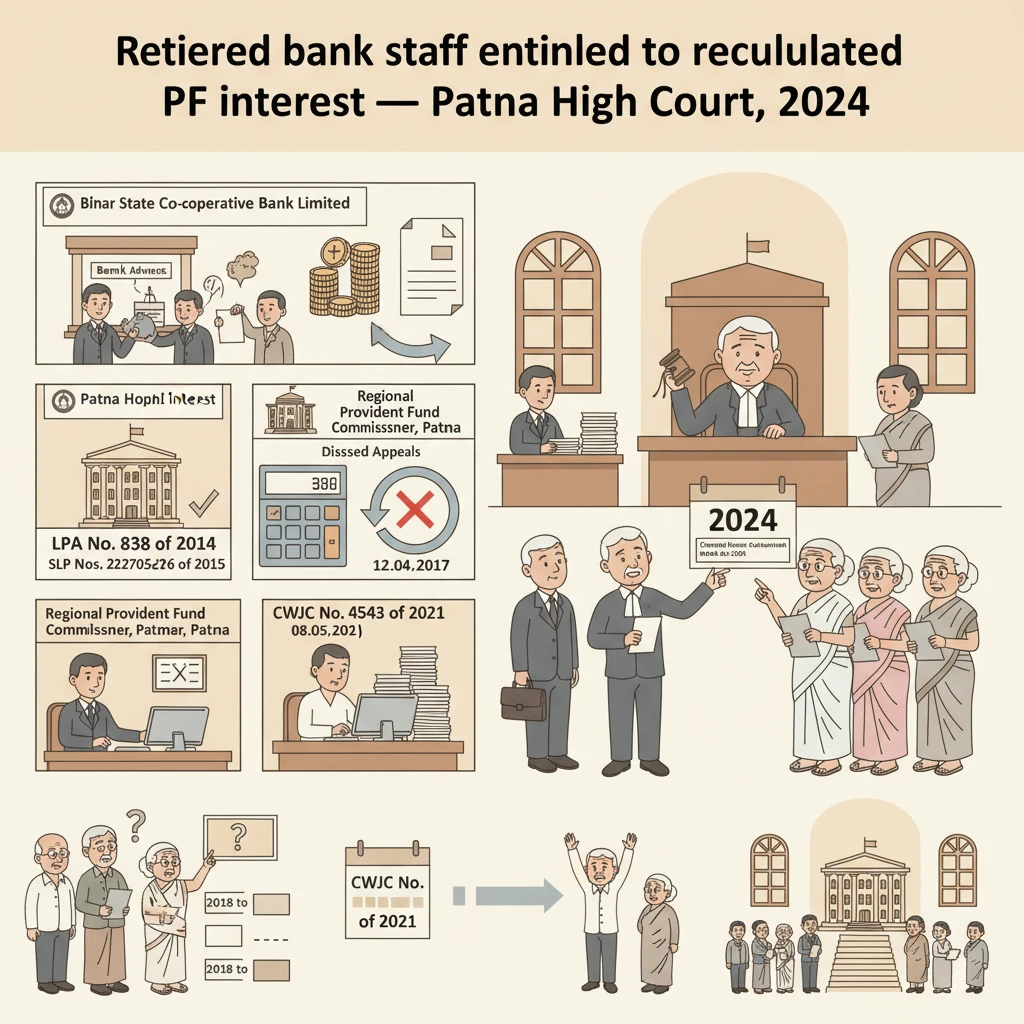
Case Background
The petitioners in this batch of writ petitions are retired employees of Bihar State Co-operative Bank Limited. They had served in different branches of the bank and superannuated between the years 2004 and 2010.
During their service, they had taken advance loans against their provident fund deposits. At the time of their retirement, the bank recovered these advances from their provident fund accounts.
However, while making these recoveries, the bank charged compound interest on the loan instead of simple interest. According to the petitioners, this led to an excess and illegal debit from their provident fund accounts.
The issue of such compound interest on provident fund advances was raised earlier by other employees of the same bank through several writ petitions before the Patna High Court. Ultimately, the matter was decided in LPA No. 838 of 2014 and other analogous cases, including LPA No. 1175 of 2014 filed by the Regional Provident Fund Commissioner.
The Division Bench held that no refund of provident fund shall be made to an employee except on retirement or termination of service, and that the levy of compound interest on advance loans by treating them as part of provident fund was untenable. The bank carried the matter to the Supreme Court in SLP Nos. 22705–22706 of 2015, but those petitions were dismissed on 06.03.2017, affirming the Division Bench judgment.
Following this, the Regional Provident Fund Commissioner, Patna, passed an order on 12.04.2017. Based on this, the bank got the debited provident fund amounts of the petitioners recalculated through a Chartered Accountant with interest for the period from 2004 to 08.05.2015. Part payments were made to the petitioners in 2018 and again in 2019.
According to the petitioners, these payments did not include interest from 08.05.2015 till the actual dates of payment. They also claimed that their leave encashment amounts had earlier been withheld for adjustment of advance loans on compound interest and were returned only after about a decade, without any interest.
Feeling aggrieved by what they considered incomplete payment despite settled law, the petitioners filed these writ petitions in 2021 before the Patna High Court.
What the Court Examined and Decided
The Patna High Court, through Hon’ble Mr. Justice Harish Kumar, heard all four connected writ petitions together. The Court heard learned counsel for the petitioners, for the Bihar State Co-operative Bank, for the Employees Provident Fund Organisation (EPFO) and for the State.
The petitioners mainly sought three kinds of relief. First, they asked for directions to pay their full provident fund amounts with up-to-date interest till the dates of actual payment, in light of the Regional Provident Fund Commissioner’s order dated 12.04.2017.
Second, they sought a direction to include interest amounts which, according to them, had been left out when the bank got calculations done through the Chartered Accountant, allegedly without notice to the petitioners. They wanted interest not only up to 08.05.2015 but till the dates on which payments were made to them.
Third, they sought refund of leave encashment and salary amounts that had been adjusted at the time of retirement for recovery of advances, with 10% interest, placing reliance on an order passed in LPA No. 1401 of 2014 (referred later as LPA No. 1461 of 2011 for the proposition regarding interest on leave encashment).
The petitioners’ counsel argued that other similarly situated employees of the same bank had already been granted interest on their outstanding dues till actual payment by this Court. Denying the same benefit to the present petitioners, they submitted, was discriminatory and had forced them to approach the Court.
They also highlighted that leave encashment amounts had been illegally withheld for almost a decade to adjust loans with compound interest and were later returned without any interest. This, according to them, clearly required compensation by way of interest at 10% as recognised in the earlier LPA.
On the other hand, counsel for the co-operative bank took a preliminary objection on the ground of delay and laches. He pointed out that the petitioners had retired between 2004 and 2010, but approached the High Court only in 2021, after a gap of 15–17 years from their retirement.
He argued that a person who sleeps over his rights for a long period and then wakes up from “deep slumber” ought not to be granted extraordinary relief in writ jurisdiction. For this proposition, he relied on the Supreme Court judgment in Tridip Kumar Dingal and Others v. State of West Bengal and Others, (2009) 1 SCC 768.
He further submitted that the petitioners had already been paid the admissible amounts, and any further liability towards interest on outstanding dues would cause extra financial burden on the bank. However, he could not dispute that the central issue of charging compound interest on advances against provident fund had already been conclusively decided by the Division Bench of the High Court and affirmed by the Supreme Court.
The Court closely examined the sequence of events and the earlier litigation. It noted that the issue of compound interest on advances against provident fund deposits had been settled on 08.05.2015 by the Division Bench in LPA No. 838 of 2014 and analogous cases. The bank’s challenge to that decision through SLP Nos. 22705–22706 of 2015 had failed on 06.03.2017 when the Supreme Court dismissed the SLPs.
Only after the legal position became final did questions arise about the consequential benefits that employees were entitled to, particularly regarding interest on the provident fund amounts. The Court observed that when such consequential benefits were not granted, employees, including the present petitioners, were compelled to approach either the authorities or the Court.
On these facts, the Court rejected the bank’s objection of delay and laches as “wholly misconceived” and fit to be rejected outright. It held that there was no delay on the part of the petitioners. Instead, it was the bank that had failed to discharge its statutory obligation to properly implement the Court’s earlier orders.
The Court then referred to similar writ petitions which had come up earlier before different coordinate Benches. In those cases, the Court had directed the Managing Director of Bihar State Co-operative Bank Limited to recalculate the interest accrued on the contributions made in the employee’s provident fund account up to a specified date, complete all formalities including fresh forms, and forward the papers to the Regional Provident Fund Commissioner, Patna.
The Regional Provident Fund Commissioner was in turn directed to recalculate and verify the interest and, if any arithmetical mistake was found in the bank’s calculations, to advise necessary corrections and complete all formalities within a fixed time after giving the employee an opportunity to raise grievances.
Despite such orders in favour of identically placed employees, the Court noted with concern that other employees with the same grievance were still being forced to come to Court. The Court referred to the Bihar State Litigation Policy, 2011. Clause 4-C(I) of that policy clearly states that all similarly situated employees should be granted the benefit of covered matters. If Court orders have been implemented in the case of some litigants, they should be implemented for all other identically placed persons as well.
The Court emphasised that once a legal issue is settled, the State or any of its instrumentalities falling within the definition of “State” must ensure uniform implementation of the Court’s ruling for everyone who is similarly placed, without compelling each person to litigate afresh.
In this backdrop, the Court decided to dispose of these writ petitions with directions identical to those issued in earlier similar cases. It directed the Managing Director of Bihar State Co-operative Bank Limited to recalculate the interest accrued on the contributions made in the provident fund accounts of the petitioners.
The bank was instructed to complete all formalities relating to payment, including getting fresh forms filled up by the petitioners, and then forward the same to the Regional Provident Fund Commissioner, Patna.
The Regional Provident Fund Commissioner, Patna, was directed to ensure, at his own level, that interest is recalculated and to verify whether the recalculation approved by the Managing Director contained any error or mistake. If an error was found, he was to advise correction and see that all formalities were completed within eight weeks, in accordance with law, after giving the petitioners an opportunity of hearing to place their grievances.
The Court expressed its expectation that the respondents adhere to this time limit and ensure payment of all admissible dues in accordance with law. With these observations and directions, the batch of writ petitions was disposed of.
Why This Judgment Matters
This judgment is important for retired employees of co-operative banks and similar institutions in Bihar who have faced deductions from their provident fund on the basis of compound interest on advances.
First, the Patna High Court has once again reinforced that employees are entitled to full provident fund benefits along with proper interest, and that earlier orders of the Court must be implemented in favour of all similarly situated persons.
Second, the Court has made it clear that employees cannot be denied their dues on the ground that they approached the Court many years after retirement when the delay is actually caused by non-implementation of settled judgments by the employer.
Third, by relying on the Bihar State Litigation Policy, 2011, the Court has reminded government bodies and public institutions that they must voluntarily extend benefits of Court decisions to all eligible employees, instead of forcing each one to litigate separately.
Practically, the judgment directs a clear mechanism: the bank must recalculate interest, the EPFO must verify it, and all formalities must be finished within eight weeks, after hearing the employees. This gives a roadmap to other retirees in similar situations about what they can demand.
Legal Issues and Answers
- Issue: Were the writ petitions liable to be dismissed on the ground of delay and laches, as the petitioners retired between 2004 and 2010 but approached the Court only in 2021?
Answer: No. The Court held that there was no delay or laches on the part of the petitioners because the issue of compound interest on advances against provident fund was finally settled only in 2015–2017, and the bank failed to implement the settled law, compelling the petitioners to approach the Court. - Issue: Are the petitioners entitled to recalculation of interest on their provident fund contributions and payment of all admissible dues in line with earlier judgments on the same issue?
Answer: Yes. The Court directed the Managing Director of Bihar State Co-operative Bank Limited to recalculate interest on the petitioners’ provident fund contributions and forward the details to the Regional Provident Fund Commissioner, who must verify the calculations, correct errors if any, and ensure payment within eight weeks after hearing the petitioners. - Issue: Should benefits of earlier Court orders in similar matters be automatically extended to all similarly situated employees?
Answer: Yes. Referring to the Bihar State Litigation Policy, 2011, the Court held that once an issue is settled and implemented for some litigants, the State or its instrumentalities must extend the same benefit to all identically placed persons without forcing them into separate litigation.
Cases Cited by the Court
- LPA No. 838 of 2014 and analogous cases, including LPA No. 1175 of 2014 (Division Bench of Patna High Court on illegality of compound interest on PF advances).
- SLP Nos. 22705–22706 of 2015 (filed by the Bihar State Co-operative Bank Limited; dismissed by the Supreme Court on 06.03.2017, affirming the Division Bench judgment).
- Tridip Kumar Dingal and Others v. State of West Bengal and Others, (2009) 1 SCC 768 (cited by the bank on delay and laches).
- LPA No. 1461 of 2011 (referred regarding interest on delayed payment of leave encashment).
- CWJC No. 3223 of 2023, CWJC No. 4139 of 2023, and CWJC No. 8612 of 2023 (earlier Patna High Court orders directing recalculation of provident fund interest for similarly situated employees).
Case Details
Case Numbers: Civil Writ Jurisdiction Case No. 4543 of 2021; with CWJC No. 5299 of 2021; CWJC No. 5427 of 2021; CWJC No. 5670 of 2021.
Case Title: Balmiki Prasad Sharma v. The Managing Director, Bihar State Co-operative Bank Ltd. & Anr.; with connected writ petitions of Ram Naresh Kumar Sharma; Dhirendradhari Singh; and Sachchidanand Prasad Sharma.
Citation: 2024 (4) PLJR 731.
Coram: Hon’ble Mr. Justice Harish Kumar.
Advocates:
For the petitioners (in all cases): Mr. Jai Prabhat Kishore, Advocate.
For the Managing Director, Bihar State Co-operative Bank Ltd.: Mr. S. N. Pathak, Advocate.
For the Regional Provident Fund Commissioner / EPFO: Mr. Prashant Sinha, Advocate; Mr. Prashant Kumar, Advocate.
For the State of Bihar: Mr. Sushil Kumar Singh, AC to AAG-10.
Nature of the Case: Writ petitions under civil writ jurisdiction seeking directions for payment of full provident fund and interest and related retirement dues.
Date of Judgment: 21.10.2024.
Link to Full Judgment: Patna High Court Judgment – CWJC No. 4543 of 2021 and batch
If you found this explanation helpful and wish to stay informed about
how legal developments may affect your rights in Bihar,
you may consider following Samvida Law Associates for more updates.







