
Case Background
The petitioner is a retired employee of the Industries Department, Government of Bihar, connected with the Upendra Maharathi Udyogship Anusandhan Sansthan, Patna.
A departmental proceeding was initiated against her while she was in service. This proceeding ended in an order of punishment issued by the Director, Industries Department (respondent no. 3), through Memo No. 2550 dated 26.06.2015.
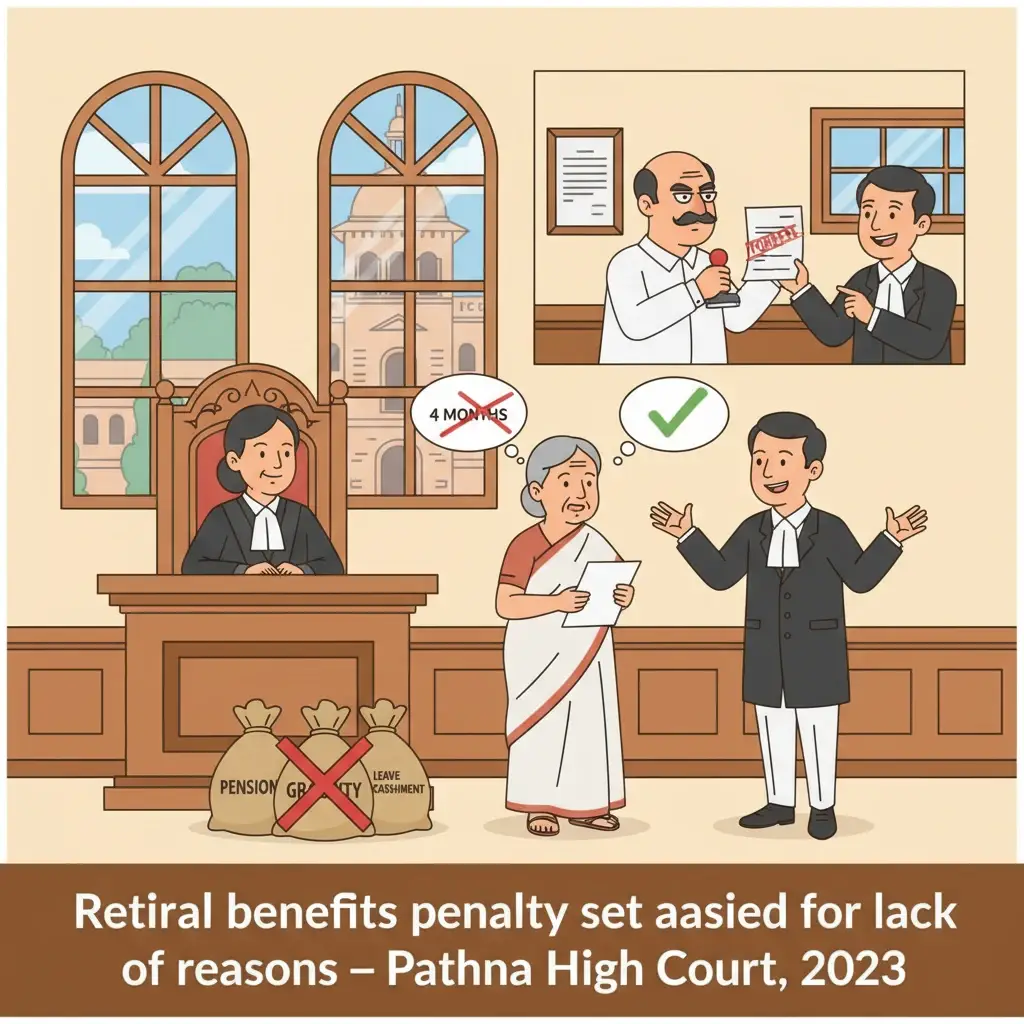
By this memo, the disciplinary authority imposed a very serious penalty: forfeiture of all the petitioner’s retirement benefits, including pension, gratuity and leave encashment. According to the writ petition as summarized in the judgment, she also claimed that her full salary for four months prior to retirement had not been paid.
The petitioner filed an appeal before the Principal Secretary, Industries Department (respondent no. 2), challenging the punishment order. This appeal was rejected by Memo No. 1545 dated 24.05.2017 (Annexure-10).
Feeling aggrieved by both the original punishment and the rejection of her appeal, the petitioner approached the Patna High Court under its civil writ jurisdiction in CWJC No. 1654 of 2018.
In the writ petition, she sought quashing of the appellate order dated 24.05.2017, quashing of the punishment order dated 26.06.2015, direction for payment of her full salary for four months prior to retirement with interest, and direction for release of all retiral benefits (pension, gratuity and leave encashment).
What the Court Examined and Decided
The matter was heard by Hon’ble Mr. Justice Prabhat Kumar Singh on 09.01.2023. The judgment is an oral one.
The core challenge was to the legality of the appellate order issued by respondent no. 2, the Principal Secretary, Industries Department, by Memo No. 1545 dated 24.05.2017 (Annexure-10). The petitioner’s main ground was that this order was passed without proper consideration of her defence as required under the Bihar Government Servants (Classification, Control & Appeal) Rules, 2005, commonly referred to as the Bihar C.C.A. Rules, 2005.
Learned counsel for the petitioner made a focused, short submission. She argued that the appellate order had been passed without taking into account the reply to the show-cause notice which the petitioner had filed in the departmental proceeding.
According to the petitioner’s counsel, the Principal Secretary had acted without application of mind and without following the procedure under Rule 17 of the Bihar C.C.A. Rules, 2005. The complaint was not just about an incorrect conclusion, but about the way the conclusion was reached.
Specifically, it was argued that in the entire appellate order (Annexure-10), there was no discussion of the pleas raised by the petitioner in her defence. The order did not assign any reasons to explain why her reply to the show-cause notice was not acceptable to the disciplinary authority or the appellate authority.
The petitioner’s side thus focused on a core principle: when a show-cause notice is issued and a reply is given, the authority must consider that reply, apply its mind, and give reasons for accepting or rejecting it. A punishment, especially as serious as forfeiting all retiral benefits, cannot be imposed or upheld through a non-speaking, unreasoned order.
On the other side, learned counsel for the State appeared for the respondents. During the hearing, the Court records that the State’s counsel was unable to dispute the contention made on behalf of the petitioner.
In other words, the State did not successfully show that the appellate authority had, in fact, considered the petitioner’s defence and recorded reasons, or that the order complied with Rule 17 of the Bihar C.C.A. Rules, 2005.
After hearing both sides, the Court examined the impugned appellate order dated 24.05.2017 (Annexure-10). On perusal, the Court found that this order did not contain any discussion of the petitioner’s defence.
The judgment notes clearly that the order did not set out the petitioner’s case as presented in her reply to the show-cause notice. Nor did it contain any reasoning explaining why the appellate authority found that reply to be unacceptable. There were no reasons assigned for upholding the punishment.
Based on this, the Court accepted the petitioner’s submission. The High Court observed that the appellate order was in “complete violation” of Rule 17 of the Bihar C.C.A. Rules, 2005.
Rule 17 governs the procedure for imposing major penalties in departmental proceedings. While the text of Rule 17 is not reproduced in the judgment, the Court’s reasoning shows that it expects the disciplinary and appellate authorities to consider the defence reply and record reasons when they decide on punishment after the second show-cause.
Because the appellate order was unreasoned and did not show consideration of the petitioner’s defence, the Court found it legally unsustainable. The violation was procedural and went to the root of fairness in the disciplinary process.
Consequently, the Court set aside the impugned appellate order bearing Memo No. 1545 dated 24.05.2017 (Annexure-10).
Importantly, the Court did not itself decide whether the petitioner was guilty of the charges in the departmental proceeding, nor did it directly quash the original punishment order (Annexure-7) on merits. Instead, the Court chose to remit the matter back.
The judgment states that the matter is remitted “for its consideration in accordance with law from the stage of second show-cause.” This means that the competent authority must now reconsider the case starting from the point after the second show-cause notice was issued, taking into account the petitioner’s reply properly and passing a reasoned order as required by law.
By doing so, the High Court restored the procedural safeguards that had been bypassed. The authority will now have to decide again whether the punishment of forfeiture of all retirement benefits is justified or whether some other outcome should follow, and must give clear reasons either way.
With these observations and directions, the writ petition was allowed. The judgment records no further directions regarding immediate payment of retiral benefits or salary; those issues will depend on the outcome of the reconsideration after remand.
Why This Judgment Matters
This judgment is significant for government employees in Bihar, especially those facing departmental proceedings near retirement.
First, it reinforces that authorities cannot simply ignore an employee’s reply to a show-cause notice. Even if they believe the employee is at fault, they must read the reply, consider the points raised, and explain why they are not convinced.
Second, the Patna High Court made it clear that when a serious punishment is imposed—such as forfeiture of pension, gratuity and leave encashment—the order must be a speaking order. It must show that the authority has applied its mind. A silent, unreasoned order will not stand.
Third, the decision underlines that Rule 17 of the Bihar C.C.A. Rules, 2005 is not a formality. It is a safeguard. If the procedure under Rule 17 is not followed, the punishment order can be set aside and the matter sent back for fresh consideration.
For employees, this judgment shows that they have a right to have their defence properly heard and dealt with. For departments, it is a reminder that procedural fairness and reasoned orders are mandatory, not optional, especially when dealing with retiral benefits which are often the main financial support in old age.
Legal Issues and Answers
- Issue: Whether the appellate order rejecting the petitioner’s appeal against the punishment of forfeiture of all retiral benefits, passed without discussing her reply to the show-cause notice and without assigning reasons, was valid under Rule 17 of the Bihar C.C.A. Rules, 2005.
Answer: No. The Patna High Court held that the order dated 24.05.2017 (Memo No. 1545) was in complete violation of Rule 17 as it did not discuss the petitioner’s defence or give reasons for rejecting it, and therefore set it aside while remitting the matter for reconsideration from the stage of second show-cause.
Cases Cited by the Court
- No earlier judgments or precedents are cited or relied upon in the text of this judgment.
Case Details
Case Number: Civil Writ Jurisdiction Case No. 1654 of 2018
Case Title: Sudama Devi v. The State of Bihar & Ors.
Citation: 2023 (1) PLJR 776
Court: High Court of Judicature at Patna
Coram: Hon’ble Mr. Justice Prabhat Kumar Singh
Date of Judgment: 09.01.2023
Nature of the Case: Writ petition (civil) challenging departmental punishment and appellate order concerning forfeiture of retiral benefits
Petitioner’s Counsel: Ms. Mahasweta Chatterjee (for the petitioner)
Respondents’ Counsel: Mr. Suresh Kumar, AC to GP-1 (for the State/respondents)
Key Impugned Orders:
- Memo No. 2550 dated 26.06.2015 issued by Respondent No. 3 (punishment order forfeiting pension, gratuity and leave encashment)
- Memo No. 1545 dated 24.05.2017 issued by Respondent No. 2 (appellate order rejecting appeal; Annexure-10)
Final Outcome: Writ petition allowed; appellate order dated 24.05.2017 set aside; matter remitted for fresh consideration in accordance with law from the stage of second show-cause.
Judgement link; https://patnahighcourt.gov.in/viewjudgment/MTUjMTY1NCMyMDE4IzEjTg==-zzfa4VrNQzc=
If you found this explanation helpful and wish to stay informed about
how legal developments may affect your rights in Bihar,
you may consider following Samvida Law Associates for more updates.







