

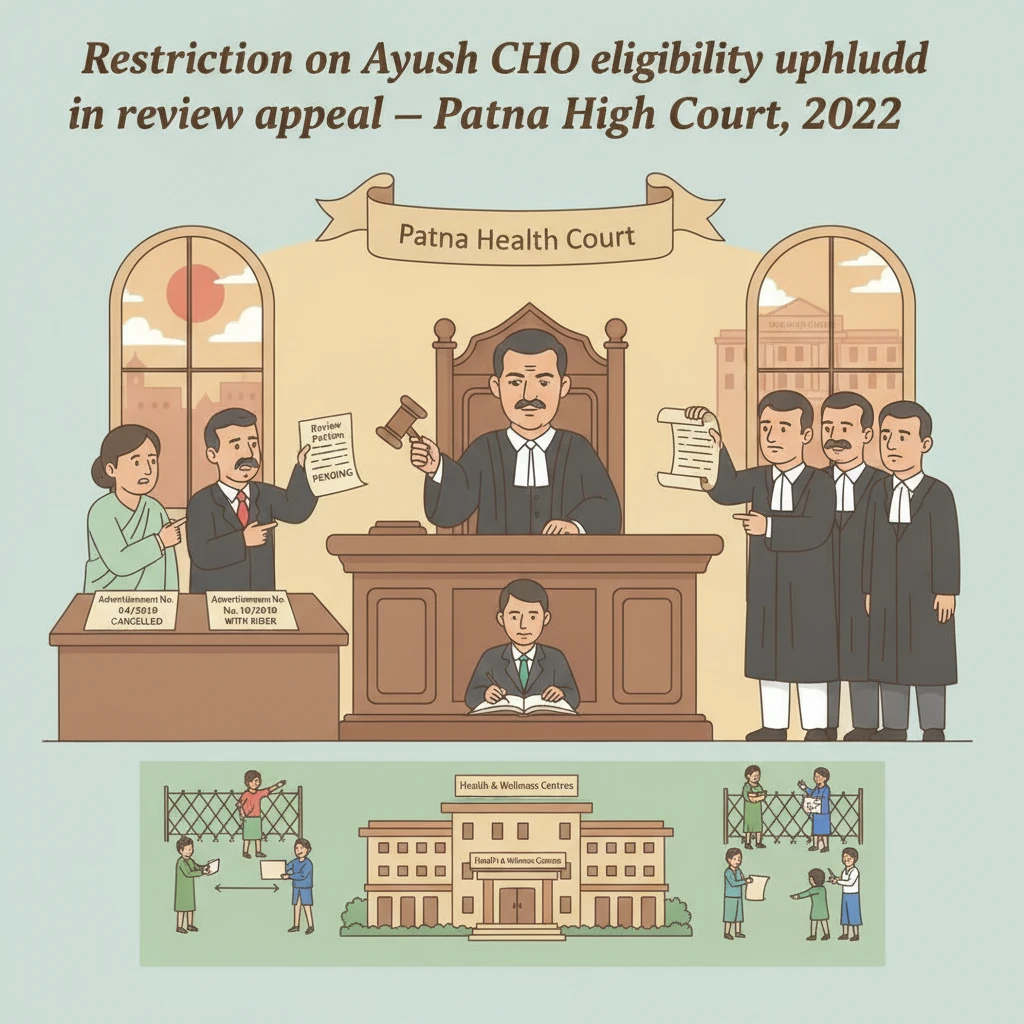
Case Background
The National Health Mission, Ministry of Health and Family Welfare, Government of India issued “Ayushman Bharat; Comprehensive Primary Health Care through Health and Wellness Centres – Operational Guidelines”.
Under Section 4.1 of Section 4 of these guidelines, Community Health Officers (CHOs) are to be appointed from people who undertake a six‑month bridge course in community health. Only three categories are eligible for that course: persons with B.Sc. in Community Health, General Nursing and Midwifery (GNM), and Ayurveda practitioners trained and certified through IGNOU or other State public health/medical universities.
On this basis, the Bihar State Health Society published an advertisement in 2017 inviting eligible candidates for the six‑month bridge certificate programme in Community Health. The process was ongoing, with courses held twice a year.
In 2019, Advertisement No. 04/2019 again invited applications for a six‑month certificate course for Ayurveda practitioners, GNMs and B.Sc. Community Health Service graduates. Those who completed the course were to be posted as CHOs with a remuneration of Rs. 25,000 per month and incentives up to Rs. 15,000 per month.
Some Homeopathy and Unani doctors were aggrieved because they were not included in the eligibility list. They approached the Patna High Court in CWJC Nos. 13410 and 15491 of 2019 seeking a direction to allow them to participate in the bridge course.
The writ petitions were heard by a learned single judge. On 26.09.2019, the single judge allowed Homeopathy and Unani practitioners also to participate in the six‑month certificate course.
While passing that order, the single judge relied on submissions of the State counsel conveying the stand of the Principal Secretary, Health Department, Government of Bihar. The stand communicated was that Homeopathy and Unani practitioners would also be eligible to participate in the six‑month certificate course.
After this order, Advertisement No. 04/2019 was cancelled. A fresh Advertisement No. 10/2019 was issued on 19.12.2019. It allowed practitioners of other Ayush streams, namely Homeopathy and Unani, to apply. However, it carried a clear rider that their final selection for the training course would depend upon the final orders of the Court in the review petition to be filed against the order in CWJC Nos. 13410 and 15491 of 2019.
According to the scheme, candidates are first selected, then given six months’ training, and only thereafter become eligible for appointment as CHOs. Because of the rider in Advertisement No. 10/2019, the result of the selection process was not declared, apparently awaiting an order in the civil review filed by the State Health Society.
Meanwhile, some Ayurveda practitioners approached the Court again in CWJC No. 7540 of 2020. They sought a direction for publication of the results and continuation of the training process. By order dated 23.09.2020, the Court directed the State Health Society to publish the result on or before 29.09.2020.
When that order was not complied with, a contempt petition was filed by those petitioners. Thereafter, the State Health Society published results for 73 Ayurveda practitioners only. The remaining 227 seats were reserved for practitioners of other Ayush streams.
This left many Ayurveda applicants without selection, even though, as per the Central guidelines, the course was specifically meant only for Ayurveda practitioners (from within Ayush), GNMs and B.Sc. Community Health degree holders.
In this situation, the State Health Society filed Civil Review No. 433 of 2019 seeking review of the 26.09.2019 order of the single judge. The review petition was admitted, but the single judge clarified that there would be no interim order. As a result, the State Health Society would still be bound to comply with the original order dated 26.09.2019.
The State Health Society then filed the present Letters Patent Appeal No. 1 of 2021 challenging primarily this order in the review petition, and the consequent obligation to comply with the earlier writ order.
What the Court Examined and Decided
The Division Bench, consisting of Hon’ble Mr. Justice Ashutosh Kumar and Hon’ble Mr. Justice Anjani Kumar Sharan, heard the appeal. The Court also allowed an interlocutory application to implead interveners as party respondents, as the decision would affect them.
The main grievance of the appellant State Health Society and the interveners was that the Central Government scheme had fixed specific qualifications for the CHO bridge course. Yet, by judicial order, eligibility was expanded to include Homeopathy and Unani practitioners, contrary to the guidelines.
They argued that because of the single judge’s order, candidates from other Ayush streams were allowed to participate. This, in turn, prevented declaration of full results, kept many candidates on the wait‑list and denied Ayurveda practitioners their rightful chance to be selected and trained.
The Court examined the relevant Central guidelines. Section 4.1 of Section 4 of the “Ayushman Bharat; Comprehensive Primary Health Care through Health and Wellness Centres – Operational Guidelines” clearly states that CHOs must be appointed from:
(a) B.Sc. in Community Health; or
(b) GNMs; or
(c) Ayurveda practitioners, trained and certified through IGNOU or other State Health/Medical Universities, with competence in delivering public health and primary healthcare services.
The Court noted that the guidelines are “absolutely clear” and make the bridge course tailor‑made only for these three categories. Other Ayush streams like Homeopathy and Unani are not mentioned.
During the appeal, the appellant placed before the Court a communication from the Government of India, Ministry of Health and Family Welfare, addressed to the State Health Society. This communication was in response to a request for clarification on whether Homeopathy and Unani practitioners could be included in the community health certificate programme.
In that communication, the Central Government explained that the training scheme for Ayurveda practitioners, GNMs and B.Sc. Community Health was based on recommendations of an expert group. That group had concluded that only these professionals possess in‑depth knowledge of human anatomy gained through rigorous clinical experience and training.
Because of this background, such persons were considered to have a holistic understanding of public health needed for delivering comprehensive primary healthcare. Therefore, they alone were identified as eligible categories for the CHO bridge course.
The Central Government noted that objections from practitioners of other Ayush streams had been considered. It was, however, clarified that extension of the programme to other Ayush streams could be contemplated only if no BAMS/Ayurveda practitioners were available for the training. This was a conditional and exceptional situation, not the norm.
On this basis, the Central Government’s stand was expressed without ambiguity: in terms of Section 4.1 of Section 4 of the Ayushman Bharat Operational Guidelines, a CHO must be either B.Sc. in Community Health, a GNM, or an Ayurveda practitioner with the specified training and certification.
The Central Government also issued an advisory to the Bihar State Health Society. It advised the Society to seek review of the learned single judge’s order, which had permitted practitioners from other Ayush streams to participate in the course, and to do so at the earliest.
Taking these materials into account, the Division Bench observed that the entire purpose of the training programme was at risk. If the review petition remained pending and the broadened eligibility was not reconsidered, the objective of training and appointing properly qualified CHOs as per the Central scheme would be derailed.
The Court therefore emphasised that the review petition should be dealt with and disposed of expeditiously by an appropriate Bench. Only then could the training programme proceed in line with the Central guidelines.
While reaching this conclusion, the Bench referred to three important Supreme Court decisions: Banarsidas & Ors. v. State of UP & Ors., AIR 1956 SC 520; Mukul Kumar Tyagi v. State of UP & Ors., (2020) 4 SCC 86; and Zahoor Ahmad Rather & Ors. v. Sheikh Imtiyaz Ahmad & Ors., (2019) 2 SCC 404.
In these cases, the Supreme Court clarified the limits of judicial review over qualifications prescribed in advertisements. It has been consistently held that it is open to the competent authority to lay down pre‑requisite conditions for qualification. Courts should ordinarily not interfere with such prescriptions on the judicial side.
Applying this principle, the Patna High Court Division Bench accepted that the Central Government, acting on expert advice, had fixed the eligibility criteria for the CHO bridge course. The State Health Society, as the implementing agency, was bound to follow these criteria. The Court should not alter or expand them by judicial direction except in rare situations supported by law.
Given these reasons, the Division Bench allowed the Letters Patent Appeal. It directed that a copy of its order be placed before Hon’ble the Chief Justice for placing the matter before an appropriate Bench for further action on the review petition. The appeal was thus allowed and disposed of.
Why This Judgment Matters
This judgment is important for health workers and students seeking government posts under the Ayushman Bharat scheme, especially in Bihar. It confirms that eligibility for the CHO bridge course is strictly tied to the Central Government guidelines.
For Homeopathy and Unani practitioners, the judgment shows that they cannot insist on inclusion in such schemes when the Central guidelines do not list them, except in the special situation indicated by the Central Government itself.
For Ayurveda graduates, GNMs and B.Sc. Community Health degree holders, the decision safeguards their reserved space in the programme. Seats earmarked for them cannot be diluted by expanding eligibility through court orders without backing from the scheme‑framing authority.
More broadly, the judgment reinforces that courts will be slow to interfere with recruitment or training qualifications fixed by expert bodies and government guidelines. This offers predictability in public health recruitment processes run under national programmes.
Legal Issues and Answers
Issue: Can the High Court, in exercise of writ jurisdiction, expand the eligibility criteria for a Central Government CHO bridge course to include Homeopathy and Unani practitioners when the Ayushman Bharat guidelines restrict it to Ayurveda practitioners, GNMs and B.Sc. Community Health graduates?
Answer: The Division Bench held that qualifications under such schemes are for the competent authority to prescribe, based on expert recommendations, and should not be altered judicially. The appeal was allowed and the review petition is to be decided expeditiously in light of the Central Government’s clarified stand.
Issue: What is the effect of the Central Government’s clarification and advisory on the pending selection and training process in Bihar?
Answer: The Court accepted the Central Government’s clear position that only specified categories are eligible and directed that the review petition be promptly decided so that the training programme for CHOs proceeds without derailing the Central scheme.
Cases Cited by the Court
- Banarsidas & Ors. v. State of UP & Ors., AIR 1956 SC 520
- Mukul Kumar Tyagi v. State of UP & Ors., (2020) 4 SCC 86
- Zahoor Ahmad Rather & Ors. v. Sheikh Imtiyaz Ahmad & Ors., (2019) 2 SCC 404
Case Details
Case Number: Letters Patent Appeal No. 1 of 2021 in Civil Review No. 433 of 2019
Case Title: State Health Society through its Executive Director v. Dr. Manoj Kumar & Ors.
Coram: Hon’ble Mr. Justice Ashutosh Kumar and Hon’ble Mr. Justice Anjani Kumar Sharan
Citation: 2022 (2) PLJR 371
Advocates: Mr. Kishore Kumar Sinha, Advocate for the appellant/State Health Society; Mr. Gopal Govind Mishra, Advocate for the respondents; Mr. Prashant Kumar Sinha, Advocate for the intervener.
Nature of the Case: Letters Patent Appeal arising out of an order in a civil review petition connected to writ proceedings.
Date of Judgment: 12.04.2022
Link to Judgment: https://patnahighcourt.gov.in/viewjudgment/MyMxIzIwMjEjMSNO-QWgAnc–ak1–ob5I=
If you found this explanation helpful and wish to stay informed about
how legal developments may affect your rights in Bihar,
you may consider following Samvida Law Associates for more updates.







