
Case Background
This case arises from a dispute over a vocational course called “Industrial Fish & Fisheries” in Ramdayalu Singh College, Muzaffarpur, a constituent unit of Babasaheb Bhim Rao Ambedkar Bihar University.
The University Grants Commission (UGC), by letter dated 14.06.1996, approved the introduction of this vocational subject in the college from the academic session 1996–1997. Under that scheme, UGC allowed appointment of staff on contract basis: two Lecturers, one Instructor, one Lab Technician and two Peons.
Importantly, UGC clearly stated that it would provide recurring financial support only for five years, from 1996 to 2000. After that, the institution had to meet the expenditure either through support from the State Government or from other sources. The UGC letter also emphasized that the institution should move towards financial self-sufficiency for this course.
Following UGC’s approval, the Vice-Chancellor of the University permitted commencement of B.Sc. (Honours) vocational course in Industrial Fish & Fisheries in the Department of Zoology of the college. This was communicated to the Principal by the Registrar vide Memo No. B / 2334 dated 31.07.1996.
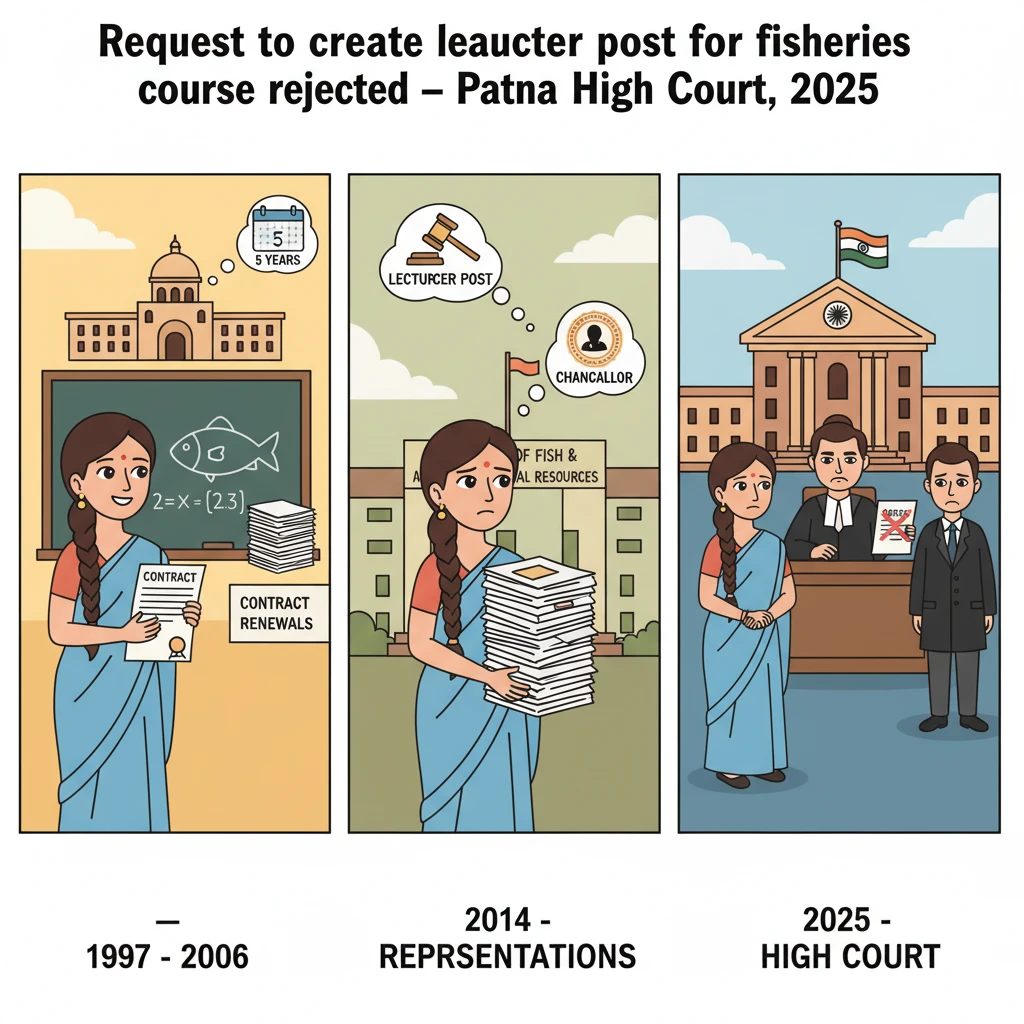
The college then issued an advertisement on 02.04.1997 in a daily newspaper for contract appointments of Lecturers, Instructors and Lab Technicians. The petitioner applied and, on the recommendation of the Selection Committee, was appointed as Instructor with effect from 25.04.1997 on a contractual, fixed-salary basis.
Her contractual engagement was extended from time to time, and her services continued up to 2006 as Instructor. In 2004, the Lecturers originally appointed for this vocational course resigned. The college again advertised in 2004 for Lecturers. The petitioner applied, her candidature was considered, and she was appointed as Lecturer by office order dated 13.04.2006. She joined as Lecturer on 15.04.2006, still on a contractual basis.
The petitioner claims that she has been continuously working—first as Instructor (1997–2006), then as Lecturer (from 2006 onwards)—to the full satisfaction of the authorities. However, she continued on fixed remuneration, without being brought on regular pay scale or regular cadre.
She made representations in 2014, including to the Minister, Department of Fish and Animal Resources, and to the Hon’ble Chancellor, University of Bihar. In those, she requested sanction of two Lecturer posts in Industrial Fish & Fisheries at the college and regularization of her services against one of those posts. Those representations did not yield any relief.
The present writ petition (Civil Writ Jurisdiction Case No. 18782 of 2016) was then filed before the Patna High Court seeking directions for creation of posts, financial takeover by the State, and regularization of her services.
What the Court Examined and Decided
The petitioner’s main prayer was for a mandamus to the State authorities, particularly the Education Department, Government of Bihar, to sanction or create posts of Lecturers in the Industrial Fish & Fisheries department in the concerned college, and to take over the financial liability of that department.
She also sought a consequential direction to grant approval for regularization of her services as Lecturer in Industrial Fish & Fisheries. In the alternative, she requested regularization on a sanctioned and vacant Lecturer post in the Department of Zoology in the same college.
Her counsel relied heavily on the original UGC scheme. He argued that UGC’s letter dated 14.06.1996 permitted continuation of the course with State Government support after UGC aid stopped in 2000–2001. He pointed out that when UGC assistance was about to cease, the University Registrar, by letter dated 17.08.2001, requested the State’s Higher Education Department to grant permission to continue the Industrial Fish & Fisheries course and to provide financial assistance for recurring expenses.
According to the petitioner, the University administration continued the vocational course even after expiry of UGC’s five-year assistance and took over the recurring expenditure from the academic year 2000–2001. The State, she said, never objected to this continuation or the University’s assumption of liability.
She highlighted that her contract had been repeatedly renewed, and that she had worked satisfactorily for several years, but remained only on fixed remuneration. She relied on a letter dated 23.05.2015 from the Principal of the college to the University, in which the Principal requested that the Governor’s Secretariat direct the State Government to take over the financial liability of the department and sanction posts, and that the petitioner’s services be regularized as Lecturer.
The petitioner also pointed to a letter dated 19.02.2016 by the University Registrar to the Additional Secretary, Higher Education, Government of Bihar. In that letter, the Registrar requested the State to grant consent for creation of at least two posts of Assistant Professor, one post of Associate Professor, one post of Instructor, and to take over the financial liability of the Industrial Fish & Fisheries department started under the 9th Five Year Plan.
Her counsel argued that a similar situation had arisen in Patna University, where two UGC-approved new courses (Biochemistry and Rural Studies) continued after UGC assistance ceased. There, by letter dated 16.01.2015, the State Government sanctioned posts of Professor, Assistant Professor and Associate Professor and took over the financial liability. She contended that the State could not discriminate or give “step-motherly treatment” to her course, which was also UGC-approved and popular in North Bihar.
The petitioner further referred to the Government of Bihar’s move to create posts of Fisheries Supervisors under the Bihar Animal & Fisheries Resources (Fisheries) Service Appointment Rules, 2007, arguing that this showed the importance of fisheries and the need for such courses. She relied on Supreme Court decisions in Nihal Singh & Others v. State of Punjab & Others (2013) 14 SCC 65 and Sabha Shankar Dube v. Divisional Forest Officer & Others (2019) 12 SCC 297 to support her claim for regularization and, at least, minimum of the regular pay scale on the principle of equal pay for equal work.
On the other hand, the State’s counsel focused on the clear terms of the UGC letter of 14.06.1996. He stressed that UGC had explicitly limited its recurring financial support to five years (1996–2000). After that, the institution had to arrange funds, possibly with State support, but only if the State agreed.
The State submitted that after 2000, the college had been running the course from its internal resources and from student fees. The State Government had never consented to run the course, nor had it undertaken the recurring financial liability after UGC assistance ended. Therefore, this vocational course was being run from the institution’s own or other sources, not from the State exchequer.
The State pointed out that only in 2016—about sixteen years after UGC aid ended—the University wrote to the Education Department (letter dated 19.02.2016) seeking financial assistance and creation of posts. In response, by letter dated 30.05.2016, the Department asked the Registrar to explain on what basis the University claimed that the State had agreed to take over salary liabilities and to produce evidence. No such evidence was produced.
The State also argued that the petitioner had been appointed purely on contract on a fixed remuneration and could not, in absence of any statutory scheme, claim regularization as a matter of right.
The University’s counsel relied on Section 35 of the Bihar State Universities Act, 1976, to submit that only the State Government has the power to create posts. Once posts are created, appointments are made by the University, following recruitment rules, reservation and roster. Regularization or absorption can be considered only when there is a duly created and sanctioned post. Since the petitioner’s Lecturer post in Industrial Fish & Fisheries had never been sanctioned by the State, her services could not be regularized.
After hearing both sides, the Court distilled the issue into two parts: whether it could direct the State to create posts of Lecturer in Industrial Fish & Fisheries, and whether it could direct regularization of the petitioner, or at least grant her minimum of regular pay scale.
The Court noted the admitted position that the UGC support ceased after five years and that the college continued the course thereafter from its own funds and student fees. The UGC scheme itself envisaged that institutions should become financially self-sufficient, including by levying development charges and user charges, and specifically stated that UGC would not be liable for staff salaries, even when staff were appointed contractually.
The Court accepted the State’s stand that there was no evidence that the Government of Bihar had agreed to take over the financial liability of this course. On the contrary, the Government had asked the University to substantiate its claim, and no supporting document was produced.
On the legal side, the Court held that the petitioner’s reliance on Nihal Singh was misplaced. That case involved recruitment of Special Police Officers under statutory powers during a law and order crisis in Punjab, with a different factual and legal backdrop, including that creation of posts there did not increase the State’s financial burden because banks were bearing the cost. Those peculiar facts did not exist here.
The Court instead relied on Supreme Court precedents that restrict judicial power to create posts. It cited Divisional Manager, Aravali Golf Club & Another v. Chander Hass & Another, (2008) 1 SCC 683, where the Supreme Court held that creation and sanction of posts is the prerogative of the executive or the legislature, and courts cannot assume that role.
It also referred to Maharashtra State Road Transportation Corporation v. Casteribe Rajya Parivahan Karmachari Sanghatana, (2009) 8 SCC 556, reiterating that courts cannot grant permanency where there is no sanctioned post and that creation of posts lies outside the judicial domain.
Further, the Court relied on the recent decision in Government of Tamil Nadu & Another v. Tamil Nadu Makkal Nala Paniyalargal & Others, 2023 LiveLaw (SC) 294, where the Supreme Court held that in the absence of sanctioned posts, the State cannot be compelled to create posts and absorb persons.
Based on these authorities, the Patna High Court held that, while exercising writ jurisdiction under Article 226 of the Constitution, it cannot direct the State Government to create or sanction posts. Creation of posts is an executive or legislative policy decision with financial implications and falls exclusively within the Government’s domain.
Since the petitioner was a contractual Lecturer and not working against any sanctioned post, the Court held that it could not compel the State to first create a post and then regularize her, nor could it direct payment of minimum of the pay scale for a Lecturer in such circumstances.
Ultimately, the Court found no merit in the writ application and rejected it, leaving the petitioner in her existing contractual position, subject to the college’s own decisions and resources.
Why This Judgment Matters
This judgment is important for thousands of contractual teachers, especially in self-financing or UGC-launched vocational courses in Bihar.
The Patna High Court has made it clear that:
If there is no sanctioned post from the State Government, the Court cannot force the State to create such a post or to regularize someone appointed on contract by a college or university. Even long service and good performance on a fixed salary do not, by themselves, create a right to regularization or to minimum pay of a regular post.
The judgment also highlights that UGC-approved vocational courses, started for a limited period of financial support, may later be run from college resources and student fees. In such cases, unless the State formally takes over financial responsibility and sanctions posts, teachers remain on the rolls of the institution as contractual staff.
For affected teachers, the practical consequence is that their remedy may lie more in policy decisions by the State and University than in court directions. For institutions, it underlines the need to be transparent with staff about the basis of their appointments and funding.
Legal Issues and Answers
-
Issue: Can the Patna High Court direct the State of Bihar to create and sanction posts of Lecturer in Industrial Fish & Fisheries and take over financial liability for the course?
Answer: No. The Court held that creation and sanction of posts is an executive/legislative function. In writ jurisdiction, it cannot compel the State to create posts or assume financial liability where no sanctioned posts exist. -
Issue: Can a contractual Lecturer appointed without any sanctioned post claim regularization or at least minimum of the regular pay scale through a writ petition?
Answer: No. The Court held that in absence of a duly created and sanctioned post, neither regularization nor direction to grant minimum of the pay scale can be ordered. The petitioner’s long contractual service did not confer such a right.
Cases Cited by the Court
- Divisional Manager, Aravali Golf Club & Another v. Chander Hass & Another, (2008) 1 SCC 683
- Maharashtra State Road Transportation Corporation v. Casteribe Rajya Parivahan Karmachari Sanghatana, (2009) 8 SCC 556
- Government of Tamil Nadu & Another v. Tamil Nadu Makkal Nala Paniyalargal & Others, 2023 LiveLaw (SC) 294
- The petitioner also cited: Nihal Singh & Others v. State of Punjab & Others, (2013) 14 SCC 65 and Sabha Shankar Dube v. Divisional Forest Officer & Others, (2019) 12 SCC 297, but the Court found Nihal Singh distinguishable on facts.
Case Details
Case Number: Civil Writ Jurisdiction Case No. 18782 of 2016
Case Title: Dr. Mamta Kumari v. The Babasaheb Bhim Rao Ambedkar Bihar University and Others
Citation: 2025(4) PLJR 238
Coram: Hon’ble Mr. Justice Anil Kumar Sinha
Date of Judgment: 01-09-2025
Advocates:
- For the Petitioner: Mr. Avanindra Kumar Jha, Advocate
- For the State/Respondent(s): Mr. Madanjit Singh, GP-20
- For the University: Mr. Zaki Haider, Advocate
Nature of the Case: Writ petition under Article 226 of the Constitution of India seeking mandamus for creation/sanction of teaching posts, State financial takeover of a vocational course, and regularization/minimum pay for a contractual Lecturer.
Link to Judgment: Patna High Court Judgment – CWJC No. 18782 of 2016
If you found this explanation helpful and wish to stay informed about
how legal developments may affect your rights in Bihar,
you may consider following Samvida Law Associates for more updates.







