

Case Background
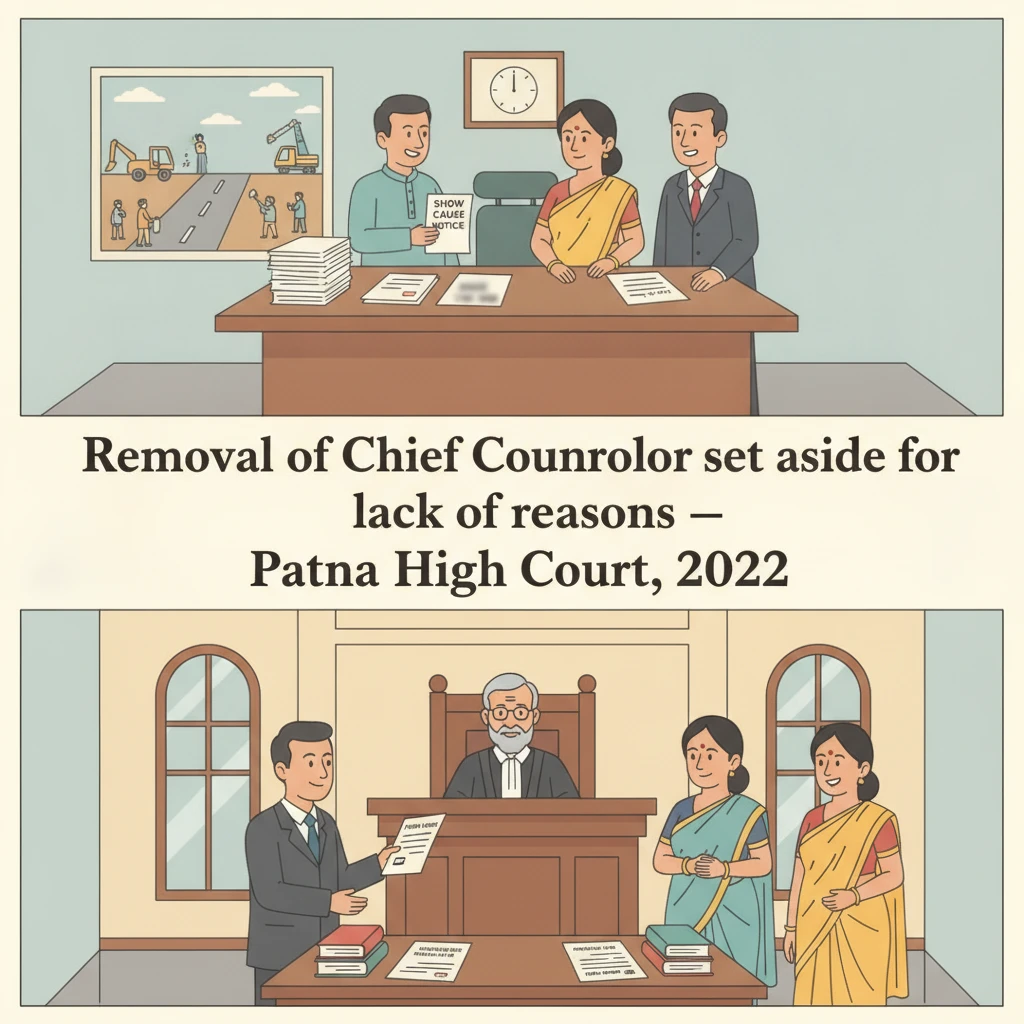
The petitioner was the elected Chief Councillor of Nagar Parishad, Siwan. A complaint was filed against her by respondent no. 9, a former Minister of State, alleging corruption and irregularities in municipal works and land purchase.
Acting on this complaint, the District Magistrate, Siwan conducted an enquiry and submitted a report dated 06.04.2021. On the basis of this report, the Urban Development and Housing Department issued a show cause notice to the petitioner under Section 25(5) of the Bihar Municipal Act, 2007.
The petitioner submitted a detailed reply on 28.09.2021, denying the allegations and offering explanations. However, she claimed she was never given a copy of the enquiry report and was not granted any personal hearing.
On 29.11.2021, an order was issued in the name of the Department, under the signature of the Under Secretary, stating that the charges mentioned in the enquiry report were found proved and that the petitioner’s show-cause reply was “not worth acceptable”. Relying on Section 25(5), this order removed her from the post of Chief Councillor.
Aggrieved, the petitioner filed Civil Writ Jurisdiction Case No. 20463 of 2021 before the Patna High Court challenging the removal order dated 29.11.2021, memo no. 3484. An intervenor applicant also sought to be impleaded, claiming to have earlier complained to constitutional functionaries about the petitioner’s conduct.
What the Court Examined and Decided
The Division Bench of Hon’ble Mr. Justice Chakradhari Sharan Singh and Hon’ble Mr. Justice Madhuresh Prasad examined the legality of the removal order and the procedure followed under Section 25(5) of the Bihar Municipal Act, 2007.
At the outset, the Court reproduced the impugned order in full, including the ten specific allegations said to have been found proved in the District Magistrate’s enquiry, such as alleged irregularities in road widening work, premature release of reserved amount, land purchase for garbage disposal without proper approval, and payments to a developer in violation of guidelines.
The English translation of the order showed two key features: first, it simply listed the findings of the District Magistrate’s enquiry; second, it contained a single, bare statement that the petitioner’s explanation was not acceptable, and then straightaway removed her from office under Section 25(5). No discussion of her defence was recorded.
The petitioner argued that the order was unreasoned and non-speaking, and that she had not been supplied the enquiry report or given a proper opportunity of hearing. She stressed that such an order, which removes a democratically elected representative and carries serious consequences, must strictly follow the statute and the principles of natural justice.
The State initially attempted to defend the order, suggesting that reasons existed in the departmental file and asking time to file a supplementary counter affidavit. On 27.01.2022, the Bench recorded its prima facie view that the order was “patently illegal”, “non-speaking and unreasoned having serious civil consequences”, yet the State still insisted on defending it and sought time.
Respondent no. 9’s senior counsel candidly conceded that the order was unsustainable because it was non-speaking.
However, an intervenor’s counsel relied on the Supreme Court judgment in State of Maharashtra v. Prabhu (1994) 2 SCC 481 and a Patna High Court decision in State of Bihar v. Akhil Bhartiya Jan Kalyan Sangh, 2000(1) PLJR 632, to urge that Article 226 is an equity jurisdiction. He argued that given the gravity of allegations against the petitioner, the High Court should refrain from interfering, as quashing the order would restore her as Chief Councillor and allegedly cause miscarriage of justice.
The Court examined Section 25(5) of the Bihar Municipal Act, which allows removal of a Chief Councillor or Deputy Chief Councillor, inter alia, where he or she is found guilty of misconduct in discharge of duties, but only after giving a reasonable opportunity for explanation. The Court noted that the impugned notification was issued in light of an order passed by the Principal Secretary, approved by the departmental Minister, though signed by the Under Secretary.
The petitioner specifically pleaded that the enquiry report relied upon was never supplied to her. In the State’s counter affidavit, sworn by the Project Officer-cum-Deputy Director, it was only said that the Special Secretary had mentioned the charges contained in the enquiry report in the show cause notice. There was no clear denial that the report itself was not furnished to her.
The Court observed that from the face of the impugned order, it was evident that it merely recited the enquiry findings and declared the reply “not acceptable”, without any reasoning or consideration of the petitioner’s explanations. The State’s stand that “every point” submitted by the petitioner had been considered was found “manifestly incorrect”, as no such consideration appeared in the order.
The Bench next considered Section 44 of the Bihar Municipal Act, which provides for appointment of Lok Prahari to inquire into allegations of corruption or misconduct against municipal office bearers and staff. The proviso to Section 25(5) states that after appointment of Lok Prahari, the Government may pass removal orders only on the basis of the Lok Prahari’s recommendation.
It was an admitted position before the Court that despite this provision being in the statute for about eleven years, no Lok Prahari had been appointed by the State Government.
Before deciding on the impugned order, the Court first rejected the intervenor’s application (I.A. No. 1 of 2021). Relying on the Supreme Court judgment in Ravi Yashwant Bhoir v. District Collector, Raigad, (2012) 4 SCC 407, particularly paragraphs 59 and 60, the Court held that a person with only a remote or sentimental grievance cannot claim to be a necessary party in such a lis. A complainant must show actual legal injury or violation of a proprietary right to claim locus standi. The intervenor had no such enforceable right; therefore, his application was “wholly misconceived”.
On merits, the Court placed strong reliance on several Supreme Court decisions on the protection of democratically elected local representatives. It noted that municipalities now have constitutional status after the 74th Constitutional Amendment, and elected officials cannot be removed “unceremoniously” by the State adopting a “casual approach”.
Quoting extensively from Ravi Yashwant Bhoir, the Bench emphasised that an elected office-bearer must be treated on a higher pedestal than a government servant. If even a temporary employee cannot be dismissed for misconduct without a full-fledged enquiry, an elected representative surely cannot be removed without following full procedure, giving reasons, and strictly adhering to natural justice.
The Court underlined paragraph 34 of Ravi Yashwant Bhoir: in a democracy, an elected representative is entitled to hold office for the full term unless removed by lawful procedure; removal proceedings must meet natural justice standards and show that the authority has applied its mind to both allegations and explanations.
The Bench also referred to State of Punjab v. Bhajan Singh, (2001) 3 SCC 565, where the Supreme Court condemned executive obstruction of an elected municipal president from assuming office, and imposed personal costs on the erring Secretary. It cited Tarlochan Dev Sharma v. State of Punjab, (2001) 6 SCC 260, warning senior civil servants not to surrender their statutory discretion to political pressure and insisting that drastic powers like removal of municipal presidents be exercised with full independent application of mind.
Applying these principles, the Patna High Court held that the removal order against the petitioner was in “flagrant violation of the principles of natural justice”, passed in a “causal and cavalier manner”. It found that the authority appeared insensitive to the serious consequences of a Section 25(5) order, which not only removes an elected Chief Councillor but also disqualifies her from contesting again during the remaining term and creates a social stigma that can mar future electoral prospects.
The Court reiterated basic natural justice standards: any quasi-judicial order with civil or evil consequences must be reasoned; the order must reflect application of mind; the person affected must have reasonable opportunity to explain; any show-cause reply must be duly considered and this must appear on the face of the order; and any material relied upon, such as enquiry reports, must be supplied in advance.
In this case, none of these safeguards were followed. The enquiry report was not supplied; no hearing was given; the show-cause reply was not discussed; and no reasons were recorded as to why the petitioner’s defence was rejected.
The Bench also discussed the concept of “legal malice” or “malice in law” as explained in Ravi Yashwant Bhoir. While the Court found no material to hold that the order was motivated by personal spite or ill-feeling, it concluded that there was “no lawful excuse” for passing such an order in disregard of the petitioner’s rights. On that basis, it held that the action was taken with an “oblique and indirect object” and therefore suffered from legal malice.
The State, through the Advocate General, produced two communications: one from the Advocate General to the Principal Secretary cautioning the Department against passing such non-speaking orders in future under Section 25(5), and another from the Department stating that it proposed to withdraw the impugned order and pass a fresh, detailed, reasoned order, for which it sought the Court’s permission.
The Court, however, declined to simply allow the Department to withdraw and reissue a reasoned order, because the communication made no mention of curing the basic defects—supplying the enquiry report and giving the petitioner an opportunity of hearing. The Bench therefore chose to finally decide the writ petition and quash the order.
In the operative part, the Court set aside the impugned order dated 29.11.2021, memo no. 3484, of the Urban Development and Housing Department. It clarified that it was not ruling on the truth or falsity of the allegations against the petitioner; any observations should not be read as findings on merits.
The Court left it open to the respondents, if so advised, to initiate fresh proceedings but strictly in accordance with law, after supplying the enquiry report, granting proper opportunity of hearing, and keeping in mind the law laid down in Ravi Yashwant Bhoir.
Recognising that the illegal order had kept the petitioner out of the office of Chief Councillor of Siwan Nagar Parishad, the Court followed Bhajan Singh and imposed exemplary costs. It directed the State of Bihar to pay Rs. 25,000 to the petitioner within two weeks. The consequences of quashing the order, including restoration to office, were to follow.
Why This Judgment Matters
This judgment is important for all elected representatives of municipalities and Nagar Parishads in Bihar and beyond.
It sends a clear message that the State Government cannot remove a democratically elected Chief Councillor by issuing a short, unreasoned order. Authorities must give full opportunity of hearing, share enquiry materials, and carefully consider the person’s defence before taking such drastic steps.
The Patna High Court also highlighted that provisions like Lok Prahari under Section 44 of the Bihar Municipal Act cannot be ignored indefinitely. Safeguards built into the law for fair enquiries must be respected.
For ordinary citizens and councillors, the decision shows that courts will step in where government orders violate basic fairness, even when there are serious allegations. The Court quashed the order not because the allegations were false, but because the correct legal process was not followed.
Legal Issues and Answers
Issue: Could the State remove a Chief Councillor under Section 25(5) of the Bihar Municipal Act based on an enquiry report, without supplying that report, without recording reasons, and without considering her reply in the order?
Answer: No. The Patna High Court held the removal order to be patently illegal, non-speaking, in violation of principles of natural justice, and therefore quashed it.
Issue: Was the intervenor, who claimed to have earlier complained against the Chief Councillor, a necessary party to the writ proceedings challenging the removal order?
Answer: No. Relying on Ravi Yashwant Bhoir, the Court held that a person with only a remote or sentimental interest and no legal injury has no locus standi and dismissed the intervention application.
Issue: Should the High Court, in equity, refuse to interfere with an illegal removal order because of the seriousness of allegations against the elected representative?
Answer: No. The Court distinguished State of Maharashtra v. Prabhu and held that equity cannot justify upholding an order that clearly violates statutory safeguards and natural justice, especially when it removes a democratically elected local representative.
Cases Cited by the Court
- Ravi Yashwant Bhoir v. District Collector, Raigad and others, (2012) 4 SCC 407.
- State of Punjab v. Bhajan Singh, (2001) 3 SCC 565.
- Tarlochan Dev Sharma v. State of Punjab and others, (2001) 6 SCC 260.
- State of Maharashtra and others v. Prabhu, (1994) 2 SCC 481.
- State of Bihar v. Akhil Bhartiya Jan Kalyan Sangh and others, 2000(1) PLJR 632.
- State of Punjab v. Baldev Singh, (1999) 6 SCC 172.
- Other Supreme Court cases referred within quotations, such as Anirudhsinhji Jadeja, Purtabpore Co. Ltd., etc., as part of broader principles on discretion and rule of law.
Case Details
Case Number: Civil Writ Jurisdiction Case No. 20463 of 2021
Case Title: Smt. Sindhu Singh v. The State of Bihar & Ors.
Court: High Court of Judicature at Patna
Bench: Division Bench
Coram: Hon’ble Mr. Justice Chakradhari Sharan Singh and Hon’ble Mr. Justice Madhuresh Prasad
Date of Judgment: 08.02.2022
Citation: 2022 (1) PLJR 897
Advocates:
- For the Petitioner: Mr. Sanjay Singh, Sr. Advocate; Mr. Ashok Kumar, Advocate; Mr. Bibhuti Narayan, Advocate.
- For the State of Bihar: Mr. Lalit Kishore, Advocate General; assisted by Mr. Kinkar Kumar, SC-9.
- For Respondent No. 9: Mr. P.K. Shahi, Sr. Advocate; Mr. Vikas Kumar, Advocate.
- For the Intervenor: Mr. Y.C. Verma, Sr. Advocate.
Nature of the Case: Writ petition under Article 226 of the Constitution challenging an order of removal of an elected Chief Councillor passed under Section 25(5) of the Bihar Municipal Act, 2007.
Link to Judgment: Click here to read the full judgment of the Patna High Court
If you found this explanation helpful and wish to stay informed about
how legal developments may affect your rights in Bihar,
you may consider following Samvida Law Associates for more updates.







