
Case Background
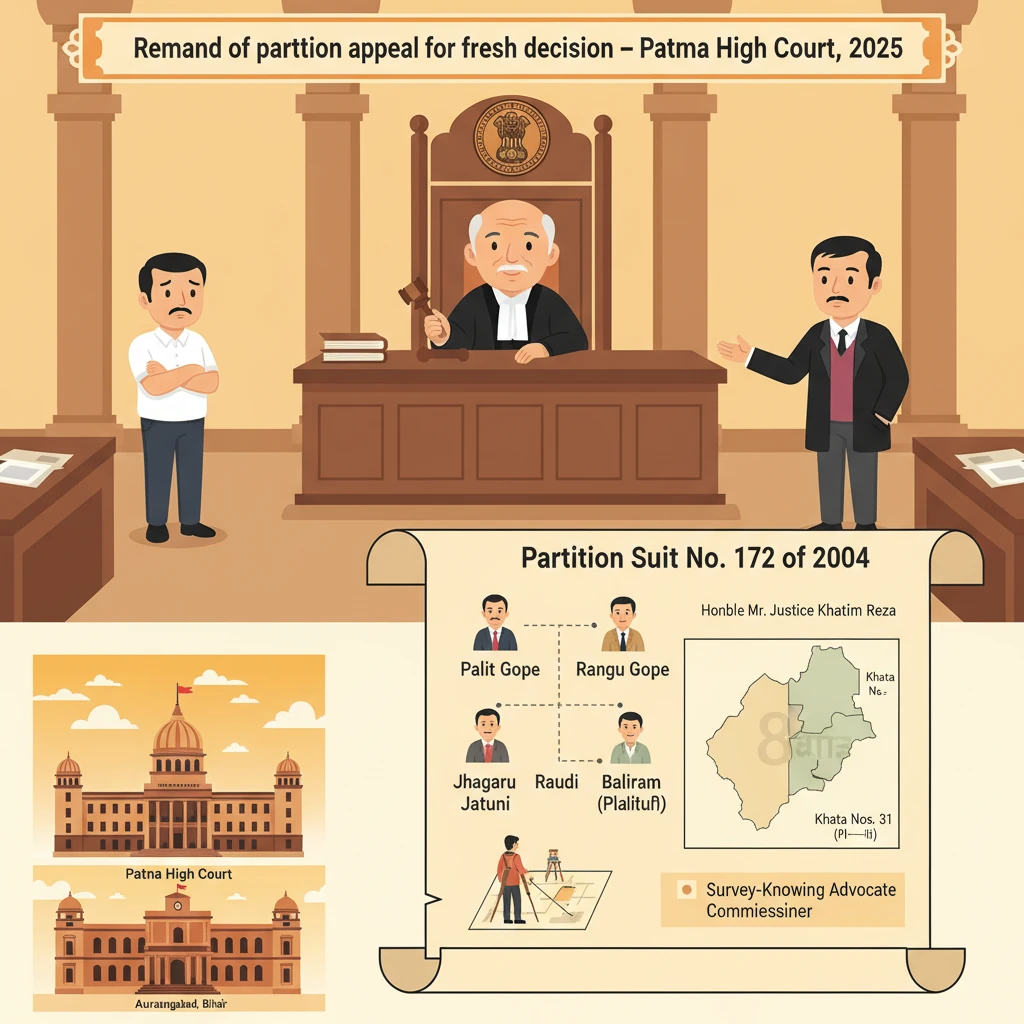
This case arises out of a long‑running family dispute over ancestral land in village Parariya, district Aurangabad, Bihar. The respondent, as plaintiff, had filed Partition Suit No. 172 of 2004 before the Sub-Judge-I, Aurangabad, seeking partition of his 8 annas (half) share in the joint family property. He also sought that a survey‑knowing Advocate Commissioner be appointed after the final decree, and that he be put in possession of his separated share.
In the plaint, the plaintiff described the suit lands and gave a detailed genealogical table to show his relationship with the original defendant, late Jatuni Gope @ Ramjatan Yadav, and other family members. According to him, the lands under Khata No. 25 of village Parariya stood recorded in the Cadastral Survey (C.S.) Khatiyan in the name of Palit Gope, son of Pati Gope, and Khata No. 31 stood in the name of Rangu Gope, son of Mangru Gope.
He pleaded that though Palit Gope and Rangu Gope were recorded separately in the C.S. Khatiyan, they were members of a joint Hindu family and in joint possession of the lands of Khata Nos. 25 and 31. On the death of Rangu Gope issueless and in a state of jointness, his interest devolved upon his nearest relation. The plaintiff’s case was that Palit Gope thereupon became the sole owner of both khatas.
After Palit Gope’s death, he left behind three sons: Jhagaru (also spelt Jhagru) Gope, Raudi Gope and Dewa Gope, all in a state of jointness. On the subsequent death of Raudi issueless, his share remained with his two full brothers, Jhagaru and Dewa. Jhagaru later died leaving behind his son, Jatuni Gope (original defendant), and his full brother, Dewa, who in turn died leaving behind the plaintiff, Baliram.
According to the plaintiff, after the deaths of Jhagaru and Dewa, Jatuni Gope became the Karta and manager of the joint family consisting of the plaintiff and the defendant. The plaintiff claimed that the suit property was ancestral or coparcenary property in which both he and the defendant had equal interest, with unity of title and possession, and that no partition had taken place among the sons of Palit or between the plaintiff and defendant.
The dispute came to court when, according to the plaintiff, the defendant tried to transfer the joint property without partition. The plaintiff asked for partition by metes and bounds, which the defendant finally refused, leading to the filing of the partition suit.
On being summoned, the original defendant, Jatuni Gope, contested the suit. He filed a written statement, challenged the maintainability of the suit, and denied that the plaintiff had any locus standi. He specifically denied the plaintiff’s genealogy and asserted that the plaintiff was not related to his family. He claimed that the plaintiff’s father, Dewa Gope, was not the son of late Palit Gope and not a member of their undivided Hindu joint family. He also gave his own genealogical table in respect of the family of Ama Gope.
The trial court framed eight issues. It treated Issue Nos. 5, 6 and 7 as the main issues for decision and termed the remaining as formal. After considering pleadings, oral evidence, and documentary evidence from both sides, the Sub-Judge-I, Aurangabad, decreed the suit on 30.04.2008, holding that the plaintiff was entitled to half share in the suit property.
The defendant then preferred Partition Appeal No. 18 of 2008/115 of 2018 before the Additional District Judge-III, Aurangabad. By judgment and decree dated 20.06.2019, the lower appellate court dismissed the appeal and affirmed the trial court’s decree.
Challenging that appellate judgment, the legal heirs of the original defendant, now appellants, filed Second Appeal No. 424 of 2019 before the Patna High Court.
What the Court Examined and Decided
In the second appeal, the Patna High Court, per Hon’ble Mr. Justice Khatim Reza, first identified two substantial questions of law:
(I) Whether the appellate court passed its judgment in violation of the mandatory provisions of Order XLI Rule 31 of the Code of Civil Procedure (CPC) by not formulating any point of determination.
(II) Whether the appellate court’s decision was unsupported by independent reasons, having merely copied the trial court’s judgment while affirming it.
To properly assess these questions, the High Court revisited the background of the suit. The plaintiff’s case was based on joint Hindu family and coparcenary rights descending from common ancestor Palit Gope and his sons, ultimately claiming an 8 annas share. The defendant’s defence rested mainly on two planks: denial of relationship (genealogy) and an alleged prior sale of part of the land by an earlier recorded raiyat.
On genealogy, the trial court had found that the witnesses produced by both sides were neither family members nor neighbours, nor persons having any special means of knowledge about the family tree. In the absence of reliable oral evidence, the trial court relied on Exhibit 1, the Chakbandi Khatiyan, which showed the plaintiff and defendant coming from the same branch, with equal shares. Since this document was neither disputed nor disbelieved by the defendant, the trial court held that the plaintiff’s genealogical table was correct. This finding was later mechanically affirmed by the lower appellate court.
On title and possession, the defendant relied on an asserted transaction: the case that Rangu Gope, recorded holder of Khata No. 31, had sold his entire land for legal necessity to Nagina Devi, wife of Jhagru Gope, on 21.07.1926 for Rs. 75/-, by an unregistered sale deed (Exhibit-D). It was claimed that a memorandum of sale was written the same day, that possession was delivered, and that Nagina’s name was mutated in the ex-landlord’s records. Upon her death, her husband Jhagru and then her son Jatuni allegedly came into possession as raiyats. Based on this, the defendants argued that the suit land was not ancestral or coparcenary property of the plaintiff.
The defendant produced various documents, including:
Ext.-A (Vakalatnama), Ext.-A1 (advocate’s signature on written statement), Ext.-B to B5 (rent receipts), Ext.-C to C2 (zamindari receipts), and Ext.-D (unregistered sale deed). The plaintiff produced Ext.-1 (Consolidation/Chakbandi Khatiyan), Ext.-2 (Cadastral Survey Khatiyan) and a Panchnama as Ext.-X. Both parties also led extensive oral evidence, with eight witnesses from the plaintiff’s side and fourteen from the defendant’s side.
The trial court had examined Issue Nos. 6 and 7 regarding prior partition and the alleged sale by Rangu. It held that there was no document showing any prior partition between the parties. It also disbelieved the zamindari receipts produced by the defendant due to contradictions in his own evidence. As to the unregistered sale deed (Ext.-D) for Rs. 75/-, the trial court treated it as an unregistered document and did not accept it as sufficiently proving the defendant’s exclusive title or possession.
In the second appeal, the appellants attacked the lower appellate court’s judgment on the ground that it had failed to independently evaluate this evidence and had not complied with Order XLI Rule 31 CPC. They argued that the first appellate court did not frame points for determination, did not examine oral and documentary evidence afresh, and simply copied the trial court’s findings. They contended that this approach violated their valuable right to a full rehearing on facts and law in first appeal.
The appellants also argued that both courts had wrongly discarded Ext.-D solely on the ground of non-registration, without properly appreciating that under Section 17 of the Registration Act, registration of a sale deed for less than Rs. 100/- is optional, not mandatory. They contended that the appellate court failed to consider this aspect at all.
The respondent, on the other hand, supported the concurrent findings. Relying on Parmanand Yadav & Anr. v. Jagdeo Yadav & Ors. (2014) 3 PLJR 827, it was argued that concurrent findings of fact, even if erroneous, cannot be disturbed in second appeal. The respondent also relied on Section 54 of the Transfer of Property Act to emphasize that sale of immovable property of value less than Rs. 100/- must be either by registered instrument or by delivery of possession, and that mere constructive delivery is not enough. The respondent pointed out that the defendant had failed to prove actual possession flowing from Ext.-D, and that both courts were right in rejecting the claim.
The respondent further submitted that the lower appellate court had, in substance, considered the trial court’s findings and thus substantially complied with Order XLI Rule 31 CPC. Reliance was placed on the Gauhati High Court decision in Gopendra Goswami & Ors. v. Haradhan Das & Ors., AIR 2009 Gauhati 41, to argue that where the appellate court agrees with the trial court, it need not restate all the evidence or reasons separately.
The Patna High Court closely scrutinized the appellate judgment. It found that the findings in paragraph Nos. 10, 11, 12 and 13 of the lower appellate court’s judgment were nothing but a copy-paste of paragraph Nos. 8, 9, 10 and 11 of the trial court’s judgment. There was no independent analysis or application of judicial mind by the appellate court.
The High Court reiterated the settled legal position regarding first appeals. Referring to the Supreme Court’s decision in P.V. Nagesh & Anr. v. H.V. Sreenivasa Murthy, (2010) 3 SCC 530, and Malluru Mallappa (Dead) Through LRs v. Kuruvathappa & Ors., (2020) 4 SCC 313, it emphasized that Order XLI Rule 31 CPC mandates that a judgment of the appellate court must state:
(a) the points for determination,
(b) the decision thereon,
(c) the reasons for the decision, and
(d) where the decree is reversed or varied, the relief to which the appellant is entitled.
The Supreme Court had clearly held that the first appeal is a valuable right. The whole case is open for rehearing on both facts and law. Therefore, the appellate court must show conscious application of mind, deal with all issues and evidence, and give its own reasons.
Applying these principles, the Patna High Court held that the lower appellate court had failed to fulfil these mandatory requirements. It neither formulated points for determination nor reappreciated the evidence. It merely adopted the trial court’s findings without independent reasoning. This, the High Court held, caused serious prejudice to the appellants and amounted to non-compliance with Order XLI Rule 31 CPC, resulting in an infirm judgment.
The High Court also noted that the question regarding registration of a sale deed of value less than Rs. 100/- and its effect under Section 54 of the Transfer of Property Act had not been examined by the lower appellate court in its proper perspective. Thus, important legal and factual issues remained unaddressed in the first appeal.
In light of this, the Patna High Court answered the substantial questions of law in favour of the appellants. It set aside the judgment and decree dated 20.06.2019 passed in Partition Title Appeal No. 18 of 2008/115 of 2018 by the Additional District Judge-III, Aurangabad. The matter has been remanded to the lower appellate court to decide the appeal afresh in accordance with law. The High Court directed that the appeal be disposed of preferably within six months from the date of receipt of a copy of its judgment.
The second appeal thus succeeded and was allowed. All contentions of the parties on merits were left open for consideration by the lower appellate court. No order as to costs was made, and all pending interlocutory applications, if any, were disposed of.
Why This Judgment Matters
This judgment is significant mainly for how the Patna High Court enforced the duties of a first appellate court. It does not finally decide who owns the land or how it should be partitioned. Instead, it stresses that when a party files a first appeal, that appeal must be heard seriously and fully.
For litigants in partition suits and other civil disputes, this means that the appellate court cannot simply copy the trial court’s order and dismiss the appeal. It must:
Frame its own points for determination, examine both facts and law again, discuss the oral and documentary evidence, and give clear reasons for agreeing or disagreeing with the trial court.
If this is not done, the High Court can interfere in second appeal and send the case back. That is exactly what has happened here. The plaintiff’s partition decree is no longer final; it will now depend on the fresh decision of the lower appellate court.
The judgment also highlights, in the specific context of rural family property disputes, that unregistered old sale deeds of small value and rent receipts must be properly examined in light of Section 54 of the Transfer of Property Act and the Registration Act. While the High Court has not given a final answer on those issues, it has signalled that such questions must be addressed in detail by the appellate court.
Legal Issues and Answers
- Issue: Did the lower appellate court violate Order XLI Rule 31 CPC by not formulating points for determination and by failing to give its own reasons?
Answer: Yes. The Patna High Court held that the appellate court merely copied the trial court’s findings without independent analysis, violating the mandatory requirements of Order XLI Rule 31. - Issue: Was the appellate court’s decision sustainable when it did not independently consider the oral and documentary evidence on record?
Answer: No. The High Court found that the appellate court had neither reappreciated the evidence nor passed a reasoned judgment, causing prejudice to the appellants and rendering its judgment infirm. - Issue: What consequence follows from such non-compliance by the first appellate court?
Answer: The High Court set aside the appellate decree and remanded the appeal to the lower appellate court for fresh disposal in accordance with law, within a specified time.
Cases Cited by the Court
- P.V. Nagesh & Anr. v. H.V. Sreenivasa Murthy, (2010) 3 SCC 530
- Malluru Mallappa (Dead) Through Legal Representatives v. Kuruvathappa & Ors., (2020) 4 SCC 313
- Gopendra Goswami & Ors. v. Haradhan Das & Ors., AIR 2009 Guwahati 41 (cited in argument)
- Parmanand Yadav & Anr. v. Jagdeo Yadav & Ors., (2014) 3 PLJR 827 (cited in argument)
- Janardhan Narasimha Nayak v. Balwant Venaktesh Kulkarni & Anr., (2007) 9 SCC 658 (cited in argument)
Case Details
Case Number: Second Appeal No. 424 of 2019
Case Title: Deonandan Yadav @ Deonarayan Yadav & Ors. v. Baliram Gop
Coram: Hon’ble Mr. Justice Khatim Reza
Citation: 2025(3) PLJR 208
Advocates:
For the appellants (defendants): Mr. Narendra Kumar, Advocate; Mr. Tej Narayan Singh, Advocate; Mr. Akash Ambuj, Advocate.
For the respondent (plaintiff): Ms. Sunita Kumari, Advocate; Mr. Dharmendra Kr. Sinha, Advocate.
Date of Patna High Court judgment: 15.05.2025
Nature of the case: Second appeal in a partition suit (family property dispute), challenging the first appellate court’s judgment affirming a decree for partition.
Lower Court History:
Trial Court: Partition Suit No. 172 of 2004, judgment and decree dated 30.04.2008 by Sub-Judge-I, Aurangabad, decreeing half share to the plaintiff.
First Appeal: Partition Title Appeal No. 18 of 2008/115 of 2018, judgment and decree dated 20.06.2019 by Additional District Judge-III, Aurangabad, affirming the trial court and dismissing the appeal.
Link to Judgment: https://patnahighcourt.gov.in/viewjudgment/OSM0MjQjMjAxOSMxI04=-lYshrG2S6n4=
If you found this explanation helpful and wish to stay informed about
how legal developments may affect your rights in Bihar,
you may consider following Samvida Law Associates for more updates.







