
Case Background
This case arises from recruitment to Class III posts (Clerks) in the Civil Courts of Bihar under the Bihar Civil Court Staff (Class III and IV) Rules, 2009.
An Employment Notice No. 01/2016 dated 07.02.2016 invited applications. The writ petitioner (respondent No. 1 in the appeal) participated in the preliminary examination, mains examination and interview. He secured 74.25 marks and, though he fell short of the unreserved cut‑off, his name appeared in the waiting list at serial number 28. He obtained this position later by using the Right to Information Act.
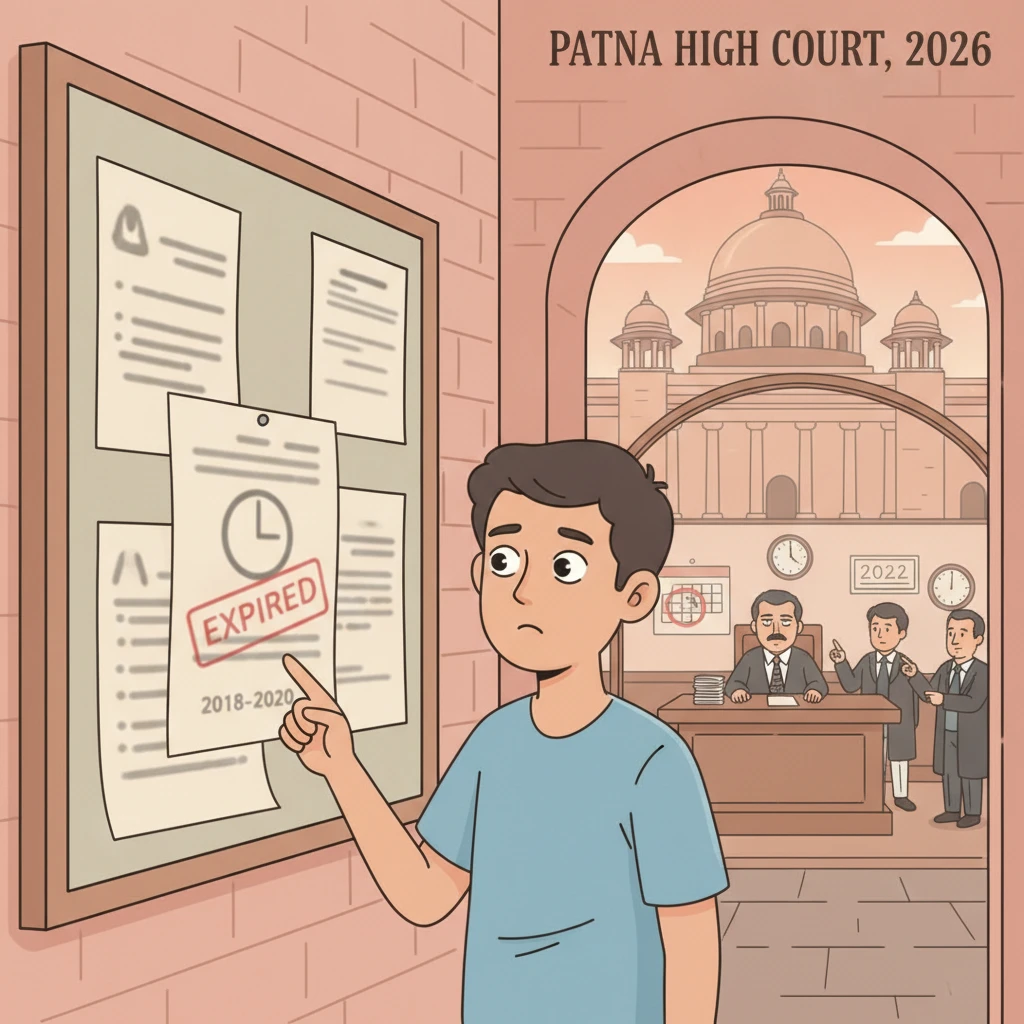
A common merit panel or waiting list dated 26.09.2018 was prepared. Under Rule 7(13) of the 2009 Rules, this panel had a life of two years and, therefore, expired on 26.09.2020.
Several candidates earlier approached the High Court in 2018 and 2019, during the life of this panel, complaining that many vacancies, including 273 said to have arisen due to non‑joining of selected candidates, were not being filled from the panel. Those writs eventually led to a Division Bench judgment dated 19.04.2023 in L.P.A. No. 650 of 2022 and analogous cases, where the Court held that the authorities were obliged to operate the panel within its validity to fill vacancies.
The present writ petitioner did not file his own writ during that period. He filed an interlocutory application (I.A. No. 04 of 2022) on 09.05.2022 in an already pending writ of similarly placed candidates, and later, on legal advice, withdrew that attempt and filed an independent writ petition, C.W.J.C. No. 10521 of 2022, on 22.07.2022. By that time, the panel had expired nearly two years earlier.
On 09.07.2025, a learned Single Judge allowed his writ petition. The Judge held that his case was squarely covered by Division Bench judgments dated 19.04.2023 (L.P.A. No. 650 of 2022 and analogous cases), 18.01.2024 (L.P.A. No. 727 of 2023), and 16.12.2024 (L.P.A. No. 261 of 2024. The Single Judge directed the High Court authorities to consider his case and, if otherwise eligible, issue necessary appointment and posting orders as Clerk by extending similar treatment as others, preferably within eight weeks.
The High Court administration (through the Patna High Court, Registrar General, and the Convenor, Co‑ordination Committee‑cum‑District and Sessions Judge, Patna) filed the present Letters Patent Appeal No. 891 of 2025 against that order.
What the Court Examined and Decided
The Division Bench (Hon’ble the Chief Justice and Hon’ble Mr. Justice Alok Kumar Sinha, speaking through Justice Sinha) examined four key issues: delay and laches, whether the writ petitioner was a “fence‑sitter”, whether the Single Judge could direct consideration for appointment, and whether the impugned order contained legal error warranting interference.
First, on delay and laches, the Court focused on the validity period of the 26.09.2018 panel. Rule 7(13) of the 2009 Rules fixes the life of such panel at two years. Thus it expired on 26.09.2020.
The writ petitioner’s I.A. dated 09.05.2022, and even more so his writ petition dated 22.07.2022, were filed well after this expiry. The Court treated this as “clear and unexplained delay of more than one and a half years” in invoking writ jurisdiction.
To explain the law, the Bench relied on the Supreme Court judgment in State of U.P. vs. Harish Chandra, (1996) 9 SCC 309. There, the Supreme Court held that no mandamus can be issued to appoint candidates from a selection list after its statutory life is over. Even if, on some occasions, authorities have illegally made appointments from an expired list, such illegal acts do not give other candidates any enforceable right to demand the same through a writ.
The Bench quoted paragraph 10 of Harish Chandra, emphasising two points. One, a writ of mandamus requires a legal right that is still subsisting on the date of the petition. Two, courts cannot direct something contrary to statutory rules; they cannot perpetuate illegality merely because in some instances authorities have done so earlier.
The Court also referred to Chairman/Managing Director, U.P. Power Corporation Ltd. vs. Ram Gopal, (2021) 13 SCC 225. That judgment reiterates that candidates who come to court only after expiry of a select list cannot claim appointment merely because some others with lesser merit, who litigated in time, won relief. “Delay defeats equity,” and stale claims should not be entertained in writ jurisdiction.
Applying these principles, the Bench contrasted this petitioner with earlier writ petitioners in C.W.J.C. No. 21219 of 2018 and C.W.J.C. No. 6259 of 2019. Those candidates moved the Court during the panel’s validity. Their timely assertion of rights was the foundation for the eventual relief in L.P.A. No. 650 of 2022. By comparison, the present petitioner remained silent during that crucial two‑year period.
The Court rejected his argument that, because he filed an I.A. and later a writ in 2022 while earlier writs were pending, his claim could not be treated as delayed. The cause of action, if any, arose when vacancies remained unfilled during the panel’s life. The mere pendency of other cases could not extend the panel’s life or revive a stale cause of action.
The petitioner also relied on the Supreme Court decision in State of U.P. vs. Arvind Kumar Srivastava, (2015) 1 SCC 347. That case recognises that similarly situated persons should ordinarily receive similar relief. But the Patna High Court emphasised paragraph 22.2 of that judgment, which carves out a clear exception for those who sleep over their rights. People who do not challenge an illegal action in time and wake up only after seeing others succeed are treated as “fence‑sitters” and can be denied relief on the ground of delay and acquiescence.
On facts, the Bench held that this petitioner falls exactly within that exception.
The Court then examined whether he was indeed a “fence‑sitter”. Referring to Arvind Kumar Srivastava and to Shiba Shankar Mohapatra vs. State of Orissa, (2010) 12 SCC 471, the Bench explained that “fence‑sitters” are those who watch from the sidelines while others fight, and approach the Court only after those others succeed. The law discourages such behaviour because it upsets settled positions and can prejudice third parties.
The Bench noted that the petitioner did not move the Court during the panel’s life (up to 26.09.2020). Earlier litigants acted in 2018–2019. His first move came in May 2022 and then July 2022, long after the panel had expired and after earlier writs had been heard and were close to decision.
The petitioner argued that since he came to Court before the Division Bench judgment dated 19.04.2023, he could not be branded as seeking to ride on that success. The Bench disagreed. The relevant question is not whether he filed before or after the appellate decision, but whether he asserted his claim while the cause of action (existence of a live panel) still existed. On that test, he failed.
The Court also rejected his plea that he could not have approached earlier because the waiting list was not officially published. Other candidates with similar status had still managed to challenge the non‑operation of the panel in time. The petitioner knew he had participated in the recruitment and knew the broad outcome by 2018. His failure to act earlier could not be excused.
Thus, the Bench concluded that his conduct clearly fitted the “fence‑sitter” category, disentitling him from relief based on parity with more diligent litigants.
Next, the Bench examined the Single Judge’s direction to consider his case for appointment in light of Rule 7 of the 2009 Rules and the fact that candidates with lower marks had already been appointed.
The Bench accepted that Rule 7(12)–(14) required authorities to prepare and operate a merit panel for two years to fill existing and anticipated vacancies, and that the Division Bench in L.P.A. 650 of 2022 had held that failure to operate the panel was illegal.
However, the crucial point for this appeal was the scope of those earlier judgments. The appellants argued that the benefit of the 19.04.2023 judgment was confined to the petitioners in those cases and others who had asserted rights within reasonable time, and that the judgment was in personam, not in rem.
The Bench accepted this reasoning. Even if some candidates with lower marks were appointed pursuant to those judgments or subsequent orders, their appointments were tied to their own timely litigation. Article 14 does not allow “negative equality” — one illegality cannot be used to demand another. Therefore, the mere fact that some lower‑merit candidates obtained appointments could not create a right for a latecomer from an expired panel.
The Court also noted that other coordinate Benches in C.W.J.C. No. 1063 of 2024 and C.W.J.C. No. 4175 of 2024 had already rejected similar delayed claims on grounds of laches. The Single Judge’s contrary view created inconsistency within the High Court.
The Bench distinguished the Supreme Court judgment in Lt. Col. Suprita Chandel vs. Union of India, 2024 SCC OnLine SC 3664, which had been cited for the parity principle. That case applied where claimants were not guilty of delay or acquiescence. The Supreme Court itself recognised that in exceptional cases involving delay, benefits may be rightly denied. Here, delay was central.
Finally, the Bench evaluated whether the Single Judge’s decision contained legal infirmity warranting appellate interference. It found three major errors:
First, the Single Judge treated L.P.A. 650 of 2022 as if it had universal application, without examining whether the Division Bench intended that. The actual direction there was only for consideration of the appellants’ cases within the panel’s validity period, not for reopening the lapsed panel for all candidates.
Second, the Single Judge relied heavily on the fact that candidates with lower marks had been appointed, effectively applying “negative equality”. This goes against settled Supreme Court law that illegality cannot be multiplied under Article 14.
Third, the Single Judge did not give proper weight to delay, laches and the statutory expiry of the panel under Rule 7. Any direction to consider appointments from a lapsed panel, especially when new recruitment under new Rules (Advertisement No. 01 of 2022) had already begun, could disrupt the recruitment framework and affect third‑party rights.
Because of these legal errors, the Division Bench held that the impugned judgment dated 09.07.2025 could not stand. It allowed the Letters Patent Appeal, set aside the Single Judge’s order, and dismissed the writ petition. No order as to costs was made.
Why This Judgment Matters
This judgment sends a clear message to job‑seekers participating in government or court recruitments in Bihar.
First, if you believe there is illegality in how a selection list or waiting list is being used, you must approach the court while that list is still valid, or at least within a reasonable time. Waiting to see the outcome of other people’s cases can fatally weaken your own claim.
Second, even if some candidates with lower marks obtain jobs through their own timely litigation, others who stayed silent cannot automatically demand the same relief later. Courts will not extend benefits to “fence‑sitters”.
Third, the Patna High Court has again underlined that it cannot order appointments from a panel after its statutory life has ended, except where earlier timely petitions are still being worked out. Once a panel lapses, new recruitment rules and advertisements take over.
For aspirants of Civil Court Clerk posts and other government jobs, this decision highlights the importance of acting quickly and independently, instead of relying on future favourable judgments for others.
Legal Issues and Answers
Issue: Was the writ petition filed by the candidate maintainable despite being filed after expiry of the 26.09.2018 panel under Rule 7 of the 2009 Rules?
Answer: No. The Patna High Court held the writ was barred by delay, laches and acquiescence, as it was filed more than one and a half years after the panel expired.
Issue: Could the candidate be treated as similarly situated to those who obtained relief in L.P.A. No. 650 of 2022 and subsequent cases, and claim parity based on appointments of lower‑merit candidates?
Answer: No. He was treated as a “fence‑sitter” who did not assert his rights in time. The earlier judgments were held to be in personam, and Article 14 does not permit negative equality.
Issue: Did the Single Judge’s direction to consider his appointment suffer from legal error warranting interference in an intra‑court appeal?
Answer: Yes. The Division Bench found misapplication of law on delay and laches, incorrect extension of earlier judgments beyond their scope, and improper reliance on appointments of lower‑merit candidates. The order was set aside and the writ dismissed.
Cases Cited by the Court
- State of U.P. vs. Harish Chandra, (1996) 9 SCC 309.
- Chairman/Managing Director, U.P. Power Corporation Ltd. vs. Ram Gopal, (2021) 13 SCC 225.
- State of U.P. vs. Arvind Kumar Srivastava, (2015) 1 SCC 347.
- Shiba Shankar Mohapatra vs. State of Orissa, (2010) 12 SCC 471.
- Lt. Col. Suprita Chandel vs. Union of India, 2024 SCC OnLine SC 3664 (distinguished).
Case Details
Case Number: Letters Patent Appeal No. 891 of 2025 in Civil Writ Jurisdiction Case No. 10521 of 2022.
Case Title: The Patna High Court through its Registrar General & Ors vs. Chandan Kumar & Ors.
Citation: 2026 (3) PLJR 494.
Coram: Hon’ble the Chief Justice; Hon’ble Mr. Justice Alok Kumar Sinha.
Date of Judgment: 24.03.2026.
Advocates:
- For the appellants (High Court authorities): Mr. Piyush Lall, Advocate.
- For the State of Bihar: Mr. S. Raza Ahmad, AAG‑5; Mr. Alok Ranjan, AC to AAG‑5.
- For respondent No. 1 (writ petitioner): Mr. Kumar Kaushik, Advocate; Mr. Hemant Raj, Advocate.
Nature of the Case: Intra‑court appeal (Letters Patent Appeal) against an order of a Single Judge in a writ petition under Article 226 of the Constitution, concerning non‑appointment from a Civil Court staff waiting list.
Link to Judgment: Click here to view the official Patna High Court judgment
If you found this explanation helpful and wish to stay informed about
how legal developments may affect your rights in Bihar,
you may consider following Samvida Law Associates for more updates.







