
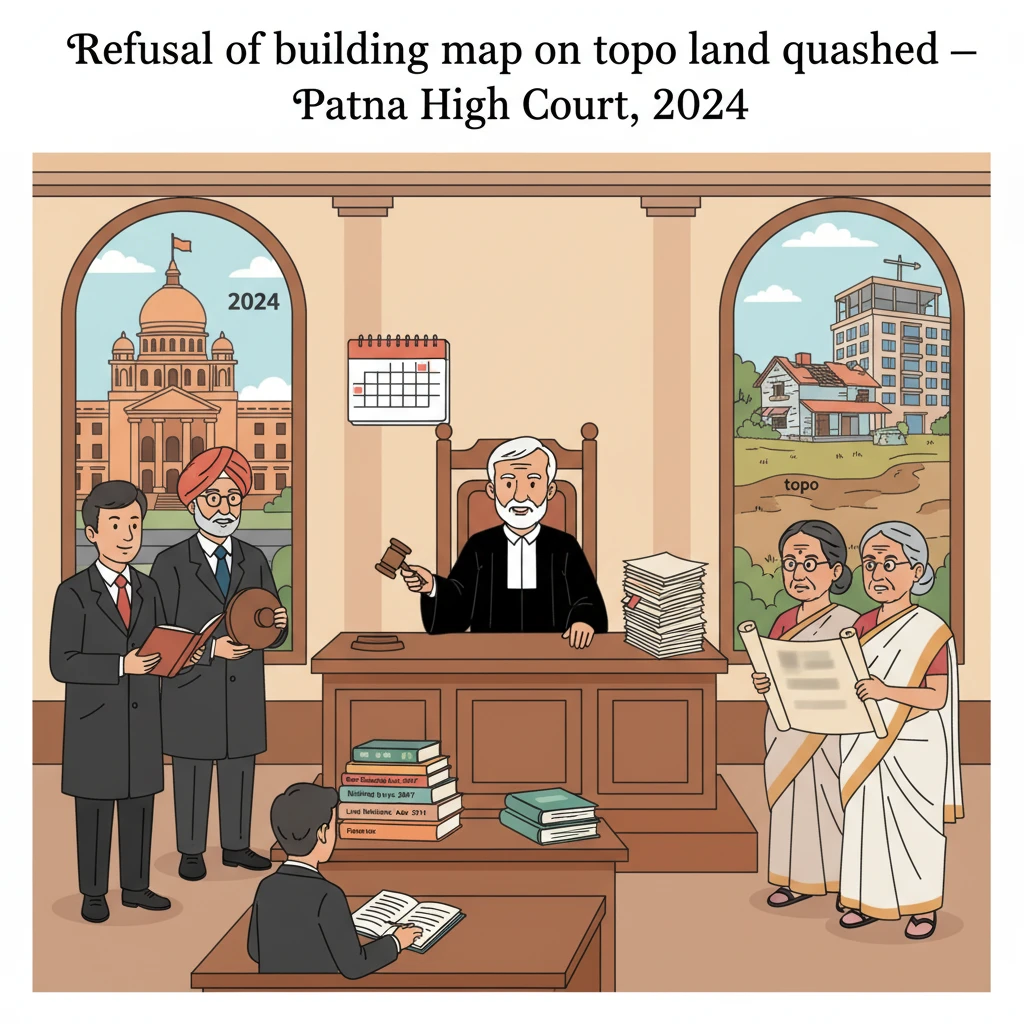
Case Background
The petitioner claimed to be in continuous possession of a plot measuring about 5800 sq. ft. (12.823 decimals) within Chapra Municipal Corporation area, bearing holding no. 716, Ward No. 2, Circle No. 16, District Saran.
This land was purchased through two registered sale deeds from the same vendor, one dated 22.06.2006 in favour of the petitioner for 200 sq. ft., and another dated 20.11.2006 in favour of his wife for 5586 sq. ft. The Municipal Corporation, after examining these documents, mutated the holding in their names and the petitioner started paying municipal dues.
There was a dilapidated house over about 1000 sq. ft. of this land. The petitioner wanted to demolish it and construct a residential-cum-commercial building. For this, he applied for sanction of a building plan (map) before Chapra Municipal Corporation.
On 26.06.2023, the petitioner and his wife submitted the building plan application in the prescribed Form-II, along with Form-IV (Certificate of Structural Stability), Form-V (Supervision), Form-VI (Check List), and Form-X (Notice of Commencement). These were signed by an authorised engineer of Chapra Municipal Corporation. The petitioner also deposited building permission fees of Rs. 1,51,500 and Rs. 35,513 by cheques, and filed an affidavit dated 29.08.2022 as required under the Bihar Building Bye-Laws, 2014.
When no sanction came, the petitioner filed a representation on 05.07.2023 before the Municipal Commissioner (respondent no. 9) seeking approval of his building plan.
Instead of granting permission, the Municipal Commissioner, Chapra, rejected the application by letter no. 2823 dated 14.09.2023. The rejection was based on a report by the Junior Engineer (respondent no. 10) that rent receipts, land possession certificate (LPC) and other revenue documents were not attached with the check list.
The petitioner then approached the Patna High Court under Article 226 of the Constitution in Civil Writ Jurisdiction Case No. 15963 of 2023, challenging this rejection and seeking a direction to sanction his building map.
What the Court Examined and Decided
The Patna High Court, through Hon’ble Mr. Justice Purnendu Singh, heard senior counsel for the petitioner, the State’s counsel, and counsel for the municipal body.
The petitioner argued that he had complied with the requirements of the Bihar Building Bye-Laws, 2014 and that his holding had been validly recorded by Chapra Municipal Corporation for years on the basis of registered sale deeds.
He submitted that the municipal authorities were duty-bound to issue the building plan based on the holding number, particularly for un-surveyed or “topo” lands in urban areas where conventional survey records like khata and khesra do not exist. He also pointed out that similarly placed neighbours had obtained building plans and had already constructed commercial complexes on adjacent plots.
The main grievance was that the Municipal Commissioner rejected the application only because revenue documents like Jamabandi, LPC and rent receipts were not attached, even though the Circle Officer refused to issue these documents due to a State-level prohibition on dealing with topo lands until a new survey and policy were finalised.
The Municipal Corporation, on the other hand, argued that the writ petition was not maintainable because an appeal lay to the Municipal Building Tribunal under Section 329 of the Bihar Municipal Act, 2007 against rejection of a building plan. They also claimed that the petitioner had failed to comply with Rule 6 of the Bihar Building Bye-Laws, 2014 by not furnishing requisite land-related documents, and therefore the rejection was justified.
In view of the wider issue regarding topo lands, the Court directed the Additional Chief Secretary, Revenue and Land Reforms Department, to personally appear and clarify the legal position. In the post-lunch session, the Additional Chief Secretary appeared with the learned Advocate General.
The Additional Chief Secretary informed the Court that the land in question is an un-surveyed “topo land”. As per the existing understanding, all un-surveyed lands belong to the Government and no individual can claim ownership. However, the State was contemplating a policy to grant ownership rights to citizens who have been living or carrying on agricultural or business activities on such lands for decades and have been paying taxes. A survey of topo lands was ongoing, after which Jamabandi and related rights would be regularised, to reduce land disputes.
The Court then examined the broader context of topo lands in Bihar. It noted that around 20 percent of land in Bihar is unsurveyed topo land, largely in riverine areas such as the Ganga and Koshi basins, where land appears and disappears due to alluvion and diluvion. Because of this, cadastral and revisional surveys could not fully capture these lands. Districts like Saran have large stretches of such land, leading to frequent disputes over ownership and transfers.
The Court traced the administrative history. Based on a meeting held on 03.06.2017 under the Chairmanship of the Principal Secretary, Revenue and Land Reforms, the Registration, Excise and Prohibition Department had earlier issued Letter No. 3113 dated 20.07.2017, directing all District Registrars and Sub-Registrars not to register any documents transferring rights in unsurveyed lands.
This ban was challenged earlier. In C.W.J.C. No. 9937 of 2020 (Satyendra Kumar Singh v. State of Bihar & Ors.), a Division Bench dealt with unsurveyed land in Chapra town. The Sub-Registrar had refused to register a mortgage deed without reasons. The Division Bench held that if a document complies with statutory requirements, the registrar is duty-bound to register it and cannot refuse on executive policy grounds. The State’s Special Leave Petition (Diary No. 11958/2023) against this decision was dismissed by the Supreme Court on 10.04.2023.
Similarly, in C.W.J.C. No. 2524 of 2018 (Rakesh Gupta v. State of Bihar & Ors.), a coordinate Bench considered topo land in Chapra Municipal Corporation area. The Court declared the 03.06.2017 minutes (memo dated 07.06.2017) and the consequential Letter No. 3113 dated 20.07.2017 as invalid and non est.
Following these rulings, the Assistant Inspector General, Registration, Excise and Prohibition Department, withdrew the earlier ban via Letter No. 4087 dated 16.08.2022, thereby restoring sale and purchase of topo land.
However, another meeting on 12.09.2022 under the Chairmanship of the Additional Chief Secretary, Revenue and Land Reforms Department, decided that although municipal bodies could change holding numbers and ownership for topo lands based on municipal records, Circle Officers would not be allowed to create or cancel Jamabandi or fix rent for such topo lands until completion of a fresh survey. This decision was circulated by Urban Development and Housing Department through Memo No. 597 dated 29.09.2022.
On the facts, the Court noted that the petitioner had purchased the land through registered sale deeds and that Chapra Municipal Corporation had long ago created holding no. 716 in his and his wife’s names. There were no khata or khesra numbers because the entire area was unsurveyed topo land. The Commissioner’s rejection letter itself admitted that the petitioner satisfied the conditions of the Building Bye-Laws, 2014 except for non-submission of rent receipts and LPC.
The Court carefully analysed the Bihar Building Bye-Laws, 2014 and the prescribed forms, especially Form-II (application), Form-VI (check list) and the provisions under Rule 5 and Rule 6. It found that the bye-laws did not make Jamabandi, revenue rent receipt or LPC from the Circle Officer an absolute precondition for sanction of building plans in the manner claimed in the rejection order, especially where such documents cannot be issued due to a State-imposed restriction.
The Court also referred to general legal principles. It invoked the doctrine “lex non cogit ad impossibilia” (the law does not compel the doing of impossibilities) and “impotentia excusat legem” as discussed by the Supreme Court in Industrial Finance Corporation of India Ltd. v. Cannanore Spg. and Wvg. Mills Ltd., State of M.P. v. Narmada Bachao Andolan, and LIC v. CIT. These cases establish that where law creates a duty but performance is impossible without fault of the person, insistence on performance must yield.
Here, the petitioner was ready to comply and even offered to pay rent, but the Circle Officer, acting under Memo No. 597 dated 29.09.2022, refused to issue Jamabandi, rent receipts or LPC. Therefore, the Court held that requiring these very documents from the petitioner as a condition for sanctioning the building plan was an impossible condition.
The Court further held that the existence of an appellate remedy under Section 329 of the Bihar Municipal Act, 2007 did not bar the writ petition in this case. Relying on Supreme Court decisions including State of U.P. v. Ehsan, Magadh Sugar & Energy Ltd. v. State of Bihar, and others, the Court held that writ jurisdiction can be exercised where pure questions of law arise, or where the authority acts without jurisdiction or contrary to settled legal principles, and where forcing a party to exhaust alternate remedies would cause injustice.
The Court also emphasised Article 300A of the Constitution, which protects a person’s right to property and requires that no one be deprived of property save by authority of law. The State cannot, by an executive decision not backed by law, effectively prevent mutation and then, through municipal bodies, deny the benefits that flow from registered ownership such as sanction of building plans.
On this reasoning, the Court concluded that the Municipal Commissioner’s rejection order, issued mechanically on the recommendation of the Junior Engineer without giving the petitioner an opportunity to furnish or explain documents, and without properly applying the Building Bye-Laws, 2014, was without authority of law.
Accordingly, the Court set aside and quashed letter no. 2823 dated 14.09.2023 (referred to in para 59 as letter no. 2825 dated 14.09.2023) rejecting the petitioner’s building plan. It observed that the petitioner should not be forced to pursue the appellate remedy in these circumstances.
Separately, taking note of the State’s submission that survey of topo land was ongoing, the Court directed that steps already initiated by the State be completed expeditiously within a reasonable period, at least for Chapra town where the township has existed for more than 100 years and the pattern of alluvion and diluvion has stabilised.
With these findings and directions, the writ petition was disposed of without any order as to costs.
Why This Judgment Matters
This judgment is important for landowners and residents living on topo (unsurveyed) land in Bihar, especially in towns like Chapra where entire localities stand on such land.
It makes clear that once a person has purchased land through a registered sale deed and obtained a municipal holding number, the municipal authorities cannot indefinitely deny basic civic permissions, like sanction of building plans, only because the State has chosen not to complete its surveys or issue Jamabandi and rent receipts.
The Patna High Court has held that authorities cannot demand documents which, due to their own government instructions, cannot legally be issued. Law does not require a person to do the impossible, and executive decisions that effectively block rights flowing from valid registrations cannot override statutory protections and constitutional rights.
Practically, this judgment offers relief to many families and small businesses on topo land who need to repair, rebuild or construct their houses and shops. It signals to municipal bodies that they must apply building bye-laws reasonably and not hide behind incomplete revenue formalities when those formalities are themselves frozen by the State.
The judgment also nudges the State Government to complete the survey and policy work on topo lands quickly, so that long-pending uncertainty over land titles and Jamabandi can be resolved and disputes reduced.
Legal Issues and Answers
- Issue: Can Chapra Municipal Corporation refuse sanction of a building plan on topo (unsurveyed) land solely because the applicant has not produced Jamabandi, rent receipts and LPC, when these documents are not being issued by the Circle Officer due to a State memo?
Answer: No. The Patna High Court held that insisting on such documents, which the State itself has prohibited from being issued till completion of survey, is an impossible condition. The building plan rejection was held to be without authority of law and was quashed. - Issue: Is the writ petition barred because an alternative remedy of appeal to the Municipal Building Tribunal exists under Section 329 of the Bihar Municipal Act, 2007?
Answer: No. In the facts of this case, involving pure questions of law and arbitrary refusal contrary to binding precedents and constitutional principles, the Court held that availability of an alternate remedy did not prevent exercise of writ jurisdiction. - Issue: Can executive instructions or internal minutes restricting dealings with unsurveyed land override statutory provisions and the right to property under Article 300A?
Answer: No. The Court reiterated that such executive directions, not backed by statutory authority, cannot be treated as public policy to defeat valid registrations or mutation rights and cannot justify denying consequential civic permissions like building plan sanction.
Cases Cited by the Court
- C.W.J.C. No. 9937 of 2020, Satyendra Kumar Singh v. The State of Bihar & Ors. (Division Bench; SLP Diary No. 11958/2023 dismissed by Supreme Court on 10.04.2023).
- C.W.J.C. No. 2524 of 2018, Rakesh Gupta v. The State of Bihar & Ors.
- Amar Nath Pandey & Ors. v. The State of Bihar & Ors., C.W.J.C. No. 906 of 2014.
- Ashwani Kumar Gupta v. The State of Bihar & Ors., 2000 (2) PLJR 221.
- Nripendra Nath Roy Choudhary v. Commissioner of Chaibasa Municipality, 1981 BLJR 154 (Full Bench).
- State of Rajasthan v. Basant Nahata, (2005) 12 SCC 77.
- Industrial Finance Corporation of India Ltd. v. Cannanore Spg. and Wvg. Mills Ltd., (2002) 5 SCC 54.
- State of M.P. v. Narmada Bachao Andolan, (2011) 7 SCC 639.
- LIC v. CIT, (1996) 7 SCC 524.
- State of U.P. & Anr. v. Ehsan & Anr., 2023 LiveLaw (SC) 887.
- Magadh Sugar & Energy Ltd. v. The State of Bihar & Ors., LL 2021 SC 495.
- Assistant Commissioner of State Tax v. M/s Commercial Steel Limited, Civil Appeal No. 5121 of 2021.
- State of H.P. v. Gujarat Ambuja Cement Ltd. & Anr., (2005) 6 SCC 499.
- Executive Engineer, Southern Electricity Supply Company of Orissa Limited (Southco) & Anr. v. Sri Seetaram Rice Mill, (2012) 2 SCC 108.
- Bihar Deed Writers Association v. State of Bihar (cited in Satyendra Kumar Singh).
- Chandra Kishore Jha v. Mahavir Prasad, (1999) 8 SCC 266.
- Hira Tikkoo v. UT, Chandigarh, (2004) 6 SCC 765.
- HUDA v. Dr. Babeswar Kanhar, (2005) 1 SCC 191.
- L. Hirday Narain v. ITO, (1970) 2 SCC 355.
Case Details
Case Number: Civil Writ Jurisdiction Case No. 15963 of 2023
Case Title: Shyam Chandra Sharma v. The State of Bihar & Ors.
Coram: Hon’ble Mr. Justice Purnendu Singh
Date of Judgment: 01.04.2024
Citation: 2025(3) PLJR 892
Advocates:
For the petitioner: Mr. Mrigank Mauli, Senior Advocate; Mr. Pratik Kumar Sinha, Advocate.
For the State of Bihar: Mr. Subhash Prasad Singh, GA-3.
For the Municipal Corporation: Mr. Indu Bhushan Singh, Advocate.
Nature of the Case: Writ petition under Article 226 of the Constitution challenging rejection of building plan (map) for construction of residential-cum-commercial building on topo (unsurveyed) land within Chapra Municipal Corporation area.
Link to Judgment: Patna High Court Judgment CWJC No. 15963 of 2023
If you found this explanation helpful and wish to stay informed about how legal developments may affect your rights in Bihar, you may consider following Samvida Law Associates for more updates.







