
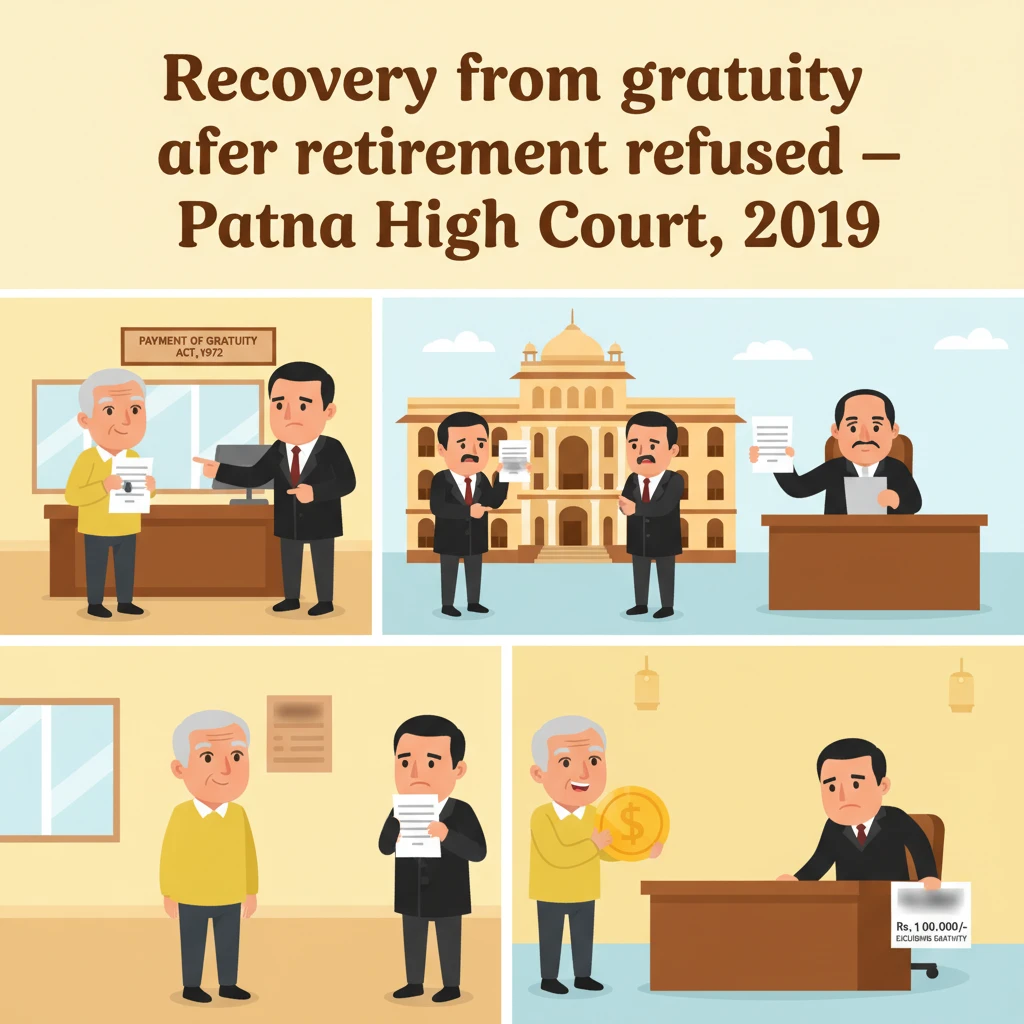
Case Background
The dispute arises out of the gratuity payable to a former Manager (Depot) of the Food Corporation of India (FCI), referred to here as the respondent-employee.
The respondent-employee was served with a memorandum of charge on 23 January 2013. The charge related to financial irregularities and alleged loss caused to the Corporation.
Just a few days later, on 31 January 2013, the respondent-employee attained the age of superannuation. According to the Corporation, he was “relieved” from his post and not “retired”. On this basis, they claimed that the disciplinary proceedings could continue even after he left service.
Ultimately, on 9 September 2014, a punishment order was passed against the respondent-employee. The penalty imposed was reduction of five stages in the time-scale of pay with cumulative effect, along with recovery of Rs. 1,00,000/-. Importantly, this punishment order clearly stated that the recovery of Rs. 1,00,000/- would be made “excluding gratuity”.
Meanwhile, the respondent-employee had not received his full gratuity. He therefore approached the Controlling Authority under the Payment of Gratuity Act, 1972 (the 1972 Act). On 30 September 2013, the Controlling Authority directed that the entire amount of gratuity payable to him be released.
The FCI (through its General Manager, Region) filed an appeal against this direction before the Appellate Authority under the 1972 Act. To maintain this appeal, the Corporation deposited the full gratuity amount as required by law. The respondent-employee withdrew this deposited amount.
The Corporation’s appeal under the 1972 Act was dismissed. The Corporation then approached the High Court through a writ petition, challenging the orders of the gratuity authorities and asserting its right to recalculate and recover part of the gratuity. The learned Single Judge of the Patna High Court dismissed the writ petition.
Aggrieved, the Corporation filed the present Letters Patent Appeal (L.P.A. No. 288 of 2018) before a Division Bench of the Patna High Court.
What the Court Examined and Decided
The central dispute before the Division Bench was whether the Corporation could treat its later action as a mere “re-calculation” of gratuity based on the reduced pay, and then claim a refund of what it called “excess” gratuity already withdrawn by the respondent-employee.
Counsel for the appellant-Corporation argued that the learned Single Judge had not appreciated the true nature of the controversy. According to the Corporation, this was not a case of forfeiture of gratuity under Section 4(6) of the 1972 Act but a simple re-calculation of the gratuity amount based on the last wages drawn after the punishment order.
The Corporation’s submissions, as recorded by the Court, can be broadly summarised as follows.
First, once the punishment order arising from the disciplinary proceedings had been passed and the respondent-employee had not challenged it, the reduced pay as per that punishment order had to be treated as his “last wages” for determining gratuity.
Second, on this basis, the Corporation argued that the earlier gratuity calculation, which did not reflect this pay reduction, had resulted in excess payment. It claimed that such excess could be recovered by way of refund.
Third, the Corporation stated that the initial payment of gratuity was not voluntary. It had deposited the amount only as a compulsory pre-condition to filing its appeal under the 1972 Act. Therefore, according to it, allowing recovery of the “excess” amount would not amount to taking away gratuity voluntarily paid, but only adjusting what was conditionally disbursed.
Fourth, the Corporation heavily relied on the distinction between “relieved” and “retired”. It maintained that the respondent-employee had been relieved from service and not retired, so disciplinary proceedings and consequential changes in pay could affect his gratuity even after he left service.
Finally, the Corporation asserted that its action was not one of “forfeiture” of gratuity as mentioned in Section 4(6) of the 1972 Act. It was said to be a lawful re-calculation of gratuity on the basis of the final, reduced wage and recovery of any excess paid.
The Division Bench examined all these contentions carefully. The Court first addressed the nature of the payment and the concept of “re-calculation”.
The Bench observed that, as a matter of principle, if it is not a case of forfeiture under Section 4(6) of the 1972 Act, then a re-calculation of wages resulting in reduced last wages would not amount, by itself, to forfeiture of gratuity. In such a situation, any excess gratuity paid may, in law, be recoverable, provided the payment was not voluntary.
However, on the facts of the present case, the Court found two significant obstacles to the Corporation’s claim.
First, the Bench considered the Corporation’s attempt to rely on the word “relieved” as opposed to “retired”. The Court held that merely describing the employee as “relieved” on superannuation did not change the true nature of his exit from service. The respondent-employee had attained the age of superannuation and was therefore effectively retired.
The Court noted that the punishment order dated 9 September 2014 itself described the respondent-employee as “now retired”. This description, coming from the Corporation’s own order, directly contradicted the argument that he was only relieved and not retired. The Court held that, in substance, the Corporation was treating him as a retired employee, and the use of the word “relieved” did not change that reality.
Second, and more crucially, the Bench focused on the specific term used in the punishment order regarding recovery of Rs. 1,00,000/-. The order clearly stated that this recovery would be made “excluding gratuity”.
The Court drew an important conclusion from this language. By expressly stating that recovery would be made “excluding gratuity”, the Corporation had voluntarily chosen not to realize any part of the said amount from the gratuity payable to the respondent-employee.
Having consciously excluded gratuity from the source of recovery in the punishment order, the Corporation could not later do, in an indirect manner, what it was not willing to do directly. In other words, after deciding not to touch gratuity for recovery, it could not subsequently treat the same gratuity payment as a pool from which to claw back funds under the label of “re-calculation”.
The Court made it clear that an employer cannot be allowed to bypass its own decision recorded in a formal punishment order. Allowing such an exercise would amount to permitting the employer to change the character of the punishment and undermine the finality of its own decision.
The Bench also took note that the earlier payment of gratuity to the respondent-employee occurred pursuant to the order of the Controlling Authority and the statutory requirement of deposit for appeal. While such payment was not a voluntary ex gratia action, the Court’s reasoning turned mainly on the express exclusion of gratuity from recovery in the punishment order, and the fact that the respondent-employee was treated as retired.
In the closing part of the judgment, the Court stated that, even though the pure legal position regarding re-calculation and recovery of excess amounts might have been explained differently in another set of facts, the specific facts of this case did not permit such an approach.
Given these findings, the Division Bench held that there was no error in the learned Single Judge’s decision upholding the orders under the 1972 Act and protecting the respondent-employee’s gratuity.
Consequently, the Letters Patent Appeal filed by the Corporation failed and was dismissed.
Why This Judgment Matters
This judgment is important for retired employees facing attempts by employers to cut or claw back their gratuity after retirement, especially when disciplinary proceedings continue beyond the date of superannuation.
The Patna High Court emphasised that the true nature of retirement cannot be altered by using different words like “relieved” when the employee has actually superannuated and is treated as retired in the employer’s own documents.
Most significantly, the Court held that where an employer has, in a punishment order, clearly stated that recovery will be made “excluding gratuity”, it cannot later try to indirectly recover money from the gratuity amount by calling it a “re-calculation”.
For employees, this offers reassurance that explicit protections in orders, such as exclusion of gratuity from recovery, have real meaning and can be enforced. For employers, it is a reminder that the terms of their own disciplinary orders bind them, and that gratuity, as a statutory terminal benefit, cannot be lightly disturbed.
Legal Issues and Answers
- Issue: After a retired employee’s gratuity has been released under the Payment of Gratuity Act, can the employer later recalculate the gratuity on the basis of a punishment order reducing pay and recover the alleged excess from the gratuity amount?
Answer: On the specific facts of this case, no. Since the punishment order itself directed that recovery be made “excluding gratuity” and the employee was treated as retired, the employer could not indirectly recover from gratuity by calling it re-calculation. - Issue: Does describing an employee as “relieved” on superannuation allow an employer to treat him as not retired for purposes of disciplinary proceedings and gratuity adjustment?
Answer: No. Merely using the word “relieved” does not alter the fact that the employee was relieved on superannuation, which is nothing but retirement, especially when the employer’s own punishment order describes him as “now retired”.
Cases Cited by the Court
- The judgment text provided does not record any other judicial precedents being cited or relied upon by the Court.
Case Details
Case Number: Letters Patent Appeal No. 288 of 2018 in Civil Writ Jurisdiction Case No. 18110 of 2015
Case Title: The General Manager (Region), Food Corporation of India, Regional Office, Patna vs. The Union of India & Others
Citation: 2019 (3) PLJR 510
Coram: Hon’ble The Chief Justice Amreshwar Pratap Sahi; Hon’ble Justice Smt. Anjana Mishra
Advocates: Mr. P.K. Verma, Senior Advocate, with Mr. Saroj Kumar Sharma, Advocate for the appellant; advocate for the respondents is not specified in the text provided.
Nature of the Case: Letters Patent Appeal against dismissal of a writ petition challenging orders under the Payment of Gratuity Act, 1972.
Date of Judgment: 30 April 2019
Link to Judgment: Patna High Court Judgment
If you found this explanation helpful and wish to stay informed about
how legal developments may affect your rights in Bihar,
you may consider following Samvida Law Associates for more updates.







