
Case Background
The case arises from recruitment to the post of Assistant Professor (Physics) in different universities of Bihar.
The Bihar State University Service Commission issued Advertisement No. AP-PHYS-20/20-21 dated 21.09.2020. It invited online applications for regular appointment to the post of Assistant Professor (Physics).
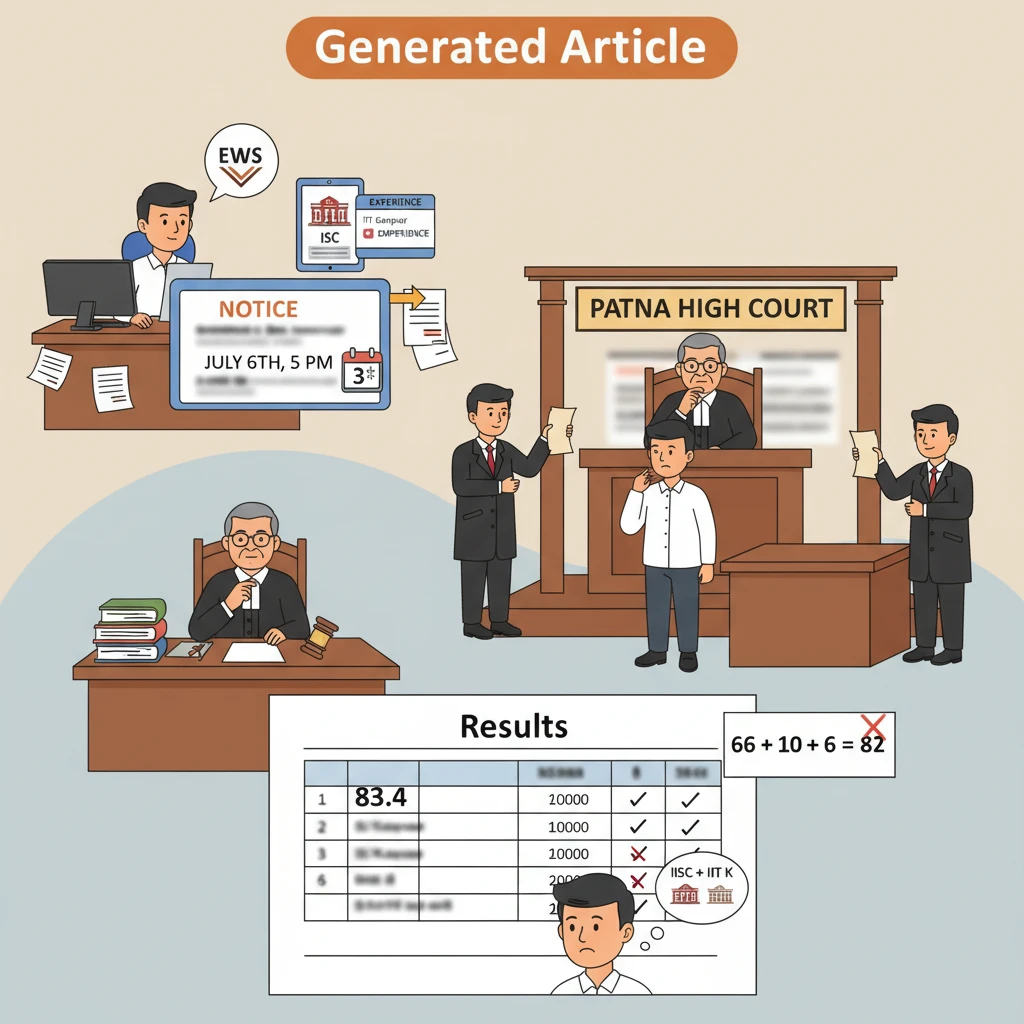
The petitioner applied under the Economically Weaker Section (EWS) category. He submitted his application with necessary documents, including experience certificates showing his post-doctoral and research work at premier institutions such as the Indian Institute of Science (IISC), Bangalore and the Indian Institute of Technology (IIT), Kanpur.
After scrutiny, the Commission issued Notice No. 595 dated 21.06.2024, listing candidates whose applications were approved. The petitioner’s name appeared at serial number 1158. This notice also allowed candidates to raise grievances or claims by email up to 5:00 PM on 06.07.2024.
Out of caution, the petitioner emailed some additional documents to support his experience at IISC, Bangalore. The Commission acknowledged the email but clearly stated that marks would be awarded only on the basis of documents attached with the online application form. Additional documents sent later by email would not be considered.
The petitioner was issued a call letter for interview and appeared before the Interview Committee on 24.09.2024, submitting attested copies of his original documents.
On 30.09.2024, the Commission published the final, category-wise results through Notice No. 1640. In the EWS category, the cut-off was fixed at 83.4 marks and 22 candidates were selected. The petitioner’s name did not appear in the list.
Feeling aggrieved, the petitioner sought details of his marks. On 16.10.2024, the Commission uploaded the detailed scores of candidates, including the petitioner. His system-generated total score was 66, manual score 10, and interview score 6, totaling 82 marks.
He noticed that no marks had been given for his post-doctoral experience of about seven years at premier institutions. As a result, he fell short of the EWS cut-off by 1.4 marks. He approached the Patna High Court through this writ petition, challenging the non-inclusion of his name in the selection list and the non-consideration of his experience certificates.
What the Court Examined and Decided
Justice Harish Kumar heard arguments from both sides — the petitioner’s senior counsel, counsel for the Bihar State University Service Commission, and counsel for the State of Bihar.
The petitioner’s side argued that the Commission had negligently ignored valid experience certificates from premier institutes. According to the petitioner, the certificate regarding his experience at IIT Kanpur was issued by the Joint Registrar, who is an authorized signatory.
He had post-doctoral experience of 4 years, 8 months and 9 days at IISC, Bangalore and 2 years, 5 months and 13 days at IIT, Kanpur. On this basis, he claimed that his marks could not have been less than 86 even if he had scored zero in the interview.
The petitioner also pointed out that the internal administrative structure of IITs is different from conventional universities. In IITs, he argued, the Joint Registrar or Deputy Registrar functions under the authority of the Registrar, and is delegated powers including the issuance of experience certificates.
To support this, he placed on record a letter bearing No. 569 dated 23.10.2024 with an enclosure dated 15.10.2020 from the Registrar, IIT Kanpur. This letter clarified that the Joint Registrar is an authorized signatory for issuing experience certificates of candidates or employees.
The petitioner contended that refusing to accept such a certificate violated the autonomy of IITs, which are governed by the IIT Act, 1961 and their statutes. He argued that the Commission’s stand — that any experience certificate without the Registrar’s endorsement is invalid — was illegal and caused undue hardship to meritorious candidates from premier institutes.
The Commission’s counsel opposed the petition. He relied heavily on the terms of Advertisement No. AP-PHYS-20/20-21, particularly Clause 7, which deals with the selection process.
Under Clause 7.1, 100 marks were allotted for educational qualifications and 15 marks for the interview. Clause 7.2 laid down the criteria for shortlisting. A footnote to Clause 7.2 stated that if the teaching or post-doctoral experience was less than one year, marks would be proportionately reduced. Crucially, it said that credit would be given only on the basis of certificates counter-signed by the Registrar of the University.
Further, Clause 5.12 of the advertisement stated that only those certificates and degrees mentioned in the online application form would be treated as valid for qualification. Clause 15 warned that all entries must be carefully filled in the online application, and no change or modification would be accepted later. The Commission would not be responsible for any errors.
On this basis, the Commission submitted that after scrutinising the petitioner’s application and enclosures, the expert committee awarded zero marks for teaching experience because the certificates were not countersigned by the Registrar, as required by Clause 7.2. As the petitioner scored only 82 marks, while the last selected EWS (Male) candidate had 83.4 marks, he was not selected.
The Court then examined the exact nature of the petitioner’s experience certificates. For the period September 2013 to May 2018 at IISC, Bangalore (as Research Associate), the certificate was issued under the signatures of the Chairman and Professor of the Department of Materials Engineering. It did not bear any signature of a Registrar or equivalent authority.
For the period from 11.05.2018 at IIT Kanpur (as Senior Project Science in the Department of Material Science and Engineering), the certificate was issued by a Professor of that department along with a certificate from the Joint Registrar (Research and Development), IIT Kanpur.
The Commission had not treated either certificate as valid teaching or post-doctoral experience under Clause 7.2, because in its view both lacked countersignature of a Registrar.
The Court then discussed the legal framework on strict adherence to advertisement terms. It referred to:
(i) The Supreme Court judgment in Bedanga Talukdar v. Saifudaullah Khan, (2011) 12 SCC 85, which held that the selection process must strictly follow the procedure stated in the advertisement. Conditions cannot be relaxed unless such power is specifically reserved and publicised, as any hidden relaxation would violate Articles 14 and 16 of the Constitution.
(ii) The Full Bench decision of the Patna High Court in Braj Kishore Prasad v. State of Bihar, 1998 (3) PLJR 34, which emphasized that dates and conditions in recruitment advertisements must be strictly followed. Documents submitted after the last date should not be accepted, unless the authority publicly extends the time for all candidates. The Full Bench also noted that in cases of extreme hardship beyond a candidate’s control, the High Court may grant relief, provided the candidate acted diligently and did not delay or show laches.
(iii) The Supreme Court decision in State of T.N. v. G. Hemalathaa, (2020) 19 SCC 430, reaffirming strict adherence to advertisement terms.
The Commission’s counsel also relied on a recent Patna High Court judgment in Dr. Babita Kumari v. State of Bihar & Ors. (C.W.J.C. No. 12893 of 2024). There, the candidate’s experience certificate issued by a college principal was rejected because it was not countersigned by the University Registrar as required by Clause 7.2 of another advertisement. The Court, applying Bedanga Talukdar and Braj Kishore Prasad, dismissed the writ petition because the candidate failed to obtain and submit a proper certificate before the cut-off date.
After considering these precedents, the Court turned to the present facts. It found that the IISC, Bangalore certificate was issued only by the Chairman and a Professor of the department, with no material on record showing they were duly authorized by a competent authority to issue such certificates. Therefore, the Commission was justified in not considering that certificate for experience marks.
However, the situation regarding IIT Kanpur was different. The Court noted that the IIT Kanpur experience certificate was accompanied by a certificate issued by the Joint Registrar (Research and Development), who was stated to be an authorized signatory for such certificates. The Registrar of IIT Kanpur had clarified through the letters on record that the Joint Registrar is an authorized signatory for experience certificates of candidates or employees.
In light of this, the Court held that the petitioner’s claim based on the IIT Kanpur experience certificate could not be ignored outright. The marking of academic achievements, research publications, awards and experience is to be carried out by the expert committee, not by an automated computer process. There could not be a blanket rejection of all experience certificates that were duly issued by an authorized signatory, such as the Joint Registrar of IIT Kanpur.
The Court observed that a certificate issued by the Joint Registrar or Registrar of a premier institution like IIT Kanpur should not be summarily rejected without giving an opportunity for clarification from the candidate or the institute, if needed.
The Court acknowledged the importance of requiring teaching experience certificates to be countersigned by a University Registrar. But it also recognised that there can be genuine situations, such as absence or vacancy of a Registrar, where duties are assigned to an in-charge Registrar or a Joint Registrar. In such circumstances, certificates or orders issued by an authorized Joint Registrar cannot be treated as illegal and invalid only because they do not bear the Registrar’s physical signature.
The Court stated that the Commission’s action, based on such a rigid view, had no legal sanction. While terms of advertisements must be followed to avoid arbitrariness and ensure equal treatment, there can still be cases of extreme hardship or injustice beyond a candidate’s control. In such deserving cases, the High Court can exercise writ jurisdiction and grant relief.
The Court was informed that, during verification of testimonials of some candidates in Physics under the same advertisement, some certificates were found to be forged or fabricated. Their appointments had been cancelled and the posts remained vacant.
In this context, the Court found it appropriate to direct the Commission to consider the petitioner’s experience certificate issued by the Joint Registrar, IIT Kanpur and award him marks accordingly. If, after such reassessment, the petitioner secures at least the cut-off marks for his category, the Commission must recommend his name to the concerned university for appointment as Assistant Professor (Physics).
The Court directed that this entire exercise must be completed within eight weeks from the date of receipt or production of the order. The writ petition was allowed to this extent, and pending applications were disposed of.
Why This Judgment Matters
This judgment is important for teaching and academic job aspirants in Bihar and elsewhere who rely on experience certificates from premier institutions.
The Patna High Court has affirmed that recruitment authorities must follow advertisement conditions strictly, but they cannot adopt a mechanical or rigid view that ignores genuine certificates issued by authorized officials.
For candidates working in institutions where the Joint Registrar or similar officers are officially empowered to sign experience certificates, this decision gives reassurance that such certificates cannot be brushed aside without proper consideration.
The Court also highlighted that when some posts are lying vacant due to cancellation of appointments based on forged or fabricated certificates, genuine candidates should not be denied their chance on hyper-technical grounds.
Legal Issues and Answers
- Issue: Whether the Bihar State University Service Commission was justified in giving zero marks for the petitioner’s teaching and post-doctoral experience on the ground that his certificates were not countersigned by a Registrar as per Clause 7.2 of the advertisement.
Answer: The Court held that while the IISC Bangalore certificate was rightly ignored due to lack of proof of proper authorization, the IIT Kanpur certificate issued by the Joint Registrar (Research and Development), who was an authorized signatory, could not be rejected outright and must be considered for awarding experience marks. - Issue: Whether the Court could interfere in the selection process despite strict clauses in the advertisement and previous judgments insisting on adherence to such terms.
Answer: The Court held that in cases of extreme hardship or injustice, and where the candidate acted diligently, it can exercise writ jurisdiction. Considering that posts were vacant and the petitioner’s IIT Kanpur experience certificate was duly issued by an authorized Joint Registrar, the Court directed reassessment of his marks. - Issue: What directions should be given regarding the petitioner’s selection in light of the reassessment.
Answer: The Court directed the Commission to re-evaluate and award marks for the petitioner’s IIT Kanpur experience. If his total marks reach or exceed the EWS category cut-off, the Commission must recommend his name to the concerned university for appointment as Assistant Professor (Physics) within eight weeks.
Cases Cited by the Court
- Bedanga Talukdar v. Saifudaullah Khan, (2011) 12 SCC 85.
- Braj Kishore Prasad v. State of Bihar & Ors., 1998 (3) PLJR 34 (Full Bench, Patna High Court).
- State of T. N. v. G. Hemalathaa, (2020) 19 SCC 430.
- Dr. Babita Kumari v. The State of Bihar & Ors., C.W.J.C. No. 12893 of 2024 (Patna High Court).
- Dr. Shishu Pal Singh @ Shishu Pal Singh v. The State of Bihar & Ors., L.P.A. No. 1003 of 2024 (Patna High Court, Division Bench).
Case Details
Case Number: Civil Writ Jurisdiction Case No. 17547 of 2024
Case Title: Dr. Kumar Brajesh @ Kumar Brajesh v. The Bihar State University Service Commission & Ors.
Citation: 2026 (1) PLJR 348
Court: High Court of Judicature at Patna
Coram: Hon’ble Mr. Justice Harish Kumar
Date of Judgment: 15.12.2025
Advocates for Petitioner: Mr. Anand Kumar Ojha, Senior Advocate; Mr. Shankar Kumar, Advocate; Mr. Askhansh Shankar, Advocate
Advocates for Respondents (State): Mr. Standing Counsel (20); Md. Zeeshan Kalim, AC to SC-20
Advocates for Bihar State University Service Commission (BSUSC): Mr. Pawan Kumar, Advocate; Ms. Diksha, Advocate
Nature of Case: Writ petition under Article 226 of the Constitution of India challenging non-inclusion in selection list and non-consideration of experience certificate in recruitment to Assistant Professor (Physics).
Link to Judgment: View full judgment on Patna High Court website
If you found this explanation helpful and wish to stay informed about
how legal developments may affect your rights in Bihar,
you may consider following Samvida Law Associates for more updates.







