
Case Background
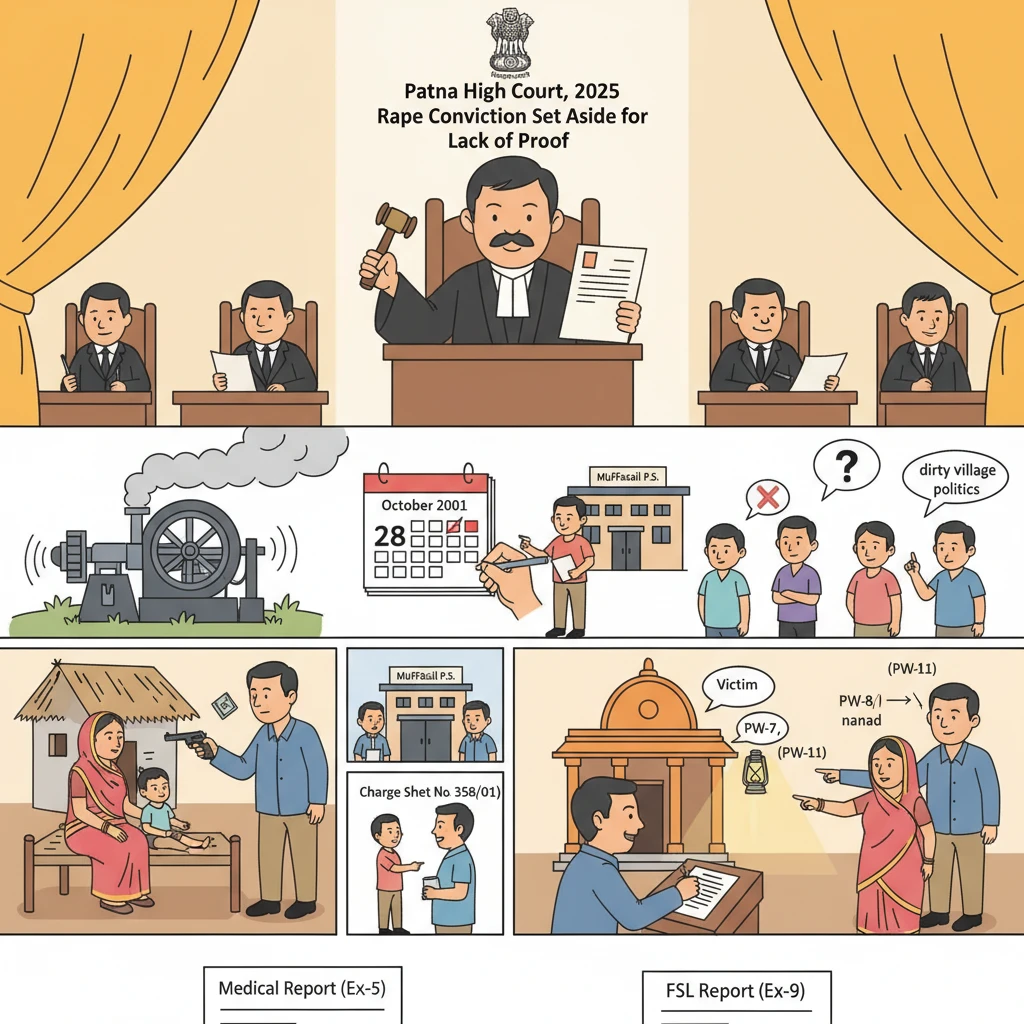
This case arose from an allegation of rape made by a village woman against her neighbour. According to the prosecution, the incident took place on 19.10.2001 at around 8 p.m. in the courtyard of her house in village Chilmil Tola, within Mufassil Police Station, district Begusarai.
The informant, Sumitra Devi, gave her fardbeyan on 28.10.2001, nine days after the alleged occurrence. On that basis, Muffasil P.S. Case No.289 of 2001 was registered under Section 376 of the Indian Penal Code against the neighbour, Bharat Mahton.
After investigation, the police submitted charge sheet No.358/01 dated 26.12.2001 under Section 376 IPC. The Chief Judicial Magistrate took cognizance on 04.01.2001 (as recorded in the judgment) and committed the case to the Court of Sessions on 31.05.2002. The case was registered as Sessions Trial No.231 of 2002 (arising out of G.R. Case No.2530 of 2001).
On 19.07.2002, the 5th Additional Sessions Judge, Begusarai, framed charge under Section 376 IPC. The accused pleaded not guilty and was put on trial. The trial court examined 13 prosecution witnesses and relied on several documents, including the fardbeyan, FIR, medical report, and forensic report. On 22.03.2004, the trial court convicted the appellant under Section 376 IPC and, by order dated 25.03.2004, sentenced him to rigorous imprisonment for 10 years, with set off.
Aggrieved by this conviction and sentence, the accused filed Criminal Appeal (SJ) No.261 of 2004 before the Patna High Court. The appeal was heard by Hon’ble Mr. Justice Dr. Anshuman, who delivered the CAV judgment on 10.10.2025.
What the Court Examined and Decided
The Patna High Court closely examined the prosecution story, the defence stand, the medical and forensic evidence, and the conduct of witnesses. The central question was whether the prosecution had proved rape beyond reasonable doubt.
As per the fardbeyan, the informant stated that on 19.10.2001 at about 8 p.m., she was lying on a cot in her courtyard with her son Chamak Sah. Her husband had gone to village Chandpura to make a statue of Goddess Durga. She alleged that the neighbour, the appellant, entered her courtyard, sat on her cot, tried to give her a Rs.50 note, which she refused, then threw the note on her body and committed rape.
She further alleged that when her son protested, the appellant assaulted the child and threatened to kill her. She raised alarm, but said nobody heard her because of the loud noise of a diesel engine operating a nearby mill. She asserted that when the appellant again entered the courtyard, she ran to the house of her nanad, Durbal Devi, and to the house of Anup Mahton, but no one helped her. She also stated that she handed over her undergarment (saya) to the police.
The defence attacked this story on several grounds. Counsel for the appellant stressed the nine-day delay between the alleged occurrence (19.10.2001) and the lodging of the fardbeyan (28.10.2001), arguing that there was no explanation for such delay in a serious offence like rape.
The defence highlighted that there were 13 prosecution witnesses, but key neighbours did not support the prosecution. PW-1 (Sheojee Mahton), PW-3 (Asharfi Devi), and PW-4 (Narayan Mahton) denied any occurrence, and yet they were not declared hostile. PW-6 (Parma Nand Yadav) also did not support the case and was declared hostile. PW-2 (Tripurari Mahton), an adjacent neighbour, stated in cross-examination that the informant had ten children and that the appellant was implicated due to “dirty village politics”. He too was not declared hostile, so his evidence remained part of the prosecution record.
Further, PW-5, the seizure witness, admitted in cross-examination that nothing was recovered in his presence and he could not read what was written on the paper where his signature was taken. The defence argued that this weakened the seizure of the undergarment.
The prosecution mainly relied on two witnesses: PW-8 (the informant’s son) and PW-10 (the informant herself). PW-8, assessed to be about 12–13 years at the time of deposition, stated that around 8–9 p.m. he was sleeping with his mother, who had fever, when the appellant came, showed a pistol, and committed rape. He said the appellant then offered Rs.50 to his mother, which she refused, and that he raised alarm but it was drowned by the sound of the diesel engine. He stated that the appellant assaulted him and that he recognized the appellant in lantern light. He denied in cross-examination that there was any loan given by the appellant for his sister’s marriage.
PW-10, the informant, repeated her allegation that the appellant came, sat on the cot, showed a Rs.50 note, committed rape at pistol point, and that she raised alarm but was not heard due to the noise of the engine. She said she recognized him in lantern light, ran out, was threatened, and then went to her nanad, PW-7, and narrated the incident. She stated her undergarment became wet due to the act, which she handed over to the police, and that a seizure list was prepared. She also said she lodged the case after her husband returned and denied taking a loan from the appellant for her daughter’s marriage.
PW-7 (Durbal Devi), the nanad, supported the informant’s version, saying that she heard the alarm and went to the informant, who told her that the appellant had committed rape at pistol point. She also stated that due to the noise of a futfutia mill run by diesel engine, others could not hear the alarm. She denied that the informant had taken a loan from the appellant.
PW-11, the husband, stated that while he was away preparing an idol in village Neema Chandpura, he got information that the appellant had raped his wife. On his return on the morning of 28.10.2001, he heard the incident from his wife in the presence of 10 to 20 villagers. While he and his wife were heading to the police station, the Officer-in-Charge met them near Rajaura Haldiya Durgasthan and recorded his wife’s statement (fardbeyan), on which he signed. He denied any land dispute or loan dispute with the appellant.
The medical evidence, however, did not support the allegation of forced intercourse. PW-12, Dr. Savitri Adhikari, examined the informant on 29.10.2001. She found no injury on any part of the body: face, chest, back, breast, abdomen, or inner thighs. On examination of the private parts, she found no external or internal injury. She noted some abnormal discharge in the uterus, took a vaginal swab for pathological examination, and reported that no spermatozoa was seen. Her report was marked as Exhibit-5.
The Investigating Officer, PW-13, stated that he sent the seized undergarment to the Forensic Science Laboratory, Patna. The FSL report (Exhibit-9) reported presence of human sperm on the cloth. But in cross-examination, he admitted that there was no note in the case diary that semen of the appellant or of the victim’s husband was ever collected or sent for examination. Thus, there was no scientific way to link the sperm on the garment to the appellant rather than to the husband.
The defence also brought out, through cross-examination and suggestions, that the appellant and the informant’s family knew each other well, and that the appellant used to visit their house. A story emerged that the appellant had allegedly given Rs.8,000 as financial help (loan) to the informant’s family for her daughter’s marriage, and that he had been demanding repayment. It was suggested that, to avoid returning the money and to “teach a lesson”, a false case was filed against him. The Court noted that this defence suggestion regarding loan was not effectively challenged by the prosecution in cross-examination.
After considering all material, the Patna High Court recorded several important doubts:
First, the unexplained nine-day delay in lodging the case, despite the seriousness of the allegation.
Second, three adjacent neighbours (PW-1, PW-2, PW-3) and PW-4 did not support the prosecution case and were not declared hostile. PW-2, in particular, clearly stated that the appellant was implicated due to dirty village politics.
Third, according to PW-8’s evidence, the informant had three sons and four daughters, all sleeping on the same cot, with a baby lying next to the mother, and rape was allegedly committed on that very cot in their presence. The Court treated this as a factor requiring strong corroboration, which was missing.
Fourth, although the undergarment showed human sperm, the failure to collect and compare semen of the appellant or the husband meant the FSL report could not firmly connect the appellant to the alleged act.
Fifth, the medical report showed no signs of physical assault or forced sexual activity: no injuries anywhere and no spermatozoa in the vaginal swab.
In light of these factors, the Court held that the prosecution had not proved its case beyond all reasonable doubt. The Court further concluded that, on the circumstances emerging from the record, the relationship between the appellant and the informant appeared to be a consensual physical relationship known to the family, rather than a forcible rape.
The Court referred to Supreme Court decisions, including Deepak Gulati v. State of Haryana, (2013) 7 SCC 675: AIR 2013 SC 2071; Kaini Rajan v. State of Kerala, (2013) 9 SCC 113; and Dr. Dhruvaram Murlidhar Sonar v. State of Maharashtra, AIR 2019 SC 327. These cases discuss the distinction between rape and consensual sex, the meaning of consent under Section 375 IPC, and the need to carefully assess circumstances to see whether essential ingredients of rape are made out.
Applying these principles, the Patna High Court held that the essential parameters of rape were lacking in the case. Even assuming that some physical relationship had developed between the parties, it could only be treated as consensual sex and not rape. Therefore, Section 376 IPC was not attracted.
On this basis, the Court allowed the appeal, set aside the conviction and sentence dated 22.03.2004 and 25.03.2004, and acquitted the appellant of the charge under Section 376 IPC. As the appellant was on bail at the time of judgment, his bail bonds were ordered to be cancelled and sureties discharged. The lower court records were directed to be sent back.
Why This Judgment Matters
This judgment shows how the Patna High Court deals with rape cases where evidence is weak or doubtful. It underlines that a serious allegation like rape cannot be upheld only on suspicion or on incomplete investigation.
The Court stressed the importance of:
• Explaining delay in lodging an FIR in sexual offence cases.
• Consistency between medical evidence and the prosecution story.
• Proper forensic work, including collecting and matching semen samples.
• Treating neighbours’ and independent witnesses’ evidence seriously, especially when they are not declared hostile.
For villagers and ordinary citizens, this judgment highlights that both sides of a story are examined. It also shows that if prosecution witnesses themselves deny the incident, if medical signs of force are missing, and if investigation leaves key gaps, a conviction may not stand.
Legal Issues and Answers
- Issue: Did the prosecution prove beyond reasonable doubt that the appellant committed rape on the informant under Section 376 IPC?
Answer: No. The Patna High Court held that, due to unexplained delay, lack of medical support, weak corroboration, neighbours denying the incident, and incomplete forensic linkage, the charge of rape was not proved beyond reasonable doubt. - Issue: On the facts proved, was the relationship between the appellant and the informant to be treated as rape or as consensual sex?
Answer: The Court concluded that, even if a physical relationship existed, the circumstances pointed to consensual sex rather than rape, so Section 376 IPC was not attracted.
Cases Cited by the Court
- Deepak Gulati v. State of Haryana, (2013) 7 SCC 675: AIR 2013 SC 2071.
- Kaini Rajan v. State of Kerala, (2013) 9 SCC 113.
- Dr. Dhruvaram Murlidhar Sonar v. State of Maharashtra, AIR 2019 SC 327.
Case Details
Case Number: Criminal Appeal (SJ) No.261 of 2004
Case Title: Bharat Mahton v. The State of Bihar
Court: High Court of Judicature at Patna
Trial Court Details: Sessions Trial No.231 of 2002 = G.R. Case No.2530 of 2001, arising out of Muffasil P.S. Case No.289 of 2001
Impugned Judgment and Sentence: Judgment of conviction dated 22.03.2004 and order of sentence dated 25.03.2004 passed by the 5th Additional Sessions Judge, Begusarai
Coram: Hon’ble Mr. Justice Dr. Anshuman
Citation: 2025 (4) PLJR 605
Advocates:
- For the Appellant: Mr. Rajendra Kishore Prasad, Advocate; Mr. Madhukr Pandey, Advocate
- For the State/Respondent: Mr. Ramchandra Singh, Additional Public Prosecutor
Nature of the Case: Criminal appeal (against conviction under Section 376 IPC)
Date of Alleged Occurrence: 19.10.2001 (as per prosecution)
Date of Fardbeyan and FIR Registration: 28.10.2001
Date of High Court Judgment: 10.10.2025
Final Outcome: Conviction and sentence under Section 376 IPC set aside; appellant acquitted; bail bonds cancelled and sureties discharged.
Link to Judgment: View full judgment on Patna High Court website
If you found this explanation helpful and wish to stay informed about how legal developments may affect your rights in Bihar, you may consider following Samvida Law Associates for more updates.







