

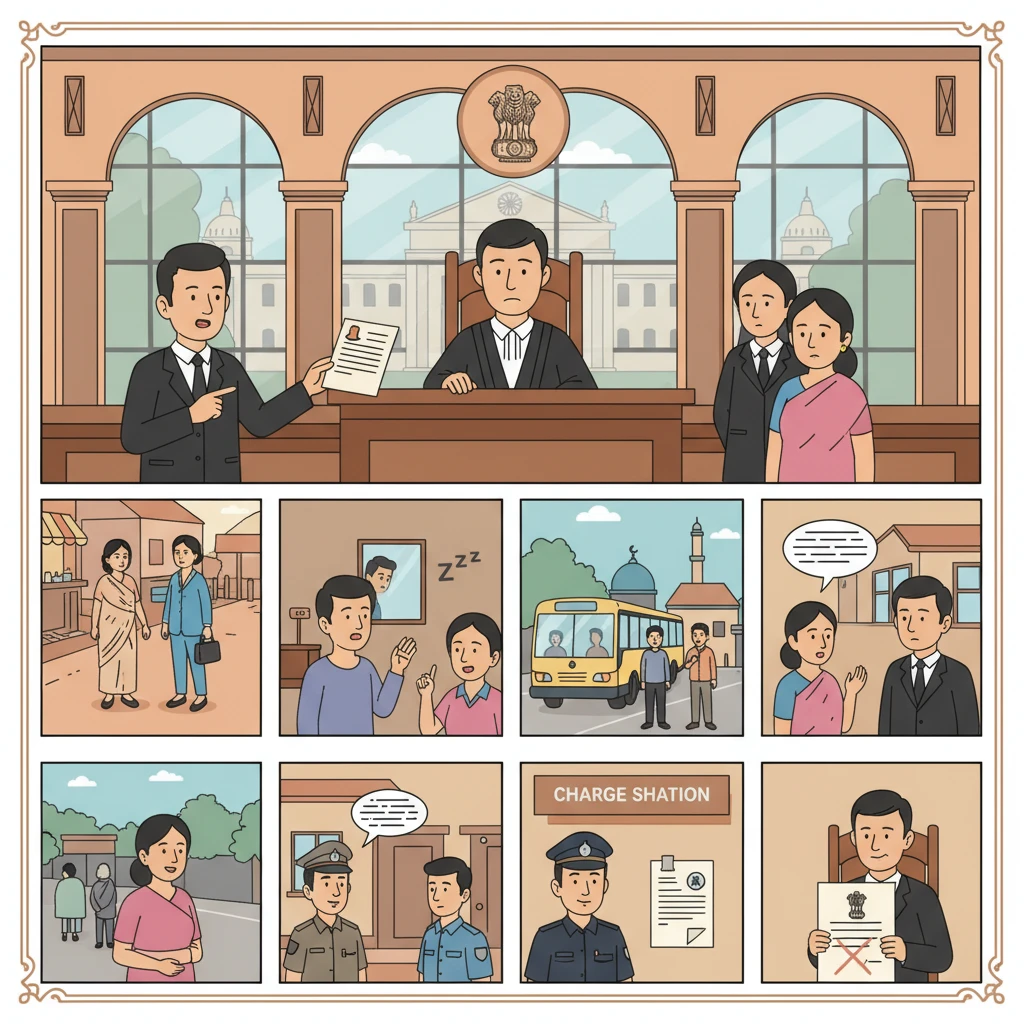
Case Background
The case started with a written report given at Aurangabad Mahila Police Station on 25.10.2018. The informant, a girl described as a student, alleged that on 21.10.2018, at about 4:00 P.M., her friend took her to Dev market to buy items for practical work.
From the market, the friend took her to her own house. There, according to the informant, the friend’s elder brother confined her in a room, gagged her when she tried to come out, and raped her the whole night.
The next morning, when the accused allegedly went to take water, she started crying and called out for her friend. On hearing her, the friend came there. The informant said she requested the friend to take her away, and the friend took her around 4:00 A.M. to Aurangabad, where they stayed in a mosque at Kasai Mohalla.
Later that day, she was persuaded to travel by bus to Ranchi and then to Gumla, and finally to the village Satbarwa, to the house of the friend’s maternal aunt. The aunt informed the informant’s brothers, who then reached Satbarwa and took the girl to Dev Police Station on 25.10.2018 at about 10:00 A.M. From there she was sent to Mahila Police Station, Aurangabad.
On this written report, Mahila P.S. Case No. 29 of 2018 was registered against the accused (later appellant) and the co-accused friend for offences under Sections 342, 343, 376, 120B of the Indian Penal Code (IPC) and Section 4 of the Protection of Children from Sexual Offences Act (POCSO Act).
After investigation, charge-sheet dated 24.12.2018 was submitted against both. On the friend’s application she was declared a juvenile and her case was separated and sent to the Juvenile Justice Board.
In the Sessions Court, charges under Sections 343, 376, 120B IPC and Section 4 POCSO Act were framed against the male accused. He pleaded not guilty and faced trial.
The trial court, by judgment dated 12.07.2021 and order of sentence dated 19.07.2021, convicted him under Sections 376, 342 and 120B IPC and Section 4 POCSO Act. Applying Section 42 POCSO, it effectively sentenced him under Section 376 IPC to 20 years’ rigorous imprisonment with fine of Rs.30,000/-, another 20 years with fine under Section 120B IPC, fine under Section 342 IPC, all sentences to run concurrently. The court also recommended compensation of Rs.4,00,000/- to the informant through District Legal Services Authority, Aurangabad.
Aggrieved, the accused filed Criminal Appeal (DB) No. 550 of 2021 before the Patna High Court. During appeal, he remained in custody.
What the Court Examined and Decided
The Division Bench of Hon’ble Mr. Justice Ashutosh Kumar and Hon’ble Mr. Justice Jitendra Kumar heard the appeal. The judgment was authored by Hon’ble Mr. Justice Jitendra Kumar and delivered on 30.10.2024.
The defence attacked both the application of the POCSO Act and the conviction under IPC. The main points raised were:
First, that the POCSO Act applies only if the victim is a “child”, i.e. below 18 years. According to the appellant, the prosecution had failed to prove the girl’s age in the manner required by law, particularly as per Section 94 of the Juvenile Justice (Care and Protection of Children) Act, 2015, which is to be followed while deciding age disputes under POCSO.
Second, they argued that the prosecution case must stand on its own without relying on the statutory presumption under Sections 29 and 30 POCSO, especially when the foundational facts were not proved. Therefore, for IPC offences, guilt had to be proved beyond reasonable doubt like in any other criminal case.
Third, the defence submitted that the informant (P.W.5) was the sole eye-witness and her deposition was full of improvements and contradictions compared to her earlier version. Her conduct, they said, was inconsistent with the allegation of force. They also pointed out that medical evidence did not support the claim of recent rape.
They further argued that except P.W.1, all non-official witnesses were close relatives of the informant and therefore interested, whose evidence required caution.
The State supported the conviction, submitting that the informant was below 18 years as per her own statement and those of her mother (P.W.4) and brothers (P.W.2 and P.W.3). The prosecution maintained that the overall evidence proved guilt beyond reasonable doubt and that there was no infirmity in the trial court’s findings.
Requirement to prove minority under POCSO
The High Court first focused on whether the prosecution had proved that the informant was a child at the time of the alleged incident.
The Court noted that POCSO applies only if the victim is below 18 years as per Section 2(d) of the Act. It referred to Section 34(2) of the POCSO Act, which directs the Special Court to determine age and record reasons, and to Supreme Court rulings in Jarnail Singh v. State of Haryana and P. Yuvaprakash v. State. These decisions held that the procedure for determining age of a juvenile in conflict with law, now contained in Section 94 of the Juvenile Justice Act, 2015, must also be followed for determining the age of a victim under POCSO.
The Bench reproduced Section 94 JJ Act and emphasised its step-wise method. Age has to be determined, in order of preference, from: (i) school date of birth certificate or matriculation certificate, (ii) birth certificate from municipal authority or panchayat, and only in absence of both, (iii) ossification test or other latest medical age test. Other forms of proof, such as mere oral statements, are impliedly excluded.
Looking at the record, the Court found that the informant was a school student, but no school certificate, matriculation certificate, or birth certificate from local authorities was produced. Nor was any radiological or ossification test done, as the Investigating Officer (P.W.7) admitted that no such examination was carried out, citing lack of X-ray facilities in Sadar Hospital.
Only oral statements were given about age: P.W.2, P.W.3 and P.W.4 spoke of her being 14 years old, while the informant herself said she was 15. Importantly, the only independent witness, neighbour P.W.1, stated that the girl was 18 at the time of occurrence.
The High Court held that in the face of Section 94 JJ Act and the Supreme Court’s directions, oral evidence of age was of no value when documentary or medical methods had not been used though feasible. It concluded that the prosecution had failed to prove the girl’s minority in the legally prescribed way.
Because of this failure, the Court drew an adverse inference against the prosecution and held that the victim was to be treated as a major, that is, above 18 years, on the date of occurrence. As a direct result, POCSO provisions could not be applied to the appellant.
The Court therefore acquitted the appellant of the POCSO charge. The judgment records that he could not be convicted under Section 6 of the POCSO Act and stood acquitted of that charge. (At trial he had been sentenced under Section 376 IPC instead of Section 4 POCSO due to Section 42 POCSO’s scheme; on appeal, the larger POCSO framework itself was found inapplicable.)
Presumption under Sections 29 and 30 POCSO
Before moving to IPC charges, the Court also clarified the law on presumption. It noted that the presumption of innocence is a fundamental right, citing Babu v. State of Kerala. Even though special statutes like POCSO provide for presumptions against the accused, these operate only after the prosecution proves foundational facts of the alleged offence.
Referring to Navin Dhaniram Baraiye v. State of Maharashtra and several other High Court decisions, the Patna High Court reiterated that mere filing of an FIR or charge-sheet under POCSO does not trigger automatic presumption of guilt. Foundational facts, including the victim’s minority and basic ingredients of the offence, must first be proved beyond reasonable doubt.
Assessment of IPC charges and witness credibility
Once POCSO was found inapplicable, the Court turned to whether the prosecution had proved offences under IPC—mainly rape, wrongful confinement and criminal conspiracy.
The Bench reminded that absence of independent witnesses is not, by itself, a ground to throw out the prosecution case, citing precedents such as Appabhai v. State of Gujarat. Evidence of related witnesses cannot be rejected only because they are relatives; it must be tested on the touchstone of truth, with due caution. The Court also referred to multiple Supreme Court decisions stating that minor discrepancies do not matter, but material contradictions do.
The central witness was the informant (P.W.5). The Court acknowledged the settled position that a conviction can rest on the sole testimony of the prosecutrix if she is a reliable, “sterling” witness. However, after examining her statement, the Court found she did not meet this standard.
The judgment notes that P.W.5 had significantly developed and improved her case in court compared to her original written report. There were serious inherent contradictions in her narration and in her conduct before and after the alleged incident.
One major aspect was her behaviour after the night she claimed to have been raped. Despite alleging forcible confinement and rape by the friend’s brother, she continued to accompany the friend from Dev to Aurangabad, then by bus to Ranchi, onwards to Gumla, and then to Satbarwa. She did not attempt to escape, did not raise any alarm in public places like the market, the auto-rickshaw, the bus stand or en route, and did not seek help from police or bystanders.
She also claimed that the friend repeatedly gave her medicine which she realised to be intoxicant, yet she did not refuse to take it. The Court found such conduct inconsistent with the allegation of continued force and coercion, especially when she was held to be a major girl.
The conduct of her family members also struck the Court as unusual when measured against the prosecution story. The mother (P.W.4) admitted she did not go to the friend’s house the same night when her daughter did not return. The elder brother (P.W.3) also did not visit the house of the friend that night. Only P.W.2 claimed to have gone there and to have informed police the next day. However, the Investigating Officer (P.W.7) clearly stated that no such information was received by any police station before the written report of this case. P.W.3 also denied going with P.W.2 as claimed by the latter.
In the Court’s view, if the girl had truly been forcibly confined or abducted from 21.10.2018, her family would likely have taken active steps—such as filing a missing report or repeatedly contacting the police—between 21.10.2018 and her recovery on 25.10.2018. The absence of such steps created reasonable doubt about the prosecution version.
Medical evidence
The medical examination was conducted by P.W.6, Dr. Lalsa Sinha. She found that the hymen was ruptured, but the rupture was old. The vagina admitted one finger easily. The victim was menstruating at the time of examination. No marks of injury were found on the body, except slight tenderness at the vaginal opening during examination. Vaginal swabs showed no spermatozoa.
On this basis, the doctor only opined that the girl “seemed to have undergone sexual act”. In cross-examination she confirmed there were no injuries and that age was not determined because police had not asked for such a report.
The High Court observed that the absence of injuries, coupled with the old rupture of the hymen, did not support the allegation of recent forcible sexual intercourse. When seen together with the girl’s conduct and the family’s inaction, the Court found it unsafe to hold that rape had been proved beyond reasonable doubt.
Final conclusion of the Court
After assessing all these factors, the Division Bench concluded that the prosecution had “miserably failed” to establish the IPC charges beyond reasonable doubt. There were reasonable doubts about use of force or coercion. The Court reiterated that in criminal law, such doubts must benefit the accused.
Accordingly, the Patna High Court set aside the judgment of conviction and the order of sentence passed by the trial court. The appeal was allowed. The appellant was acquitted of all charges and directed to be released forthwith if not required in any other case. The Court also ordered that its judgment be sent to the Jail Superintendent and that the trial court records be returned.
Why This Judgment Matters
This decision is important for both accused persons and complainants in sexual offence cases.
First, it clearly shows that in POCSO cases, the prosecution must strictly prove the victim’s age using school records, birth certificates or medical age tests. Simple statements by family members are not enough when better evidence is possible. If age is not proved, POCSO cannot be applied.
Second, the judgment underlines that courts will carefully examine the behaviour of all involved: the complainant, her family, and the accused. Where the story and conduct do not match, courts may treat the case with caution. This does not mean victims must behave in one fixed way, but serious inconsistencies can weaken a prosecution.
Third, it reminds investigating agencies of their duty to follow proper legal procedure—especially on crucial issues like age determination and prompt recording of preliminary information. Failure to do so can result in acquittal even in serious allegations.
Finally, the case reaffirms that even in sensitive offences like rape, the basic rule remains: guilt must be proved beyond reasonable doubt. Presumptions in special laws such as POCSO work only after the prosecution first lays a solid factual foundation.
Legal Issues and Answers
- Issue: Was the informant proved to be a “child” so that POCSO Act provisions and presumptions could apply?
Answer: No. The prosecution failed to produce school or birth certificates or any medical age test. Oral testimony about age was held insufficient under Section 94 JJ Act. The Court treated the informant as a major and held POCSO inapplicable. - Issue: Were the IPC charges of rape, wrongful confinement and criminal conspiracy proved beyond reasonable doubt?
Answer: No. The Court found major contradictions and improvements in the informant’s evidence, unusual conduct of the informant and her family, lack of supporting medical evidence, and overall reasonable doubt about use of force or coercion. The appellant was acquitted of all IPC charges. - Issue: Could conviction rest on the sole testimony of the prosecutrix in this case?
Answer: In principle, yes, but only if she was a trustworthy “sterling” witness. On facts, the Court held that her testimony was not reliable due to inherent contradictions, behavioural inconsistencies and lack of corroboration on key points.
Cases Cited by the Court
- Babu v. State of Kerala, (2010) 9 SCC 189
- Navin Dhaniram Baraiye v. State of Maharashtra, 2018 SCC Online Bom 1281
- Joy V.S. v. State of Kerala, 2019 SCC Online Ker 783
- Sahid Hossain Biswas v. State of West Bengal, 2017 SCC Online Cal 5023
- Dharmender Singh v. State (Govt. of NCT of Delhi), 2020 SCC Online Del 1267
- Latu Das v. State of Assam, 2019 SCC Online Gau 5947
- Jarnail Singh v. State of Haryana, (2013) 7 SCC 263
- P. Yuvaprakash v. State, 2023 SCC Online SC 846
- Appabhai and another v. State of Gujarat, 1988 Supp SCC 241
- Abhishek Sharma v. State (NCT of Delhi), 2023 SCC Online SC 1358
- Yogesh Singh v. Mahabeer Singh & Ors, (2017) 11 SCC 195
- Mano Dutt and another v. State of U.P., (2012) 4 SCC 79
- Daulatram v. State of Chhattisgarh, 2009 (1) JIJ 1
- State v. Saravanan, AIR 2009 SC 152
- State of U.P. v. Kishanpal, (2008) 16 SCC 73
- Namdeo v. State of Maharashtra, (2007) 14 SCC 150
- State of A.P. v. S. Rayappa, (2006) 4 SCC 512
- Pulicherla Nagaraju v. State of A.P., (2006) 11 SCC 444
- Harbans Kaur v. State of Haryana, (2005) 9 SCC 195
- Hari Obula Reddy and Ors. v. State of A.P., (1981) 3 SCC 675
- Piara Singh and Ors. v. State of Punjab, (1977) 4 SCC 452
- C. Muniappan & others v. State of T.N., (2010) 9 SCC 567
- State of U.P. v. Krishan Master, AIR 2010 SC 3071
- Shivaji S. Bobade & Anr v. State of Maharashtra, 1973 AIR 2622
- Sanjay Kumar v. State of Bihar, 2019 SCC Online Pat 1077
- State of Madhya Pradesh v. Dal Singh, (2013) 14 SCC 159
- Smt. Shamim v. State (GNCT of Delhi), 2018 (4) PLJR 160
- S. Govidaarju v. State of Karnataka, 2013 (10) SCALE 454
- Narotam Singh v. State of Punjab and Anr., AIR 1978 SC 1542
- Leela Ram v. State of Haryana, (1999) 9 SCC 525
- Subal Ghorai and Ors. v. State of West Bengal, (2013) 4 SCC 607
Case Details
Case Number: Criminal Appeal (DB) No. 550 of 2021; arising out of Mahila P.S. Case No. 29 of 2018, District Aurangabad; G.R. No. 72 of 2018, C.I.S. No. 72 of 2018.
Case Title: Mannu @ Saddam @ Md. Mannu Sadam v. State of Bihar
Citation: 2024 (4) PLJR 843
Coram: Hon’ble Mr. Justice Ashutosh Kumar; Hon’ble Mr. Justice Jitendra Kumar
Advocates: Mr. Satish Chandra Mishra, Advocate for the appellant; Mr. Uma Kant Mishra, Advocate for the appellant; Mr. Abhimanyu Sharma, APP for the State.
Nature of Case: Criminal appeal (Division Bench) against judgment of conviction and order of sentence passed by the Additional Sessions Judge-VIII-cum-Special Judge, POCSO Act, Aurangabad.
Date of High Court Judgment: 30.10.2024
Trial Court: Court of Additional Sessions Judge-VIII-cum-Special Judge, POCSO Act, Aurangabad, Bihar.
Link to Judgment: Patna High Court official PDF
If you found this explanation helpful and wish to stay informed about
how legal developments may affect your rights in Bihar,
you may consider following Samvida Law Associates for more updates.







