

Case Background
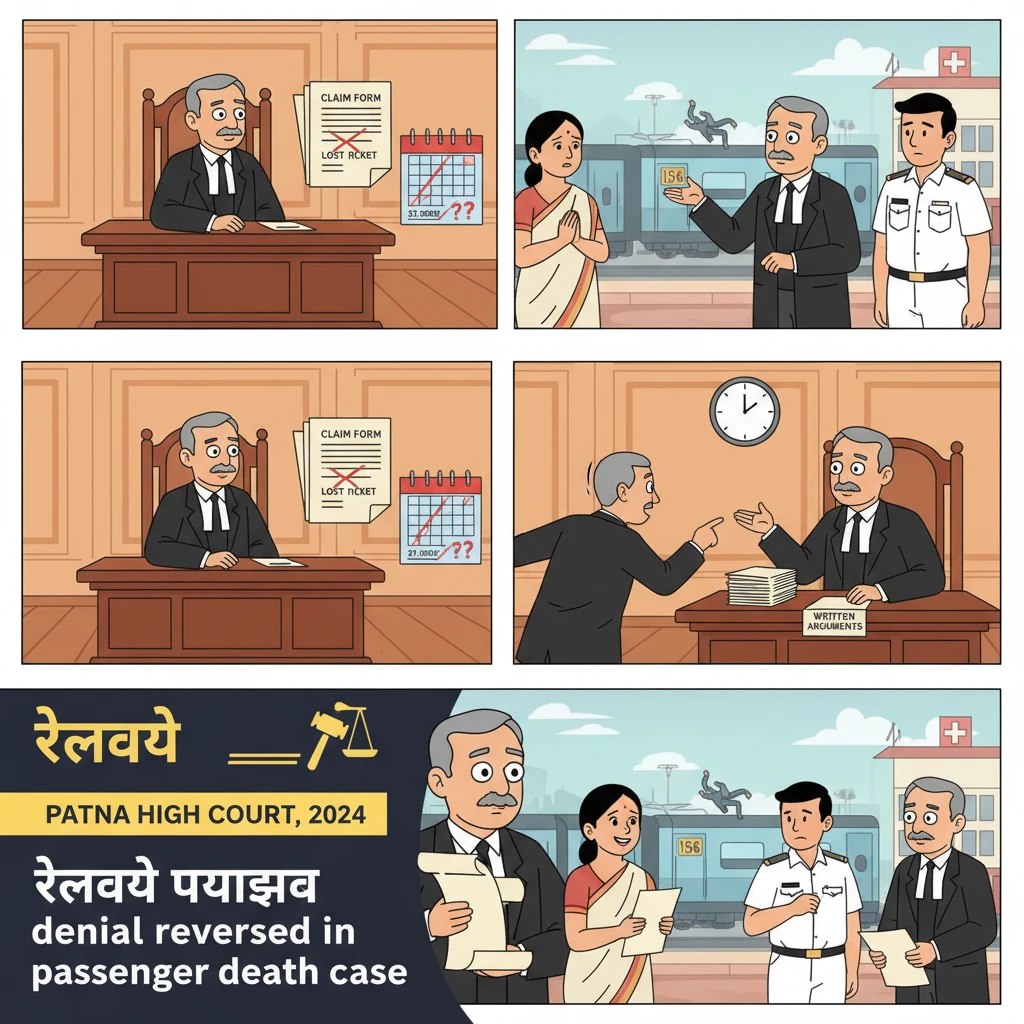
The appellant, Kavita Devi, lost her husband in a train accident on 19.05.2002. According to her claim, he fell from a running train, Train No. 156 (Summer Special), at Mokama railway station and later died during treatment at PMCH, Patna.
After her husband’s death, she approached the Railway Claims Tribunal, Patna Bench. She filed a claim application for compensation of Rs. 4,00,000/- (four lakhs) along with interest, under the scheme of compensation for railway accidents and untoward incidents.
The Union of India, through the General Manager, East Central Railway, Hajipur, filed a written statement before the Tribunal. The Railways mainly argued that the deceased was not a bona fide passenger, that is, he was allegedly not travelling with a valid ticket.
The Railway Claims Tribunal accepted the Railways’ objection and dismissed the claim. It held that the deceased was not a bona fide passenger. Two reasons were highlighted in the impugned order: first, that in the printed claim form, it was stated that the ticket was lost in the accident, but later a ticket was produced and marked as an exhibit; and second, that though the death allegedly occurred on 19.05.2002, the inquest report was prepared only on 21.05.2002.
Feeling aggrieved by the rejection of her claim, Kavita Devi filed Miscellaneous Appeal No. 770 of 2013 before the Patna High Court against the Tribunal’s order dated 03.10.2013 in Claim Application No. OA 00049 of 2003.
What the Court Examined and Decided
The appeal came up before Hon’ble Mr. Justice Nawneet Kumar Pandey of the Patna High Court. The Court heard the learned counsel for the appellant. At the time of hearing, no one initially appeared for the Union of India/Railways. Later, counsel for the Railways did appear and was asked to file written arguments within three days. However, even after this opportunity, no written arguments were filed on behalf of the Railways.
The key question before the Court was whether the deceased was a bona fide passenger and whether the Tribunal was right in rejecting the claim on that ground. The High Court closely examined the Tribunal’s reasoning, the claim form, and the documentary evidence on record.
The High Court noted that the claim application had been filed in a printed proforma. In column no. 7 of that form, it was mentioned that the ticket was lost. On this basis, the Tribunal had doubted the status of the deceased as a passenger, especially because later a ticket was produced and exhibited as Ext. A/6.
The High Court pointed out that this reasoning was not sound. Once the ticket was produced and marked as an exhibit, and when there was no dispute raised about the genuineness or authenticity of that ticket, the mere mention in column no. 7 that the ticket was lost could not be a valid ground to deny compensation.
The Court observed that there had been no cross-examination from the side of the Union of India/Railways on this specific point. The Railways did not question the claimant on how or when the ticket was found, nor did they challenge the authenticity of the ticket. In the absence of such challenge, the ticket stood as reliable evidence of the deceased’s status as a bona fide passenger.
The High Court clearly held that the veracity of the deceased being a bona fide passenger could not be disbelieved merely because of the entry in one column of the printed form where it was typed that the ticket was lost. The Court treated this as a technical or formal discrepancy which could not override the solid documentary evidence on record.
The Tribunal had also referred to the timing of the inquest report. It had noticed that the death was said to have occurred on 19.05.2002, but the inquest report was prepared on 21.05.2002. From this, the Tribunal appeared to draw doubt about the accident and the circumstances of death.
The High Court did not accept this reasoning either. It emphasized that both the post-mortem report and the death certificate were available in the record and confirmed that the deceased had lost his life in a train accident. These documents, being official records, supported the claimant’s version of events.
By placing weight on these medical and official documents, the Court concluded that the death due to the train accident was sufficiently proved. The timing of preparation of the inquest report, by itself, was not enough to demolish the clear evidence of accidental death in the course of railway travel.
After considering the overall facts and circumstances, the High Court held that the claimant had successfully proved her case. The Court found that she had demonstrated that:
- Her husband was travelling by Train No. 156 (Summer Special) on 19.05.2002.
- He fell from the running train at Mokama railway station.
- He died during treatment at PMCH, Patna, from injuries sustained in the train accident.
- He was a bona fide passenger, supported by the exhibited ticket and unchallenged evidence.
Once these facts were accepted, the legal consequence was that she became entitled to compensation as claimed. The High Court therefore set aside the order of the Railway Claims Tribunal, Patna Bench, dated 03.10.2013 in Claim Application No. OA 00049 of 2003.
Allowing the appeal, the Court directed the respondent Railways/Union of India to pay compensation of Rs. 4,00,000/- (Rupees four lakhs) to the appellant. Additionally, the Court awarded interest at the rate of 6% per annum from the date of filing of the claim application before the Tribunal, i.e., from 04.02.2003, until payment.
The Court fixed a clear timeline for compliance. The entire amount of compensation, together with interest, was to be paid to the claimant within a period of two months from the date of receipt or communication of the High Court’s order.
In summary, the Patna High Court corrected what it saw as an unjust denial of relief by the Tribunal. It stressed that minor inconsistencies in a printed form, or delay in preparation of an inquest report, cannot override genuine and unrebutted evidence such as a valid ticket, post-mortem report, and death certificate. On this basis, it restored the widow’s right to compensation.
Why This Judgment Matters
This judgment is important for families of railway accident victims, especially those from rural or less-educated backgrounds who depend on standard forms and may make small mistakes while filling them.
The Patna High Court made it clear that technical errors in a printed claim form, like wrongly noting that a ticket was lost, cannot be used to defeat a genuine claim when a valid ticket and other records support the case. This offers protection to claimants who may not understand the legal consequences of every entry they make in such forms.
The decision also signals that courts should rely on substantive evidence—such as tickets, post-mortem reports, and death certificates—rather than overemphasizing minor time gaps in inquest reports or procedural steps.
For day-to-day practice, this judgment reinforces that the Railways cannot casually deny compensation by merely asserting that the deceased was not a bona fide passenger, especially when they do not cross-examine the claimant or dispute the authenticity of produced documents.
Legal Issues and Answers
- Issue: Whether the deceased was a bona fide passenger so as to entitle the claimant to compensation for his death in a train accident.
Answer: Yes. The High Court held that the deceased was a bona fide passenger, supported by the exhibited ticket whose genuineness was not disputed and which was not challenged in cross-examination. - Issue: Whether the Railway Claims Tribunal was justified in rejecting the claim based on the mention in the form that the ticket was lost and on the timing of the inquest report.
Answer: No. The High Court found that these grounds were insufficient and unsustainable, particularly in the face of unchallenged documentary evidence like the ticket, post-mortem report, and death certificate. - Issue: Whether the claimant was entitled to compensation and interest from the date of filing the claim application.
Answer: Yes. The Court directed payment of Rs. 4,00,000/- with interest at 6% per annum from 04.02.2003 (the date of filing) until payment, to be made within two months.
Cases Cited by the Court
- No prior cases are cited or relied upon in the text of the judgment provided.
Case Details
Case Number: Miscellaneous Appeal No. 770 of 2013
Case Title: Kavita Devi v. The Union of India, through The General Manager, East Central Railway, Hajipur
Coram: Hon’ble Mr. Justice Nawneet Kumar Pandey
Citation: 2024(2) PLJR 768
Advocates:
- For the Appellant: Mr. Krishna Mohan Murari
- For the Respondent (Union of India/Railways): Mr. Tarkeshwar Nath Thakur, Central Government Counsel (C.G.C.)
Nature of the Case: Miscellaneous Appeal against an order of the Railway Claims Tribunal, Patna Bench, in Claim Application No. OA 00049 of 2003, relating to compensation for death in a train accident.
Impugned Order: Order dated 03.10.2013 passed by the Railway Claims Tribunal, Patna Bench, in Claim Application No. OA 00049 of 2003.
Date of High Court Judgment: 09.05.2024 (CAV judgment; CAV date 15.02.2024; uploading date 09.05.2024)
Link to the Judgment: View full judgment on Patna High Court website
If you found this explanation helpful and wish to stay informed about
how legal developments may affect your rights in Bihar,
you may consider following Samvida Law Associates for more updates.







