
Case Background
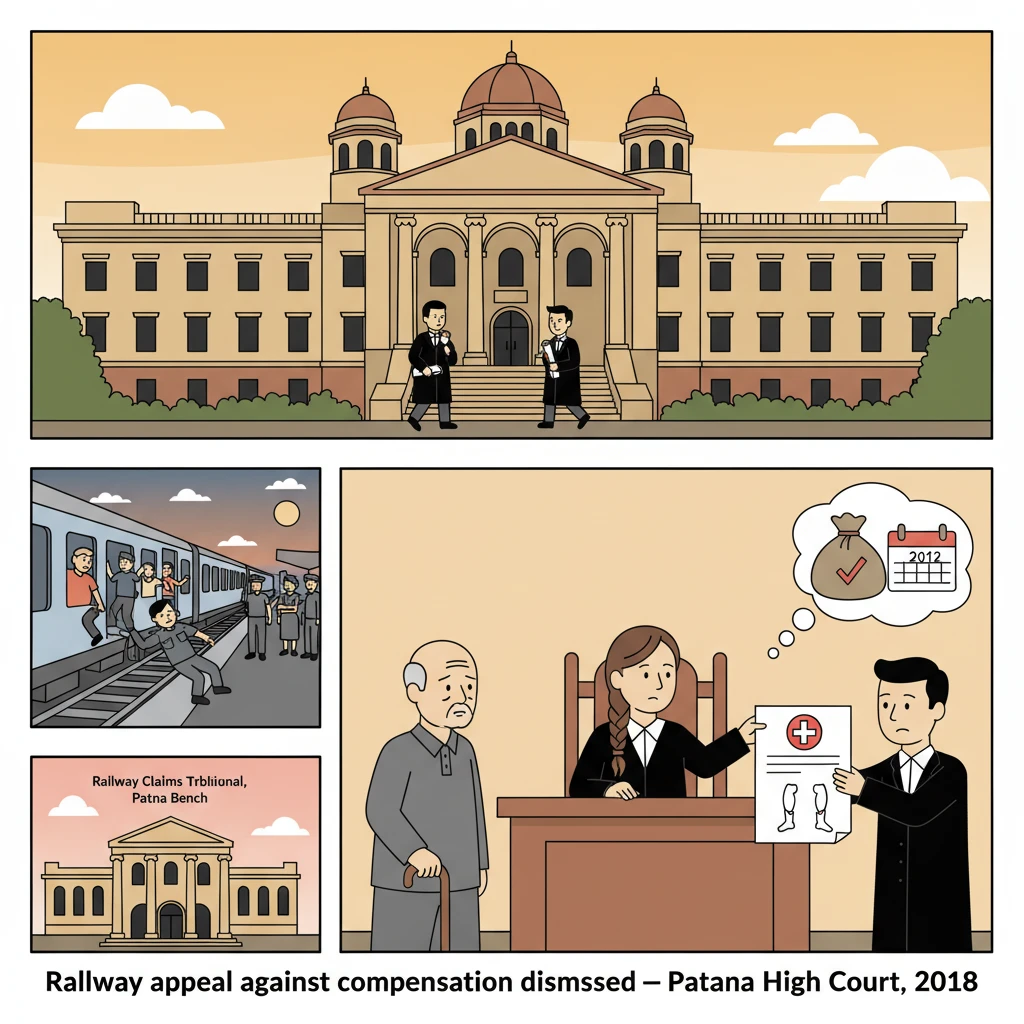
This case arose from the death of a young man, a Naik posted in SPR Engineering Regiment 216 Transit Camp, Jammu. On 31.03.2002, he was travelling from Jammu to his native village Bakarpur in District Munger by Himgiri Express.
He was travelling on a second class reserved ticket issued against an official railway warrant. On 02.04.2002, when the train was about to arrive at Kiul Railway Station in the evening, there was heavy jostling among passengers trying to get down.
According to the claim, due to this jostling, he fell from the running train near platform no. 5 at Kiul and suffered multiple injuries all over his body, dying on the spot. Railway officials noticed the incident, and a Station Memo was issued by the Deputy Station Superintendent, Kiul.
Based on this, Kiul Railway Police registered U.D. Case No. 3 of 2002 on 02.04.2002. After investigation, the police found the case to be true. The claimant, the father of the deceased, filed Claim Application No. OA000191 of 2002 before the Railway Claims Tribunal, Patna Bench, under Section 125 of the Railways Act, seeking compensation of Rs. 4 lakhs for the death.
The Railways appeared and filed a written statement. Both sides led evidence before the Tribunal. On 20.09.2012, the Tribunal allowed the claim and directed the Railways to pay Rs. 4 lakhs with 6% yearly interest from the filing date till the order.
Aggrieved by this, the Union of India through the General Manager, Eastern Railway, Kolkata, filed Miscellaneous Appeal No. 217 of 2013 before the Patna High Court.
What the Court Examined and Decided
The appeal came before Hon’ble Mr. Justice Prakash Chandra Jaiswal. The core dispute was simple but crucial: how did the deceased die, and did it fall within the definition of an “untoward incident” under the Railways Act, which would entitle the family to statutory compensation?
The Railways argued that the man was not a victim of a fall from the train. Instead, according to them, he had been “run over” while crossing the railway track. They relied on the inquest report and post-mortem report, pointing out that the deceased had multiple injuries and that his head, left hand and left leg were severed from the body.
In the Railways’ view, such serious and severing injuries could not be caused by merely falling from a running train. They contended that only a run over by a train, while the person was on the track, could cause such damage. On this basis, they attacked the Tribunal’s conclusion and alleged that the Tribunal had first treated the case as one of run over, but later changed its view and treated it as an untoward incident just because the deceased was a military personnel.
Counsel for the Railways described the Tribunal’s approach as arbitrary and capricious and sought setting aside of the compensation order.
On the other hand, counsel for the claimant stressed that both sides had admitted that the deceased was a bona fide passenger. The Tribunal had also given a clear finding that he was travelling on a valid second class reserved ticket issued against a railway warrant.
The claimant’s case was that the dead body was found beside the railway track of line no. 5, near platform no. 5 at Kiul. This, they said, was consistent with a fall from the running train while alighting, and not with someone being run over while crossing the track from one side to another.
The claimant’s counsel added that in the crowded compartment, during travel and while trying to get down, the deceased fell, came under the same train, and was crushed by it. The fact that some body parts were severed did not automatically prove that it was a case of run over during track-crossing.
Crucially, they pointed out that in its written statement the Railways never claimed that the deceased died by being run over while crossing the track. They had simply denied that any accident took place as alleged. The Tribunal, however, had made out a “third case” by suggesting death during track crossing, which neither side had pleaded.
Before examining the legal question, the High Court carefully looked into the pleadings, the evidence, and the Tribunal’s reasoning. The Court noted that the claimant’s version was consistent throughout: the deceased travelled by Himgiri Express on a valid second class reserved ticket on a railway warrant, and fell near platform no. 5 at Kiul due to jostling while alighting.
In contrast, the Railways’ written statement only disputed the occurrence of the accident as described; it did not present any alternative detailed version such as a track-crossing run over. This absence was significant.
The High Court observed that from the impugned order it appeared the Tribunal had indeed gone beyond the pleadings by treating the death as a run over while crossing the track. The Court reminded that it is a settled principle of law that a court or tribunal cannot suo motu create a third version of facts which neither party has pleaded.
The Court then turned to the documentary record – the FIR, final report and inquest report. These showed that the deceased was found with multiple injuries beside the railway track of line no. 5 of platform no. 5 at Kiul Railway Station on the evening of 02.04.2002. The inquest report was prepared at 6:10 pm that day.
The inquest and post-mortem did show that the left hand, left leg and head were severed. But the Court held that this kind of injury, by itself, does not decisively prove a run over case. The Court reasoned that since the injuries were on the left side, they could also be explained if the deceased fell from the train on his left side, and his head and left side came under the wheels of the same train.
The Court also emphasised another key circumstance: it was admitted, and already found by the Tribunal, that the deceased was a bona fide passenger travelling with a second class reserved ticket on a railway warrant. This showed that he was indeed in the train and travelling on duty-related movement.
Taking these facts together – the place where the body was found, the nature and side of injuries, the timing, the contemporaneous Station Memo and police case, and the admission that he was a bona fide passenger – the High Court concluded that the more probable version was the claimant’s.
The Court held that the deceased fell from the train near platform no. 5 while the train was moving and suffered fatal injuries. In the Court’s considered opinion, this made it a case of “untoward incident” within the meaning of the Railways Act, and not merely a “run over” situation outside the scope of statutory compensation.
Once it was accepted that the death occurred due to an untoward incident involving a bona fide passenger, the entitlement to compensation followed. The Court thus agreed with the ultimate conclusion of the Tribunal that the claimant was entitled to compensation for the death of his son.
Accordingly, the Patna High Court upheld the Tribunal’s order granting Rs. 4 lakhs with 6% interest per annum from the filing date of the claim petition until the date of the Tribunal’s order. The Miscellaneous Appeal filed by the Railways was dismissed.
Why This Judgment Matters
This judgment is important for families of passengers who die in railway accidents where the Railways try to label the incident as a simple “run over” case. The Patna High Court has underlined that courts must look closely at the actual pleadings and documents rather than accept a convenient theory.
Where the evidence shows that a person was a bona fide passenger and the death is reasonably connected with falling from a moving train, the claim should be treated as arising from an untoward incident. The mere fact that injuries are severe or body parts are severed is not enough to deny compensation.
The judgment also sends a clear signal that tribunals and courts cannot invent a “third version” of how an accident happened when neither side has pleaded that story. Victims and their families cannot be denied statutory benefits on the basis of an unpleaded assumption.
For ordinary passengers and their families, especially in Bihar and adjoining regions served by Eastern Railway, this decision of the Patna High Court reinforces that genuine claims following rail accidents must be assessed fairly, keeping in mind both the law and the factual record.
Legal Issues and Answers
Issue: Whether the deceased, a bona fide passenger, died due to a fall from the running train constituting an untoward incident, or due to being run over while crossing the track, taking the case outside the scope of statutory compensation.
Answer: The Court held that the deceased fell from the running train and suffered fatal injuries, making it a case of untoward incident. The compensation awarded by the Tribunal was therefore upheld and the Railways’ appeal was dismissed.
Cases Cited by the Court
- No other judgments are expressly cited or relied upon in the text of this decision.
Case Details
Case Number: Miscellaneous Appeal No. 217 of 2013
Case Title: Union of India through the General Manager, Eastern Railway, Kolkata vs. Md. Barik
Coram: Hon’ble Mr. Justice Prakash Chandra Jaiswal
Citation: 2019 (3) 180
Advocates:
- For the Appellant (Union of India/Eastern Railway): Mr. Bijay Kumar Sinha, Advocate
- For the Respondent (Claimant): Mr. Uma Shankar, Advocate
Nature of the Case: Miscellaneous Appeal against an order of the Railway Claims Tribunal, Patna Bench, in a claim application under Section 125 of the Railways Act for compensation for death in an alleged railway accident.
Link to Judgment: Patna High Court Judgment
If you found this explanation helpful and wish to stay informed about
how legal developments may affect your rights in Bihar,
you may consider following Samvida Law Associates for more updates.







