
Case Background
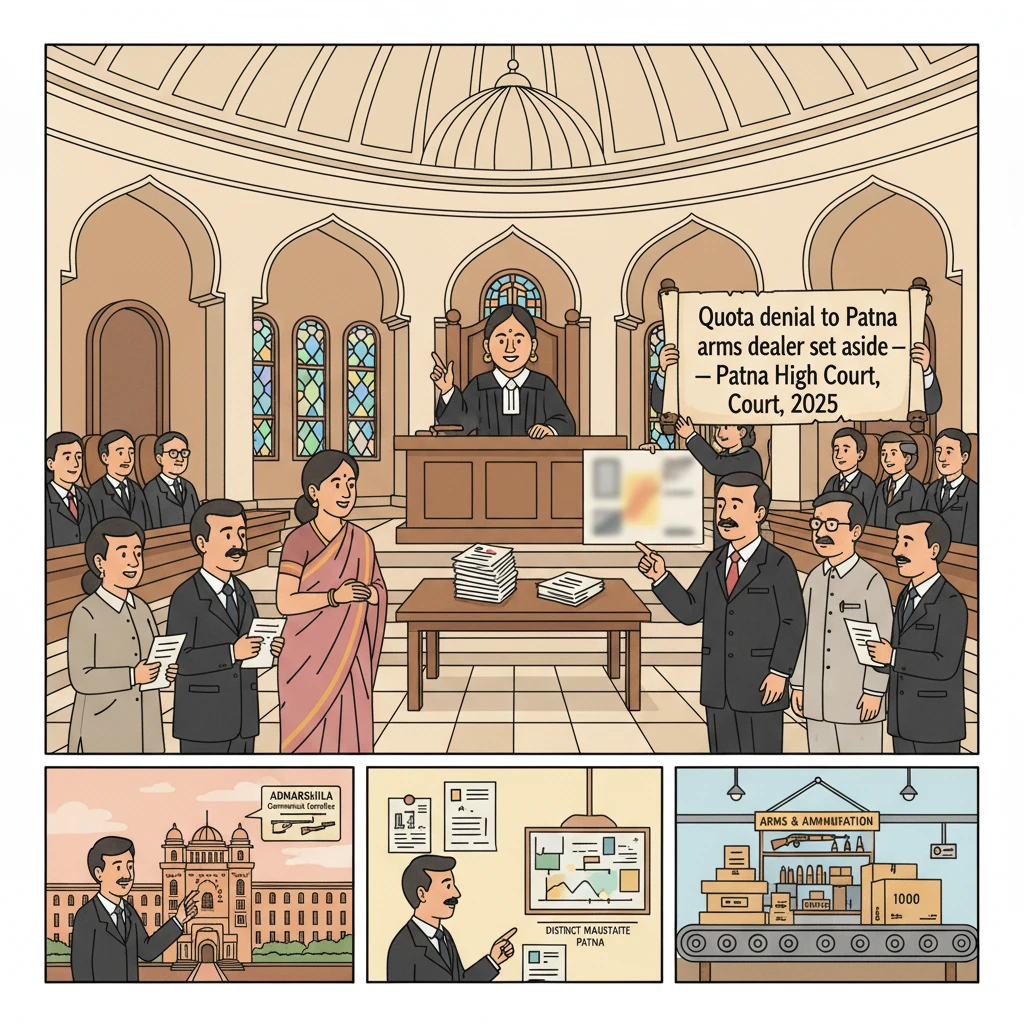
The case concerns a licensed arms and ammunition dealer based at Adharshila Commercial Complex, South Gandhi Maidan, Patna. The business runs under a trade licence in Form XII, Arms Trade License No. 4 of 2004, granted on 11.03.2005, permitting trade in arms and ammunition of all bores under NP bore category. The licence has been renewed from time to time and continues to be valid.
While applying for renewal of this licence, the dealer also requested enhancement of her permissible stock of arms and ammunition. She stated that her existing sanctioned limit was too low to meet the genuine demand of licensed arms holders in Patna.
The District Magistrate, Patna, conducted an enquiry and, after considering local demand and law-and-order aspects, recommended enhancement of her quota. The Divisional Commissioner, Patna, also approved and forwarded this recommendation to the Home Department of the State Government.
Despite these favourable recommendations, the Additional Secretary (Home), Government of Bihar, by Memo No. 10169 dated 28.12.2016, rejected the request for enhancement. Later, after further proceedings before the Patna High Court, the competent authority again rejected the request by Memo No. 4848 dated 03.05.2024, this time heavily relying on general concerns such as “celebratory firing.”
The dealer then filed Civil Writ Jurisdiction Case No. 13539 of 2016 before the Patna High Court, challenging these rejection orders and seeking directions for enhancement of her quota as per the district-level recommendations.
What the Court Examined and Decided
The Patna High Court, presided over by Hon’ble Mr. Justice Alok Kumar Sinha, examined both the factual background and the legal framework under the Arms Act, 1959 and the Arms Rules, 2016.
On behalf of the petitioner, it was argued that she is a validly licensed dealer, selling only to persons who themselves hold legal arms licences. She pointed out that her existing quota did not allow her to procure enough ammunition, especially given that ordnance factories supply minimum lots of 1000 cartridges per bore.
She asserted that because of the restricted quota, she could not maintain adequate variety and quantity of cartridges in stock, which seriously affected her business and ability to serve genuine license holders in Patna. The lengthy process of obtaining permissions, such as NOC under Rule 98 and transport licences under Rule 97 of the Arms Rules, 2016, meant that any shortfall in quota resulted in substantial delay and loss of business.
The petitioner emphasized that both the District Magistrate and the Divisional Commissioner had, after due enquiry, recommended enhancement. She argued that these recommendations, made by officers closest to the ground realities, could not be brushed aside by the Home Department without proper, reasoned grounds.
She further asserted discrimination. In several other districts, including smaller ones with a lower population and lesser demand, the State had sanctioned dealers to the maximum limit. By contrast, in Patna, despite higher demand, her quota remained restricted. She alleged this violated Article 14 of the Constitution of India.
Reliance was placed on a reported decision, 2007(3) PLJR 537 (M/s Rajdhani Arms vs. State of Bihar), where it was held that the Additional Secretary (Home) could not arbitrarily differ from the recommendation of the District Magistrate without recording valid reasons.
The State, on the other hand, argued that arms and ammunition trade is a highly controlled sector governed by the Arms Act, 1959. It contended that no dealer has any vested right to enhancement of quota and that such decisions must be guided by public safety, law-and-order considerations and overall public interest.
The State placed statistics before the Court. In Patna district, 7847 valid arms licences are registered in the National Database of Arms Licenses (NDAL). Each licensee is permitted 50 cartridges per year, giving a maximum potential demand of 3,92,350 cartridges annually.
The State also stated that, as of January 2017, there were 12 licensed arms traders in Patna who could collectively cater to this demand. It submitted that there was no shortage of ammunition in Patna district.
To question the petitioner’s claim of high demand, the State produced her own sale figures. In 2013, 2014 and 2015 she sold 23,720, 27,710 and 28,810 cartridges respectively. However, in the same period, she sold only 1 rifle, 4 revolvers and 1 pistol. According to the State, this showed that the petitioner’s demand projections were inflated and that her existing quota was adequate.
Additionally, the State pointed out that the petitioner’s husband was the proprietor of another licensed firm, M/s City Fire Arms, Sultanganj, Patna, with License No. 2 of 1994. This firm enjoyed a significantly higher quota of 60 rifles, 25 revolvers, 25 pistols and ammunition quotas of 15,000 rifle cartridges, 5,000 revolver cartridges and 5,000 pistol cartridges. The State argued that this indicated that the petitioner’s family was already well provided for under the licensing system.
The subsequent rejection order dated 03.05.2024 was defended on the ground that enhancement could not be allowed in view of increasing misuse of arms in celebratory firing, rising gun-related crime and indiscriminate wildlife hunting. The State said that overall social trends and effective policing had actually reduced legitimate demand for arms, so allowing more ammunition into circulation would only create law-and-order risks.
The Court framed four clear issues: whether the petitioner had a legal right to seek enhancement; whether district-level recommendations were binding on the State Government; whether the petitioner was unequally treated compared to dealers in other districts; and whether public safety and misuse of firearms were valid grounds in this particular case to deny enhancement.
On the first issue, the Court held that while the State retains the power to regulate quota, it cannot exercise this power arbitrarily or ignore material facts. A Form XII dealer licence carries with it a legitimate expectation that the business may expand with genuine market demand, under regulatory control. Repeated recommendations from the District Magistrate and Divisional Commissioner were, in the Court’s view, significant. They were not empty formalities but formal acknowledgements that enhancement was needed.
The Court observed that the Home Department rejected the request on general and vague grounds like celebratory firing and supposed sufficiency of stock. It held that such reasons were irrelevant to this licensed dealer, who is legally allowed to sell only to valid license holders, under strict records. It ruled that a refusal based on such extraneous considerations was arbitrary and offended Article 14. The Court therefore held that the petitioner did have a legal right to have her request for enhancement considered fairly and reasonably, and that the denial in this case was unsustainable.
On the second issue, the Court noted that the final decision-making power lies with the State Government. However, the recommendations of the District Magistrate and Divisional Commissioner are integral to the statutory process. These officials understand local law-and-order conditions, genuine demand from license holders and the conduct of dealers. Once they recommend enhancement, the Government must provide clear, relevant and rational reasons if it chooses to disagree.
In this case, the Home Department failed to show any material that undermined the district-level findings. Reasons like “sufficient stock” and “celebratory firing” did not respond to the specific observation that the existing quota was insufficient for Patna’s legitimate demand. The Court held that the rejection suffered from non-application of mind and arbitrariness. While not technically binding, the recommendations were binding in effect, to the extent that they could not be ignored without cogent grounds.
On the third issue, regarding unequal treatment, the Court recorded that the petitioner had specifically pleaded that dealers in smaller districts had been sanctioned higher quotas, yet this was not effectively denied by the State. The State’s general defence that quotas vary by district was accepted only in principle. The Court held that differentiation must be based on intelligible criteria and adequate reasons.
Since both the District Magistrate and Divisional Commissioner for Patna had recommended enhancement, but no valid justification was given for keeping her quota lower than dealers in smaller districts, the Court found that Article 14 was violated. The petitioner had been treated unequally without rational basis.
On the fourth issue, the Court acknowledged the State’s power to invoke public safety and misuse of firearms as legitimate concerns. However, it held that such concerns cannot be used in a vague and sweeping manner. The State had failed to show any specific link between celebratory firing, criminal misuse, wildlife hunting and the petitioner’s business operations. Her sales were limited to licensed individuals whose ammunition use remains subject to regulation and record-keeping.
Thus, while public safety is undoubtedly a relevant factor in principle, the Court concluded that, in the facts of this case, the reasons cited were not sufficient or properly connected to the petitioner’s request. A general reference to public safety could not be used to defeat a licensed dealer’s specific claim supported by district-level recommendations.
In its final conclusion, the Court held that the State’s rejection orders were arbitrary, suffered from non-application of mind, and failed to respect the recommendations of field officers. It quashed Memo No. 10169 dated 28.12.2016 and Memo No. 4848 dated 03.05.2024 issued by the Home Department, Government of Bihar.
The Court directed the respondents to “forthwith” enhance the petitioner’s quota of arms and ammunition as per the recommendations of the District Magistrate, Patna and the Divisional Commissioner, Patna. It ordered that necessary orders and authorisations be issued within two weeks from the date of receipt or production of the judgment. The writ petition was allowed to this extent, with no order as to costs.
Why This Judgment Matters
This judgment is significant for arms and ammunition dealers across Bihar and beyond. It makes clear that while the State has strong regulatory powers in this sensitive sector, those powers must be exercised fairly and with reasons.
For dealers, the decision confirms that if district officers recommend enhancement of quota after due enquiry, their views cannot be casually ignored by higher authorities. If a request is denied, the Government must show concrete reasons linked to the dealer’s circumstances and local conditions, not rely on broad and vague fears.
For ordinary licensed arms holders, the judgment indirectly supports their ability to obtain ammunition lawfully, especially in districts with high demand. If the market is artificially constrained without proper basis, the High Court may step in to correct the imbalance.
The ruling also reinforces Article 14 protections against unequal treatment. Where similarly placed traders in other districts enjoy higher quotas, a dealer in a major district like Patna cannot be kept at a lower limit without convincing justification.
Legal Issues and Answers
- Issue: Does a licensed arms dealer have a legal right to seek enhancement of quota under her trade licence?
Answer: Yes. While the State can regulate, the dealer has a right to fair and reasonable consideration of her request. Denial cannot be arbitrary or based on irrelevant reasons. - Issue: Are recommendations of the District Magistrate and Divisional Commissioner binding on the State Government in quota matters?
Answer: They are not technically binding, but form an integral part of the statutory process. The State cannot disregard them without cogent, germane reasons; otherwise, its decision becomes arbitrary. - Issue: Can the State rely on general concerns like celebratory firing and misuse of firearms to deny enhancement of quota in this case?
Answer: Not in the circumstances of this case. Without specific material linking such concerns to the petitioner’s business, these were held to be vague and insufficient grounds to deny enhancement.
Cases Cited by the Court
- 2007(3) PLJR 537 (M/s Rajdhani Arms vs. State of Bihar)
Case Details
Case Number: Civil Writ Jurisdiction Case No. 13539 of 2016
Case Title: M/s Premlata and Sons vs. The State of Bihar & Ors.
Citation: 2025(3) PLJR 938
Coram: Hon’ble Mr. Justice Alok Kumar Sinha
Nature of the Case: Writ petition (civil) challenging refusal to enhance quota under arms dealer’s licence
Advocates for the Petitioner: Mr. Mrigank Mauli, Sr. Advocate; Ms. Manisha Pandey, Advocate; Mr. Deepak Kumar, Advocate; Ms. Shweta Pandey, Advocate; Mr. Sanket, Advocate
Advocate for the Respondents (State): Md. Nadeem Seraj, Advocate
Date of Judgment: 20.08.2025
Link to Judgment: Read full Patna High Court judgment
If you found this explanation helpful and wish to stay informed about how legal developments may affect your rights in Bihar, you may consider following Samvida Law Associates for more updates.







