
Case Background
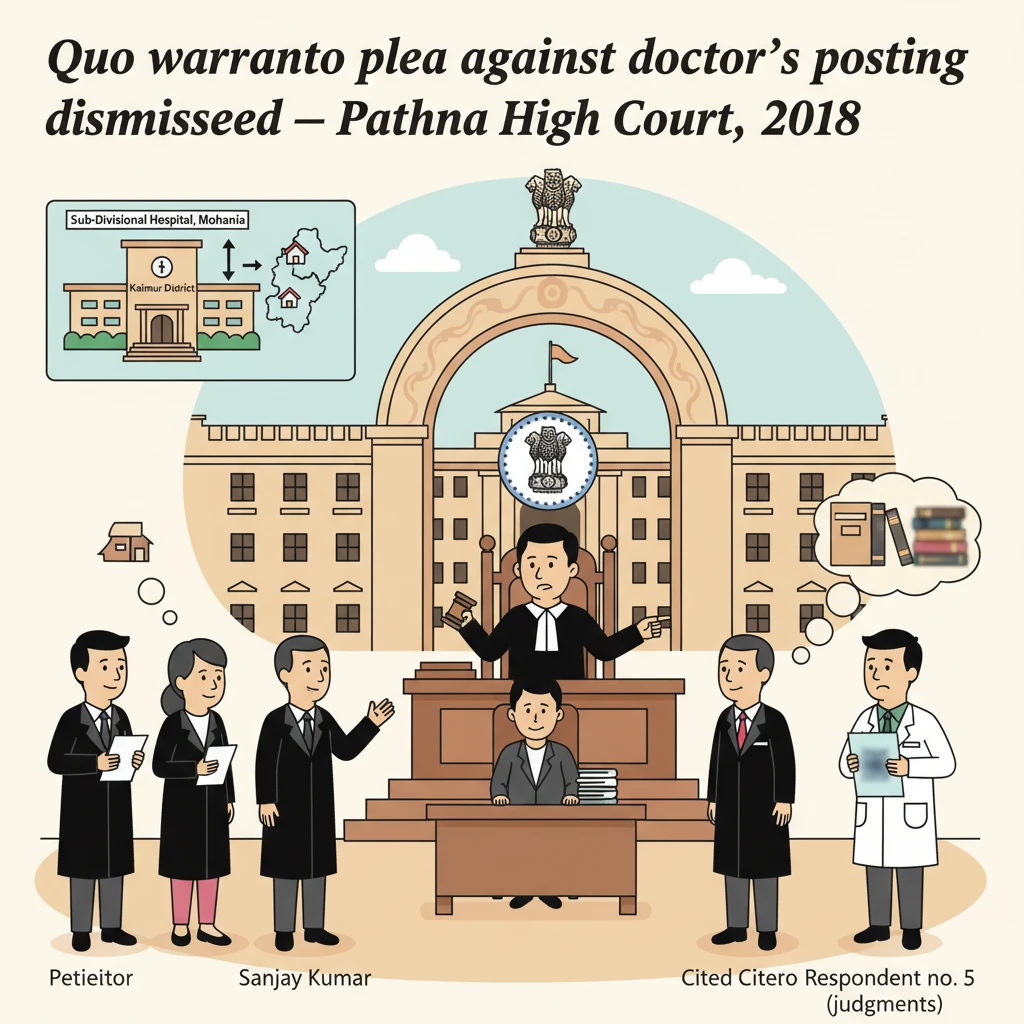
The petitioner, a resident of Rohtas district and describing himself as a social worker, filed a civil writ petition in the nature of public interest litigation before the Patna High Court.
He challenged the holding of office by respondent no. 5, a doctor posted as Deputy Superintendent of the Sub-Divisional Hospital, Mohania, in district Kaimur at Bhabua. According to the petitioner, the doctor’s home district was also Kaimur, and a “government policy decision” allegedly barred postings in one’s home district.
On this basis, the petitioner prayed for a writ of quo warranto, asking the Court to remove respondent no. 5 from the post of Deputy Superintendent, Sub-Divisional Hospital, Mohania.
The State of Bihar and its health authorities, including the Principal Secretary, Department of Health, the Director-in-Chief, Health Services, and the Civil Surgeon-cum-Chief Medical Officer, Kaimur, were also arrayed as respondents.
The matter was heard by Hon’ble Mr. Justice Mohit Kumar Shah, who reserved the judgment (C.A.V.) and pronounced it on 29.06.2018.
What the Court Examined and Decided
The core question before the Patna High Court was whether a writ of quo warranto could be issued to unseat respondent no. 5 from the post of Deputy Superintendent on the ground that his posting in his home district violated a government policy. The Court examined both the maintainability of the petition and the legal limits of the writ of quo warranto.
At the outset, counsel for the State raised a preliminary objection. They argued that public interest litigations are not maintainable in service matters and that the petitioner, being neither an affected employee nor a competitor for the post, lacked locus standi to challenge the posting.
In response, the petitioner’s counsel relied on several Supreme Court decisions to contend that:
- a writ of quo warranto can be sought by any citizen;
- strict “locus standi” requirements are relaxed for habeas corpus and quo warranto;
- public interest litigation is permissible for such writs even in matters connected with service.
The judgments cited included:
- AIR 1965 SC 491 (The University of Mysore v. C.D. Govinda Rao & Anr.)
- (2000) 2 SCC 465 (Railway Board v. Chandrima Das)
- (2009) 8 SCC 273 (Mahesh Chandra Gupta v. Union of India)
- (2013) 1 SCC 501 (Rajesh Awasthi v. Nand Lal Jaiswal)
- (2013) 5 SCC 1 (State of Punjab v. Salil Sabhlok)
- (2014) 1 SCC 161 (Central Electricity Supply Utility of Odisha v. Dhobei Sahoo)
The Court carefully considered these authorities but distinguished most of them, emphasising what was directly relevant to the case.
Nature and limits of a writ of quo warranto
The Court referred to the classic description in The University of Mysore v. C.D. Govinda Rao and other Supreme Court decisions, noting that a writ of quo warranto:
- is a judicial enquiry into whether a person holds a public office without legal authority;
- can be issued when an appointment is contrary to statutory provisions or when the holder lacks eligibility as prescribed in law;
- is meant to prevent usurpation of public office, not to control day-to-day administrative decisions like transfers or postings.
The Court highlighted that in B.R. Kapur v. State of Tamilnadu, the Supreme Court clarified that quo warranto is not a substitute for mandamus, injunction, appeal or writ of error. Its purpose is not to prevent an “improper exercise of power lawfully possessed” but only to stop a person from exercising power that he does not lawfully have.
Similarly, in Central Electricity Supply Utility of Odisha v. Dhobei Sahoo, the Supreme Court held that:
- the High Court’s jurisdiction in quo warranto is limited;
- such a writ can be issued only when the person holding public office lacks eligibility or the appointment is contrary to statutory rules; and
- concepts like locus standi applicable in ordinary service disputes should not expand the scope of quo warranto.
The Court also cited Hari Bansh Lal v. Sahodar Prasad Mahto, B. Srinivasa Reddy v. Karnataka Urban Water Supply & Drainage Board Employees’ Association, High Court of Gujarat v. Gujarat Kishan Mazdoor Panchayat, Ghulam Qadir v. Special Tribunal, and other judgments. Across these cases, one consistent principle emerges: even in public interest, quo warranto lies only where there is a clear violation of statutory rules or lack of eligibility.
Distinguishing PIL in service matters
While acknowledging that some Supreme Court decisions allow public interest litigation for quo warranto, especially in relation to constitutional or high public offices, the Patna High Court underlined two constraints:
- PILs in service matters are generally barred, except in narrow situations where quo warranto is clearly attracted; and
- even then, the High Court must first be satisfied that the appointment itself violates a statutory rule or eligibility condition.
Referring to State of Punjab v. Salil Sabhlok, the Court noted that in “service matters” affecting government servants, the law of master and servant applies, and only a writ of quo warranto is generally open in PIL form. But again, this is tied to statutory violation in appointment, not every administrative decision.
Application to the facts of this case
After setting out the legal position, the Patna High Court examined what the petitioner had actually pleaded.
The petitioner did not challenge the initial appointment of respondent no. 5 as a government doctor or his basic eligibility to hold the post of Deputy Superintendent. There was no allegation that his entry into service or his substantive appointment was contrary to any statute, rule, or notification.
Instead, the sole grievance was that respondent no. 5 had been posted as Deputy Superintendent at Mohania, within his home district Kaimur, allegedly contrary to a “government policy decision” that postings in the home district are barred.
The Court noted an important factual gap: the petitioner had not produced any statutory rule or regulation to show that this policy formed part of binding service rules. No government notification or rule with statutory backing was placed on record or pointed out in the writ petition.
In the absence of such material, the Court treated the alleged bar as, at best, an administrative policy, not a statutory requirement going to eligibility or validity of appointment.
On these facts, the Court held:
- There was no challenge to the legality of respondent no. 5’s initial appointment.
- The complaint related only to his posting or transfer to a particular place.
- Quo warranto cannot be used to challenge such a transfer when the substantive appointment remains unassailed and in accordance with law.
- The absence of any stated statutory breach meant that the basic condition for issuing quo warranto was not met.
The Court also reasoned that merely attacking an individual posting cannot stretch the scope of quo warranto. Since the writ is not meant to command performance of official duties or control administrative discretion, using it to question where an officer is posted would go beyond its permissible limits.
Conclusion of the Court
After reviewing the Supreme Court case law and the pleadings, the Patna High Court concluded that:
- the writ petition, styled as a public interest matter, was not maintainable in the form presented; and
- even on merits, it was devoid of substance as no violation of statutory rules governing appointment was shown.
The Court therefore dismissed the writ petition, holding that a writ of quo warranto could not be issued against respondent no. 5 merely on the ground that his posting was allegedly against a non-statutory government policy on home district postings.
Why This Judgment Matters
This decision of the Patna High Court is significant for two main reasons.
First, it clearly explains that a writ of quo warranto is a very limited remedy. It can be used only where:
- the appointment to a public post violates a statutory rule; or
- the person does not fulfil the eligibility criteria laid down in law.
It cannot be used to challenge ordinary administrative decisions like transfers or postings, even if someone believes a policy has been breached.
Second, the case sends a message to social workers, activists, and citizens who may wish to file public interest litigations against government postings. If they cannot point to a specific statutory rule that has been violated in the appointment itself, their petitions are likely to be dismissed.
For government employees and administrators, the judgment reassures that:
- posting and transfer decisions, when made within the legal framework, will not normally be overturned using quo warranto; and
- courts will be slow to interfere in service matters unless there is a clear statutory breach.
For ordinary citizens, especially in Bihar, this ruling clarifies that if they suspect someone is illegally holding a public office, they must be able to show that the appointment breaks a law or eligibility rule, not just an internal policy or perceived unfairness.
Legal Issues and Answers
- Issue: Can a writ of quo warranto be issued to remove a government doctor from the post of Deputy Superintendent of a hospital on the allegation that his posting in his home district violates a government policy, when no breach of statutory rules or eligibility conditions is pleaded?
Answer: No. The Patna High Court held that quo warranto can be issued only when the appointment to public office is contrary to statutory rules or when the incumbent lacks eligibility. A challenge limited to the place of posting, based only on an alleged policy and without pointing to any statutory violation in the initial appointment, does not satisfy this requirement. The writ petition was therefore not maintainable and was dismissed.
Cases Cited by the Court
- AIR 1965 SC 491 – The University of Mysore v. C.D. Govinda Rao & Anr.
- (2000) 2 SCC 465 – Railway Board v. Chandrima Das
- (2009) 8 SCC 273 – Mahesh Chandra Gupta v. Union of India
- (2013) 1 SCC 501 – Rajesh Awasthi v. Nand Lal Jaiswal
- (2013) 5 SCC 1 – State of Punjab v. Salil Sabhlok
- (2014) 1 SCC 161 – Central Electricity Supply Utility of Odisha v. Dhobei Sahoo
- (2001) 7 SCC 231 – B.R. Kapur v. State of Tamilnadu
- (2006) 11 SCC 731 – B. Srinivasa Reddy v. Karnataka Urban Water Supply and Drainage Board Employees’ Association & Ors.
- (2010) 9 SCC 655 – Hari Bansh Lal v. Sahodar Prasad Mahto
- High Court of Gujarat v. Gujarat Kishan Mazdoor Panchayat (citation as referred in judgment)
- Mor Modern Coop. Transport Society Ltd. v. Govt. of Haryana (citation as referred in judgment)
- Ghulam Qadir v. Special Tribunal (citation as referred in judgment)
- Other Supreme Court authorities mentioned in extracted passages (R.K. Jain v. Union of India, A.N. Shashtri v. State of Punjab, B. Singh (Dr.) v. Union of India, etc.), to the extent reproduced in the judgment.
Case Details
Case Number: Civil Writ Jurisdiction Case No. 7983 of 2017
Case Title: Sanjay Kumar v. The State of Bihar & Ors.
Coram: Hon’ble Mr. Justice Mohit Kumar Shah
Citation: 2019 (3) PLJR 409
Date of Judgment: 29.06.2018
Advocates:
- For the Petitioner: Mr. Jitendra Kumar Roy
- For the Respondents: Mr. Sunil Kr. Mandal, SC-3; Mr. Bipin Kumar, A.C. to SC-3; Mrs. Neelam Kumari
Nature of the Case: Writ petition under Article 226 of the Constitution seeking a writ of quo warranto against a government doctor’s posting; filed as a public interest matter relating to service/posting in the Health Department.
Link to Judgment: Patna High Court Judgment
If you found this explanation helpful and wish to stay informed about
how legal developments may affect your rights in Bihar,
you may consider following Samvida Law Associates for more updates.







