
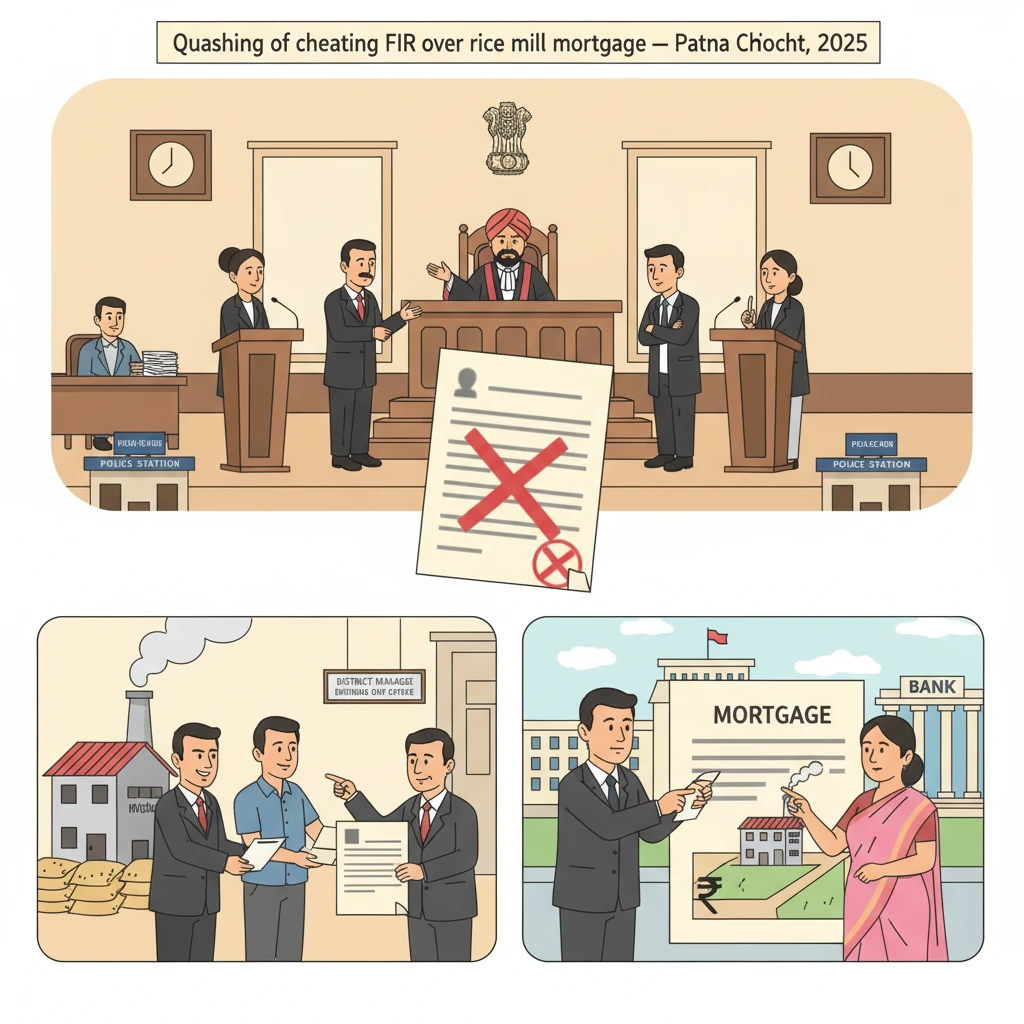
Case Background
The dispute started with a piece of land owned by the informant. She had leased this land to her uncle for business purposes. When her uncle’s business did not go well, he sub-let the land to a co-accused, Abhay Kumar Singh, who established a rice mill on that land.
In January 2013, according to the FIR, Abhay Kumar Singh went to the informant’s uncle and asked for the original land deed. He said he needed it to verify the boundary, area and details of the land. The original land deed, which had earlier been given by the informant to her father and then passed on to Abhay Kumar Singh, was allegedly never returned.
Later, the informant came to know that Abhay Kumar Singh, in connivance with the present petitioner, had used her land to obtain a paddy supply contract worth Rs. 35 lakhs from Bihar State Food and Civil Supplies Corporation. The allegation was that this was done to siphon off money and ultimately get her land sold.
At the relevant time, the petitioner was posted as District Manager, Bihar State Food and Civil Supplies Corporation, Bhagalpur. On the basis of the written information lodged by the informant, Bhagalpur (Adampur) P.S. Case No.924 of 2014 was registered on 13.12.2014 for offences under Sections 420, 467, 471 and 120-B of the IPC.
Before this FIR, another case about the same land transaction had already been lodged as Sultanganj P.S. Case No.284 of 2014 by the informant’s uncle, Jawahar Lal Mandal. In that earlier FIR only Abhay Kumar Singh was named, though he suspected involvement of others.
The petitioner earlier filed Cr. Misc. No.11396 of 2015 before the Patna High Court seeking quashing of the present FIR on the ground that it was a second FIR for the same occurrence. On 06.02.2018, the High Court dismissed that petition. The petitioner approached the Supreme Court in Special Leave Petition (Crl.) Diary No.30123 of 2018. On 07.09.2018, the Supreme Court dismissed the SLP.
What the Court Examined and Decided
In the present Criminal Miscellaneous No.22744 of 2025, the petitioner again sought quashing of Bhagalpur (Adampur) P.S. Case No.924 of 2014. This time, he relied on changed circumstances. The main grounds were: inordinate delay in investigation and the later police conclusion that there was a mistake of law regarding his implication.
The petitioner’s counsel, Mr. Nilanjan Chatterjee, argued that almost eleven years had passed since registration of the FIR, yet no charge-sheet had been submitted against the petitioner. During pendency of this petition, he came to know that investigation had in fact been completed earlier and that the petitioner had not been sent up for trial.
Taking note of this assertion, the Court directed the Senior Superintendent of Police, Bhagalpur, on 09.04.2025 to file a counter affidavit regarding the status of investigation. The SSP’s counter affidavit dated 19.04.2025 stated that Final Form No.110 of 2020 dated 09.04.2020 had been submitted as “mistake of law” (vidhi ki bhul) in respect of the petitioner.
The report further clarified that for the same occurrence, Sultanganj P.S. Case No.284 of 2014 had been registered under Sections 420, 406, 467, 468, 469 and 471 IPC. In that Sultanganj case, Charge Sheet/Final Form No.34 of 2015 had already been submitted before the court. Therefore, in Jogasar P.S. Case No.924 of 2024 (earlier Bhagalpur Kotwali (Adampur) P.S. Case No.924 of 2014), the final form against the petitioner was submitted as “mistake of law” and investigation was closed.
The Court first examined whether a second quashing petition was maintainable after dismissal of the earlier one and rejection of SLP. For this, the petitioner relied on the Supreme Court decisions in Superintendent and Remembrancer of Legal Affairs, West Bengal v. Mohan Singh and Vinod Kumar, IAS v. Union of India & Ors. The Supreme Court had held that dismissal of an earlier petition under Section 482 CrPC does not bar a subsequent petition if fresh facts or changed circumstances justify it.
The Patna High Court accepted this legal position. It held that there was no doubt about the maintainability of the second quashing petition in view of the changed circumstances, namely the long delay and the filing of final form showing mistake of law.
On the question of delay, the petitioner’s counsel also cited Pankaj Kumar v. State of Maharashtra & Ors., where the Supreme Court quashed criminal proceedings due to inordinate delay in investigation and trial, treating such delay as violation of the right to speedy investigation and trial. The Patna High Court reproduced paragraphs 25–28 of Pankaj Kumar to emphasise how prolonged investigation without explanation can justify quashing.
The Court noted that the petitioner had been facing the pressure of a criminal case for about 15 years. It observed that, despite the final form having been submitted in 2020, there was no further progress in court, and the petitioner continued to suffer the trauma of criminal prosecution.
Next, the Court examined the FIR itself and the materials referred to in the counter affidavit. The FIR alleged that the petitioner, as District Manager of the Corporation, colluded with Abhay Kumar Singh to mortgage the informant’s land as security for a government paddy supply contract worth Rs. 35 lakhs. The informant said that documents were prepared without true consent and that her land was used to obtain government money.
However, the Court noted certain important aspects. It found that the allegation against the petitioner was essentially based on suspicion arising from his official position as District Manager. It also noted that the informant herself had filed an affidavit before the Corporation about mortgage of her land. The Court referred to the SSP’s counter affidavit to highlight that, for the same occurrence, two FIRs had been lodged: one by the uncle and the later one by the informant after certificate proceedings had been initiated against her.
In the earlier FIR lodged by the uncle, the petitioner was not named. In the later FIR lodged by the informant, he was named, but the police, after full investigation, reached the conclusion that, so far as the petitioner was concerned, there was a “mistake of law”. On that basis, Final Form No.110 of 2020 was submitted against him.
The Court then turned to the principles laid down by the Supreme Court in State of Haryana v. Bhajan Lal, particularly the illustrative categories in paragraph 102 where inherent powers under Section 482 CrPC can be exercised to quash criminal proceedings. These include situations where:
- Even if FIR allegations are taken at face value, they do not constitute any offence against the accused.
- The uncontroverted allegations and evidence do not disclose commission of any offence.
- Allegations are so absurd or improbable that no prudent person would proceed further.
- Proceedings are attended by mala fide or instituted with an ulterior motive.
Applying these principles, the Court held that, taking the FIR allegations in their entirety and considering the subsequent final form treating the case against the petitioner as mistake of law, no cognizable offence was prima facie made out against him. The suspicion based merely on his designation and official actions was not enough to continue a criminal case when the investigating agency itself had found no legal basis to prosecute him.
The Court also took into account that two FIRs had been lodged for the same broad occurrence, and that the earlier FIR by the uncle had already resulted in a charge sheet. This supported the police decision to close the later case against the petitioner as a mistake of law.
In this background, and considering the prolonged trauma caused to the petitioner by the pending criminal case, the Court concluded that this was a fit case to exercise its inherent power to secure the ends of justice.
Accordingly, the Patna High Court quashed and set aside Bhagalpur (Adampur) P.S. Case No.924 of 2014 dated 13.12.2014, along with all consequential proceedings, insofar as they related to the petitioner. The quashing was “qua petitioner”, meaning it applied only to him and not necessarily to other accused.
With this, the current quashing petition was allowed. The Court also directed that a copy of the judgment be sent to the concerned court without delay.
Why This Judgment Matters
This judgment is important for people who find themselves named in criminal cases because of their official role, especially in government or public sector organisations. It shows that if the police themselves later file a final report saying there was a mistake of law in implicating someone, the High Court can step in and close the case against that person.
It also highlights that a person should not be kept under the constant fear of criminal trial for many years without clear evidence. Long, unexplained delay in investigation, combined with weak or suspicion-based allegations, can lead to quashing of the case.
For complainants and police, this judgment underlines the need to be careful before naming public officials as accused when their involvement is only presumed from their post, and not supported by concrete acts described in the FIR.
Legal Issues and Answers
- Issue: Can a second petition under Section 482 CrPC be maintained to quash an FIR after an earlier quashing petition and SLP have been dismissed?
Answer: Yes. The Patna High Court held, relying on Supreme Court decisions, that a second petition is maintainable where there are changed circumstances or new facts, such as a later police final form. - Issue: Whether continuation of criminal proceedings in Bhagalpur (Adampur) P.S. Case No.924 of 2014 against the petitioner was justified in law?
Answer: No. In view of the police final form treating the case as “mistake of law”, the long delay, and the nature of allegations, the Court held that no cognizable offence was made out against the petitioner and quashed the FIR and all consequential proceedings as against him. - Issue: Does inordinate delay in investigation, without explanation, affect the accused’s right to speedy investigation and trial?
Answer: Yes. Referring to Pankaj Kumar, the Court recognised that unexplained and prolonged delay in investigation can violate the constitutional right to speedy investigation and trial and can justify quashing in appropriate cases.
Cases Cited by the Court
- Pankaj Kumar v. State of Maharashtra & Ors., (2008) 16 SCC 117
- Superintendent and Remembrancer of Legal Affairs, West Bengal v. Mohan Singh & Ors., (1975) 3 SCC 706
- Vinod Kumar, IAS v. Union of India & Ors., Live Law 2021 SC 281 (order quoted)
- State of Haryana v. Bhajan Lal & Ors., 1992 Supp (1) SCC 335
- Amit Bhai Anil Chandra Shah v. Central Bureau of Investigation & Anr., (2013) 6 SCC 348 (referred in earlier 2018 order)
Case Details
Case Number: Criminal Miscellaneous No.22744 of 2025 (arising out of P.S. Case No.924 of 2014, Bhagalpur Kotwali (Adampur), District Bhagalpur)
Case Title: Shovendra Kumar Chaudhary @ Shobhendra Kumar Chaudhary v. The State of Bihar & Anr.
Coram: Hon’ble Mr. Justice Chandra Shekhar Jha
Citation: 2025(3) PLJR 147
Advocates:
For the Petitioner: Mr. Nilanjan Chhaterjee, Advocate; Mr. Ujjwal Raj, Advocate; Mr. Sahil Kumar, Advocate
For the State/Opposite Parties: Mr. Anil Kumar Singh No.1, APP
Nature of the Case: Petition under Section 482 CrPC seeking quashing of FIR and consequential criminal proceedings.
Link to Judgment: https://patnahighcourt.gov.in/viewjudgment/NiMyMjc0NCMyMDI1IzEjTg==-avbedSUHVMc=
If you found this explanation helpful and wish to stay informed about
how legal developments may affect your rights in Bihar,
you may consider following Samvida Law Associates for more updates.







