
Case Background
The petitioner was working as a Storekeeper at the Sub-Divisional Hospital, Dalsinghsarai in the district of Samastipur.
According to the judgment, he worked there from 8.6.1983 to 1.11.1989. Many years later, allegations were made that he had helped in the irregular purchase of medicines from M.S.D., Calcutta, in violation of rules and government guidelines.
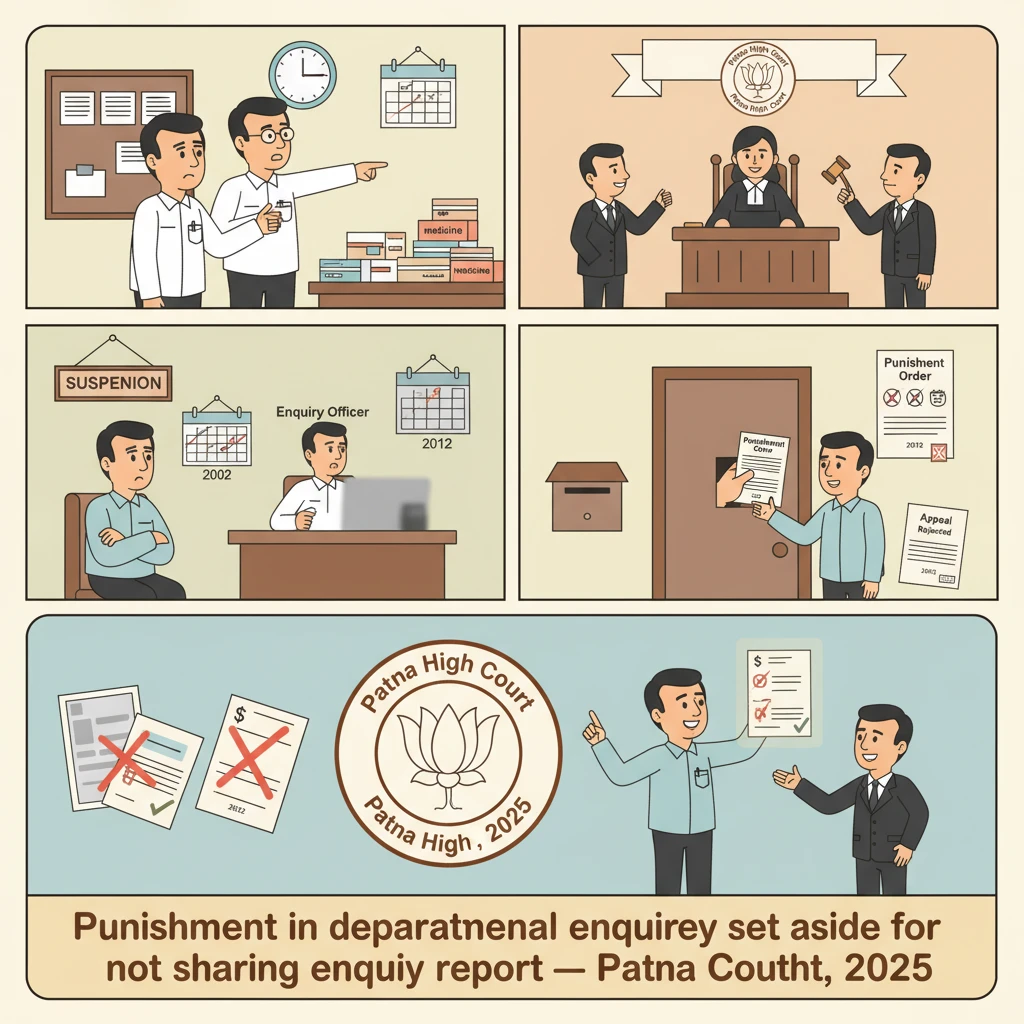
On 3.2.2002, a memo of charge was served on the petitioner, starting a departmental proceeding against him. The Regional Deputy Director, Health Services, Darbhanga Division, was appointed as the Enquiry Officer.
The petitioner submitted his reply to the charges and took part in the enquiry. While the enquiry was pending, he was placed under suspension on 19.8.2002 on the basis of the allegations about purchase of medicines in violation of rules.
After completion of enquiry, the Enquiry Officer submitted his report to the disciplinary authority. On 6.5.2010, the Director-In-Chief, Health Service, Bihar, Patna, passed an order of punishment against the petitioner.
The punishment order was severe. It directed withholding of two increments with cumulative effect, imposed a censure, stated that the petitioner should not be given any financial work, and ordered withholding of future promotion. It also directed that the petitioner would get nothing for the suspension period except subsistence allowance, although that period would count for pension. The order further recorded that, as the matter was under CBI enquiry, the punishment might be reconsidered after investigation.
The petitioner filed a departmental appeal. On 12.1.2012, the Appellate Authority, namely the Principal Secretary, Health Department, passed Order no. 61(4), dismissing the appeal and upholding the punishment.
Aggrieved, the petitioner approached the Patna High Court in Civil Writ Jurisdiction Case No. 8475 of 2012, challenging both the punishment order dated 6.5.2010 and the appellate order dated 12.1.2012.
What the Court Examined and Decided
The writ petition was heard by Hon’ble Mr. Justice Partha Sarthy. The petitioner was represented by Ms. Roona, Advocate, and the State respondents by Mr. Manish Kumar, AC to Ex-AAG-6 (Incharge AAG-5).
The petitioner asked for multiple reliefs. He sought quashing of the punishment order dated 6.5.2010 and the appellate order dated 12.1.2012. He also asked for a declaration that the whole departmental proceeding was void because he was not served with the enquiry report and the second show cause notice before punishment. Further, he wanted a declaration that as a Storekeeper he had not played any role in the alleged irregular purchase of medicines.
In the hearing, learned counsel for the petitioner put forward a focused argument. She stated that the petitioner had, in fact, no role in purchasing medicines, as he was only a Storekeeper. However, she clearly submitted that the main legal ground on which the petitioner relied was different.
The central submission was that after the enquiry was over, the petitioner was not supplied with a copy of the enquiry report, nor was he given a second show cause notice before final punishment was imposed. Without these, the disciplinary authority could not lawfully pass the punishment order, and the appellate authority could not legally uphold it.
The State’s counsel opposed the petition. He said that the petitioner, while posted as Storekeeper in the Sub-Divisional Hospital, was placed under suspension due to allegations of purchase of medicines in violation of rules and guidelines. A regular departmental proceeding was initiated, evidence was recorded, and the petitioner fully participated in the enquiry.
On the basis of this evidence, the Enquiry Officer submitted his report, and the disciplinary authority thereafter passed the punishment order. According to the State, the punishment was legally valid and was based on the enquiry report. The appellate authority also considered the petitioner’s points and found no merit, so the appeal was rejected. Therefore, the State argued, there was no illegality and the writ application should be dismissed.
The Court then examined the record and the pleadings. It noted that the petitioner had made a categorical assertion in paragraph 9 of the writ petition that he had never been served with the enquiry report or the second show cause notice.
Crucially, this assertion was not denied in the counter affidavit filed by the respondents. The Court treated this silence as significant. When a specific fact is stated in a writ petition and the State does not deny it in its reply, the Court can proceed on the basis that the fact is correct.
To decide the effect of non-supply of the enquiry report, the Court relied on a leading Supreme Court decision: Managing Director, ECIL, Hyderabad & Ors. vs. B. Karunakar & Ors., (1993) 4 SCC 727.
The Court quoted extensively from paragraphs 25, 26, and 27 of that judgment. In B. Karunakar, the Supreme Court had explained that departmental proceedings, where the Enquiry Officer is different from the disciplinary authority, have two stages.
The first stage ends when the disciplinary authority considers the evidence, the Enquiry Officer’s report, and the employee’s reply to that report, and then arrives at its own conclusion about guilt. The second stage begins only after that, when the disciplinary authority decides what penalty to impose.
The Supreme Court had held that the right of the delinquent employee to receive the enquiry report and to submit his reply to it is an essential part of the right to defend himself in the first stage. Denial of the report amounts to denial of reasonable opportunity and violation of principles of natural justice.
The reason is simple: the Enquiry Officer’s findings form an important material before the disciplinary authority. They may not be fully based on the evidence, or may ignore relevant evidence, or may misunderstand it. If the disciplinary authority considers this report, which the employee has never seen or answered, it would be unfair. Natural justice demands that the employee must have a chance to meet, explain, and challenge those findings before punishment is decided.
The Patna High Court applied this principle to the present case. Since the Enquiry Officer here was a different person (the Regional Deputy Director, Health Services) and the disciplinary authority was the Director-In-Chief, it was necessary, as per B. Karunakar, that the petitioner be supplied with the enquiry report and be allowed to reply to it.
On the facts of this case, the Court found that the petitioner’s statement about non-supply of the enquiry report and absence of a second show cause notice remained uncontroverted. The respondents had not said anywhere in the counter affidavit that they had supplied the report or issued the second show cause notice.
In paragraph 15 of the judgment, the Court concluded that, in view of the law laid down in B. Karunakar and the admitted position that the report and second show cause were not served, neither the punishment order nor the appellate order could be sustained.
Accordingly, in paragraph 16, the Court set aside both orders: Memo no. 698(4) dated 6.5.2010 issued by the Director-In-Chief, Health Service, Bihar, Patna and Order no. 61(4) dated 12.1.2012 issued by the Principal Secretary, Health Department, Government of Bihar.
The Court did not go into the merits of whether the petitioner had any role in the alleged irregular purchases. It allowed the writ solely on the ground of violation of natural justice due to non-supply of the enquiry report and second show cause notice.
After quashing the orders, the Court granted positive reliefs. In paragraph 17, it directed that the application is allowed with all consequential benefits. These benefits are to be paid to the petitioner within three months.
Further, in paragraph 18, the Court held that, since the punishment order has been set aside, the petitioner is entitled to the difference of arrears of salary for the suspension period, beyond the subsistence allowance already paid. This amount too must be paid within the same three-month period.
In paragraph 19, the Court recorded that the writ application stands allowed with the above observations and directions. There is no direction for a fresh departmental proceeding in the judgment.
Why This Judgment Matters
This decision of the Patna High Court is significant for government employees in Bihar and elsewhere who face departmental enquiries.
It reinforces that, where the Enquiry Officer and the Disciplinary Authority are not the same person, the employee has a clear right to receive a copy of the enquiry report and to reply to it before punishment is decided.
If this basic step is skipped, even serious punishments can be struck down, no matter what the underlying allegations are. The Court focused on fairness of procedure rather than weighing the evidence itself.
For employees, the judgment shows that they can successfully challenge disciplinary orders if the enquiry report was not supplied, provided they have clearly raised this point and the authorities cannot show that the report was indeed served.
For departments, this case is a reminder to strictly follow the law laid down by the Supreme Court in B. Karunakar. Before imposing any penalty, they must prove that the enquiry report and second show cause notice were given to the employee, and his reply, if any, was considered.
In practical terms, the judgment restored the petitioner’s increments and promotional rights, and also entitled him to arrears of full salary for the suspension period, beyond the subsistence allowance.
Legal Issues and Answers
-
Issue: Can a departmental punishment and appellate order stand when the delinquent employee was not served with the enquiry report and second show cause notice, and this non-service is not denied by the State?
Answer: No. Relying on the Supreme Court’s decision in B. Karunakar, the Patna High Court held that non-supply of the enquiry report and second show cause notice violates principles of natural justice and reasonable opportunity. Therefore, both the punishment order dated 6.5.2010 and the appellate order dated 12.1.2012 were set aside, and the petitioner was granted all consequential benefits including arrears for the suspension period.
Cases Cited by the Court
- Managing Director, ECIL, Hyderabad & Ors. vs. B. Karunakar & Ors.; (1993) 4 SCC 727.
Case Details
Case Number: Civil Writ Jurisdiction Case No. 8475 of 2012
Case Title: Braj Kumar Verma vs. The State of Bihar & Ors.
Court: High Court of Judicature at Patna
Coram: Hon’ble Mr. Justice Partha Sarthy
Date of Judgment: 20.11.2025
Citation: 2026(1) PLJR 192
Advocates: For the petitioner: Ms. Roona, Advocate. For the respondents: Mr. Manish Kumar, AC to Ex-AAG-6 (Incharge AAG-5).
Nature of the Case: Writ petition under civil writ jurisdiction challenging departmental punishment and appellate order in service matter.
Link to Judgment: Click here to read the full judgment of the Patna High Court
If you found this explanation helpful and wish to stay informed about how legal developments may affect your rights in Bihar, you may consider following Samvida Law Associates for more updates.







