

Case Background
The petitioner before the Patna High Court was an association of Dafadars and Chaukidars of district Arwal. It was represented through its District Vice President, who filed the case in a so-called representative capacity.
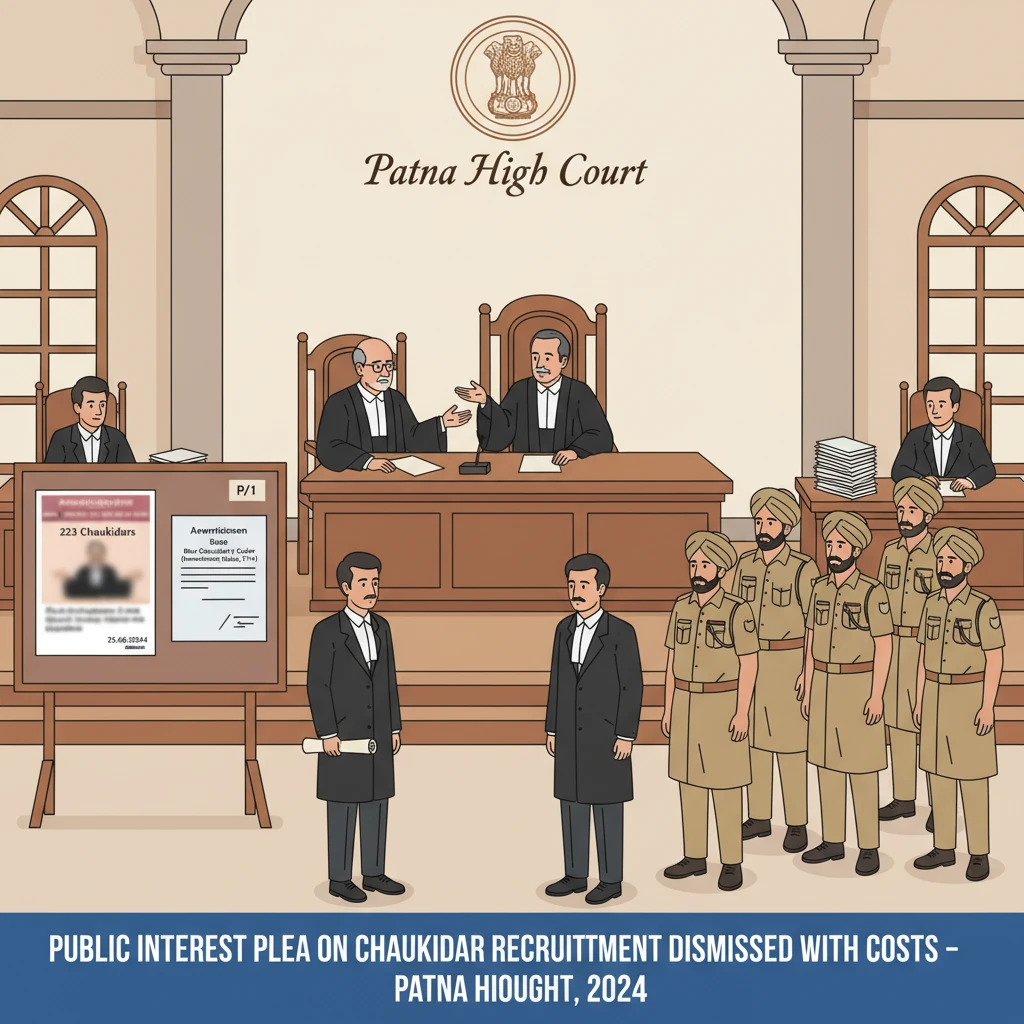
The association challenged an advertisement dated 25.06.2024 for appointment of 223 Chaukidars. This advertisement was issued by the district authorities and was placed on record as Annexure P/2.
The petitioner claimed that this advertisement violated the Bihar Chaukidari Cadre (Amendment) Rules, 2014, referred to by the Court as the “Rules of 2014”. According to the petitioner, an amendment produced as Annexure P/1 inserted a proviso after sub-rule 7 of Rule 5. This proviso allowed a Chaukidar to seek appointment of a named dependent to the post of Chaukidar at least one month before his superannuation.
On this basis, the association came to the High Court by way of a civil writ petition, styled as a public interest litigation, to challenge the advertisement for direct recruitment of 223 Chaukidars.
What the Court Examined and Decided
The matter was heard by a Division Bench of the Patna High Court comprising Hon’ble the Chief Justice and Hon’ble Mr. Justice Partha Sarthy. Learned Senior Counsel Sri V.N. Singh appeared for the petitioner association, and learned Counsel Sri Vikas Kumar represented the State.
The core grievance raised by the association was straightforward. It argued that because of the proviso inserted by the Rules of 2014, serving Chaukidars had a right to get one dependent appointed as Chaukidar before their retirement. According to the petitioner, the advertisement for 223 posts through direct recruitment would eat into those vacancies and thereby deprive dependents of retiring Chaukidars of their chance to be appointed.
The Bench first examined whether the case was really a public interest litigation. The association had described the petition as being in a representative capacity to raise an issue of general public interest. However, the relief claimed was clearly aimed at securing dependent employment for the family members of serving or retiring Chaukidars.
The Court held that this did not qualify as public interest litigation. Chaukidars are employees of the State. They are not persons who are incapable of approaching the Court themselves. If any right under the amended Rules truly exists, it can only be enforced by a specific person whose claim for appointment as a dependent is actually denied when his turn comes.
The Bench clearly recorded that it was unhappy with the manner in which the public interest litigation had been filed. In its view, the writ petition deserved dismissal even at that stage on the ground that it was not a genuine public interest case.
At this point, the petitioner’s Senior Counsel informed the Court that there was a Special Leave Petition pending before the Supreme Court relating to the same subject. He referred to an SLP arising out of Letters Patent Appeal (L.P.A.) No. 508 of 2022.
The Bench asked for details of the judgment from which the SLP had been filed. However, the judgment of the Patna High Court in that LPA was not available with the Senior Counsel at that moment. The Bench therefore posted the matter for further hearing at 2:15 p.m. to enable counsel to produce the judgment.
When the matter resumed, the Court noted the background of L.P.A. No. 508 of 2022. In that case, a Chaukidar who had voluntarily retired had applied for appointment of his son as Chaukidar. The District Compassionate Appointment Committee rejected the application because it was filed after the employee’s retirement.
The son then approached the High Court in a writ petition challenging the rejection. That writ petition was dismissed by a Single Judge. The son filed an intra-court appeal by way of L.P.A. No. 508 of 2022, but the Division Bench dismissed the appeal as well.
Importantly, in that appeal the Bench considered the very “Rules of 2014” that granted dependent appointment to persons retiring from the Chaukidari cadre. In paragraph 12 of that judgment, the Bench found that the provision granting compassionate appointment to dependents of persons who retire was in violation of Articles 14 and 16 of the Constitution of India.
The Division Bench there held that the post of Chaukidar is a public post. Such posts must be filled in accordance with the equality and equal opportunity principles under Articles 14 and 16. Giving a right of appointment to dependents of retiring Chaukidars, instead of following a fair and open recruitment process, was held to violate these constitutional mandates.
In strong words, that Bench observed that the State of Bihar had acted contrary to Articles 14 and 16 of the Constitution of India even after 77 years of independence, by providing for such dependent appointments. It therefore held that the rule granting compassionate appointment to dependents of retiring Chaukidars was unconstitutional and violative of Articles 14 and 16.
In the present case, the Patna High Court noted that the SLP against that L.P.A. judgment was pending, but there was admittedly no order of stay from the Supreme Court. So the earlier Division Bench judgment striking down the rule continued to hold the field.
The Bench expressed dismay that the petitioner association, in its writ petition, had only made a bare reference to the pending SLP. It had not disclosed that a coordinate Bench of the same Court had already struck down a similar provision of the Rules on the ground of violation of Articles 14 and 16.
This omission was taken seriously by the Court. It indicated that the petition was not fairly presented and that important facts and binding precedent had been kept back from the Court. The Bench treated this as a factor showing abuse of the process of law.
After examining the nature of the relief, the status of the earlier L.P.A. judgment, and the conduct of the petitioner, the Court reached a clear conclusion. It held that the writ petition was not in public interest. Instead, it was a misuse of the public interest litigation mechanism to advance a narrow service claim of a particular cadre of employees and their dependents.
To mark its disapproval, the Court went beyond a simple dismissal. It imposed exemplary costs of Rs. 10,000/- on the individual who had filed the writ petition as representative of the association, namely the District Vice President.
The amount was directed to be paid to the Bihar State Legal Services Authority within a period of two weeks. The Court further directed that, if the amount was not paid within that period, the Bihar State Legal Services Authority would be entitled to recover it through measures similar to recovery of arrears of land revenue through the District Magistrate.
In such an event, the District Vice President of the association would also be liable for any charges incurred in effecting such recovery, and those charges would have to be recovered by the State.
The Bench also ordered that a copy of its judgment be transmitted to the Member Secretary, Bihar State Legal Services Authority, so that the Authority could take steps to receive or recover the costs as directed.
Ultimately, the Court dismissed the writ petition with costs. There is a reference in the last line to the “LPA” standing dismissed with costs. Reading the judgment as a whole, it is clear that the present writ petition, which had been treated and argued as a public interest litigation, was dismissed and the cost order was made in this proceeding.
Why This Judgment Matters
This judgment is significant for Chaukidars, other government employees, and citizens generally in Bihar.
First, it underlines that public interest litigation cannot be used to pursue personal or service-related benefits of a particular group of government employees. If an individual’s right is affected, that individual must come to court in his or her own name.
Second, the decision reinforces a coordinate Bench’s view that rules granting automatic or preferential appointment to dependents of retiring Chaukidars conflict with Articles 14 and 16. Until the Supreme Court grants a stay or sets aside that view, such rules cannot be invoked to block regular recruitment.
Third, the imposition of exemplary costs and the mechanism for their recovery send a clear message. Persons and associations who file public interest litigations must act with full candour and responsibility. Concealing binding case law or mis-stating the nature of the case can lead to financial consequences.
For ordinary villagers, especially families of Chaukidars and Dafadars, this judgment signals that dependent employment at the time of retirement is uncertain where it conflicts with constitutional requirements of equality in public employment.
Legal Issues and Answers
- Issue: Can an association of Chaukidars maintain a public interest litigation to prevent direct recruitment of Chaukidars, relying on a rule that allows appointment of dependents of retiring employees?
Answer: No. The Court held that such a writ is not a genuine public interest litigation. Any right under the rule, if at all, is enforceable only by an individual whose claim is denied, and Chaukidars are capable of approaching the Court themselves. - Issue: Does the pending Special Leave Petition against L.P.A. No. 508 of 2022 prevent reliance on that earlier judgment, which held the dependent appointment rule unconstitutional?
Answer: No. The Court noted that there was no stay from the Supreme Court. Therefore, the coordinate Bench’s finding that the rule violates Articles 14 and 16 continues to operate and could not be ignored. - Issue: How should the Court respond when a public interest litigation is found to be an abuse of process and important adverse precedent is not disclosed?
Answer: The Court dismissed the writ petition and imposed exemplary costs of Rs. 10,000/- on the petitioner’s representative, to be paid to the Bihar State Legal Services Authority, with a recovery mechanism similar to land revenue recovery in case of default.
Cases Cited by the Court
- The Court referred to and relied upon the judgment of a coordinate Bench of the Patna High Court in L.P.A. No. 508 of 2022, where the relevant provisions of the Bihar Chaukidari Cadre (Amendment) Rules, 2014, granting compassionate appointment to dependents of retiring Chaukidars, were held violative of Articles 14 and 16 of the Constitution of India.
Case Details
Case Number: Civil Writ Jurisdiction Case No. 12337 of 2024
Case Title: Bihar Rajya Dafadar Chaukidar Panchyat at P.S. and District – Arwal through its District Vice President Mithilesh Kumar v. The State of Bihar and Others
Coram: Hon’ble the Chief Justice; Hon’ble Mr. Justice Partha Sarthy
Citation: 2024 (4) PLJR 107
Advocates: For the petitioner – Mr. V. N. Sinha, Advocate; Mr. Ravi Shankar, Advocate. For the respondents – Mr. Vikas Kumar, Advocate.
Nature of the case: Civil writ petition styled as public interest litigation challenging recruitment advertisement for Chaukidars.
Date of Judgment: 28-08-2024
Link to judgment: View full judgment on Patna High Court website
If you found this explanation helpful and wish to stay informed about
how legal developments may affect your rights in Bihar,
you may consider following Samvida Law Associates for more updates.







