

Case Background
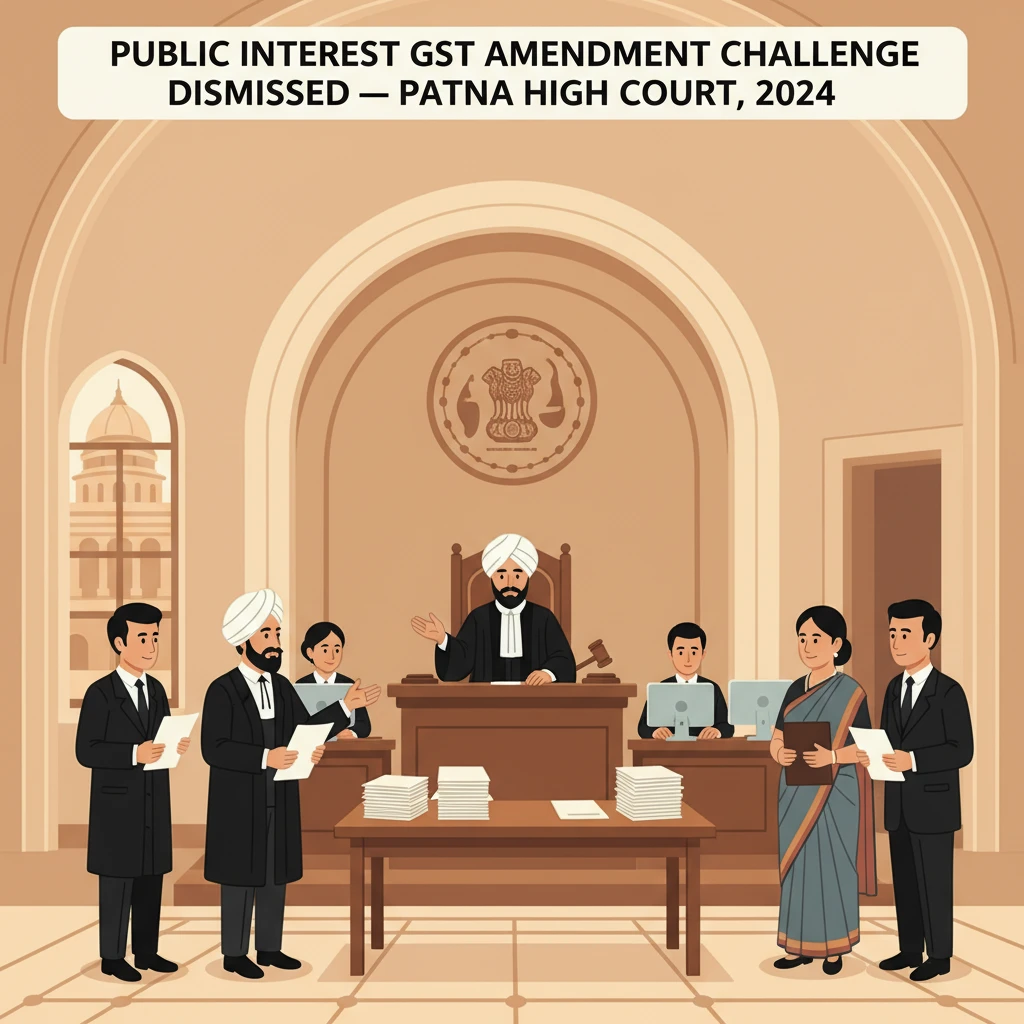
The case arose from a writ petition filed in 2017 before the Patna High Court under its civil writ jurisdiction. The petitioner, a practicing lawyer of the Patna High Court, approached the Court in person along with a legal team.
He challenged certain provisions of the Constitution (101st Amendment) Act, 2016. This constitutional amendment introduced the Goods and Services Tax (GST) regime across India.
The petitioner claimed that Sections 2, 9, 12 and 18 of the 101st Amendment Act violated the basic structure of the Constitution of India. On this basis, he asked the Court to declare these provisions invalid, void and unconstitutional.
The respondents included the Union of India through the Ministry of Law and Justice, the Additional Secretary of the Goods and Services Tax Council, and the Secretary of the Revenue Department, Government of India. They filed a detailed counter affidavit opposing the petition.
What the Court Examined and Decided
The Division Bench, led by Hon’ble the Chief Justice and Hon’ble Mr. Justice Harish Kumar, heard the matter and delivered a CAV (reserved) judgment on 01.04.2024.
The central complaint of the petitioner was that the way the GST Council was created and empowered under the 101st Amendment led to an abdication of legislative powers by Parliament. He argued that, because Parliament acts “on the recommendations” of the GST Council, its sovereign law-making role under the Constitution stood diluted. On this basis, he contended that the amendment damaged the basic structure of the Constitution.
The respondents, through their counter affidavit, presented a different picture. They highlighted the extensive national exercise that preceded the shift to a GST regime. Before GST, the power to levy many indirect taxes rested with the States. The 101st Amendment reworked this structure to allow a unified law on tax on goods and services.
To manage this major shift, the Constitution provided for the GST Council. The Court recorded that the Council consists of the Union Finance Minister as Chairperson, the Union Minister of State in charge of Revenue or Finance, and Ministers in charge of Finance or Taxation (or other nominated Ministers) from each State Government.
The respondents argued that Parliament had not abdicated its legislative power. Instead, the GST Council only gives recommendations. It serves as a forum where the Union and all States are represented and can jointly consider issues. These include pan-India concerns and State-specific problems regarding GST.
The Court also noted that the Council discusses the sharing of GST revenue between the Union and the States. However, any such sharing ultimately requires a law passed by Parliament and not by the GST Council. This, according to the respondents, kept the legislative power clearly with Parliament.
However, before the Bench could go deeper into these constitutional questions, it turned to a threshold issue: whether the petitioner had the legal standing (locus standi) to maintain this writ petition.
The judges were “more concerned with the locus standi of the petitioner, who is a lawyer practicing in this Court.” The petitioner claimed to have done extensive research and said he was acting in public interest. But when questioned, he could not give any convincing reason showing how he himself was legally affected by the 101st Amendment Act.
To test locus standi, the Court relied on the Supreme Court judgment in Ayaaubkhan Noorkhan Pathan v. State of Maharashtra & Ors., (2013) 4 SCC 465. In that case, the Supreme Court had laid down that a stranger cannot be allowed to interfere in legal proceedings unless he shows that he is an “aggrieved person”. This means the person must show that some legal injury has been caused to him or that he has some direct, substantial interest in the matter.
The Patna High Court applied this principle to the present case. It found that the petitioner had not suffered any legal injury due to the 101st Amendment. Significantly, the Court recorded that the petitioner was not involved in commercial activities. He also did not claim to be registered under any Goods and Services Tax law.
Further, the petitioner did not even argue that he was affected by the reverse charge mechanism under GST. In other words, he could not point to any concrete way in which the GST regime or the challenged constitutional provisions had harmed him personally or violated any of his legal rights.
The Bench also revisited basic rules on when a writ petition under Article 226 of the Constitution can be entertained. Referring to the position settled by the Supreme Court, the Court stated that such a writ is maintainable either:
(a) to enforce a statutory or legal right, or
(b) when there is a breach of statutory duty by an authority.
Looking at the writ petition, the Court concluded that the petitioner did not have any enforceable right in relation to the 101st Amendment that the Court could recognise judicially. He did not even plead that he had suffered any prejudice as a result of the amendment.
The petitioner attempted to rely on the concept of public interest litigation (PIL). However, the Court refused to treat this as a proper PIL. It emphasised that public interest litigation is meant to help those who are genuinely weak, voiceless, or unable to approach the courts on their own.
In this case, the people most directly affected by the transition from the earlier value added tax regime to the GST regime were the registered dealers and businesses. The Court observed that such dealers, now registered under the GST laws by virtue of the 101st Amendment, cannot be described as a “marginalized section” of society. They are fully capable of approaching the courts themselves if they feel their rights are violated.
Because of this, the Bench held that the broad “public interest” claimed by the petitioner was not a valid basis to maintain the writ petition. There was no special handicap or disadvantage preventing affected GST dealers from moving the courts.
After weighing these aspects, the Patna High Court held that there was “absolutely no reason to entertain the writ petition.” Once it found that the petitioner lacked locus standi and possessed no enforceable right, there was no need for the Court to go into the detailed merits of whether Sections 2, 9, 12 and 18 of the 101st Amendment Act violated the basic structure. That constitutional challenge was therefore not examined or adjudicated upon.
The Bench considered imposing costs on the petitioner, probably to discourage such unfounded public interest petitions. However, the judges decided not to do so. They recorded that the writ petition appeared to have been filed out of “misguided over enthusiasm.” On that sympathetic basis, they refrained from awarding costs.
Nevertheless, the Court issued a clear caution to the petitioner. It warned him against filing similar actions “in the same vein” in future. This serves as a signal that the Court may not be this lenient again if baseless public interest petitions are brought without proper standing.
In the end, the Court formally dismissed the writ petition. No further directions or reliefs were granted.
Why This Judgment Matters
This judgment is important for both lawyers and ordinary citizens who think of filing PILs against major economic or constitutional measures like GST.
First, it reinforces that the Patna High Court will not hear a case unless the petitioner can show some direct legal injury or an enforceable right. Merely being a concerned citizen or a lawyer with research and opinions is not enough.
Second, the decision clarifies that groups like GST-registered dealers or businesspersons are not treated as helpless or voiceless. Courts expect such stakeholders to fight their own legal battles if they feel harmed, instead of outsiders bringing abstract public interest challenges.
Third, by refusing to examine the validity of the GST-related provisions due to lack of locus standi, the Court shows that constitutional challenges must be rooted in real disputes, not theoretical debates.
The judgment therefore acts as a warning against “over-enthusiastic” public interest petitions which lack a clear connection to the petitioner’s own rights or to truly marginalized sections.
Legal Issues and Answers
- Issue: Can a practicing lawyer, who is not a GST-registered dealer and claims no personal prejudice, maintain a public interest writ petition challenging the constitutional validity of parts of the Constitution (101st Amendment) Act, 2016?
Answer: No. The Patna High Court held that the petitioner had no locus standi, no enforceable legal right, and no legal injury, so the writ petition was not maintainable. - Issue: Can public interest alone justify a constitutional challenge when those directly affected (GST dealers) are not marginalized and can approach the Court themselves?
Answer: No. The Court ruled that such public interest cannot be entertained where the affected group is capable of asserting its own rights before courts of law.
Cases Cited by the Court
- Ayaaubkhan Noorkhan Pathan v. State of Maharashtra & Ors., (2013) 4 SCC 465 – cited for the principle that only an aggrieved person with legal injury or interest can maintain proceedings; strangers cannot meddle without showing such status.
Case Details
Case Number: Civil Writ Jurisdiction Case No. 7483 of 2017
Case Title: Amit Pandey v. The Union of India & Ors.
Coram: Hon’ble the Chief Justice K. Vinod Chandran; Hon’ble Mr. Justice Harish Kumar
Citation: 2024(2) PLJR 672
Advocates for Petitioner: Mr. Amit Pandey (in person), Mr. Ashwini Kumar, Mr. Raj Kumar, Mr. M. Alam, Mr. Modassir Raza
Advocates for Respondents: Dr. K.N. Singh, Additional Solicitor General; Mr. Alok Kumar, Central Government Counsel; Mrs. Kanak Verma; Mr. Anshuman Singh
Nature of Case: Writ petition under Article 226 of the Constitution challenging the constitutional validity of provisions of the Constitution (101st Amendment) Act, 2016, treated as a public interest litigation.
Date of Judgment: 01.04.2024
CAV Date: 22.03.2024
Link to Judgment: Click here to read the full judgment of the Patna High Court
If you found this explanation helpful and wish to stay informed about
how legal developments may affect your rights in Bihar,
you may consider following Samvida Law Associates for more updates.







