
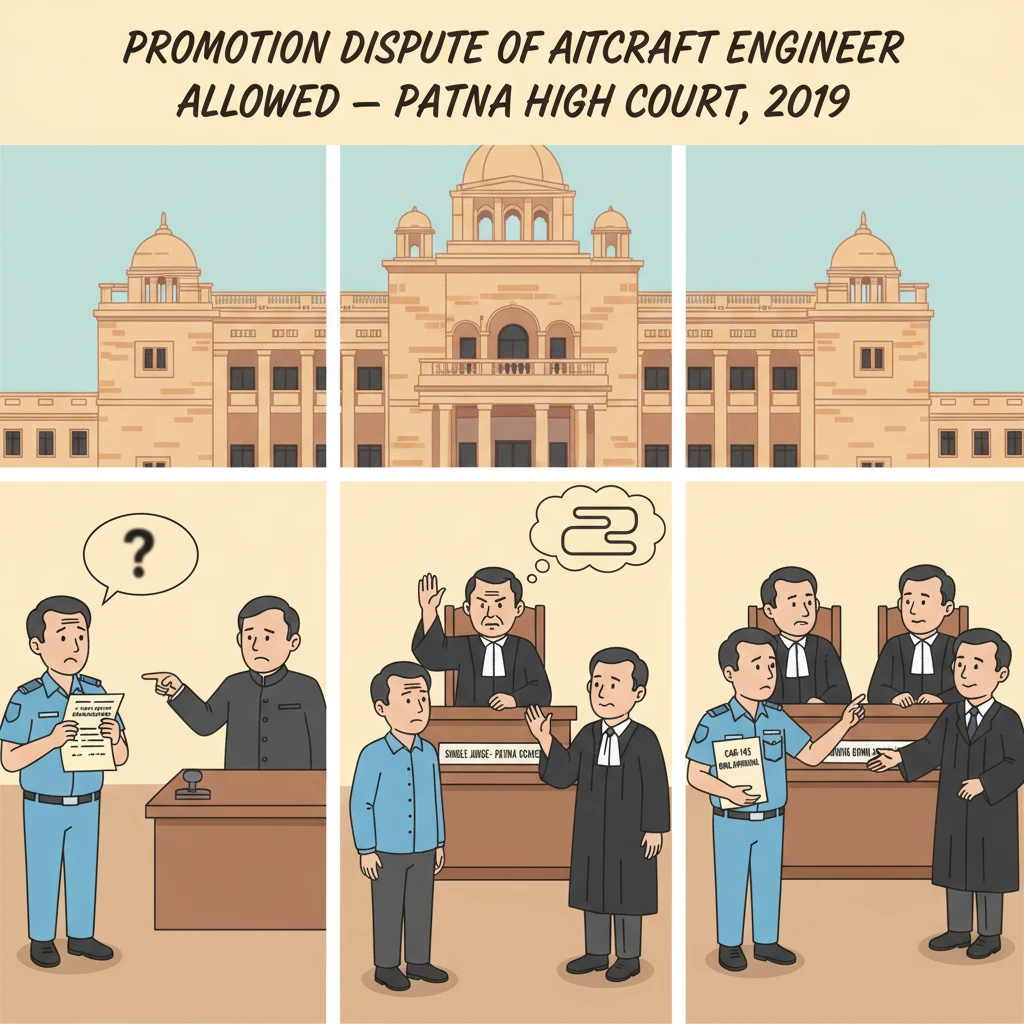
Case Background
The dispute concerns promotion to the post of Deputy Chief Aircraft Engineer in the Civil Aviation Department of the Government of Bihar.
The appellant is an aircraft engineer who was serving in the department. He claimed that he met the promotion criteria framed under Article 309 of the Constitution of India, contained in Appendix A of a notification dated 7 June 1997. The promotional post of Deputy Chief Aircraft Engineer is mentioned at Item No. 8 of that Appendix.
When he sought promotion to this post, the State Government rejected his claim. The rejection order said that he had not been acknowledged and approved as a Maintenance Manager by the Directorate General of Civil Aviation (DGCA).
The appellant challenged this decision before the High Court in Civil Writ Jurisdiction Case No. 18767 of 2012. A learned Single Judge dismissed the writ petition on 16 April 2014. The Single Judge described the appellant’s experience as a via media adopted somehow to claim promotion and held that the requisite genuine experience was lacking. The rejection order of the State Government was upheld.
Aggrieved, the appellant filed Letters Patent Appeal No. 1355 of 2014 before the Patna High Court. During the hearing of this appeal, the DGCA was added as Respondent No. 5 on 9 October 2018, and was directed to file an affidavit clarifying the position about approvals and experience requirements.
What the Court Examined and Decided
The Division Bench, speaking through the Hon’ble the Chief Justice, first noted that there was no dispute regarding the applicable promotion rules. These rules were framed by the State Government under Article 309 by notification dated 7 June 1997 and were contained in Appendix A. Item No. 8 of this Appendix specified the promotional post of Deputy Chief Aircraft Engineer and the qualifications and experience required for that post.
The central dispute was whether the appellant met the required experience, and whether the absence of DGCA approval as Maintenance Manager could be used to deny his promotion.
The State Government had rejected the appellant’s claim on the ground that he was not acknowledged and approved as a Maintenance Manager by the DGCA. This was treated as a crucial defect in his eligibility.
The learned Single Judge agreed with this view. The Single Judge held that the appellant’s experience did not satisfy the requirement of genuine experience as envisaged in the rules. The Single Judge described the experience projected by the appellant as a via media adopted somehow to claim promotion, and therefore dismissed the writ petition.
In the appeal, the appellant’s counsel, Shri Rajni Kant Jha, argued that the State had misread the rules and wrongly imported an additional requirement that was not stated in the 1997 promotion rules. He pointed out that the appellant possessed the basic qualifications and experience as per Appendix A. The question of DGCA approval, as projected by the State, did not flow from the promotion rules themselves.
After DGCA was impleaded as a party, an affidavit was filed on its behalf, through learned counsel Shri Kumar Priya Ranjan. In this affidavit, the DGCA accepted that the basic qualifications required under the rules quoted by the Court were satisfied. However, while explaining the grant of approval, DGCA stated that: the Government of Bihar, Civil Aviation Department, did not have any approval under Civil Aviation Requirement-145 (CAR-145), and no such maintenance work was being carried out by the Government of Bihar under that approval.
Because of this, even though the appellant had experience of associating himself with the relevant type of aircraft, namely King Air C 90, this did not automatically count as approved maintenance experience in the absence of CAR-145 approval for the organisation.
On behalf of the appellant, it was further pointed out that the maintenance work was being done through outsourcing. One Shri Navin Kumar, representing M/s Innovative Aviation Private Limited, was carrying out the maintenance of the aircraft. He was a licence holder of the year 2013, whereas the appellant had been granted his licence in 2012. The appellant was therefore senior to the outsourced engineer by licence date.
The appellant argued that if his statutory qualifications and experience were in order, the State could not defeat his right to be considered for promotion by relying on its own failure to obtain organisational approval from DGCA under CAR-145. According to him, the additional requirement of DGCA approval for the organisation, as mentioned in the impugned order and in DGCA’s counter affidavit, did not appear anywhere in the promotion rules framed under Article 309.
The Division Bench examined the submissions, the rules, and the DGCA affidavit. It noted that the post of Deputy Chief Engineer was lying vacant and was available for consideration, so the dispute was not academic.
The Court then addressed the key legal error. It held that the State Government had wrongly denied promotion to the appellant on the ground that he was not in possession of DGCA approval as Maintenance Manager. This, the Court said, was an erroneous assumption.
The DGCA affidavit clarified that under CAR-145, it is the organisation that must possess the approval or certification for maintenance, not the individual engineer. The individual may have experience and licence, but DGCA’s CAR-145 approval is granted to the organisation in whose set-up the maintenance is carried out.
On this basis, the Court found that the absence of DGCA certification for the Civil Aviation Department of the Government of Bihar in respect of maintenance work could not be used to defeat the appellant’s right to be considered for promotion. The appellant’s individual experience and licence were not in dispute, and the organisational certification issue was a matter between DGCA and the State, not a deficiency of the appellant.
The Court therefore concluded that the appellant’s right to have his case considered for promotion was being impeded because the Government of Bihar had not obtained DGCA certification for maintenance under CAR-145. This default of the employer could not be fastened on the appellant.
To cure this situation, the Division Bench held that the dismissal of the writ petition by the Single Judge was not justified. It decided to issue a mandamus to the Government of Bihar directing it to apply for and seek the necessary certification from the DGCA, as indicated in the DGCA’s counter affidavit.
The Court directed that the Government must make this application expeditiously, and in any case not later than three months from the date of the judgment, i.e., from 12 March 2019. Once the application is filed, it will be open to the DGCA to pass necessary orders in accordance with law, either granting or refusing certification as per its regulatory powers.
The Court then set aside the impugned judgment of the Single Judge dated 16 April 2014, as well as the State Government’s rejection order dated 24 March 2014.
The Letters Patent Appeal was allowed, subject to the direction that the Government must seek DGCA certification. The Court further directed that if the DGCA grants certification to the Government of Bihar, then the appellant’s claim for promotion to the post of Deputy Chief Aircraft Engineer must be reconsidered. While revisiting his claim, the authorities must keep in view his qualifications and any other requirements prescribed for the promotional post.
Thus, the Court did not directly order promotion. Instead, it restored the appellant’s right to a fair consideration for promotion, free from the State’s earlier erroneous assumption about individual DGCA approval, and tied the further consideration to DGCA’s decision on certification of the organisation.
Why This Judgment Matters
This judgment is important for government employees, especially technical staff like engineers, who seek promotion based on statutory service rules. It makes clear that authorities cannot introduce new eligibility conditions that are not present in the notified rules.
Here, the Patna High Court underlined that if an organisation, such as a government department, has not obtained a regulatory approval from a central authority, this failure cannot be used to deny promotion to an individual employee who otherwise meets the stated qualifications and experience.
For employees in Bihar and elsewhere, this decision shows that courts can intervene when promotions are refused on grounds that are not clearly supported by the service rules. It also shows that courts can direct the government to complete necessary regulatory steps, like obtaining DGCA certification, so that employees are not left in limbo.
More broadly, the judgment reinforces fair treatment in service matters: the government must act in accordance with its own rules, and cannot hide behind its own non-compliance with external regulatory requirements to defeat employee rights.
Legal Issues and Answers
Issue: Could the State Government deny promotion to an aircraft engineer on the ground that he lacked DGCA approval as Maintenance Manager, when the promotion rules did not prescribe such a condition?
Answer: No. The Patna High Court held that the requirement of DGCA approval under CAR-145 relates to the organisation, not the individual. The State’s reliance on this ground was an erroneous assumption, and it could not be used to reject the appellant’s promotion claim.
Issue: What directions could the Court give to remedy the appellant’s grievance while respecting DGCA’s regulatory powers?
Answer: The Court issued a mandamus directing the Government of Bihar to apply for DGCA certification within three months. It left it open to DGCA to decide on certification according to law, and directed that, if certification is granted, the appellant’s claim for promotion to Deputy Chief Aircraft Engineer must be reconsidered as per the rules.
Cases Cited by the Court
- The judgment does not record any prior case law being cited or relied upon by the Court.
Case Details
Case Number: Letters Patent Appeal No. 1355 of 2014 in Civil Writ Jurisdiction Case No. 18767 of 2012
Case Title: Prabhu Nath Singh v. The State of Bihar and Others
Coram: Hon’ble the Chief Justice Amreshwar Pratap Sahi and Hon’ble Justice Smt. Anjana Mishra
Citation: 2019 (3) PLJR 330
Date of Judgment: 12-03-2019
Advocates:
- For the Appellant: Mr. Rajni Kant Jha, Advocate
- For the State of Bihar: Mr. Ajay Kumar Rastogi, AAG-10
- For the Union of India/DGCA: Mr. Kumar Priya Ranjan, C.G.C.
Nature of the Case: Letters Patent Appeal against dismissal of a writ petition in a service promotion dispute.
Link to Judgment:https://patnahighcourt.gov.in/viewjudgment/MyMxMzU1IzIwMTQjMSNO-LZNLlhAOd5I=
If you found this explanation helpful and wish to stay informed about how legal developments may affect your rights in Bihar, you may consider following Samvida Law Associates for more updates.







