
Case Background
The dispute arose after the death of one Rupan Mahto of Nalanda district. He had executed a registered will on 02.12.2006 in favour of his daughter-in-law, Pushpa Devi. Under this will, she was also named as the sole executor.
The properties covered by the will are situated at Village Umed Nagar, P.S. Deep Nagar, District Nalanda and at Village Meghi Nagma, Thana No. 319, Khata No. 705, Plot No. 4306, Area ½ decimal, District Nalanda.
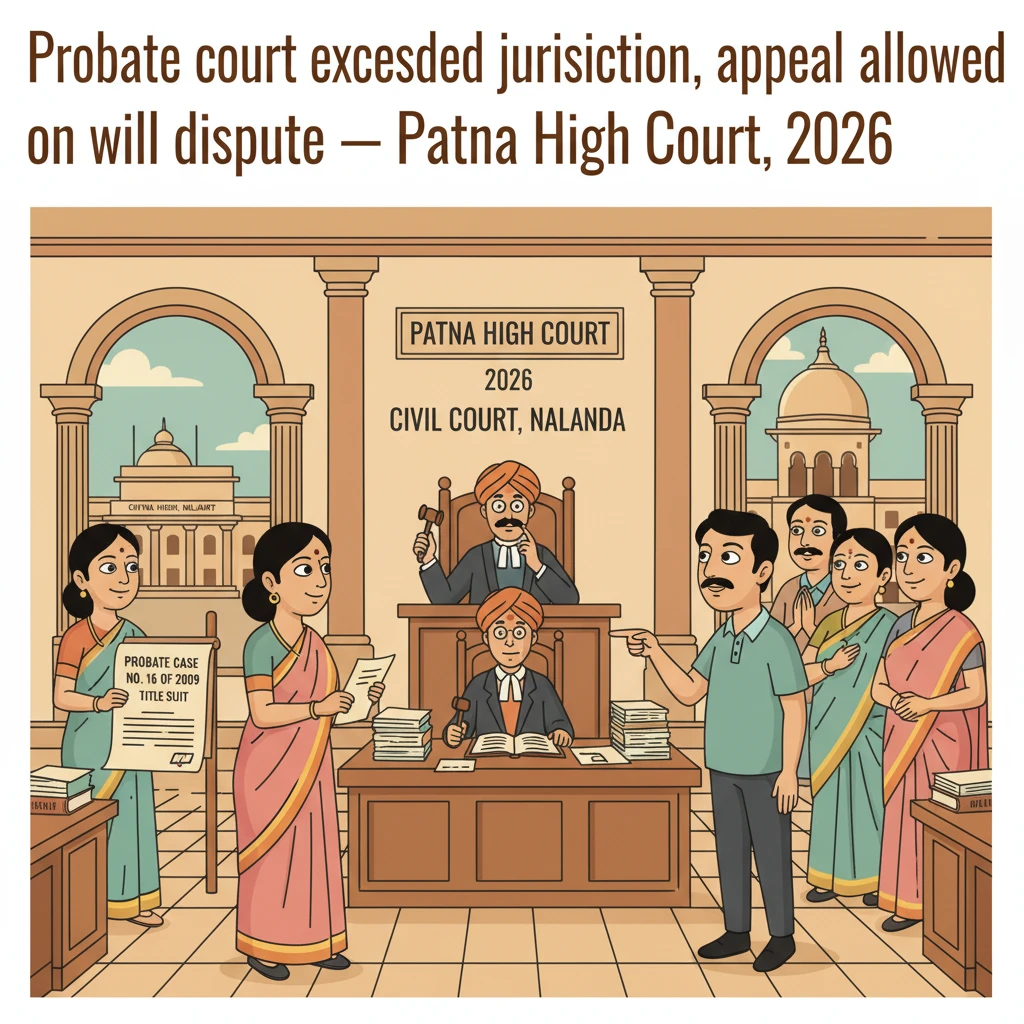
After his death, Pushpa Devi filed Probate Case No. 16 of 2009 before the Fast Track Court‑1, Nalanda at Bihar Sharif under the Indian Succession Act, 1925. She sought probate as executor of the will dated 02.12.2006.
The probate court recorded that the deceased, Rupan Mahto, had five sons and three daughters and there had been an oral partition among his sons, though no party produced details of the shares. One son, Ashok Kumar, objected to the probate. He claimed that his father had never lived with Pushpa Devi and that all children served him, and he denied any clear wish by his father to execute a registered will.
During the probate proceedings, a caveat was filed by some other heirs, including Jugeshwar Mahto and others. Later they filed a compromise petition stating that, after receiving notice and on the advice of relatives, they would not dispute the genuineness of the will dated 02.12.2006 in favour of Pushpa Devi and had no objection to probate being granted. Ashok Kumar did not join this compromise and did not file any affidavit giving up contest.
Because the case became contested, under Section 295 of the Indian Succession Act and Rule 458 of the Civil Court Rules of the Patna High Court, the probate proceeding was treated as a title suit. It was renumbered as a title suit and issues were framed.
The probate court framed two issues: whether the registered will dated 02.12.2006 in favour of Pushpa Devi was duly executed, genuine and free from suspicious circumstances, and whether it was the last will of Rupan Mahto.
By order dated 02.07.2018, the probate court dismissed the probate petition dated 04.11.2009. It held that the will was surrounded by suspicious circumstances and could not be probated. Against this order, Pushpa Devi filed First Appeal No. 110 of 2018 before the Patna High Court.
What the Court Examined and Decided
In the Patna High Court, the central question was whether the probate court had acted within its limited jurisdiction while refusing probate, and what should happen to the dispute in light of a fresh compromise arrived at during the appeal.
On behalf of the appellant Pushpa Devi, senior counsel argued that the probate court’s jurisdiction is confined to examining the genuineness and due execution of a will. It cannot decide questions of right, title and interest in the property covered by the will. It was submitted that the district court exceeded its jurisdiction while deciding the converted title suit.
To support this, reliance was placed on Supreme Court decisions in Krishna Kumar Birla v. Rajendra Singh Lodha & Ors., (2008) 4 SCC 300 and Kanwarjit Singh Dhillon v. Hardyal Singh Dhillon, (2007) 11 SCC 357. These authorities explain that a probate court only decides whether a will is genuine and validly executed, not whether the property mentioned in it is ancestral or self‑acquired, or who has title to it.
Counsel for the appellant further informed the High Court that during the pendency of the appeal, the parties wished to “buy peace of mind” and avoid further litigation. For this purpose, they filed I.A. No. 2 of 2025 under Order XXIII Rule 3 read with Section 151 of the Code of Civil Procedure, 1908, seeking to record a compromise.
He stated that, as per this compromise, the contesting respondent Ashok Kumar had no interest in the property bequeathed to Pushpa Devi under the will of late Rupan Mahto. He also emphasised that during the probate proceedings, the other coparceners had already chosen not to contest the will and had filed compromise to that effect. The present settlement was described as voluntary and not the result of coercion or undue influence.
Counsel for respondent no. 2, Ashok Kumar, supported this position. He confirmed that Ashok Kumar, being one of the heirs of late Rupan Mahto, had now entered into a compromise with Pushpa Devi. A compromise petition was filed on 07.10.2025 in the first appeal.
Before considering the compromise, the High Court examined the legal limits of probate jurisdiction. The Court recalled that a case filed under Section 217 of the Indian Succession Act, 1925, when contested under Section 295, is to be treated as a suit according to Rule 458 of the Civil Court Rules. However, merely renaming the case as a “title suit” does not expand the probate court’s powers.
The Court reproduced Section 217 of the Succession Act, which deals with application of the Part relating to probate and administration, and Rule 458, which concerns statistical treatment of such cases as miscellaneous cases until they become contested. The Court emphasised that these provisions do not authorise the probate court to decide ownership or title to property.
The High Court reiterated the settled principle that a decree passed by a court without jurisdiction is a nullity (coram non judice). Its invalidity can be raised whenever and wherever it is relied upon. With this in mind, the Court turned to the judgment of the probate court.
The probate court had, in paragraphs 19 to 21 of its judgment, given detailed reasons for treating the will as suspicious. It listed several surrounding circumstances, including absence of evidence of consent of near relatives, doubt about the testator’s mental condition, lack of proof that only Pushpa Devi had served the testator, unexplained performance of last rites by the daughter‑in‑law despite existence of five sons, and serious issues regarding attesting witnesses. On this basis, it held that the will was not duly executed and could not be probated.
While noting these findings, the High Court focused on the legal framework of probate proceedings. It summarised Section 276 of the Succession Act and stated that a probate court’s task is confined to:
(a) verifying that the will was actually executed by the testator in a sound state of mind without coercion or undue influence, (b) confirming that it was duly attested, (c) judging its genuineness, and (d) ensuring due execution. Beyond this, the court is not competent to determine title to the properties, or whether they are ancestral or self‑acquired, or to decide on the very existence of the property.
The Court then explained why strict rules exist for proving wills. Since a will takes effect only after the testator’s death, the maker cannot personally explain the circumstances of execution. To guard against manipulation, the law insists on strict statutory compliance. The High Court cited the Supreme Court’s judgment in Meena Pradhan & Ors. v. Kamla Pradhan & Anr., 2023 INSC 847, which summarises the principles for proving a will, including the need to remove any suspicious circumstances and to satisfy the judicial conscience.
Further, the High Court referred to the Supreme Court decision in Chiranjilal Shrilala Goenka v. Jasjit Singh & Ors., (1993) 2 SCC 507, which makes it clear that a probate court only decides whether the will is duly executed and attested and whether the testator had sound disposing mind. It cannot examine whether any particular bequest is good or bad, nor can it determine title to property.
The Court again relied on Kanwarjit Singh Dhillon v. Hardyal Singh Dhillon, (2007) 11 SCC 357, where the Supreme Court held that even after grant of probate, a separate civil suit to decide title and injunction is maintainable. Probate only conclusively proves the will and the appointment of executor; it is not a final decision on ownership of the properties.
Applying these principles, the Patna High Court found that the Nalanda probate court had gone beyond its authority. It had examined whether the property covered by the will was ancestral or purchased, evaluated documents for this purpose, and then used those conclusions to say that the will was not duly proved. This amounted to deciding questions of title and existence of property, which a probate court cannot do.
Therefore, in light of Krishna Kumar Birla and Kanwarjit Singh Dhillon, the High Court held that the judgment and order dated 02.07.2018 in T.(Prob.) S. No. 16 of 2009 were without jurisdiction and thus null and void. The impugned order was quashed and set aside.
After clearing this jurisdictional issue, the Court considered the compromise filed as I.A. No. 2 of 2025. The compromise petition, supported by individual affidavits of Pushpa Devi and Ashok Mahto, stated that the matter had been settled outside court, and requested that the first appeal be disposed of in terms of the compromise.
The High Court examined the terms of settlement and found them lawful, without any legal impediment or improper conditions. It accepted that the compromise was voluntary and aimed at ending the dispute.
As a consequence, the Court held that, in view of the compromise, the appellant Pushpa Devi became entitled to the schedule property mentioned in the compromise petition. The matter was remitted to the probate court at Nalanda to give effect to this compromise in accordance with law.
The first appeal was accordingly disposed of. All pending applications, if any, were also disposed of. There was no order as to costs.
Why This Judgment Matters
This judgment is important for families in Bihar and elsewhere who face disputes over wills and ancestral property. The Patna High Court has clearly reminded lower courts that probate proceedings have a very narrow role.
A probate court can check whether a will is genuine, properly signed, and made by a person of sound mind without pressure. It cannot decide whether the property mentioned is ancestral, joint family property, or self‑acquired, or who actually owns it. Those questions must be taken to a regular civil court in a separate suit.
For ordinary people, this means that if a probate court starts going into questions about who really owns the land, or whether it was bought or inherited, that may be beyond its powers. Such an order can be challenged as without jurisdiction.
The judgment also shows that even after years of fighting, parties can still settle their differences through compromise. The High Court respected the family’s wish to end their dispute and ensured that their lawful settlement would be given effect.
Legal Issues and Answers
- Issue: Could the probate court, while dealing with a will under the Indian Succession Act, decide questions about the nature and title of the properties mentioned in the will?
Answer: No. The Patna High Court held that the probate court’s jurisdiction is limited to examining due execution, attestation, genuineness and the testator’s state of mind. It cannot decide whether the properties are ancestral or self‑acquired or determine title. - Issue: What was the effect of the probate court exceeding its jurisdiction in dismissing the probate petition?
Answer: The High Court held that the order dated 02.07.2018 was without jurisdiction, a nullity, and therefore it was quashed and set aside. - Issue: Could the High Court dispose of the first appeal on the basis of a compromise arrived at during the appeal?
Answer: Yes. After setting aside the void probate order, the High Court allowed the compromise application under Order XXIII Rule 3 CPC, accepted the lawful terms of settlement, held the appellant entitled to the schedule property as per the compromise, and remitted the matter to the probate court to give effect to it.
Cases Cited by the Court
- Meena Pradhan & Ors. v. Kamla Pradhan & Anr., 2023 INSC 847
- Chiranjilal Shrilala Goenka v. Jasjit Singh & Ors., (1993) 2 SCC 507
- Kanwarjit Singh Dhillon v. Hardyal Singh Dhillon, (2007) 11 SCC 357
- Krishna Kumar Birla v. Rajendra Singh Lodha & Ors., (2008) 4 SCC 300 (relied upon by counsel and referred to by the Court)
Case Details
Case Number: First Appeal No. 110 of 2018; arising out of Probate Case No. 16 of 2009 (later treated as Title Suit)
Case Title: Smt. Pushpa Devi v. Estate of Rupan Mahto and Anr; Ashok Kumar
Coram: Hon’ble Mr. Justice Purnendu Singh
Date of Judgment: 22.01.2026 (Uploading Date: 29.01.2026)
Citation: 2024(2) PLJR 337
Advocates: For the Appellant – Mr. Rajendra Prasad, Senior Advocate; Mr. Pramod Kumar, Advocate; Mr. Ritesh Kumar, Advocate; Mr. Dhirendra Kumar, Advocate; Ms. Srishti, Advocate. For the Respondents – Mr. Santosh Kumar Sinha, Advocate.
Nature of the Case: First appeal against dismissal of probate petition (probate proceeding treated as title suit), with compromise recorded in appeal.
Link to the Judgment: MSMxMTAjMjAxOCMxI04=-MR13muS8jq0=
If you found this explanation helpful and wish to stay informed about
how legal developments may affect your rights in Bihar,
you may consider following Samvida Law Associates for more updates.







