

Case Background
The dispute arises from a Will said to have been executed by one Late Mahima Sharan Singh. The appellant is his daughter-in-law, described in the judgment as the legatee under the Will.
According to the appellant, the testator was pleased with the services rendered by her. He therefore executed a registered Will in her favour in respect of a portion of land described as part of khata no. 23, plot no. 402, measuring 10½ feet by 47 feet. This is stated to be his share in the property.
The Will was registered on 15.07.2010. The appellant’s case is that the testator was in a sound mental state and under no coercion or undue influence at the time of execution. The scribe of the Will is said to be Chandra Bhushan Prasad, who wrote out the document, read it over to the testator, and also allowed the testator to read and understand it himself.
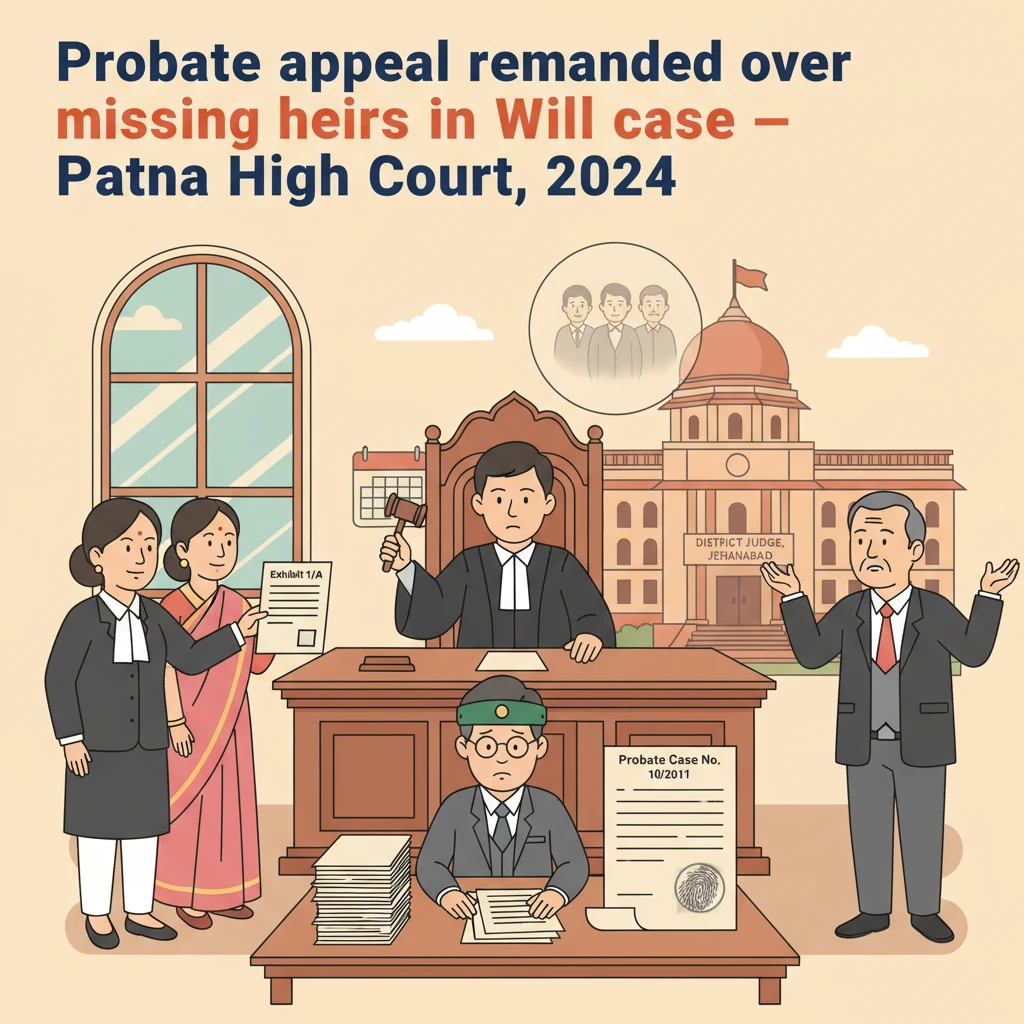
After this, the testator is said to have put his thumb impression on the Will in the presence of three attesting witnesses: Satya Narain Singh, Mahesh Prasad Singh and Arjun Singh. These witnesses were allegedly present at the request of the testator to witness the making of the Will. The Will deed is marked as Exhibit 1/A in the probate case.
The testator later died on 24.12.2010, and the Sharadh ceremony was performed. A death certificate of the testator was produced as Exhibit 2.
The appellant then filed Probate Case No. 10 of 2011 before the District Judge, Jehanabad, seeking probate of the Will dated 15.07.2010. The property and the residence of the testator were within the jurisdiction of that court.
The District Judge, by judgment and order dated 20.12.2013, dismissed the probate petition. Against that dismissal, the appellant filed the present Miscellaneous Appeal No. 82 of 2014 before the Patna High Court.
What the Court Examined and Decided
Justice Nawneet Kumar Pandey heard the learned counsel for both sides. The core question before the Patna High Court was whether the District Judge was right in dismissing the probate petition, and what should happen next in the probate proceedings.
The appellant’s case in the High Court was that the Will dated 15.07.2010 was genuine and validly executed. She claimed that the District Judge had dismissed the probate case only on “technical grounds.” According to her, the main technical objections of the lower court were that the sons of the testator were not impleaded as parties in the probate application, and that the date of death of the testator’s wife was not mentioned in the Will.
The judgment records that the property originally stood in the name of the testator’s wife. The testator had inherited a one-fourth share in that property from his wife, who predeceased him. The testator had three sons, so his share is recorded as one-fourth. The legatee–appellant is the wife of one of these sons, namely Umesh Kumar Sinha.
In the probate case, only one son, Umesh Kumar Sinha, was impleaded as opposite party no.2. He is the husband of the appellant. The other two sons, Vijay Kumar Singh and Suresh Kumar Singh, were not made parties to the petition.
The learned counsel for the appellant argued that all the mandatory ingredients required in a probate petition under Section 276 read with Section 279 of the Indian Succession Act, 1925 had been properly stated. Despite this compliance, the District Judge dismissed the case, which the appellant challenged as being based only on technicalities.
It was further pointed out that opposite party no.2, Umesh Kumar Sinha, had entered appearance by filing a Vakalatnama and had supported the case of the appellant. The witnesses connected to the execution of the Will were also examined.
Three attesting witnesses, Arjun Singh, Satya Narain Singh and Mahesh Prasad Singh, were examined as P.W. 2, P.W. 3 and P.W. 4 respectively. They supported the fact that the Will was executed by the testator in their presence and that he was in a sound mental state. The scribe, Chandra Bhushan Prasad, was examined as P.W. 5. The appellant herself was examined as P.W. 1.
According to the High Court’s narration, all these witnesses unanimously supported the appellant’s case. They stated that the testator had executed the Will in favour of the appellant of his own free will and without any pressure, threat or inducement, and in the presence of the attesting witnesses.
However, the High Court then focused on a significant procedural issue. The appellant had chosen to implead only one son of the testator, namely her husband, as a party to the probate case. The other two sons of the testator, Vijay Kumar Singh and Suresh Kumar Singh, were not impleaded, and the reason for leaving them out was not explained.
The Will itself, according to the recitals noted in the judgment, clearly mentions that the testator had three sons: Vijay Kumar Singh, Suresh Kumar Singh and Umesh Kumar Sinha. Despite this, only Umesh Kumar Sinha was made a party, both in the original Probate Case No. 10 of 2011 and in the present appeal.
The High Court observed that when one son of the testator has been impleaded, there was no explanation why the other two sons were not joined as parties. This omission, in the Court’s view, created doubts. The judgment does not expand on all the possible doubts, but it clearly underlines that all the sons, as close heirs of the deceased, should have an opportunity to be heard in a probate proceeding concerning his Will.
Having considered these facts and circumstances, the Patna High Court decided not to affirm the dismissal of the probate petition outright. Instead, the Court set aside the impugned judgment and order dated 20.12.2013 passed by the District Judge, Jehanabad in Probate Case No. 10 of 2011.
The matter was remitted back to the District Judge to decide the case afresh. The High Court directed that the case should be decided after giving an opportunity to the other two sons of the testator, namely Vijay Kumar Singh and Suresh Kumar Singh.
The High Court further directed that the records of the lower court should be sent back immediately. The District Judge has been asked to make every endeavour to dispose of the probate case within nine months of receiving the records.
The Court also specifically directed the appellant to implead Vijay Kumar Singh and Suresh Kumar Singh as opposite parties in Probate Case No. 10 of 2011 and to send notice to them. Thus, the appeal was disposed of with these observations and directions, without the High Court itself granting or refusing probate.
Why This Judgment Matters
This judgment is important for anyone dealing with a Will or probate in Bihar, especially in family property disputes. The Patna High Court has underlined that all close legal heirs of the deceased, particularly sons and daughters, should be given notice and an opportunity to participate in probate proceedings.
Even where the Will appears properly executed and all attesting witnesses support it, the Court expects transparency and fairness. Leaving out obvious heirs without explanation can create doubts and delay.
For people in similar situations, this case shows that the probate court is not only checking whether a Will is signed correctly. It is also ensuring that no interested family member is silently bypassed. The judgment also provides a time-frame to the lower court, indicating that such matters should be decided without undue delay once all proper parties are before the court.
Legal Issues and Answers
- Issue: Whether the dismissal of the probate petition for non-impleadment of all sons of the testator could stand when the Will and its execution were otherwise supported by evidence.
Answer: No. The Patna High Court set aside the dismissal and remitted the case for fresh decision after impleading and hearing the other two sons of the testator. - Issue: What course should be followed when close heirs of the testator are left out of a probate proceeding without explanation.
Answer: The matter should be sent back to the probate court with directions to implead the omitted heirs, issue notice to them, and then decide the case afresh within a time-bound schedule.
Cases Cited by the Court
- The judgment text provided does not mention or rely on any previous decided case. No authorities are cited.
Case Details
Case Number: Miscellaneous Appeal No. 82 of 2014
Case Title: Poonam Kumari v. Estate of Deceased Mahima Sharan Singh and another
Citation: 2024 (4) PLJR 49
Court: High Court of Judicature at Patna
Coram: Hon’ble Mr. Justice Nawneet Kumar Pandey
Date of Patna High Court Judgment: 10.04.2024
Impugned Order: Judgment and order dated 20.12.2013 passed by the District Judge, Jehanabad in Probate Case No. 10 of 2011
Advocates: For the appellant – Dr. Uma Shankar Prasad, Senior Advocate, assisted by Mr. Dineshwar Prasad Singh; For the respondents – Mr. Kamalakant Tiwary
Nature of the Case: Miscellaneous appeal arising out of a probate case under the Indian Succession Act, challenging dismissal of an application for grant of probate of a Will.
Link to Judgment: Patna High Court Judgment in Miscellaneous Appeal No. 82 of 2014
If you found this explanation helpful and wish to stay informed about
how legal developments may affect your rights in Bihar,
you may consider following Samvida Law Associates for more updates.







