
Case Background
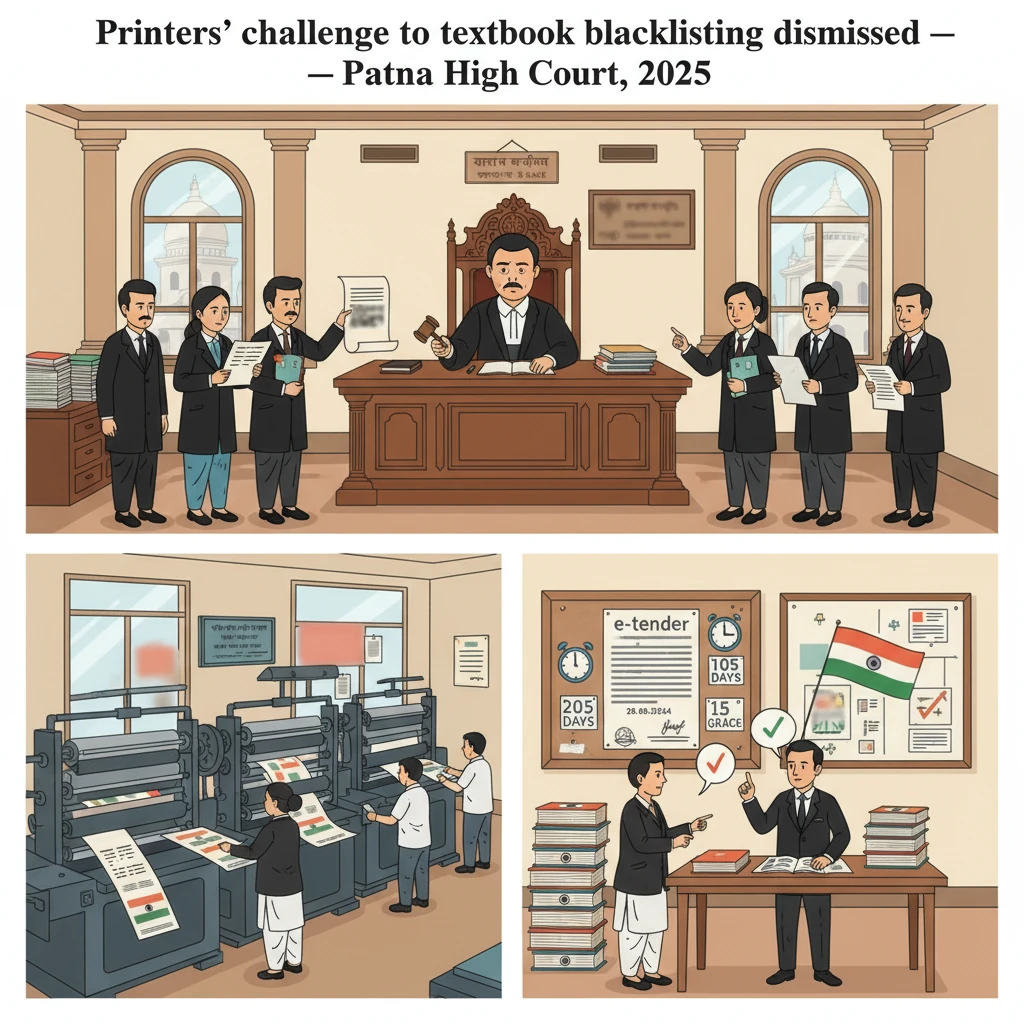
This judgment arises out of a batch of writ petitions filed by different Patna-based printing presses. All of them had been awarded work orders by Bihar State Text Book Publishing Corporation Limited for printing and supplying Samagra Shiksha Abhiyan (SSA) textbooks for Classes I to VIII for the academic year 2025–2026.
The Corporation had issued an e-tender notice on 28.08.2024 inviting bids from eligible printers for class-wise, district-wise and language-wise printing and supply of textbooks to 548 Block Resource Centres in 38 districts of Bihar. The petitioners participated in the tender process, were declared successful, and received separate work orders for specific “packages” and districts.
For example, in C.W.J.C. No. 11437 of 2025, the concerned petitioner was awarded work order dated 14.11.2024 for Package-52 (Class VI, districts Araria, Banka and West Champaran) and another work order for Package-58 (Class VII, districts Begusarai, Samastipur and Sheohar) for printing, binding, set making and supply of Hindi, Urdu and mixed-medium books.
As per the tender conditions, the printers had to get dummy/proof approvals from the State Council of Educational Research and Training (SCERT) and then supply books within a fixed timeline calculated from the “final approval” date. Time was clearly stated to be the essence of the contract.
The petitioners claimed that SCERT and the Corporation approved final proofs only in early December 2024 and then issued several changes in design, cover, and even added books. They said these changes caused delays. The record shows that SCERT, by letters dated 11.12.2024, 17.12.2024 and 24.12.2024, directed changes such as alteration in design of the National Flag on all books and the addition of five books in the Class VIII curriculum.
During execution of the contracts, the Corporation repeatedly monitored progress and found significant shortfalls in delivery by some printers. It issued multiple show cause notices in February, March and April 2025, calling upon defaulting printers to explain why they had not delivered the required percentage of books by specific dates.
Ultimately, by orders dated 18.06.2025, the Corporation blacklisted the petitioners for a period of one year. Aggrieved, they approached the Patna High Court under Article 226 of the Constitution, seeking quashing of the blacklisting orders and, in some cases, permission to participate in a fresh tender (Tender Notice No. 620 dated 05.06.2025) during pendency of the writ petitions.
What the Court Examined and Decided
The Division Bench, consisting of Hon’ble the Chief Justice and Hon’ble Mr. Justice Partha Sarthy, heard all six writ petitions together, as the dispute and core issues were similar. For convenience, the factual matrix was primarily drawn from C.W.J.C. No. 11437 of 2025 and applied across the batch.
The Court first recorded the contractual scheme under the tender documents:
Under Section II.B 1.4 of the NIT dated 28.08.2024, the contract period started from issuance of the work order. Textbooks had to reach destination points (HQs/BRCs) by 01.02.2025 or within 105 days from the date of final approval of dummy/proof, whichever was earlier. Clause 11 of Section II empowered the Corporation to vary quantities at the time of award.
Clause 8 of Section III (General Conditions of Contract) required delivery at destination points strictly within 01.02.2025 or 105 days from final approval, plus a grace period of 15 days for 100% delivery. Clause 8.2 made it clear that “time is the essence” of the contract and that the schedule had to be strictly followed at any cost. Negligence and delays were not to be entertained.
Clause 12 of Section III dealt with penalties for delay in delivery. It provided that if the maximum penalty touched 10% of the remaining default contract value, the Corporation could terminate the contract, forfeit performance guarantee and take other penal actions such as debarment/blacklisting under Clause 12(A).
On the petitioners’ side, two main lines of argument were advanced:
First, senior counsel for the petitioners argued that the blacklisting orders violated principles of natural justice. They claimed that although several letters and notices about delay were issued, there was no specific show cause notice proposing blacklisting as a penalty. They relied on Supreme Court decisions such as Gorkha Security Services v. Govt. (NCT of Delhi), Oryx Fisheries Pvt. Ltd. v. Union of India, Isolators and Isolators v. MP Madhya Kshetra Vidyut Vitran Co. Ltd. and others, to say that blacklisting, being akin to “civil death” for a contractor, requires a clear prior notice explicitly mentioning the proposed penalty.
They also contended that the impugned orders were “cyclostyled” (identical in language for all petitioners), non-speaking and passed without considering their detailed replies which had explained the reasons for delay, including alleged fault on the part of SCERT and the Corporation in changing designs and adding books late. On this basis, they alleged arbitrariness and violation of Article 14 of the Constitution.
Second, petitioners argued that they were within the broader 120-day period (105 days + 15 days grace) from final approval of proofs and that any delay was not solely attributable to them. They stressed that the Corporation could not take advantage of its own wrong, citing All India Groundnut Syndicate Ltd. v. Commissioner of Income Tax.
On the other hand, senior counsel for the Corporation took a firm stand that the writ petitions were not maintainable in the face of an arbitration clause (Clause 17 of the tender), which provided for disputes to be resolved first by mutual consent and then under the Arbitration and Conciliation Act, 1996. He stressed that in contractual matters, judicial review is limited.
On merits, the Corporation pointed to multiple show cause notices, including specific notices proposing blacklisting dated 21.04.2025 and 30.04.2025. These notices had asked each petitioner why penal action including blacklisting should not be taken for failing to supply required quantities within the stipulated timeframe.
The Corporation also produced charts showing performance of all 57 printers involved in the tender. It highlighted that only six printers (the petitioners) had faced action. Others had delivered 100% or at least more than 86% of the allotted textbooks within time. According to the Corporation, the petitioners’ defaults were serious and quantifiable.
In C.W.J.C. No. 11437 of 2025, it was stated that the petitioner had supplied only 54.76% of textbooks till 02.04.2025 and 69.91% till 26.04.2025. Thus, the maximum penalty had reached 12% of the remaining default contract value. In C.W.J.C. No. 11244 of 2025, the petitioner had delivered only 44.37% by 02.04.2025 and 52.73% by 26.04.2025, leading to a default of 17% of the default contract value.
After examining the records, the Bench held that the petitioners’ core complaint—that no show cause notice for blacklisting had been issued—was factually incorrect. In particular, the Court referred to the show cause notice dated 30.04.2025 placed as Annexure-P/18 in C.W.J.C. No. 11437 of 2025, and a similar notice dated 30.04.2025 in C.W.J.C. No. 11244 of 2025, which specifically asked the petitioners to show cause why they should not be blacklisted.
On this basis, the Court rejected the plea that there was a violation of natural justice or that the petitioners were taken by surprise regarding the penalty.
The Court then considered the nature of the impugned orders. It noted that the orders expressly recorded that repeated correspondence had taken place, repeated requests were made to supply books on time, and that the printers had failed to do so. The orders invoked Clause 12(A) of the General Conditions of Tender to justify blacklisting for one year.
While acknowledging the law laid down in Gorkha Security Services, Oryx Fisheries, Isolators and Isolators, Subodh Kumar Singh Rathour and All India Groundnut Syndicate regarding the need for proper notice, reasoned orders and non-arbitrary action, the Bench distinguished those decisions on the facts. It held that in this case:
• Specific blacklisting notices had indeed been issued.
• Extensive correspondence and multiple opportunities were provided.
• The contract clearly made time the essence, especially as textbooks had to reach school blocks before the academic year started.
• Out of 57 printers, only the six petitioners had failed to supply the required quantities within the scheduled period, while the rest complied.
Against this backdrop, the Court found nothing arbitrary or capricious about the Corporation’s decision. It emphasised that its role in judicial review of contractual decisions is limited and it cannot sit in appeal over the Corporation’s commercial and administrative assessment, so long as the action is in line with the contract and not arbitrary.
Ultimately, the Court concluded that the exercise of powers under Clause 12(A) by the Corporation could not be labelled arbitrary. It found no non-application of mind in the impugned orders and saw no basis to interfere under Article 226.
Accordingly, all the writ petitions were dismissed, and the one-year blacklisting orders remained in force.
Why This Judgment Matters
This decision has practical importance for printers, contractors and suppliers dealing with government tenders in Bihar, especially those involving time-sensitive supplies like school textbooks.
First, the Patna High Court has clearly affirmed that when contracts state that “time is the essence,” courts will usually not rescue contractors who seriously miss deadlines, especially where delays affect public services like education.
Second, the judgment shows that where a department has issued multiple notices, including explicit notices proposing blacklisting, and has documented performance shortfalls with clear figures, courts are reluctant to interfere with blacklisting orders.
Third, the case reinforces that simply alleging that the department is also at fault, or that orders are “cyclostyled,” is not enough. Contractors must show concrete violation of natural justice or clear arbitrariness, which the petitioners could not establish here.
For vendors in Bihar and elsewhere, this ruling is a reminder to take tender timelines, dummy approvals and delivery schedules very seriously, to keep detailed records of correspondence, and to respond promptly and fully to show cause notices—particularly when blacklisting is proposed.
Legal Issues and Answers
-
Issue: Did the Bihar State Text Book Publishing Corporation blacklist the petitioners without giving them proper notice and opportunity to be heard?
Answer: No. The Court held that specific show cause notices proposing blacklisting were issued, replies were invited and considered, and therefore principles of natural justice were not violated. -
Issue: Was the one-year blacklisting of the petitioners for delayed textbook supply arbitrary or in violation of Article 14 of the Constitution?
Answer: No. The Court found that the Corporation acted under Clause 12(A) of the tender, time was the essence of the contract, other printers had complied, and the action was not arbitrary. -
Issue: Could the High Court interfere with the Corporation’s contractual decision under Article 226 in these circumstances?
Answer: The Court held that in contractual matters its scope of judicial review is limited and, in the absence of arbitrariness or violation of law, it would not interfere. Hence, the writ petitions were dismissed.
Cases Cited by the Court
- Gorkha Security Services v. Government (NCT of Delhi) & Others, (2014) 9 SCC 105.
- Oryx Fisheries Private Limited v. Union of India & Others, (2010) 13 SCC 427.
- All India Groundnut Syndicate Ltd. v. Commissioner of Income Tax, Bombay City, 1953 SCC OnLine Bom 90.
- Isolators and Isolators through its proprietor Sandhya Mishra v. Madhya Pradesh Madhya Kshetra Vidyut Vitran Company Limited and Another, (2023) 8 SCC 607.
- Subodh Kumar Singh Rathour v. Chief Executive Officer & Others, 2024 SCC OnLine SC 1682.
Case Details
Case Numbers: Civil Writ Jurisdiction Case No. 11244 of 2025; 11378 of 2025; 11386 of 2025; 11437 of 2025; 11786 of 2025; 12503 of 2025 (heard and decided together).
Case Title (Lead Case): M/s Vivid Offset through its partner Mr. Shailesh Kumar Singh v. The State of Bihar & Others.
Other Connected Petitioners: M/s Mani Printers; M/s Patna Offset; M/s The Gandhi Enterprises; M/s Capital Offset; M/s Alankar Printers (each through their respective partners/proprietors as mentioned in the judgment).
Citation: 2025 (4) PLJR 63.
Coram: Hon’ble the Chief Justice (Vipul M. Pancholi, CJ); Hon’ble Mr. Justice Partha Sarthy.
Date of Judgment: 13-08-2025 (C.A.V. judgment; CAV date 08.08.2025; Uploading Date 14.08.2025).
Advocates for Petitioners:
- In C.W.J.C. No. 11244 of 2025: Mr. Jitendra Singh, Sr. Advocate; Mr. Vikas Kumar, Advocate; Ms. Aradhana Kumari, Advocate.
- In C.W.J.C. No. 11378 of 2025: Mr. Jitendra Singh, Sr. Advocate; Mr. Vikas Kumar, Advocate; Ms. Aradhana Kumari, Advocate.
- In C.W.J.C. No. 11386 of 2025: Mr. Jitendra Singh, Sr. Advocate; Mr. Vikas Kumar, Advocate; Ms. Aradhana Kumari, Advocate.
- In C.W.J.C. No. 11437 of 2025: Mr. Y.V. Giri, Sr. Advocate; Mr. Mithilesh Kumar, Advocate; Mr. Rajesh Prasad Choudhary, Advocate; Mr. Bimal Kishore Singh, Advocate.
- In C.W.J.C. No. 11786 of 2025: Mr. Jitendra Singh, Sr. Advocate; Mr. Vikas Kumar, Advocate; Ms. Aradhana Kumari, Advocate.
- In C.W.J.C. No. 12503 of 2025: Mr. Y.V. Giri, Sr. Advocate; Mr. Mithilesh Kumar, Advocate; Mr. Rajesh Prasad Choudhary, Advocate; Mr. Bimal Kishore Singh, Advocate.
Advocates for Respondents (in various matters): Mr. P.K. Shahi, Sr. Advocate; Ms. Anukriti Jaipuriyar, Advocate; Mr. Rajnikant Kumar, Advocate; Ms. Priti Mahato, Advocate; Mr. Ajay, GA-5; Mr. Standing Counsel (28); Mr. Vikash Kumar, SC-11; Mr. Amish Kumar, Advocate; Mr. Girijish Kumar, Advocate; Mr. Akash Anand, Advocate.
Respondents: The State of Bihar through Chief Secretary/Additional Chief Secretary, Department of Education; Bihar State Text Book Publishing Corporation Ltd. and its Managing Director/OSD; State Council of Educational Research and Training (SCERT)/State Education Research and Training Council and their Director/Procurement Expert; Bihar Education Project Council and its Project/State Project Director (as per individual case arrays).
Nature of Case: Writ petitions under Article 226 of the Constitution of India challenging orders of blacklisting passed by Bihar State Text Book Publishing Corporation Limited and connected authorities in relation to a government printing and supply contract.
Outcome: All writ petitions dismissed; blacklisting orders for one year upheld; interlocutory applications disposed of.
Link to Judgment: Patna High Court Judgment – CWJC No. 11244 of 2025 & batch
If you found this explanation helpful and wish to stay informed about how legal developments may affect your rights in Bihar, you may consider following Samvida Law Associates for more updates.







