

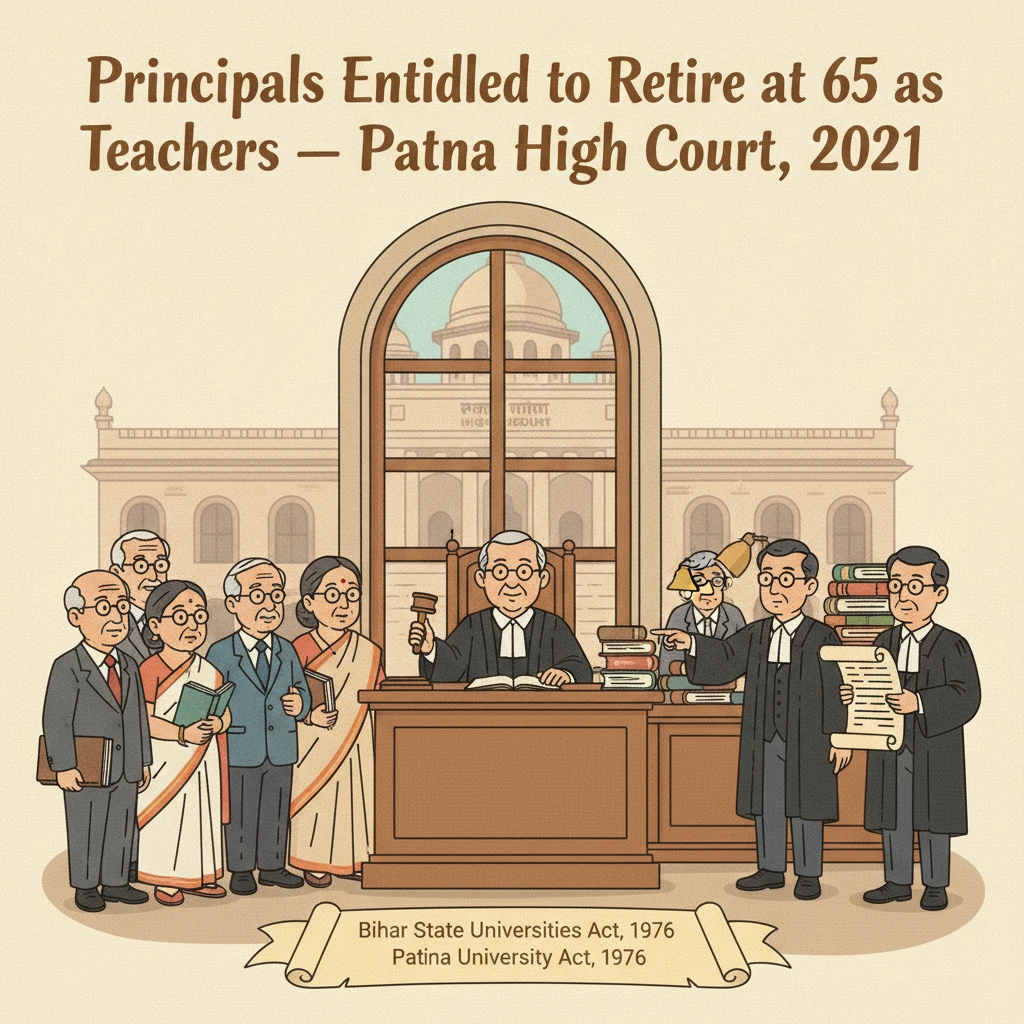
Case Background
Multiple writ petitions were filed under Article 226 of the Constitution by principals of different universities and colleges across Bihar. One petition also sought a writ of quo warranto against a serving principal.
The dispute began after the Bihar State Universities (Amendment and Validation) Act, 2012 changed the definition of “teacher” in the Bihar State Universities Act, 1976 and the Patna University Act, 1976. In this 2012 amendment, the word “Principal” was removed from the definition, and the definition was tied to University Grants Commission (UGC) regulations.
Despite this change, for several years the State and universities allowed principals to continue beyond 62 years, treating them as teachers entitled to retire at 65. No principal was asked to retire at 62 on the strength of the 2012 amendment.
In 2017, the Bihar State University (Amendment) Act, 2017 and the Patna University (Amendment) Act, 2017 again amended the definition of “teacher”, this time expressly adding “Principal” back into the definition, with effect from 18.05.2017.
On the basis of legal advice, the Education Department and the Chancellor’s Secretariat then issued several letters and memos in September 2017. These directed all universities to treat principals who had attained 62 years of age between 27.12.2012 and 15.05.2017 as having already retired on the date they turned 62, and to relieve them accordingly.
Following these directions, Registrars and Principals of various universities and colleges issued orders retrospectively retiring many principals, some with effect from dates as far back as 2015 or 2016. In one case the State also ordered recovery of salary paid after the alleged date of retirement.
Aggrieved principals approached the Patna High Court. They challenged the State’s communications, the university orders, and the Chancellor’s directions that treated them as non-teaching staff and fixed their retirement at 62. One separate writ petition (CWJC No. 2250 of 2017) asked for removal of a principal who had continued beyond 62, claiming he was illegally occupying office.
What the Court Examined and Decided
Hon’ble Mr. Justice Ahsanuddin Amanullah heard all the matters together as they raised a common question: in Bihar’s university laws, is a college principal a “teacher” entitled to retire at 65, or a non-teaching employee who must retire at 62?
The Court first set out the legal framework. The original definition of “teacher” in the Bihar State Universities Act included posts like Professor, Reader, Lecturer, Principal and Demonstrator. The 2012 Amendment replaced this with a new definition:
“Teacher” means a person holding the post of only University Professor/Professor, Reader and Lecturer and such sanctioned posts in the teacher’s grade on the basis of regulations issued by the UGC from time to time, with a saving clause only for certain old Demonstrators.
A pari materia amendment was made in the Patna University Act in 2012. The Preamble of the 2012 Amendment clearly recorded that its purpose was to correct anomalies, particularly the wrongful inclusion of non-teaching lab personnel and Demonstrators as teachers, contrary to UGC norms and earlier court rulings.
In 2017, another amendment explicitly reinserted “Principal” into the main part of the definition of “teacher”, without disturbing the “such sanctioned posts in the teacher’s grade” phrase introduced in 2012. The 2017 Acts were expressly prospective, coming into force on 18.05.2017, and contained a saving clause validating actions taken earlier.
The State and intervenor teachers argued that:
• The 2012 Amendment deliberately removed “Principal” from the definition of “teacher”, pushing principals into the non-teaching cadre.
• The 2017 Amendment, by specifically adding “Principal”, changed the position only prospectively from 18.05.2017.
• Therefore, any principal who reached 62 between 27.12.2012 and 15.05.2017 had to be treated as validly retired at 62, and could not claim the benefit of retirement at 65.
They also relied on a Division Bench judgment in Akhauri Bijay Prakash Sinha, which had upheld the 2012 Amendment against a challenge by Demonstrators, holding that only Professor, Reader and Lecturer were recognized as teachers by UGC.
The petitioners, on the other hand, stressed the Preamble of the 2012 Amendment and the phrase “such sanctioned posts in the teacher’s grade on the basis of regulations issued by the UGC from time to time”. They argued that:
• The clear mischief targeted by the 2012 Amendment was the inclusion of non-teaching lab personnel and Demonstrators, who lacked the qualifications of teachers and whom UGC did not recognize as teachers.
• Principals are appointed only from senior Professors and Readers, in the same pay scales, on sanctioned posts in the teachers’ grade as per UGC Regulations.
• The 2012 Amendment introduced a second, wider category within “teacher” to capture posts like Principal and Dean that are in the teachers’ grade under UGC Regulations, even if not named individually.
• The 2017 Amendment adding “Principal” again was merely clarificatory and done ex abundanti cautela, not to change the legal position.
The Court examined the structure and scheme of the university Acts and relevant statutes in detail. Important features noted were:
• Section 2(am) of the Act defines “equivalent post” by pay scale. Section 10(14), with its illustration, treats Reader and Principal in the same scale, and Professor and Principal in the same scale, as “equivalent posts”.
• Section 7 defines officers of the University. Section 9(7)(i) empowers the Chancellor to transfer officers and teachers from one university to another on the same or equivalent posts, retaining seniority. If principals were neither officers nor teachers, this power could not apply to them.
• Section 10(14) authorises the Vice-Chancellor to transfer “any teacher” to another department or college on an equivalent post, and the illustration again treats Principal as equivalent to Reader or Professor.
• Section 14 provides that the Dean of Students’ Welfare shall be appointed from amongst University Professors, Readers or Principals, and then describes such Dean as a “teacher” who holds lien on his original post.
• Section 26(5) provides that the Dean of Faculty shall be appointed from University Professors and Principals of the rank of University Professors, and expressly says the Dean must be “a teacher in the faculty”.
• Revised Statutes under Section 57B (framed in 2008) require that Principals be appointed in the grade of Professor or Reader, and treat Principal posts as sanctioned teaching posts with the same pay scales.
The Court also considered UGC Regulations and practice:
• UGC Regulations, 2010, issued under Section 26(1)(e) and (g) of the UGC Act, lay down minimum qualifications for teachers and for Principals.
• Appendix I to those Regulations is a “Scheme for Revision of Pay of Teachers and Equivalent Cadres in Universities and Colleges”. It places Principals in the same pay bands and Academic Grade Pay as Professors/Readers; Principals are thus part of the “teachers and equivalent cadres”.
• Certain posts like Registrar, Finance Officer, Controllers of Examinations, Demonstrators, etc. are expressly excluded from the Scheme; Principals are not excluded.
• UGC’s 2015 communication permits only “regular teachers” to supervise M.Phil. and Ph.D. research. Petitioners placed material showing they had guided Ph.D. scholars while serving as Principals, and those degrees had been awarded.
• Budget documents of Magadh University for 2016–2017 showed posts of Principals under the sanctioned strength of “teachers”, and State grants were released on that basis.
The Court then looked at how the State itself had behaved. Even after the 2012 Amendment, no principal was treated as retired at 62. Principals continued, drew salary and performed teaching and research functions without objection, and were even appointed as Deans. The controversy arose only after the 2017 Amendment and subsequent departmental letters.
On the interpretative side, the Court emphasised that a statute must be read as a whole, every word must be given meaning, and nothing should be treated as surplusage if a sensible construction is possible. The opening words of Section 2, “in this Act, unless there is anything repugnant in the subject or context”, show that the definition of “teacher” cannot be mechanically applied in a way that makes substantive provisions unworkable.
Applying these principles, the Court held:
• The Preamble and background of the 2012 Amendment Act clearly show that the only class intended to be pushed out of “teacher” was non-teaching lab personnel re-designated as Demonstrators.
• At the same time, by adding the phrase “such sanctioned posts in the teacher’s grade on the basis of regulations issued by the UGC from time to time”, the Legislature clearly wanted to include all posts that UGC treats as teaching posts or equivalent in the teachers’ grade — which includes Principals.
• Deleting the word “Principal” from the first part of the definition in 2012 did not remove Principals from “teacher”, because they squarely fall within the second part as sanctioned posts in the teachers’ grade under UGC Regulations.
• The 2017 Amendment’s re-insertion of the word “Principal” was only clarificatory; it did not change the legal position that Principals were always teachers.
• Section 4 (Saving) in the 2017 Amendment Act protects actions taken prior to 18.05.2017 from challenge on the ground of the amendment. The impugned retirement orders and government letters, however, were all issued after 18.05.2017, and therefore could not claim protection under this saving clause.
Finally, the Court addressed the argument that the vires of the 2012 and 2017 Amendments must be challenged before any relief could be granted. It held this was unnecessary. The question in these writ petitions was one of interpretation, not constitutionality. Since the petitioners were not attacking the validity of the amendments themselves, a Single Judge was competent to decide the matter.
On this reasoning, the Court allowed all writ petitions filed by principals (except the quo warranto petition), and dismissed the writ seeking removal of a principal (CWJC No. 2250 of 2017).
Why This Judgment Matters
This judgment has practical and immediate consequences for principals of Bihar’s state universities and affiliated colleges.
First, it firmly settles that a principal is a teacher for the purposes of the Bihar State Universities Act and the Patna University Act. This means principals are entitled to the same retirement age as teachers, i.e. 65 years, not 62.
Second, it invalidates the State’s attempt to retrospectively treat principals as non-teaching staff between 2012 and 2017. All government memos and university orders that forced principals to retire at 62 in that period stand quashed.
Third, for individuals who were already forced to retire at 62, the Court has granted concrete relief. They are to be treated as having continued in service as Principals till they reached 65. They must be paid all salary and allowances for that extended period, and any recoveries made from them on the basis of the State’s earlier view must be refunded.
Fourth, the decision clarifies that when State amendments tie definitions like “teacher” to UGC Regulations, those Regulations—and the way the UGC actually treats posts—must be taken seriously. A principal cannot be treated as a non-teaching employee when the UGC, the Central Government, and the universities themselves have consistently treated the post as academic and in the teachers’ grade.
For low-income and retired principals, this judgment can mean three additional years of full pay, pension revision, and restoration of dignity. For universities, it removes uncertainty and prevents posts remaining vacant due to fear of losing service benefits.
Legal Issues and Answers
-
Issue: After the 2012 Amendment to the Bihar State Universities Act and the Patna University Act, were college principals excluded from the definition of “teacher” and liable to retire at 62 as non-teaching staff?
Answer: No. Despite deletion of the word “Principal” in 2012, principals continued to fall within “such sanctioned posts in the teacher’s grade on the basis of regulations issued by the UGC from time to time” and remained teachers. -
Issue: Did the 2017 Amendment, which again named “Principal” within the definition of “teacher”, operate only prospectively so as to deny the benefit of retirement at 65 to principals who had turned 62 before 18.05.2017?
Answer: No. The 2017 Amendment was held to be clarificatory, not changing the earlier position. The State’s attempt to retrospectively treat principals as retired at 62 between 2012 and 2017 was quashed. -
Issue: Were the State Government’s and Chancellor’s directions, and consequential university orders, retrospectively retiring principals at 62 lawful?
Answer: No. All such orders and communications were quashed. Principals are deemed to have continued till 65 and are entitled to all consequential financial and service benefits; recoveries made from them must be refunded.
Cases Cited by the Court
- Dr. (Mrs.) Annapurna Devi v. State of Bihar, 1997 (1) PLJR 965 – held that a principal is a teacher entitled to teach.
- Akhauri Bijay Prakash Sinha v. State of Bihar, 2014 (2) PLJR 798 – upheld the 2012 Amendment as regards Demonstrators.
- Oriental Insurance Co. Ltd. v. Hansrajbhai V. Kodala, (2001) 5 SCC 175.
- Aswini Kumar Ghosh v. Arabinda Bose, AIR 1952 SC 369.
- Annamalai University v. Secretary to Government, Information & Tourism Department, (2009) 4 SCC 590.
- Kalyani Mathivanan v. K.V. Jeyaraj, (2015) 6 SCC 363.
- Poppatlal Shah v. State of Madras, 1953 SCR 677.
- Nathi Devi v. Radha Devi Gupta, (2005) 2 SCC 271.
- Zile Singh v. State of Haryana, (2004) 8 SCC 1.
- Vice-Chancellor, L.N. Mithila University v. Dayanand Jha, AIR 1986 SC 1200.
- Other Supreme Court authorities on statutory interpretation and UGC powers as discussed in the judgment.
Case Details
Case Number(s): Civil Writ Jurisdiction Case No. 7701 of 2017 with CWJC Nos. 2250, 14428, 14478, 14493, 14508, 14539, 14562, 14688, 14743, 14744, 14748, 14917, 15644, and 15800 of 2017, and I.A. No. 6895 of 2018 in CWJC No. 7701 of 2017.
Case Title (lead matter): Dr. Raj Kumar Mazumdar v. The State of Bihar & Ors.
Court: High Court of Judicature at Patna.
Coram: Hon’ble Mr. Justice Ahsanuddin Amanullah.
Date of Judgment: 08-10-2021.
Citation: 2022 (1) PLJR 623.
Nature of the Case: Writ petitions under Article 226 of the Constitution challenging State Government and university orders of superannuation; one writ of quo warranto; all heard and decided together.
Advocates (as recorded):
- For petitioners (in various CWJCs): Mr. Manoj Kumar Singh, Mr. Navin Prasad Singh, Mr. Jitendra Singh (Senior Advocate), Mr. P.K. Shahi (Senior Advocate), Mr. Mahesh Narayan Parbat (Senior Advocate), and several other advocates as listed in the judgment.
- For the State of Bihar: Learned Advocate General Mr. Lalit Kishore (appearing in submissions), Ms. Shilpa Singh, Mr. Ashutosh Ranjan Pandey (AAG 15), and other Government Pleaders/A.C.s as recorded.
- For the Chancellor: Mr. Rajendra Kumar Giri.
- For Universities (Magadh, Patna, LNMU, BRA Bihar University, JP University, TMBU, Veer Kunwar Singh University, KSD Sanskrit University, etc.): respective learned counsel as detailed in the judgment.
- For UGC: Mr. Amarendra Nath Verma.
- For intervenor-respondents in CWJC No. 2250 of 2017: Mr. Jitendra Singh, Senior Advocate and others.
Link to Judgment (official PDF): https://patnahighcourt.gov.in/viewjudgment/MTUjNzcwMSMyMDE3IzEjTg==-379ibYym78M=
If you found this explanation helpful and wish to stay informed about
how legal developments may affect your rights in Bihar,
you may consider following Samvida Law Associates for more updates.







