

Case Background
The case arose from Barhiya Police Station Case No. 266 of 2021 in district Lakhisarai. The petitioner was facing multiple proceedings relating to narcotic drugs and psychotropic substances.
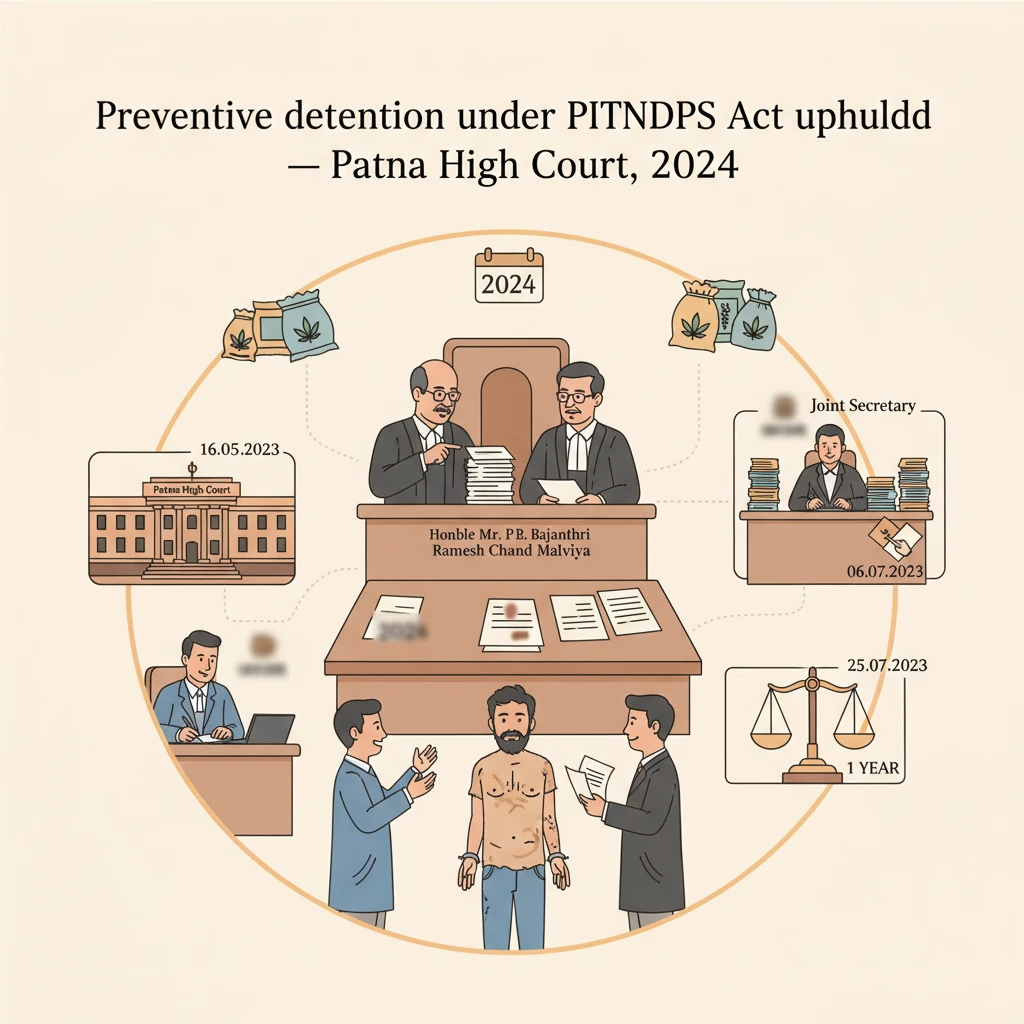
On 16.05.2023, the Joint Secretary, Ministry of Finance, Department of Revenue (P.I.T.N.D.P.S. Unit), Government of India, New Delhi, passed a preventive detention order against the petitioner under Section 3(1) of the Prevention of Illicit Traffic in Narcotics Drugs and Psychotropic Substance Act, 1988 (PITNDPS Act, 1988).
Challenging this order, the petitioner filed Criminal Writ Jurisdiction Case No. 1686 of 2023 before the Patna High Court. In the writ petition, he sought a writ in the nature of habeas corpus to set aside the detention order dated 16.05.2023 and also sought a direction for his release from custody.
The matter came before a Division Bench of Hon’ble Mr. Justice P. B. Bajanthri and Hon’ble Mr. Justice Ramesh Chand Malviya. During the hearing, it was noticed that besides questioning the detention order, the petitioner was also in custody in several NDPS cases where bail had been refused by Special Courts.
What the Court Examined and Decided
On 11.12.2023, the Bench passed an interim order recording its concerns about how the case had been presented. The Court observed that the petitioner’s prayer mixed two different kinds of relief.
First, he challenged the preventive detention order under Section 3(1) of the PITNDPS Act, 1988. Second, he asked for his release from custody as if in a habeas corpus petition. The Court pointed out that his continued custody in NDPS cases was already the subject of several proceedings before Special Courts where his bail had been denied.
The Division Bench clarified that, in substance, the case was not a pure habeas corpus petition about illegal custody, but rather a challenge to the validity of a preventive detention order passed by the Joint Secretary. Hence the matter fell in the “others” category of Group No. 53 in the Court’s roster, and not strictly under “Habeas Corpus”.
To decide the challenge, the Court had to examine whether the Joint Secretary had validly exercised the power under Section 3(1) of the PITNDPS Act, 1988. This provision allows the Central Government, State Government, or duly empowered senior officers to detain a person, including a foreigner, if they are satisfied that it is necessary to prevent that person from engaging in illicit drug trafficking.
The Bench stressed that the key requirement is the “satisfaction” of the competent authority. The Court specifically noted that it must check whether the Joint Secretary was satisfied with the material placed before him when he issued the detention order. For this, the Court relied on the Supreme Court judgment in Ameena Begum vs. State of Telangana & Ors., reported in (2023) 9 SCC 587, particularly paragraph 31.
In light of this legal position, the Bench directed the learned counsel for the Union of India to produce the original detention file bearing No. F.No. U-11011/12/2023-PITNDPS. The case was then listed for further hearing on 12.01.2024, with a specific direction that the original file be made available.
On the next date, the counsel for the respondents produced the original file, which contained the impugned detention order dated 16.05.2023, the opinion of the Advisory Board, and the subsequent confirmation by the Government of India.
After going through the record, the Court first noted that, prima facie, the writ petition was premature. Under Section 9(b) of the PITNDPS Act, 1988, an Advisory Board is constituted to examine detention orders and give its opinion. The Court pointed out that the petitioner had this statutory remedy before the Advisory Board and then in relation to the confirmation of the detention order.
Despite this, the Bench proceeded to consider the material in the file. The Joint Secretary’s detailed order dated 16.05.2023 showed that he had examined the matter on merits and had listed out the relevant pending cases against the petitioner.
On the basis of these cases and the material placed, the Joint Secretary concluded that the petitioner was allegedly a habitual offender involved in repeated drug trafficking. The order recorded that multiple seizures by the Narcotics Control Bureau (NCB) and Police Authorities indicated that the petitioner had not changed his conduct and continued to be involved in drug trafficking on a regular basis.
Taking note of paragraphs 6 to 14 of the Joint Secretary’s order, the High Court held that there was adequate satisfaction recorded by the detaining authority as required under Section 3(1) of the PITNDPS Act, 1988. The Bench found that the Joint Secretary had applied his mind to the material and had reached a reasoned conclusion that preventive detention was necessary.
The file also showed that, after the detention order, the matter was placed before the Advisory Board. The Advisory Board submitted its report on 06.07.2023. Thereafter, on 25.07.2023, the Government of India confirmed the detention order based on the Advisory Board’s opinion.
Reading the confirmation order dated 25.07.2023, the Court noted that the Government of India had decided to detain the petitioner for a period of one year. The Bench observed that, after this confirmation, the petitioner was free to approach the competent forum or authority as permitted by law.
In view of these developments, including the satisfaction recorded by the Joint Secretary, the Advisory Board’s report, and the confirmation by the Central Government, the Court held that the petitioner had not made out any case for interference with the detention order dated 16.05.2023.
The Division Bench therefore dismissed the writ petition. The preventive detention order and its confirmation remained in force for a total period of one year from the date of confirmation, subject to any remedy the petitioner might pursue before the appropriate forum thereafter.
Why This Judgment Matters
This judgment shows how the Patna High Court deals with challenges to preventive detention orders under the PITNDPS Act, 1988.
For persons accused of repeated involvement in drug trafficking, the Court emphasised that preventive detention can be upheld if the Joint Secretary or other competent authority clearly records satisfaction based on material such as pending cases and multiple seizures.
The decision also highlights that a habeas corpus-style request for release is different from a challenge to a preventive detention order. When a person is already in custody in NDPS cases where bail has been refused, the High Court will not treat the matter as a pure habeas corpus petition.
Further, the judgment reminds detainees that there is a statutory mechanism involving an Advisory Board and confirmation by the Government of India. Courts will look carefully at whether this process has been followed and whether the detaining authority has applied its mind, rather than lightly setting aside such orders.
Legal Issues and Answers
-
Issue: Whether the preventive detention order dated 16.05.2023 passed by the Joint Secretary, Ministry of Finance (PITNDPS Unit), under Section 3(1) of the PITNDPS Act, 1988, was invalid for lack of proper satisfaction.
Answer: No. The Patna High Court held that the Joint Secretary had recorded detailed satisfaction based on multiple pending cases and seizures, and therefore the detention order met the requirement of Section 3(1). -
Issue: Whether the writ petition in the nature of habeas corpus seeking both setting aside of the detention order and release from custody was maintainable.
Answer: The Court treated the petition essentially as a challenge to the detention order, noting that questions of release were already before Special Courts in NDPS cases and that the petitioner also had a statutory remedy via the Advisory Board mechanism. -
Issue: Whether the High Court should interfere with the detention order despite the Advisory Board’s opinion and subsequent confirmation by the Government of India.
Answer: No. After examining the original file, the Advisory Board’s report dated 06.07.2023, and the confirmation dated 25.07.2023, the Court found no ground to interfere and dismissed the petition.
Cases Cited by the Court
- The Court relied on the Supreme Court judgment in Ameena Begum vs. State of Telangana & Ors., reported in (2023) 9 SCC 587, particularly paragraph 31, for the principle regarding satisfaction of the detaining authority under preventive detention laws.
Case Details
Case Number: Criminal Writ Jurisdiction Case No. 1686 of 2023; arising out of Barhiya P.S. Case No. 266 of 2021, District Lakhisarai.
Case Title: Raushan Kumar @ Roshan Singh vs. The Union of India & Others.
Coram: Hon’ble Mr. Justice P. B. Bajanthri and Hon’ble Mr. Justice Ramesh Chand Malviya.
Date of Judgment: 15.01.2024.
Citation: 2024(1) PLJR 572.
Advocates: For the petitioner – Mr. Pranav Kumar Jha, Advocate. For the Union of India – Mr. K. N. Singh, A.S.G.; Mr. Anshuman Singh, CGC; Mr. Prabhat Kumar Singh, AC to ASG; Mr. Prakritita Sharma, JC to ASG; Mr. Shivadityadhari Sinha, JC to ASG. For Respondent Nos. 4 to 9 – Mr. P. K. Shahi, Advocate General; Mr. Prabhu Narayan Sharma, AC to AG.
Nature of the Case: Criminal writ petition challenging a preventive detention order under Section 3(1) of the PITNDPS Act, 1988, with a prayer in the nature of habeas corpus.
Link to Judgment: Click here to read the full judgment of the Patna High Court.
If you found this explanation helpful and wish to stay informed about
how legal developments may affect your rights in Bihar,
you may consider following Samvida Law Associates for more updates.







