

Case Background
The marriage between the parties was solemnized on 13.11.2019. According to the petitioner-wife, the parties had been living separately since 2020 and their relationship had broken down.
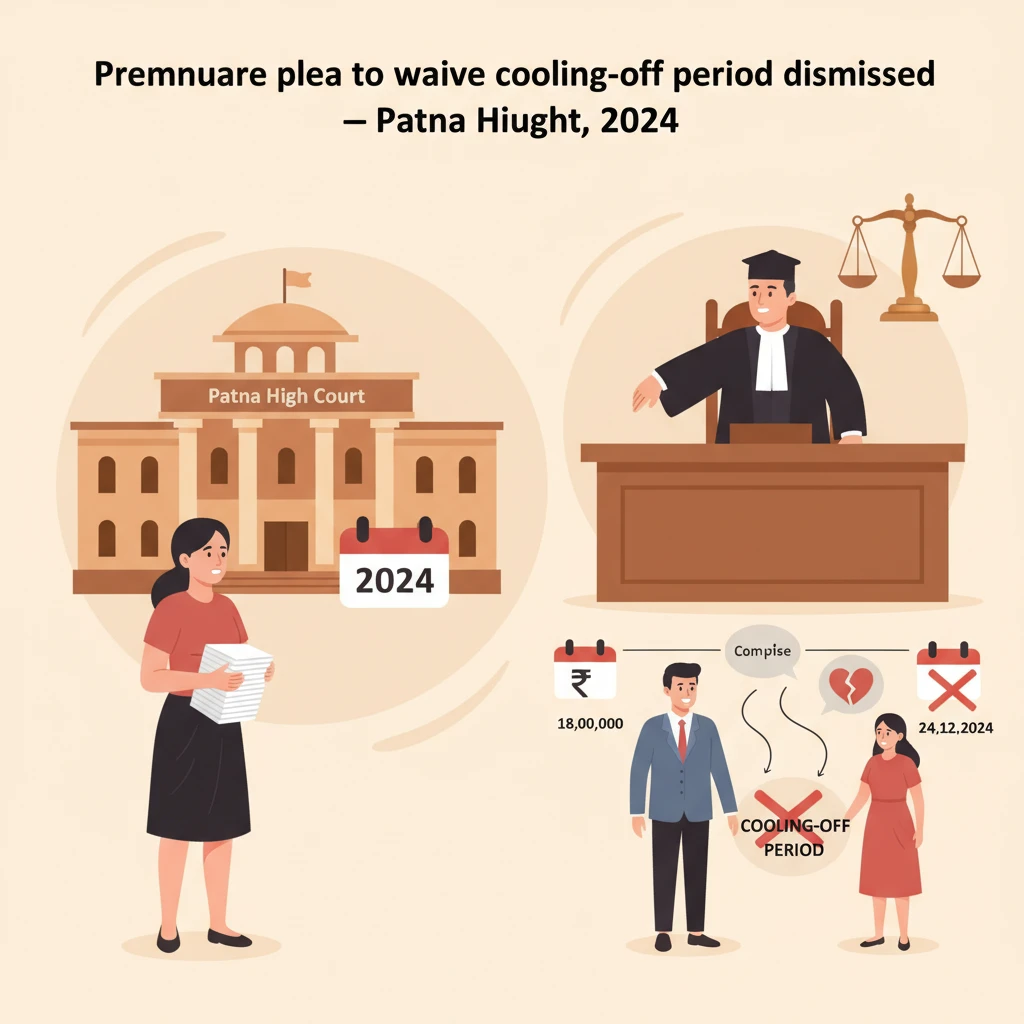
Criminal proceedings were pending against the husband before the Sessions Judge, Aurangabad. During the pendency of his bail petition, the parties entered into a compromise. On 11.06.2024, the learned Sessions Judge enlarged the husband on provisional bail. One of the conditions of this order was that he would make payment of Rs. 18,00,000 (eighteen lakhs) to the petitioner in instalments. The parties were also to move for dissolution of marriage by filing a petition under Section 13B of the Hindu Marriage Act for divorce by mutual consent, and to withdraw cases filed against each other.
Pursuant to this compromise, Matrimonial Case No. 179 of 2024 was filed before the Principal Judge, Family Court, Aurangabad under Section 13B of the Hindu Marriage Act. The matrimonial petition was taken up for the first time on 25.06.2024. On 27.06.2024, the Family Court admitted the case, recorded the first motion, and fixed 24.12.2024 as the date for recording the parties’ statements on the second motion under Section 13B(2).
The petitioner-wife was dissatisfied with the fixation of a date six months later for the second motion. Without filing any application before the Family Court seeking waiver of the statutory waiting period, she approached the Patna High Court under Article 227 of the Constitution of India through Civil Miscellaneous Jurisdiction No. 777 of 2024.
What the Court Examined and Decided
The Patna High Court, per Hon’ble Mr. Justice Arun Kumar Jha, heard the matter at the admission stage itself on mentioning by the petitioner’s counsel and decided to dispose of the petition without issuing notice to the respondent.
The core grievance of the petitioner was that the Family Court, by mechanically fixing a date after six months for the second motion in the mutual consent divorce petition, had ignored the law laid down by the Hon’ble Supreme Court in Amardeep Singh v. Harneet Kaur, (2017) 8 SCC 746, as well as in Shilpa Sailesh v. Varun Sreenivasan, 2023 SCC OnLine SC 544.
The petitioner’s counsel argued that the Supreme Court in Amardeep Singh had held that the six-month “cooling-off” period prescribed under Section 13B(2) of the Hindu Marriage Act is not mandatory but directory. The court dealing with a matter could waive this period if certain conditions were met. It was submitted that, despite this, the Family Court did not consider the request for waiver and simply fixed a date six months later for the second motion.
Counsel further submitted that, in terms of the compromise recorded by the Sessions Judge on 11.06.2024, the husband had agreed to pay Rs. 18,00,000 to the wife in instalments and, subject to payment and other terms, the parties were to seek divorce by mutual consent. It was argued that the parties had already decided to end their matrimonial relationship, to withdraw all cases against each other, and that the marriage had irretrievably broken down with no possibility of resuming cohabitation. In this background, the petitioner claimed that forcing the parties to wait for six months would only cause further mental agony.
Reliance was also placed on the judgment of the Supreme Court in Shilpa Sailesh v. Varun Sreenivasan, where it was held that the court has the discretion to dissolve the marriage by mutual consent without being bound by the procedural requirement of moving a second motion.
Before considering these arguments, the High Court reproduced Section 13B of the Hindu Marriage Act, including sub-section (2), which prescribes that the second motion can be made not earlier than six months and not later than eighteen months after presentation of the petition under sub-section (1). The Court then quoted extensively from paragraphs 18 to 21 of Amardeep Singh, where the Supreme Court discussed when a statutory provision is to be treated as mandatory or directory, and laid down specific conditions for waiver of the six-month period.
As summarised in Amardeep Singh, the Supreme Court held that the period under Section 13B(2) is directory, not mandatory. A court may waive the cooling-off period if: the statutory periods of separation are already over; all mediation and conciliation efforts have failed; the parties have genuinely settled all disputes including alimony and custody; and the waiting period will only lengthen their agony. Importantly, the Supreme Court indicated that an application for waiver can be filed one week after the first motion, giving reasons for seeking waiver, and that waiver remains a matter of judicial discretion based on the facts of each case.
Applying these principles, the Patna High Court tested the petitioner’s case. It first noted that the marriage had been solemnized on 13.11.2019. The compromise between the parties was only in 2024. The Sessions Judge’s order dated 11.06.2024 granting provisional bail to the husband was based on that compromise and imposed conditions linked to payment of money and filing of the mutual consent divorce petition. The Court accepted the petitioner’s submission that the parties had been living separately since 2020, but stressed that this by itself did not automatically lead to waiver of the cooling-off period.
The Court clearly stated that mere compromise to end the matrimonial relationship does not mean the condition under Section 13B(2) “should be waived suo motu” by the Family Court without giving the parties proper opportunity to reconcile. The Supreme Court in Amardeep Singh had specifically mentioned that a waiver application should be moved by the parties after one week from the first motion. There is no blanket power for courts to waive the six-month period in all cases; waiver is permissible only if the prescribed conditions are fulfilled.
The High Court expressed its inability to understand how the petitioner had approached it under Article 227 without first filing any waiver application before the Family Court. It was admitted that no such application had ever been filed. The Court highlighted that the compromise order of 11.06.2024 contained several conditions, and filing a Section 13B petition was only one of them. That order could not be taken to mean that every matrimonial dispute between the parties stood fully settled.
The Court further underlined that examination of whether all disputes are settled and whether reconciliation is still possible falls squarely within the domain of the Family Court, not the Sessions Judge dealing with a bail matter. There was nothing on record to show that the Family Court had made efforts at reconciliation as mandated under the Hindu Marriage Act. Therefore, even the basic factual pre-requisites identified in Amardeep Singh—such as failure of reconciliation efforts and full settlement of disputes—were not established on the record.
Regarding reliance on Shilpa Sailesh, the High Court held that this judgment dealt mainly with the powers of the Supreme Court under Article 142 of the Constitution of India. In that case, the Supreme Court was considering whether it could dissolve a marriage by mutual consent by invoking its extraordinary power under Article 142 without following the statutory procedure of Section 13B(2). The Patna High Court noted that even the reference to Amardeep Singh in Shilpa Sailesh was in the context of such orders under Article 142. Therefore, the ratio of Shilpa Sailesh was held to be inapplicable to the present case pending before a Family Court and under the supervisory jurisdiction of the High Court.
The Court also took note of a growing tendency of litigants to approach the High Court under Article 227 without first exhausting adequate remedies before the subordinate courts and without appreciating the factual and legal requirements. The present case was cited as one such instance. The matrimonial petition had been first taken up on 25.06.2024, first motion was recorded on 27.06.2024, and there had been no attempt at reconciliation. In this background, the claim that the marriage had irretrievably broken down and that the statutory period should be waived was found to be “simply not sustainable,” particularly when no waiver application had been filed and the petitioner had rushed to the High Court “showing undue haste.”
On these grounds, the High Court concluded that the petition was premature and devoid of merit, both procedurally and on merits. The prayer for waiver of the six-month period for second motion could not have been granted in such circumstances.
As a deterrent, the Court dismissed the petition with costs of Rs. 10,000 to be deposited with the Patna High Court Legal Services Committee within three weeks from the date of the order (21.08.2024). It further directed that if the cost is not deposited within the stipulated period, the Family Court shall put on hold further proceedings in Matrimonial Case No. 179 of 2024.
Why This Judgment Matters
This decision is important for parties seeking divorce by mutual consent who wish to avoid the six-month cooling-off period. The Patna High Court has made it clear that waiver of this period is not automatic, even if the parties have compromised in connected criminal or other cases.
Parties must first approach the Family Court itself with a proper waiver application after the first motion, giving reasons and supporting material. The Family Court must then consider whether the conditions laid down in Amardeep Singh are actually fulfilled—such as failed reconciliation, genuine settlement of all issues, and absence of any chance of reunion.
The judgment also sends a message that using Article 227 to challenge routine procedural orders of the Family Court, without first following the statutory process, will not be encouraged and may invite costs. For ordinary litigants, this underscores that the first port of call for such relief is the Family Court, not the High Court.
Legal Issues and Answers
- Issue: Can the High Court, under Article 227, interfere with a Family Court order fixing a date for second motion in a mutual consent divorce case, and direct waiver of the six-month period under Section 13B(2) of the Hindu Marriage Act, when no waiver application has been filed before the Family Court?
Answer: No. The petition was held to be premature since no waiver application was moved before the Family Court, and the conditions for waiver under Amardeep Singh were not shown to exist on record. The High Court refused to interfere. - Issue: Does a compromise recorded in a criminal case and a claim of irretrievable breakdown of marriage automatically entitle parties to waiver of the cooling-off period under Section 13B(2)?
Answer: No. A compromise in another proceeding and a decision to end the marriage do not by themselves justify suo motu waiver. The Family Court must have an opportunity to attempt reconciliation and to verify that all statutory and Supreme Court conditions for waiver are met. - Issue: Is the Supreme Court’s decision in Shilpa Sailesh v. Varun Sreenivasan applicable to routine mutual consent divorce proceedings before Family Courts?
Answer: No. The Patna High Court held that Shilpa Sailesh mainly concerns the Supreme Court’s powers under Article 142 of the Constitution, and its ratio is not applicable to the present case.
Cases Cited by the Court
- Amardeep Singh v. Harneet Kaur, (2017) 8 SCC 746
- Kailash v. Nanhku, (2005) 4 SCC 480
- Shilpa Sailesh v. Varun Sreenivasan, 2023 SCC OnLine SC 544
Case Details
Case Number: Civil Miscellaneous Jurisdiction No. 777 of 2024
Case Title: Shilpi Rani v. Mithilesh Kumar Singh
Coram: Hon’ble Mr. Justice Arun Kumar Jha
Citation: 2024 (4) PLJR 80
Advocates:
- For the Petitioner: Mr. Vinay Ranjan, Advocate; Mr. Praveen Kumar, Advocate
- For the Respondent: Not recorded in the judgment
Nature of the Case: Petition under Article 227 of the Constitution of India challenging an interlocutory order of the Family Court in a matrimonial case under Section 13B of the Hindu Marriage Act (mutual consent divorce), seeking waiver of the six-month cooling-off period for second motion.
Link to Judgment: Click here to read the full judgment of the Patna High Court
If you found this explanation helpful and wish to stay informed about
how legal developments may affect your rights in Bihar,
you may consider following Samvida Law Associates for more updates.







