
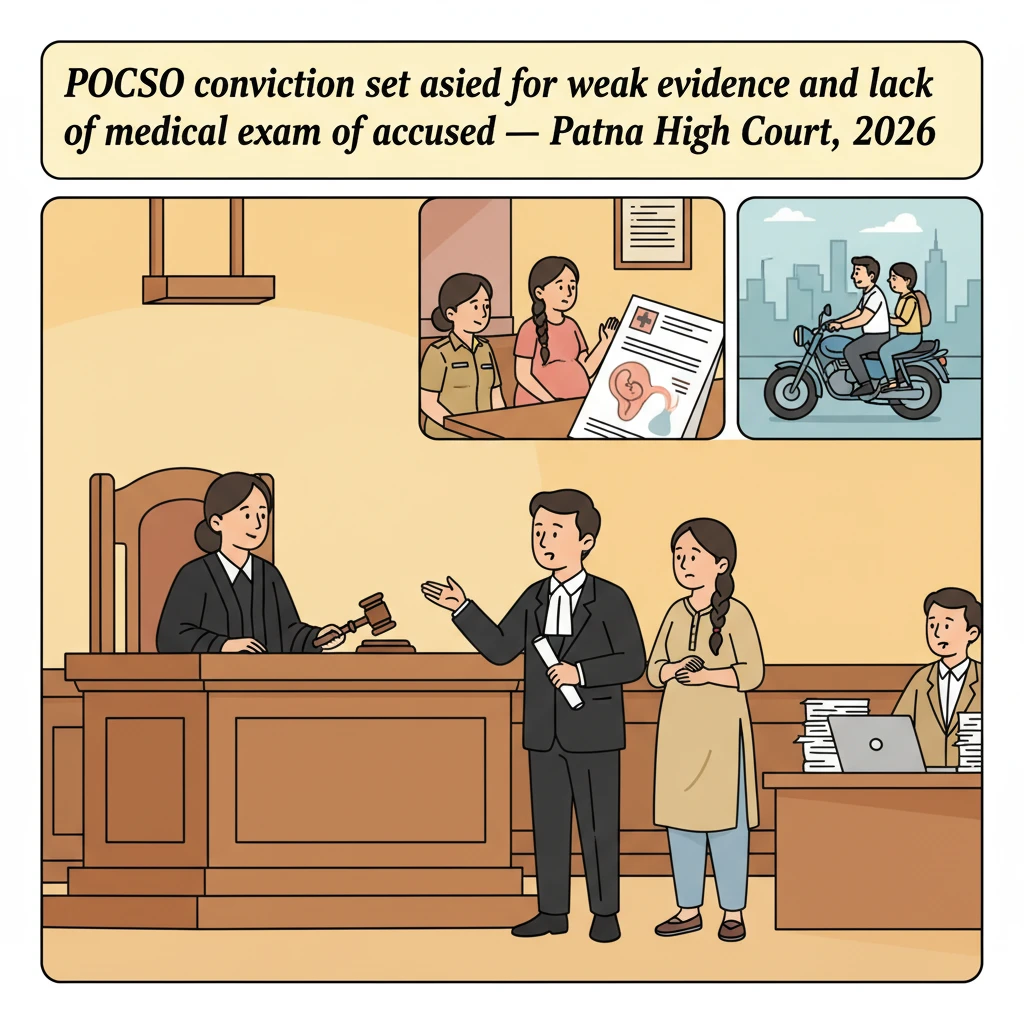
Case Background
The case began with Sultanganj P.S. Case No. 171 of 2016 dated 22 August 2016. The FIR was lodged on the basis of a farde bayan given by the father of a minor girl. The informant stated that his daughter, about 13 years old at the time, used to live at Sultanganj in the house of one “Guddun Ji” and did small household work.
According to the father, about five months before lodging the FIR, his daughter left the house of Guddun Ji and stayed away for one night, returning the next morning. He questioned her about where she had gone, but she kept silent. About one month before the FIR, he noticed physical changes in his daughter. At first, she did not say anything, but on the date of the farde bayan she disclosed that she was pregnant.
She allegedly told her father that one Md. Pappu, the present appellant, had taken her by motorcycle to Darbhanga about five months earlier and had forcibly established physical relations with her. She said that the next morning he brought her back to the house of Guddun Ji. The girl did not reveal this earlier because she was afraid and because her mother was mentally ill, so she could not confide in her mother.
The informant further stated that even after the Darbhanga incident, the appellant continued to have physical intercourse with the girl by putting her under fear. He added another allegation: that one barber, “Chhotu Thakur”, had seen the physical relations between the appellant and the girl and had then himself committed penetrative sexual assault on her by taking advantage of the situation.
On this basis, the police registered Sultanganj P.S. Case No. 171 of 2016. Investigation was entrusted to a woman Sub-Inspector from Mahila Police Station, Patna. During investigation, she visited the place of occurrence, recorded statements of available witnesses, and got the victim’s statement recorded under Section 164 of the Cr.P.C. The girl was medically examined, reports were collected, and finally a charge-sheet was submitted against the appellant under Section 376 IPC read with Sections 4 and 6 of the POCSO Act.
The charge-sheet was filed before the Chief Judicial Magistrate, Patna, who found the case to be exclusively triable by the Special Judge under the POCSO Act. The matter was committed to the Court of the Additional Sessions Judge, 1st Court, Patna-cum-Special Judge (POCSO) for trial as Special Case No. 122 of 2016.
What the Court Examined and Decided
The Sessions Court framed charges under Section 376 IPC and Sections 4/6 of the POCSO Act. The appellant pleaded not guilty and claimed trial. The prosecution examined five witnesses, including the informant father, the victim girl, the Investigating Officer, and the medical officer. The defence examined three witnesses and the accused was also examined under Section 313 Cr.P.C.
The broad defence case, as seen from cross-examination, Section 313 answers, and defence witnesses, was a complete denial. It was suggested that the girl had an illicit relationship with the barber, Chhotu Thakur. When the appellant allegedly saw this, he assaulted Chhotu. Out of grudge, the victim and her father allegedly implicated the appellant falsely.
Prosecution witness 1, the manager of a marriage hall where the appellant worked as an electrician, did not support the case. He said he did not know the informant’s daughter and denied making any statement to police. Importantly, the prosecution did not declare him hostile, so his evidence stood unrebutted.
Prosecution witness 2, the father, repeated that his daughter was about 13 years old and that he heard from her that the appellant had committed a “galat kaam” (illicit act) with her. He went to the police station and gave his statement. He also stated that his daughter gave birth to a baby, who died five days after birth. In cross-examination, he admitted that he did not know any person named Chhotu Thakur and denied telling police that Chhotu had committed any “nazayaz kaam” with his daughter. The Division Bench noted that his evidence was hearsay, based only on what he said he heard from his daughter.
Prosecution witness 3, the victim, was a child witness. The Trial Court made a brief note that her capacity to understand was tested and found satisfactory, but did not record the questions put to her for this assessment. The High Court held that this did not show proper compliance with Section 118 of the Evidence Act, which requires the court to satisfy itself that a child understands questions and can give rational answers. The Bench termed the recording of her evidence “irregular”, though not wholly illegal.
In her deposition, the girl stated that about one and a half years before her evidence (recorded on 3 February 2018) the appellant took her to Darbhanga and did “ganda ganda kaam” (illicit act) with her, as a result of which she became pregnant. She said her father was a painter and that her mother and elder sister lived at home. In cross-examination she stated that she did not know any person called Chhotu Thakur, that her father had not lodged any complaint against Chhotu, and that Chhotu had not done any wrong to her. She confirmed that she stayed in a house adjacent to the marriage hall, that the appellant worked there as electrician, and that Chhotu had a barber shop nearby but had closed it and fled after the case. She denied the defence suggestion that the appellant had not done any wrong to her.
The victim’s statement under Section 164 Cr.P.C. contained additional details. She said the appellant had taken her for a walk to Gandhi Maidan on 14 August 2016 and that on one occasion he took her to Darbhanga where he committed “ganda kaam” at about 9–10 p.m. She claimed she had raised alarm but no one heard. She could not recall when she came back home. She said she had been pregnant for about five months and that whenever her father was away the appellant would come to the house and commit “ganda kaam”.
Prosecution witness 4, Dr. Premlata Verma, examined the girl on 23 August 2016 at Guru Govind Singh Hospital, Patna City. She noted that the secondary sexual characteristics were well developed and there were no injury marks on the body, including private parts. On internal examination, the vagina admitted two fingers easily. Radiological tests suggested the girl’s age was between 14 and 16.5 years. Ultrasound from PMCH showed a single intrauterine foetus with cardiac activity and composite age of 23 weeks and 2 days. Vaginal smear did not show spermatozoa. Thus, the medical evidence clearly established that the girl was pregnant of about 23 weeks on 24 August 2016 and was a minor.
The Investigating Officer, examined as P.W.5, did not add anything significant in the appeal, and notably there was no medical examination of the accused under Section 53A Cr.P.C.
The Trial Court convicted the appellant mainly on the basis of the victim’s testimony and medical evidence, and by relying on legal principles that a victim’s sole testimony can be sufficient if trustworthy. It cited decisions such as State of Punjab v. Ramdev Singh and Rafiq v. State of U.P. It also applied the statutory presumptions under Sections 29 and 30 of the POCSO Act, which reverse the burden of proof after basic facts are proved.
In the High Court, the appellant’s counsel argued that while the law on believing a victim’s testimony was correct, the victim’s evidence here lacked the quality of a “sterling witness” as explained by the Supreme Court in Rai Sandeep @ Deepu v. State (NCT of Delhi), and recently reiterated in Nirmal Premkumar and Another v. State Rep. by Inspector of Police, and by a Division Bench of the Patna High Court in Sukumar Jana v. State of Bihar. They highlighted inconsistencies between the FIR, the Section 164 statement, and the deposition, including the role of barber Chhotu Thakur, who was first accused in the FIR but later completely cleared by both the girl and her father during trial.
The State, through the APP, supported the conviction and emphasised that the girl was admittedly a minor, pregnant for five months at the time of medical examination, and that she had clearly stated that the appellant had committed penetrative sexual assault. According to the State, this was sufficient to uphold conviction under Section 376 IPC and Sections 4/6 POCSO.
The Patna High Court carefully examined the law on sexual offence trials. It recorded three major principles: first, that the prosecutrix’s reliable and blemish-free testimony can by itself ground conviction; second, that medical examination of the victim is very important for assessing her testimony; and third, that medical examination of the accused in sexual offences is obligatory under Section 53A Cr.P.C., especially when DNA profiling might be required.
The Bench expressed strong concern that in Bihar, Section 53A Cr.P.C. was largely a “forgotten provision”. In the present case, the appellant had been arrested on the very day the FIR was lodged, yet there was no explanation why he was not medically examined. The Court noted that failure to conduct this examination could, in certain cases, even force courts to accept later pleas of impotence due to lack of contrary medical evidence. It stressed the need to sensitise the police to always ensure such medical examination after arrest in sexual offence cases.
Turning to the credibility of the prosecutrix, the Court applied the “sterling witness” test from Rai Sandeep. It observed several circumstances that cast serious doubt on the prosecution’s version. Neither the victim nor her father could give even an approximate date and time of the first alleged incident at Darbhanga. The Investigating Officer never visited Darbhanga to verify the place of occurrence. The girl was already about five months pregnant when the FIR was lodged, yet there was no clear evidence about when, where and by whom conception happened.
The Court also saw no explanation for why the barber Chhotu Thakur, who was directly accused of penetrative sexual assault in the FIR and who allegedly fled after the case, was completely let off in evidence by both the father and the girl. Despite the father’s earlier detailed allegations based on what he said the girl told him, they now denied any wrongdoing by Chhotu. The Investigating Officer also did not take steps to find out whether the pregnancy was due to the appellant or Chhotu.
Looking at these inconsistencies and gaps, the Division Bench concluded that the evidence of the prosecutrix and the de facto complainant did not satisfy the standard of a “sterling witness”. The foundational facts required to trigger the presumptions under Sections 29 and 30 POCSO had not been proved beyond reasonable doubt. The Calcutta High Court’s judgment in Subrata Biswas & Another v. State was cited with approval to emphasise that the prosecution must still prove the basic facts; only then does the reverse burden on the accused operate.
Since the foundational facts were not established and the victim’s testimony was not of sterling quality, the High Court held that the conviction could not be sustained. It disagreed with the findings of the Trial Judge and allowed the appeal. The judgment of conviction dated 29 September 2018 and sentence dated 5 October 2018 passed by the Additional Sessions Judge, 1st Court, Patna-cum-Special Judge (POCSO) were set aside. The Court directed that if the appellant was in jail, he be released forthwith, if not required in any other case.
Why This Judgment Matters
This decision of the Patna High Court is significant for victims, accused persons, lawyers, and investigating officers dealing with POCSO and rape cases in Bihar.
First, it underlines that even in sensitive cases of sexual offences against children, courts cannot convict unless basic facts are firmly proved. A minor’s pregnancy and allegations, without reliable supporting evidence and proper investigation, are not enough to sustain a life sentence.
Second, the judgment strongly reminds police and prosecutors that Section 53A Cr.P.C., requiring prompt medical examination of the accused, is not optional. Without it, courts may be left with serious evidentiary gaps, especially when questions arise about the capability of the accused or when DNA evidence could resolve disputed paternity.
Third, it clarifies that statutory presumptions under Sections 29 and 30 of the POCSO Act do not free the prosecution from its basic duty. The prosecution must still present clear, consistent, and trustworthy evidence before the burden shifts to the accused.
Finally, for families and complainants, the judgment is a caution that changing versions, omitting key names initially accused, or not giving clear details of time and place can weaken a case badly. For accused persons, it shows that higher courts will intervene where trials ignore these fundamental requirements of criminal justice.
Legal Issues and Answers
- Issue: Could the appellant’s conviction for rape and aggravated penetrative sexual assault under Section 376 IPC and Sections 4/6 POCSO be sustained mainly on the victim’s testimony and medical evidence of pregnancy?
Answer: No. The Patna High Court held that the victim’s and informant’s evidence was not of “sterling” quality, key facts like time, place, and responsible person for the pregnancy were unclear, another alleged assailant was inexplicably dropped, and the foundational facts for applying POCSO presumptions were not proved beyond reasonable doubt. - Issue: Does the statutory presumption under Sections 29 and 30 of the POCSO Act relieve the prosecution from proving the basic ingredients of the offence?
Answer: No. Relying on Subrata Biswas & Another v. State, the Court held that these presumptions apply only after the prosecution proves the foundational facts through reliable and admissible evidence. - Issue: What is the role of Section 53A Cr.P.C. in trials of sexual offences, and was it complied with here?
Answer: Section 53A makes medical examination of the accused obligatory in sexual offence cases, especially where DNA profiling may be needed. In this case the accused was not medically examined at all, which the High Court criticised as a serious lapse and an example of Section 53A being ignored in Bihar.
Cases Cited by the Court
- State of Punjab v. Ramdev Singh, (2004) 1 SCC 421
- Rafiq v. State of U.P., AIR 1981 SC 559
- Rai Sandeep @ Deepu v. State (NCT of Delhi), (2012) 8 SCC 21
- Nirmal Premkumar and Anr. v. State Rep. By Inspector of Police, 2024 SCC Online SC 260
- Santosh Prasad v. State of Bihar, (2020) 3 SCC 443
- Sukumar Jana v. State of Bihar, Cr. APP (DB) No. 304 of 2021, Patna High Court, judgment dated 6 December 2023
- Subrata Biswas & Anr. v. State, 2019 SCC Online Cal 1815
Case Details
Case Number: Criminal Appeal (DB) No. 14 of 2019; arising out of Sultanganj P.S. Case No. 171 of 2016; Special Case No. 122 of 2016
Case Title: Md. Pappu @ Md. Saba Uddin v. The State of Bihar
Coram: Hon’ble Mr. Justice Bibek Chaudhuri and Hon’ble Mr. Justice Ansul
Citation: 2024(2) PLJR 564
Date of Judgment (High Court): 03 February 2026
Trial Court: Additional Sessions Judge, 1st Court, Patna-cum-Special Judge under POCSO Act
Trial Court Judgment and Sentence Dates: Conviction judgment dated 29 September 2018; sentence dated 5 October 2018
Advocates: For the Appellant – Mr. Madhav Raj, Advocate; Mr. Vikash Kumar Jha, Advocate; Mr. Abhinav Kumar, Advocate; Mr. Kumar Ashish, Advocate. For the State – Mr. Abhimanyu Sharma, APP.
Nature of the Case: Criminal appeal (Division Bench) against conviction and sentence for offences under Section 376 IPC and Sections 4/6 of the POCSO Act.
Final Outcome: Appeal allowed; conviction and life sentence set aside; appellant to be released forthwith if not required in any other case.
If you found this explanation helpful and wish to stay informed about
how legal developments may affect your rights in Bihar,
you may consider following Samvida Law Associates for more updates.







