
Case Background
The dispute goes back to Title Suit No. 90 of 1983. In that suit, one Sheo Murat Dubey approached the civil court claiming a right of way (rasta) between Plot No. 309 and Plot No. 310.
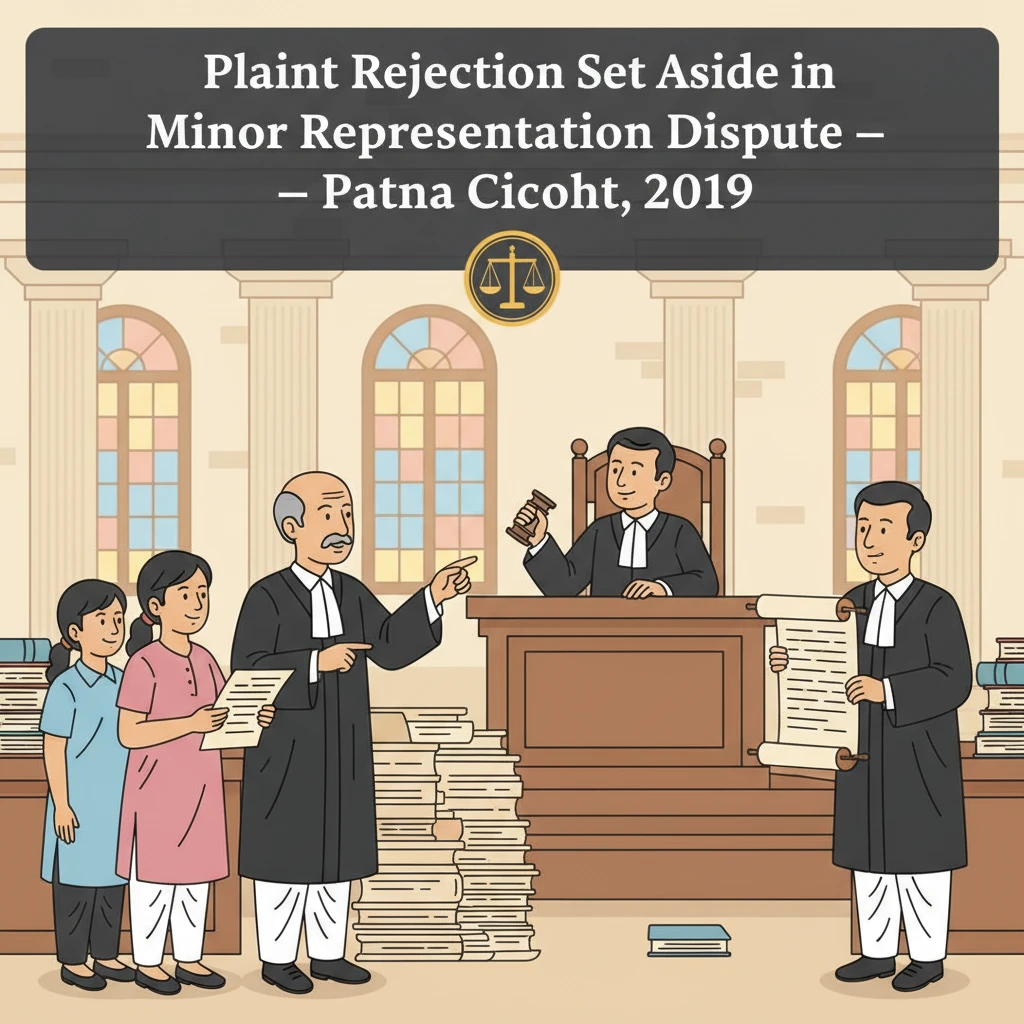
According to the later plaintiffs, Plaintiff No. 1 in that earlier suit was a minor. Defendant No. 8 and defendants numbered 14, 15 and 17 in that suit were also minors.
Because there were minors involved, the civil court appointed an advocate, Mr. Pradhan Murli Manohar Prasad, as guardian ad litem to represent the minor defendants in the 1983 suit.
The 1983 suit did not end in favour of the plaintiff. It was dismissed because the plaintiff stopped pursuing (left pairavi of) the case. After losing at the trial level, the plaintiff there filed Title Appeal No. 39 of 1991 before the District Judge. The appeal was later heard and decided by the Fast Track Court-I, Bhabua.
In that appeal, as described in the later plaint, the previously appointed guardian ad litem was not made a party or named as guardian of the minor defendants. There was also no court order removing him or appointing any fresh guardian.
Yet, even though some parties were still shown as minors in the cause title of the appeal, the appellate court allowed the appeal. It set aside the trial court’s dismissal in Title Suit No. 90 of 1983.
The matter then went up further in Second Appeal No. 455 of 2008 before the Patna High Court. The plaintiffs in the later suit claimed that even at this second appellate stage, the question of whether minors were properly represented was not examined.
Feeling aggrieved, plaintiff-respondents 1 to 3 in the present case filed a fresh suit in 2013. This was Title Suit No. 10 of 2013 in the court of the Munsif, Kaimur.
In that 2013 suit, they sought a declaration that the judgment dated 22.08.2008 and decree dated 28.08.2008 passed in Title Appeal No. 39 of 1991 by Fast Track Court-I, Kaimur at Bhabua, as well as the judgment dated 11.01.2012 in Second Appeal No. 455 of 2008 by the Patna High Court, were null, void and non est in the eyes of law, on the ground that those decisions were passed against minors without proper representation.
On 25.02.2013, the trial court in Title Suit No. 10 of 2013 dismissed the suit at the threshold. It held that the suit was barred by res judicata because the same dispute had already been decided in Title Suit No. 90 of 1983 between the same parties.
The plaintiffs then filed Title Appeal No. 10 of 2013. The 1st Additional District Judge, Bhabua, by order dated 12.09.2014, set aside the trial court’s order and sent the matter back to the Munsif for disposal according to law.
Against this order of remand, the present Miscellaneous Appeal No. 708 of 2014 was filed before the Patna High Court by the defendants of the 2013 suit (who were appellants in the miscellaneous appeal).
What the Court Examined and Decided
The Patna High Court, through Hon’ble Mr. Justice Birendra Kumar, heard the matter on 02.04.2019.
The appellants argued that the trial court had correctly rejected the plaint in the 2013 suit. They relied on Order VII Rule 11(d) of the Code of Civil Procedure (CPC). This rule states that the plaint shall be rejected where the suit appears from the statements in the plaint itself to be barred by any law.
According to the appellants, the 2013 suit was clearly barred by the principle of res judicata since the dispute about the rasta between Plot Nos. 309 and 310 had already been decided in Title Suit No. 90 of 1983, followed by appeal and second appeal. Therefore, in their view, the plaint should have been rejected as barred in law, and the lower appellate court had erred in reviving the suit.
The High Court examined the contents of the plaint in Title Suit No. 10 of 2013. The Court noted that the plaintiffs were not simply re-litigating the same right of way claim.
Instead, the plaint alleged that at different stages of the earlier proceedings, including Title Appeal No. 39 of 1991 and Second Appeal No. 455 of 2008, orders had been passed against minors who were not properly represented.
The plaintiffs pleaded that:
- In the original 1983 suit, an advocate was appointed as guardian ad litem for minor defendants.
- When the matter went in appeal, this guardian was not shown as guardian, was not removed by any court order, and no new guardian was appointed.
- Yet, decisions were passed treating some parties as minors without ensuring they had a valid guardian on record.
- Because of this, those appellate and second appellate judgments were not binding on the minors and were liable to be declared null and void.
The High Court held that, on a plain reading, the statements in the plaint did not show that the suit was barred under any law. The plaint itself set out a case that earlier proceedings suffered from a defect related to minor representation, and that the plaintiffs sought a declaration about the validity of those earlier judgments.
Even if one assumes for the sake of argument, the Court added, that there could be an arguable contention that the suit is barred by res judicata, this would not justify rejection of the plaint under Order VII Rule 11(d) CPC at the admission stage.
This is because the question whether the 2013 suit is hit by res judicata in the light of the earlier round of litigation is not something that can be decided merely from the bare statements in the plaint. It is, at the very least, a disputed question of fact or a mixed question of law and fact.
To decide such a question properly, the court would have to look beyond the plaint, consider the pleadings of both sides, and examine evidence about the earlier proceedings, their parties, issues, and the alleged defect in minor representation.
Order VII Rule 11(d) CPC, however, allows rejection of the plaint only when, from the plaint itself, the suit “appears” to be barred by any law. It is a narrow, threshold test. The Court emphasised that this provision cannot be used to decide disputed or mixed questions which require full trial.
On this reasoning, the High Court concluded that the trial court was not justified in rejecting the plaint at the outset by treating the suit as barred by res judicata.
The Court agreed with the first appellate court’s view that the matter should proceed in accordance with law before the trial court. The appellate order dated 12.09.2014 of the 1st Additional District Judge, Bhabua, therefore did not call for interference.
Accordingly, the Miscellaneous Appeal No. 708 of 2014 was dismissed. The effect is that Title Suit No. 10 of 2013 will continue before the Munsif, Kaimur, where all factual and legal issues—such as res judicata and validity of earlier judgments passed against minors—can be fully tried.
Why This Judgment Matters
This decision is important for families and litigants in Bihar where minors are parties in land or civil disputes.
First, it underlines that courts must be cautious before rejecting a plaint at the very beginning. If there is any serious factual dispute, such as whether minors were properly represented earlier, the case should generally go to trial.
Second, it gives comfort to persons who were minors when earlier decrees were passed against them. If they can show that they were not properly represented through a guardian ad litem, they may be able to challenge those decrees in a separate suit, subject to legal requirements.
Third, it clarifies that the bar of res judicata under civil law is not to be decided casually under Order VII Rule 11(d) CPC. Courts must separate simple cases where a suit is obviously barred, from more complex ones involving mixed questions of law and fact.
For villagers and landholders, especially in Kaimur and similar districts, the judgment shows that procedural rights—like proper representation of minors—are as important as the substantive right claimed, such as a right of way over land.
Legal Issues and Answers
Issue: Can a suit seeking declaration that earlier appellate and second appellate judgments are null and void be rejected at the threshold under Order VII Rule 11(d) CPC on the ground of res judicata?
Answer: No. The Patna High Court held that the plaint did not itself show that the suit was barred by law, and whether res judicata applies is a disputed or mixed question of fact and law requiring full consideration of pleadings and evidence, not rejection at admission stage.
Cases Cited by the Court
- The judgment does not mention or rely upon any other reported case law.
Case Details
Case Number: Miscellaneous Appeal No. 708 of 2014
Case Title: Most. Kunti Kuer & Ors v. Ajay Kumar Divedi @ Udaie Dubey & Ors
Coram: Hon’ble Mr. Justice Birendra Kumar
Citation: 2019 (3) PLJR 318
Advocates: Mr. Vinod Kumar Seth, Advocate for the appellants; name of counsel for the respondents is not recorded in the text provided.
Nature of the Case: Miscellaneous appeal against an appellate order setting aside rejection of plaint (civil, res judicata and Order VII Rule 11(d) CPC context).
Date of Patna High Court Judgment: 02.04.2019
Link to Judgment: Click here to read the full judgment of the Patna High Court
If you found this explanation helpful and wish to stay informed about
how legal developments may affect your rights in Bihar,
you may consider following Samvida Law Associates for more updates.







