

Case Background
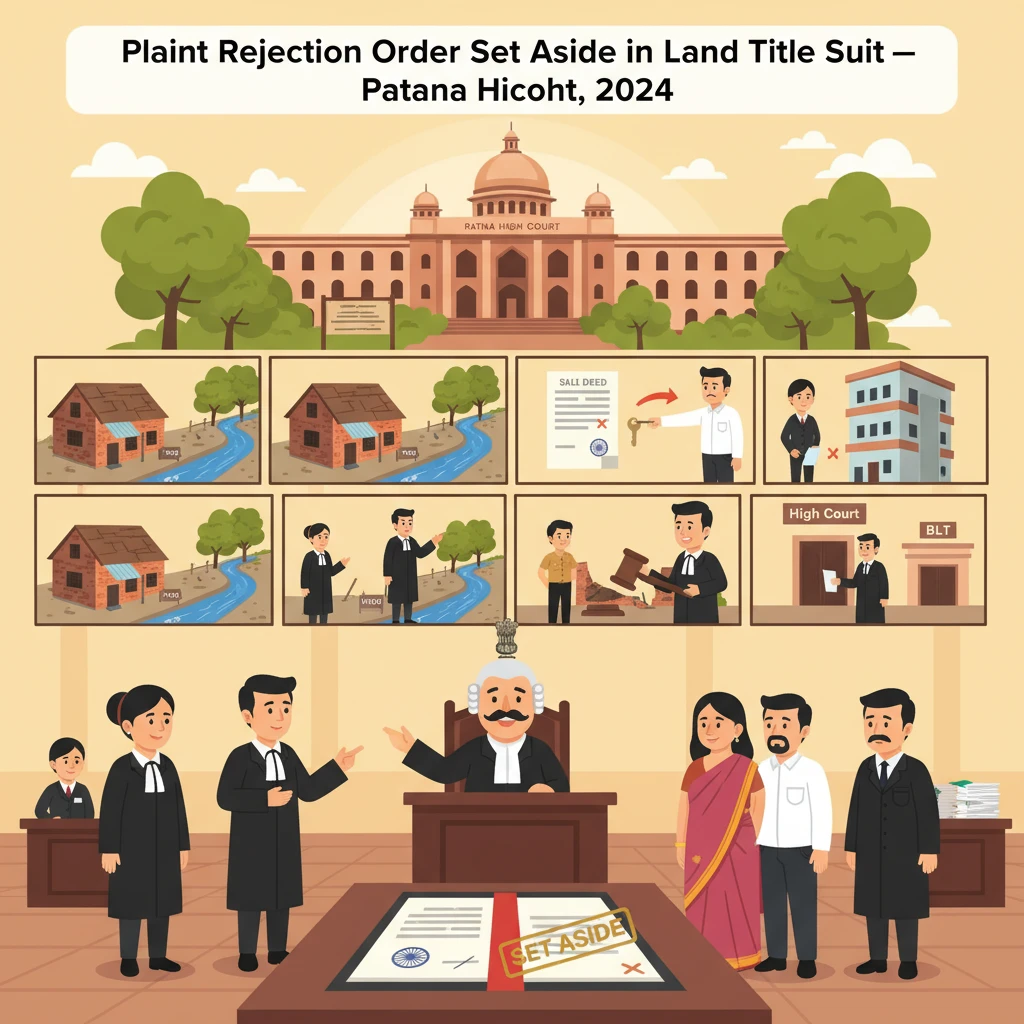
The dispute concerns a small piece of land in Mainpura, Patna, where both residential houses and shops stand on either side of Shivpuri Nala.
Opposite party no. 1 (the plaintiff in the suit) along with her brothers (proforma defendants nos. 5 and 6) purchased 7.5 decimals of land of plot nos. 1457 and 1459 through a registered sale deed dated 12.06.1982. Their names were later mutated in the revenue records under Jamabandi No. 10391 of 2007.
After purchase, it emerged that a portion of this land had been acquired by the State for a 20-feet-wide drain and two 10-feet passages. Because of this, the original plot got divided into two parts. The plaintiff’s side built a house and four shops: the house to the south of the drain and passage, and the four shops to the north.
In 1994, there was a family partition. According to the plaint, the house on the northern side of the drain and one shop on the southern side went to the plaintiff. The remaining three shops remained jointly with her brothers (proforma defendants).
Immediately north of these four shops, a three-storeyed house was constructed around 1987 on part of survey plot no. 1459 by the vendor of defendant no. 4, who is the present petitioner in the civil revision. The petitioner later purchased that property on 03.07.2010.
The plaintiff alleges that in the petitioner’s sale deed, an “excess” area of 2 dhurs and 18 dhurkis was wrongly inserted, though the vendor never owned or possessed that excess land. On this basis, according to the plaint, the petitioner began to claim this excess portion and accused the plaintiff of encroachment.
The petitioner then filed Bihar Land Dispute Resolution Case No. 93 of 2011-12 before the Deputy Collector Land Reforms (D.C.L.R.), Sadar, Patna. He claimed that the plaintiff had encroached on part of his house land and the road and had constructed shops there. The plaintiff’s brothers, though co-purchasers, were not initially made parties; only the plaintiff and her husband were impleaded.
On 20.03.2012, the D.C.L.R. allowed the case and directed removal of all four shops from the disputed land. The plaintiff appealed in Case No. 173 of 2012 before the Divisional Commissioner, Patna, but the appeal was dismissed by orders dated 28.02.2013 / 21.03.2013.
The plaintiff then approached the Patna High Court in C.W.J.C. No. 10125 of 2013. That writ petition was dismissed on 15.05.2013 with liberty to move the Bihar Land Tribunal. She filed B.L.T. Case No. 321 of 2013, which was dismissed as withdrawn on 14.06.2013 because the Tribunal held the matter barred by Section 4 of the Bihar Land Dispute Resolution Act and indicated that proper remedy lay elsewhere.
Thereafter, the plaintiff moved a modification application, M.J.C. No. 3436 of 2013, seeking modification of the High Court’s order in C.W.J.C. No. 10125 of 2013. On 11.07.2013, this Court directed the District Judge, Patna to verify the genuineness of the parties’ sale deeds and to appoint a survey revisional commissioner for measurement of land. Later, by order dated 25.07.2013, this modification application was dismissed.
The plaintiff then filed L.P.A. No. 1052 of 2013 against the orders dated 11.07.2013 and 25.07.2013. The Division Bench held that those orders, passed in a disposed writ petition, were without jurisdiction since the Court had become functus officio.
Meanwhile, the plaintiff again filed C.W.J.C. No. 18093 of 2013 challenging orders of the Tribunal and Divisional Commissioner. That writ was dismissed on 19.09.2013. The Division Bench later dismissed L.P.A. No. 1289 of 2013 as withdrawn on 21.10.2013, after the plaintiff sought liberty to avail alternative remedies.
Separately, the plaintiff’s brothers (proforma defendants) filed C.W.J.C. No. 16583 of 2013 against the original D.C.L.R. order dated 20.03.2012. The High Court on 05.12.2013 set aside that D.C.L.R. order and directed rehearing after impleading them.
On rehearing, the D.C.L.R. again decided Land Dispute Case No. 93 of 2011-12 on 10.12.2014 in favour of the petitioner (defendant no. 4), directing the plaintiff and her brothers to remove the encroachment. The proforma defendants then filed Land Dispute Appeals Nos. 633 of 2015 and 21 of 2015 before the Commissioner, Patna.
Since the dispute, according to the plaintiff, involves title to the land—an issue which only a civil court can decide—she filed Title Suit No. 463 of 2015 before the Sub-Judge-1, Patna. She sought declaration of her title and possession over Schedule-II land, declaration that Schedule-II formed part of her raiyati land purchased on 12.06.1982, a declaration that the D.C.L.R.’s order dated 10.12.2014 was void and not binding on her, and a temporary injunction restraining demolition of the structures.
What the Court Examined and Decided
Once the civil suit was filed, defendant no. 4 (the present petitioner) appeared and moved an application under Order VII Rule 11 of the Code of Civil Procedure (CPC), seeking rejection of the plaint at the threshold.
He argued before the trial court that the plaintiff had suppressed important facts about earlier litigations, including various writ petitions and Letters Patent Appeals before the Patna High Court, as well as proceedings before the Bihar Land Tribunal and orders under the Bihar Land Dispute Resolution Act. According to him, the High Court had already settled key issues, leaving the plaintiff with no cause of action.
The petitioner also pointed out that in paragraph 19 of the plaint the plaintiff admitted that from her vendor’s 7.5 decimals of land, 5 decimals were acquired for the drain and passages. So only 2.5 decimals should remain with her. Yet, as per a Pleader Commissioner’s earlier measurement report, she was allegedly in possession of more land than that. He emphasised that boundary issues had been decided under the Bihar Land Dispute Resolution Act in his favour and claimed the suit was vexatious, meritless, and based on irrelevant or imaginary statements.
The trial court, however, rejected his Order VII Rule 11 petition by its order dated 08.06.2016. The court noted that the defendant’s petition did not clearly specify under which clause of Order VII Rule 11 it was filed, even though each clause provides a distinct ground for rejection. It held that neither any part of the plaint attracted Order VII Rule 11 nor did the defendant’s petition disclose any valid ground for rejecting the plaint.
Aggrieved, the petitioner filed Civil Revision No. 133 of 2016 before the Patna High Court. He appeared in person and attacked the trial court’s order on several grounds.
He contended that the High Court, in earlier writ proceedings, had already recorded that after land acquisition in L.A. No. 50 of 1975-76, the plaintiff’s vendor had no title to sell land in excess of what she held. He relied on an order dated 19.09.2014 in C.W.J.C. No. 3901 of 2014, and on C.W.J.C. No. 5340 of 2015 decided on 22.07.2015, where a writ filed by the plaintiff was dismissed, and the subsequent L.P.A. was decided on 11.04.2017 with a fine of Rs. 50,000/- imposed on her for abuse of process and wasting court time. According to him, by not mentioning all such orders in her plaint, she had indulged in gross concealment.
He relied on the Patna High Court decision in Bhagirath Prasad Singh @ Bachcha Babu vs. Ram Narayan Rai @ Ram Narayan Singh & Anr., (2013) 1 PLJR 738, where suppression of material facts was treated as a ground for rejection of plaint. He also cited the Supreme Court decisions in Sopan Sukhdeo Sable & Ors. vs. Assistant Charity Commissioner & Ors., (2004) 3 SCC 137, T. Arivandandam vs. T.V. Satyapal & Anr., (1977) 4 SCC 467, and a Patna High Court civil revision (Alok Ranjan Pandey & Ors. vs. Ram Bachan Choudhary & Ors., 2015 SCC OnLine Pat 10057) to argue that courts should weed out frivolous suits at the threshold under Order VII Rule 11 CPC.
On the other side, counsel for the plaintiff (opposite party no. 1) argued that none of the grounds raised by the petitioner fell under any clause of Order VII Rule 11. He stressed that title disputes cannot be finally decided by writ courts or under the Bihar Land Dispute Resolution Act and that only a competent civil court can adjudicate title.
He relied on Maheshwar Mandal & Anr. vs. The State of Bihar & Ors., (2014) 3 PLJR 281, where this Court held that D.C.L.R. and other authorities under the Bihar Land Dispute Resolution Act have no jurisdiction to decide questions of civil title. He further submitted that while deciding on an Order VII Rule 11 application, the court can only look into the plaint, not the defendant’s defence or documents. All plaint averments must, at that stage, be assumed to be correct and the suit can be rejected only if it discloses no cause of action or is barred by law on its face.
Justice Khatim Reza then carefully set out the legal position. Order VII Rule 11 CPC allows rejection of a plaint only in specific situations: where no cause of action is disclosed, where relief is undervalued or insufficiently stamped and not corrected, where the suit appears barred by law from the plaint itself, where it is not filed in duplicate, or where there is failure to comply with Rule 9 about service of summons.
Crucially, the Court held that suppression of material facts is not, by itself, one of the listed grounds in Rule 11. Neither suppression, nor misrepresentation, nor even fraud, nor abuse of the process of court is mentioned in Rule 11 as a direct ground for rejecting a plaint. Clause (a) and (d) alone speak of lack of cause of action and bar by law, and those must be tested only on the plaint and documents filed with it.
For this proposition, the Court relied on several Supreme Court decisions, including Saleem Bhai & Ors. vs. State of Maharashtra & Ors., (2003) 1 SCC 557, Dahiben vs. Arvind Bhai Kalyanji Bhanusali, (2020) SCC OnLine SC 563, and Liverpool & London S.P. & I Assn. Ltd. vs. M.V. Sea Success I & Anr., (2007) 5 SCC 614. These judgments underline that while deciding an application under Order VII Rule 11, only the averments in the plaint, read as a whole and taken to be true, can be examined. The court cannot test their truth at this stage, nor rely on the defendant’s version.
On suppression of facts, the Court discussed T. Arivandandam (1977) 4 SCC 467. That case emphasised that if, on a meaningful reading, a plaint appears clearly vexatious and meritless, disclosing no clear right to sue, the court should reject it under Order VII Rule 11 and, if necessary, examine the party under Order X CPC to expose any “clever drafting” which creates only an illusion of a cause of action.
Justice Reza clarified that mere suppression of facts does not automatically mean there is no cause of action. Whether facts are suppressed can generally be assessed only when comparing the plaint with the written statement and evidence, not at the initial Rule 11 stage. Thus, suppression alone does not give an automatic right to the defendant to get the plaint rejected for want of cause of action.
The Court then examined the plaint in Title Suit No. 463 of 2015. It found that the plaintiff had clearly stated how and when the cause of action arose: particularly after the High Court allowed withdrawal of L.P.A. No. 1289 of 2013 on 21.10.2013 with liberty to avail alternative remedies, and “lastly” on 13.09.2015 when she was advised to institute a civil suit as the only competent and lawful recourse. Whether this cause of action is ultimately proved or not cannot be examined under Order VII Rule 11; at this stage the court assumes it to be true.
At the same time, the High Court accepted that suppression of material facts is a serious matter and can amount to abuse of process. But, given the framework of Rule 11, it held that the better course is to use the powers under Order X CPC and Order XIV Rule 1(5).
Order X CPC allows the court, at the first hearing, to examine parties orally to clarify matters in controversy. Statements made under Order X Rule 2 become part of the record and can be relied upon when framing issues and deciding preliminary points. Order XIV Rule 1(5) further says that, after reading pleadings and examining parties under Order X, the court must identify the material propositions on which parties disagree and then frame issues.
Justice Reza concluded that in cases like the present one—where the defendant alleges suppression and abuse of process—the court should, at the first hearing, examine the parties under Order X, record their statements, and then, if necessary, frame and decide preliminary issues under Order XIV.
Thus, the High Court held that the trial court had not properly appreciated the second part of the Supreme Court’s guidance in T. Arivandandam, which emphasises use of Order X to deal with “illusionary” causes of action.
On this reasoning, the Patna High Court set aside the order dated 08.06.2016 of the Sub-Judge-1, Patna. It directed the trial court to decide the matter afresh “according to law”, meaning after invoking Order X CPC where necessary and applying Order XIV Rule 1(5) to consider any preliminary issue, including alleged suppression, but not misusing Order VII Rule 11 to short-circuit the suit where a cause of action is pleaded on the face of the plaint.
Why This Judgment Matters
This judgment is important for landowners and litigants in Bihar whose disputes move from revenue authorities to civil courts.
First, it makes clear that even if a person has fought and lost several rounds before D.C.L.R., Commissioner, Tribunal or in writ jurisdiction, they may still approach the civil court for a decision on title, provided the plaint itself discloses a cause of action and is not clearly barred by law.
Second, it protects genuine plaintiffs from having their cases thrown out at the starting point merely because the defendant alleges suppression or past litigation. Courts must examine only the plaint and its documents to decide an Order VII Rule 11 application.
Third, it balances this protection by reminding trial courts of their power and duty under Order X CPC: to question parties early, record their statements, and detect bogus or abusive claims at the first hearing. This benefits defendants who complain of repeated or harassing litigation.
Fourth, for lawyers and laypersons, the ruling shows that orders of revenue authorities under the Bihar Land Dispute Resolution Act cannot finally decide questions of title. Only a civil court can give a binding judgment on ownership, though its process may take more time.
Overall, the decision guides subordinate courts in Bihar on how to handle threshold objections, especially where past writ or land dispute proceedings and alleged concealment are involved.
Legal Issues and Answers
- Issue: Can a civil suit for declaration of title and challenge to D.C.L.R. orders be rejected at the threshold under Order VII Rule 11 CPC on the ground that the plaintiff suppressed material facts and had earlier litigated before revenue authorities and in writ proceedings?
Answer: No. Suppression of facts by itself is not a ground under Order VII Rule 11. Since the plaint clearly discloses a cause of action and any alleged suppression can only be tested after examining parties and evidence, the suit cannot be rejected at the filing stage. - Issue: How should a trial court deal with allegations that a plaint is an abuse of process or creates only an “illusion” of cause of action?
Answer: Following T. Arivandandam, the court should at the first hearing examine the party under Order X CPC, record statements, and then, if needed, frame and decide preliminary issues under Order XIV Rule 1(5), instead of straightaway rejecting the plaint under Order VII Rule 11. - Issue: What is the proper material to consider while deciding an application under Order VII Rule 11 CPC?
Answer: Only the averments in the plaint, read as a whole along with documents filed by the plaintiff, can be considered. The defence in the written statement or documents produced by the defendant are irrelevant at this stage.
Cases Cited by the Court
- Bhagirath Prasad Singh @ Bachcha Babu vs. Ram Narayan Rai @ Ram Narayan Singh & Anr., (2013) 1 PLJR 738 (cited by petitioner).
- Sopan Sukhdeo Sable & Ors. vs. Assistant Charity Commissioner & Ors., (2004) 3 SCC 137.
- T. Arivandandam vs. T.V. Satyapal & Anr., (1977) 4 SCC 467.
- Alok Ranjan Pandey & Ors. vs. Ram Bachan Choudhary & Ors., 2015 SCC OnLine Pat 10057.
- Maheshwar Mandal & Anr. vs. The State of Bihar & Ors., (2014) 3 PLJR 281.
- Saleem Bhai & Ors. vs. State of Maharashtra & Ors., (2003) 1 SCC 557.
- Dahiben vs. Arvind Bhai Kalyanji Bhanusali, (2020) SCC OnLine SC 563.
- Liverpool & London S.P. & I Assn. Ltd. vs. M.V. Sea Success I & Anr., (2007) 5 SCC 614.
- Bhau Ram vs. Janak Singh & Ors., 2012 (6) SCALE 530, with reference to earlier Supreme Court authorities such as C. Natarajan vs. Ashim Bai & Anr., (2007) 14 SCC 183; Ram Prakash Gupta vs. Rajeev Kumar Gupta & Ors., (2007) 10 SCC 59; Hardesh Ores (P) Ltd. vs. Hede & Company, (2007) 5 SCC 614; and Mayar H.K. Ltd. & Ors. vs. Vessel M.V. Fortune Express & Ors., (2006) 3 SCC 100.
Case Details
Case Number: Civil Revision No. 133 of 2016
Case Title: Captain Rajesh Kumar vs. Pramila Singh & Ors.
Coram: Hon’ble Mr. Justice Khatim Reza
Citation: 2024 (4) PLJR 303
Advocates:
- Petitioner in revision / defendant no. 4 in suit: Captain Rajesh Kumar (appeared in person).
- Opposite parties: Mr. Dhaneshwar Pd. Gupta, Advocate.
Nature of the Case: Civil revision under Section 115 CPC (implicit from style) challenging an order of the Sub-Judge-1, Patna, refusing to reject a plaint under Order VII Rule 11 CPC in Title Suit No. 463 of 2015 (suit for declaration of title, possession, declaration against D.C.L.R. order, and injunction regarding land and structures).
Impugned Order: Order dated 08.06.2016 passed by learned Sub-Judge-1, Patna in Title Suit No. 463 of 2015, rejecting the petitioner’s application under Order VII Rule 11 CPC.
High Court Outcome: Civil revision allowed; trial court order dated 08.06.2016 set aside; matter remitted with direction to decide in accordance with law, including use of Order X and Order XIV CPC where required.
Link to Judgment: Official Patna High Court judgment
If you found this explanation helpful and wish to stay informed about
how legal developments may affect your rights in Bihar,
you may consider following Samvida Law Associates for more updates.







