

Case Background
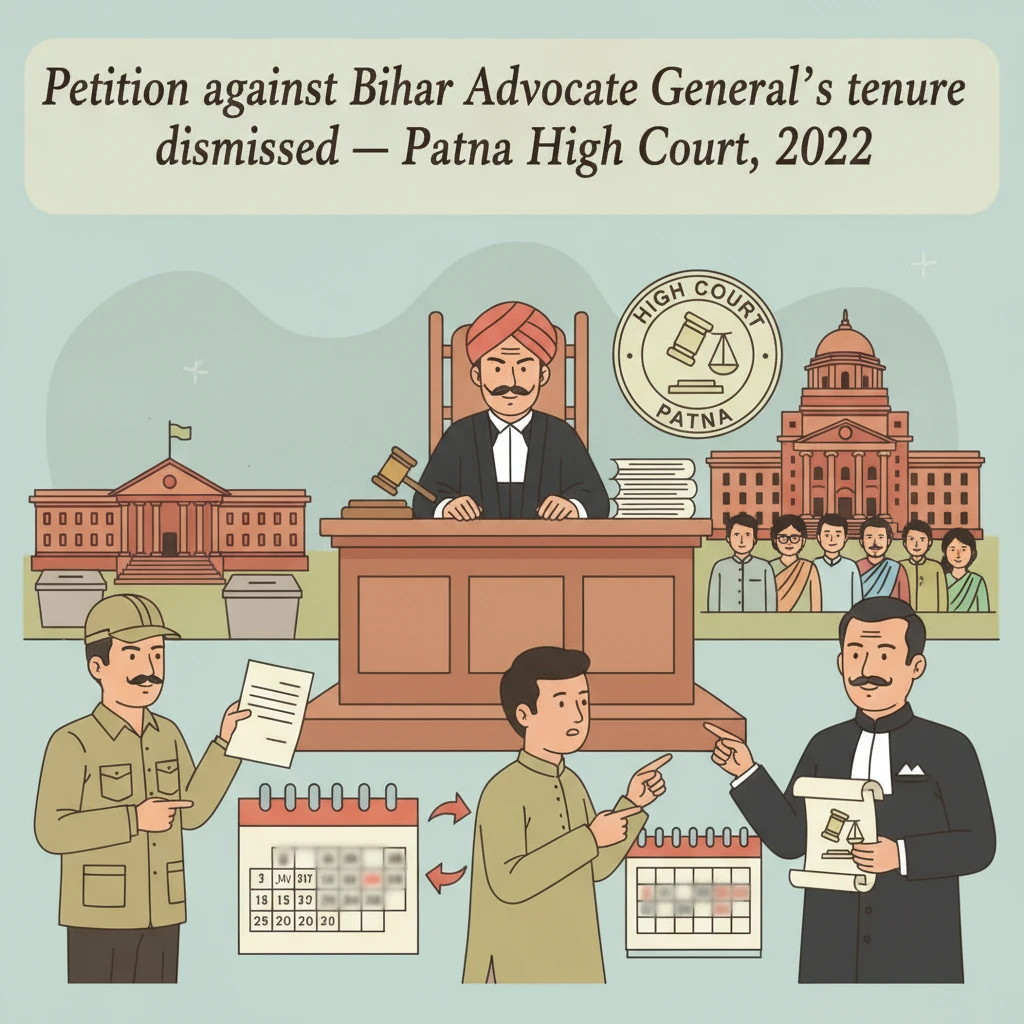
The case arose from a writ petition filed before the Patna High Court under its civil writ jurisdiction. The petitioner is a resident of Patna district. The main grievance raised was against the continuance in office of the current Advocate General of Bihar, referred to in the case as respondent no. 3.
The petitioner stated that respondent no. 3 was appointed as the Advocate General, Bihar in July 2017. This appointment followed the formation of a new ministry in the State at that time. According to the petitioner, the term of that ministry ended on 27.11.2020.
After the term ended, general elections were held in Bihar. A new Council of Ministers headed by the Chief Minister was sworn in. The petitioner’s core allegation was that the new government did not issue any notification appointing respondent no. 3 as Advocate General afresh.
Despite this, respondent no. 3 continued to act and function as the Advocate General, Bihar. The petitioner approached the Patna High Court seeking to question the legal authority of respondent no. 3 to continue in that constitutional office.
The matter was heard by a Division Bench consisting of Hon’ble the Chief Justice and Hon’ble Mr. Justice S. Kumar. The proceedings were conducted through video conferencing, with the advocates appearing from their residences.
What the Court Examined and Decided
The petitioner sought multiple reliefs. First, a writ of quo warranto was requested, requiring respondent no. 3 to show the legal or constitutional authority under which he was holding the office of the Advocate General, Bihar. Second, a writ of mandamus was prayed for to declare that respondent no. 3 was illegally occupying the office of Advocate General in violation of Article 165(3) of the Constitution of India. Third, other suitable writs or directions were sought to declare that respondent no. 3 was in illegal occupation of the office.
The central plank of the petitioner’s argument was based on Articles 164 and 165 of the Constitution. The petitioner pointed out that under Article 165(1), the Advocate General is appointed by the Governor of the State. Article 165(3) states that the Advocate General shall hold office during the pleasure of the Governor.
The petitioner then referred to Article 164, which deals with the appointment and tenure of ministers in a State. Article 164(1) provides that ministers shall be appointed by the Governor and shall hold office during the pleasure of the Governor.
From this, the petitioner argued that the “pleasure of the Governor” in the case of ministers effectively ends when a new ministry is formed. According to the petitioner, by analogy, the pleasure of the Governor in relation to the Advocate General should also end when the earlier ministry ends and a new Council of Ministers is sworn in.
The petitioner contended that the tenure of respondent no. 3 as Advocate General came to an end in November 2020 when a new ministry was formed. In the petitioner’s view, the Advocate General must be appointed every time a new ministry is formed. Since no fresh notification had been issued by the new government appointing respondent no. 3 after the elections, his continuance was claimed to be unconstitutional.
The petitioner further argued that in India’s legal system no constitutional office is permanent, and no one can hold such an office for life. According to the petitioner, every constitutional post has a fixed tenure. Specifically, for the Advocate General, the petitioner asserted that the tenure ends on the date of formation of a new ministry.
On the other hand, the State, appearing through counsel for the respondents, strongly opposed the petition. It was argued that the entire writ was misconceived because the petitioner had misread and misconstrued Article 165 of the Constitution.
The State pointed out that a plain reading of Article 165 clearly shows that the Advocate General shall hold office during the pleasure of the Governor. The Governor acts on the aid and advice of the Council of Ministers, but the Article itself does not say that the Advocate General’s term is tied, or co-terminus, with the tenure of the Chief Minister or the Council of Ministers.
The respondents submitted that the petitioner’s claim—that whenever the Chief Minister relinquishes office the Advocate General’s office automatically falls vacant and a new notification must be issued—is not a correct statement of the law.
The State also compared Article 165 with Article 164. It was argued that under Article 164(1), ministers appointed by the Governor on the advice of the Chief Minister do hold office during the pleasure of the Governor, but their maximum possible tenure is limited by the five-year term of the Legislative Assembly. Once the Legislative Assembly stands dissolved, fresh elections are required and a new Assembly is constituted. In that context, a minister’s life in office is naturally capped.
In contrast, Article 165(3), which deals with the Advocate General, does not mention any fixed tenure period. The respondents argued that the two provisions are different and distinct and cannot be equated.
To support their view, the respondents relied on debates from the Constituent Assembly. During the discussion on the then draft Article 145 (which corresponds to Article 165 of the present Constitution), an amendment was proposed to change the tenure clause for the Advocate General.
Originally, draft clause (3) of Article 145 had provided that the Advocate General shall retire upon the resignation of the Chief Minister in the State, but could continue until a successor is appointed or he is re-appointed. A member, Mr. Naziruddin Ahmad, moved an amendment to replace this with a simpler clause stating that the Advocate General shall hold office during the pleasure of the Governor and shall receive such remuneration as the Governor may determine.
In his speech, he explained that tying the tenure of the Advocate General to the rise and fall of ministries would cause inconvenience and could harm the State’s interests. For instance, if the Advocate General was in the middle of an important, long-running case for the State, his sudden removal due to a change in political power could prejudice the State’s case. He therefore argued that the tenure should depend instead on the Governor’s pleasure.
The Constituent Assembly accepted this amendment. The President of the Assembly put the new clause to vote, and it was adopted. Thus, the present Article 165(3) reflects the conscious decision of the framers that the Advocate General’s tenure should not be automatically tied to the Chief Minister’s tenure.
The High Court took note of this history. It held that the debates clearly show the framers were aware of the doctrine of pleasure and deliberately chose to ensure that the Advocate General’s tenure was not co-terminus with that of the Chief Minister.
The Court also referred to Articles 155 and 156, which govern the appointment and tenure of Governors. A Governor holds office during the pleasure of the President but, subject to this, the Constitution mentions a five-year term. The Court noted that while the Governor and Advocate General both conceptually hold office during pleasure (of the President and of the Governor, respectively), only the Governor’s office has an express fixed term of five years. No such fixed tenure is provided in the Constitution for the Advocate General.
Article 165 was quoted in full by the Court. It recorded that the Advocate General is to be a person qualified to be appointed as a Judge of a High Court, that it is his duty to advise the State Government on legal matters and perform other assigned legal duties, and that he holds office during the pleasure of the Governor, receiving such remuneration as the Governor may determine.
From a combined reading of these constitutional provisions, the Court concluded that the Advocate General continues in office so long as he enjoys the pleasure of the Governor, acting on the aid and advice of the Council of Ministers. There is no constitutional provision suggesting that his appointment automatically ends with the expiry of the Chief Minister’s term, the tenure of the State Government, or the life of the Legislative Assembly.
To reinforce its interpretative approach, the Court cited the Supreme Court’s decision in M.T. Khan v. Government of Andhra Pradesh, reported in 2004(2) SCC 267. In paragraphs 13 and 14 of that judgment, the Supreme Court had emphasised that constitutional provisions must be given their plain, ordinary meaning where the language is clear and unambiguous. Literal interpretation is to be preferred, and courts should avoid treating any word in the Constitution as surplusage if it can have meaningful application.
Following this principle, the Patna High Court held that Article 165(3) is clear on its face. The Advocate General holds office during the pleasure of the Governor. Since the text does not link this tenure to the term of a particular ministry, there was no basis to read in such a limitation.
The Court further observed that there is no obligation or compulsion on the Advocate General to resign when the Chief Minister and Council of Ministers resign, or when the Legislative Assembly’s term expires or it is dissolved. He remains in office as long as he enjoys the pleasure of the Governor.
At the same time, the Court clarified that the “at pleasure” doctrine is broad. The Advocate General can be removed by the Governor at any time, without notice and without assigning any reason, because he holds office purely at the Governor’s pleasure.
The Court also described the constitutional role of the Advocate General. He is a constitutional functionary exercising powers under Article 165. He holds office under the Constitution and is not subordinate to the State Government in a manner that would compromise his independence when giving legal advice. While he advises the Government and performs assigned legal duties, in doing so he is expected to act according to law and his own legal judgment.
On this legal and constitutional analysis, the Patna High Court concluded that there is no fixed tenure for the Advocate General of a State. No fresh notification is required merely because a new government has assumed office. Likewise, the Advocate General’s tenure does not automatically end when a new government comes in.
Accordingly, the Court found no illegality in respondent no. 3 continuing to hold the office of Advocate General, Bihar after the new Council of Ministers was sworn in. The prayers for quo warranto and mandamus were rejected. The Court held that it found no merit in the writ petition and dismissed it, with no order as to costs.
Why This Judgment Matters
This judgment is important for citizens, lawyers, and public officials who may question how long the Advocate General can stay in office. Many people assume that when the government changes, top law officers must automatically change as well. The Patna High Court has clarified that this is not how the Constitution works for the Advocate General.
The ruling confirms that the Advocate General’s tenure is not tied to the life of any particular ministry. He or she continues until the Governor, acting on proper advice, decides otherwise. This helps maintain continuity in the State’s legal representation and safeguards ongoing court matters from disruption due to political changes.
The judgment also underlines that constitutional posts must be understood based on the actual wording of the Constitution and its history. Personal beliefs about what “should” happen when governments change cannot replace clear constitutional text.
For people who may think of filing similar petitions, this decision signals that courts will look for clear constitutional breaches before issuing a writ of quo warranto to remove a constitutional office-holder.
Legal Issues and Answers
- Issue: Does the Advocate General of a State automatically cease to hold office when a new ministry or Council of Ministers is formed, requiring a fresh appointment notification?
Answer: No. The Patna High Court held that under Article 165(3) of the Constitution of India, the Advocate General holds office during the pleasure of the Governor and his tenure is not co-terminus with that of the Chief Minister, the State Government, or the Legislative Assembly. No fresh notification is required merely because a new government assumes office. - Issue: Was the continuance of respondent no. 3 as Advocate General, Bihar after the formation of a new ministry unconstitutional, warranting a writ of quo warranto or mandamus?
Answer: No. The Court found no violation of Article 165(3) and no illegality in respondent no. 3 continuing as Advocate General. Therefore, the writ petition was held to be without merit and was dismissed.
Cases Cited by the Court
- M.T. Khan v. Government of Andhra Pradesh, 2004(2) SCC 267 (relied on for principles of constitutional interpretation and literal construction of clear provisions).
Case Details
Case Number: Civil Writ Jurisdiction Case No. 15950 of 2021
Case Title: Dinesh @ Dinesh Kumar @ Dinesh Singh v. The State of Bihar & Ors.
Coram: Hon’ble the Chief Justice; Hon’ble Mr. Justice S. Kumar (CAV Judgment per Hon’ble Mr. Justice S. Kumar)
Citation: 2022 (1) PLJR 792
Date of Judgment: 11-02-2022
CAV Date: 13-09-2021
Nature of the Case: Writ petition seeking writ of quo warranto and mandamus challenging the continuance in office of the Advocate General, Bihar.
Advocates:
For the petitioner: Mr. Dinesh Kumar, Advocate
For the respondents: Mr. Pushkar Narain Shahi, AAG 6
Link to Judgment: Patna High Court Judgment in CWJC No. 15950 of 2021
If you found this explanation helpful and wish to stay informed about how legal developments may affect your rights in Bihar, you may consider following Samvida Law Associates for more updates.







