

Case Background
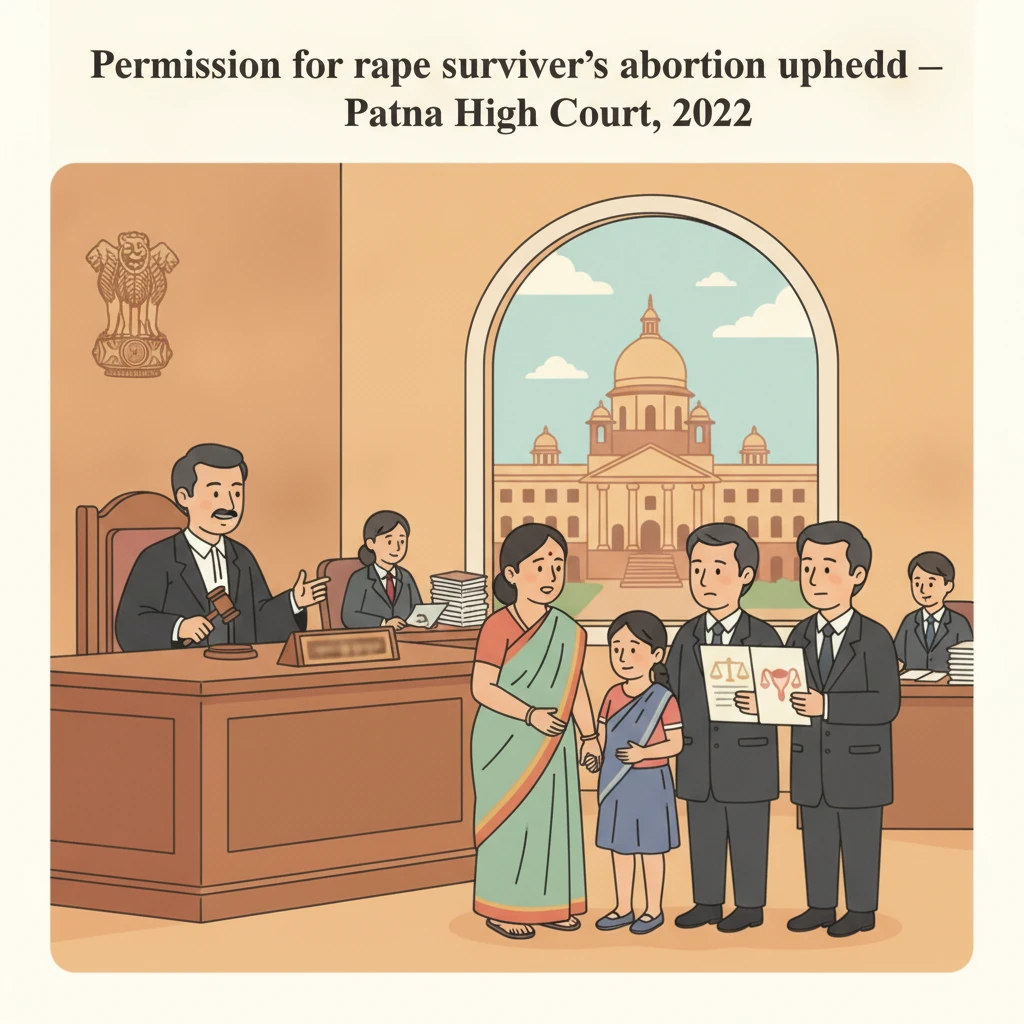
The writ petition was filed in the Patna High Court as Civil Writ Jurisdiction Case No. 4612 of 2022. It was heard and decided on 11 April 2022 by Hon’ble Mr. Justice Anil Kumar Sinha.
The petitioner is the mother of a girl referred to by pseudonym as “Miss K”. She approached the Court claiming that her minor daughter was a victim of sexual abuse and was pregnant.
According to the petitioner, her daughter, aged about 16 years and nine months, had been kidnapped by an accused person named in the judgment and kept under illegal confinement. The mother had earlier filed a habeas corpus petition before the same High Court, registered as Cr.W.J.C. No. 86 of 2022. Pursuant to that petition, the daughter was recovered.
After recovery, the victim girl was medically examined. The Doctor who examined her on 11 March 2022 opined that she was carrying a pregnancy of nine weeks at that time.
By the time the present writ petition was heard on 11 April 2022, the pregnancy had advanced to about 13 weeks. The mother sought directions to the State authorities and concerned hospitals to facilitate medical termination of this pregnancy.
What the Court Examined and Decided
The core question before the Patna High Court was whether, in the facts of this case, the pregnancy of “Miss K” could be terminated under the Medical Termination of Pregnancy Act, 1971 (MTP Act).
The petitioner’s counsel argued that the daughter was a minor and a rape survivor, and therefore met the legal requirements for termination. Reliance was placed on Section 3 of the MTP Act, particularly Section 3(b)(i) and (ii) and Explanation 2.
Counsel submitted that Explanation 2 to Section 3 of the MTP Act recognizes that where a pregnancy is alleged to have been caused by rape, the anguish caused to the woman is presumed to constitute grave injury to her mental health. On this basis, he argued that the case fell squarely within the grounds on which medical termination is statutorily permitted.
The petitioner’s side also stressed that the daughter was still a minor and that, under Section 3(4)(a) of the MTP Act, the consent of a guardian is sufficient for termination of pregnancy in the case of a minor. The mother clearly stated that she was ready and willing to give her written consent to the registered Medical Practitioner at the time of termination.
To support these submissions, the petitioner relied on the Supreme Court’s judgment in Suchita Srivastava and Another v. Chandigarh Administration, reported in (2009) 9 SCC 1. The specific emphasis was on paragraph 22 of that decision, which the Patna High Court reproduced in its judgment.
In that paragraph, the Supreme Court recognized that a woman’s right to make reproductive choices is part of “personal liberty” under Article 21 of the Constitution of India. It observed that reproductive choices include both the right to procreate and the right not to procreate. It underscored that a woman’s privacy, dignity and bodily integrity must be respected.
The Supreme Court, however, also noted that in the case of a pregnant woman, the State has a legitimate interest in protecting the life of the prospective child. Therefore, termination of pregnancy is only permitted when conditions under the applicable statute are met. The Supreme Court viewed the provisions of the MTP Act as reasonable restrictions on reproductive choices.
The petitioner further relied on a judgment of the Delhi High Court in X v. Govt. of NCT of Delhi & Anr., W.P. (CRL) 2008/2013. In that case, the Delhi High Court, applying the decision in Suchita Srivastava, had allowed medical termination of a pregnancy by two registered Medical Practitioners in accordance with Section 3 of the MTP Act.
On the other side, the State was represented by a senior counsel who filed a counter affidavit. The State placed on record a report of the Medical Board that had examined the victim girl. This report was annexed as Annexure-B to the counter affidavit.
According to the Medical Board, as of 11 March 2022 the victim was found to be pregnant with a gestation of nine weeks and zero days. The Medical Board also recorded her age as 19 years. On the date of hearing before the Patna High Court, her pregnancy was around 13 weeks.
The State counsel submitted that, keeping in view the medical report, the length of pregnancy was well within the permissible statutory limit under the MTP Act. He stated that the pregnancy could be terminated by two registered Medical Practitioners with the consent of the victim’s mother.
After hearing both sides, the Court turned to the language of Section 3 of the MTP Act. It noted that, under this provision, pregnancy may be terminated by a registered Medical Practitioner where the length of pregnancy does not exceed 24 weeks, subject to the prescribed conditions. In certain situations, including where the length of pregnancy exceeds 12 weeks but does not exceed 24 weeks, the opinion of not less than two registered Medical Practitioners is required.
The Court observed that with the consent of the pregnant woman, or the guardian in case of a minor, termination is permissible if the medical opinion satisfies the statutory criteria. This directly covered the situation presented, as the petitioner, being the mother, claimed that the girl was a minor and expressed readiness to give written consent.
The Court then examined the Delhi High Court decision relied on by the petitioner. It noted that the Delhi High Court, following Suchita Srivastava, had recognized that forcing a woman to carry a child conceived through rape is extremely traumatic, humiliating, and psychologically devastating. Based on that reasoning, the Delhi High Court directed termination of pregnancy in that case.
The Patna High Court stated that the facts before it were similar. In this case too, “Miss K” was claiming to be a rape victim, as recorded in Rajnagar Police Station Case No. 338 of 2021. Her pregnancy was within the time limit provided in Section 3(b) of the MTP Act. The mother was not ready for her daughter to give birth to a child conceived under such circumstances. She was ready to give written consent for termination.
Taking note of all these aspects, and especially that the length of pregnancy was about 13 weeks—well below 24 weeks—the Court concluded that the conditions under Section 3 of the MTP Act were fulfilled, subject to medical opinion of registered practitioners.
On that basis, the Patna High Court allowed the writ application.
The Court issued specific operative directions. It directed the petitioner, as guardian, to accompany “Miss K” and produce her before the Superintendent, Darbhanga Medical College and Hospital, Laheriasarai, Darbhanga (respondent no. 6) by 16 April 2022.
The Court recorded that the victim had earlier approached this same hospital through her mother and had already deposited the fee for getting her pregnancy terminated. Recognising this, the Court mandated that once “Miss K” and her mother reported to the Superintendent, a board of two registered Medical Practitioners must be constituted forthwith.
This board was directed to take an immediate decision on termination of the pregnancy of “Miss K” in accordance with Section 3 of the MTP Act, 1971. If, in their medical opinion, termination was appropriate within the statutory framework, the pregnancy was to be terminated accordingly.
The Court also ordered that a copy of this judgment be communicated without delay to the Superintendent, Darbhanga Medical College and Hospital, Laheriasarai, Darbhanga, through fax or email, so that the directions could be implemented in time.
With these directions, the writ petition was disposed of.
Why This Judgment Matters
This decision shows how the Patna High Court applies the MTP Act to protect bodily autonomy and mental health of a rape survivor, especially a young girl. It connects the statutory provisions with the constitutional right to personal liberty recognised by the Supreme Court.
For survivors of sexual abuse and their families in Bihar, the judgment demonstrates that courts can intervene promptly to ensure timely medical termination within the legal time limits. It confirms that a guardian’s written consent is valid for a minor, and that the role of doctors remains central in deciding on actual termination.
Practically, the ruling clarifies that when pregnancy from alleged rape is within 24 weeks and other statutory conditions are met, State authorities and public hospitals must not delay. They are required to act on the request and constitute a competent medical board to take a quick decision.
Legal Issues and Answers
- Issue: Can the pregnancy of a minor rape survivor, about 13 weeks along, be medically terminated under Section 3 of the Medical Termination of Pregnancy Act, 1971, on the basis of her guardian’s consent?
Answer: Yes. The Court held that, given the gestational age within the statutory limit, the status of the girl as a rape victim, and the mother’s willingness to give written consent, termination is permissible subject to the opinion of two registered Medical Practitioners under Section 3 of the MTP Act. - Issue: What directions can the Court give to ensure timely termination in such a case?
Answer: The Court directed the guardian to present the victim before the Superintendent of the designated government medical college and hospital by a fixed date. It ordered the Superintendent to constitute a board of two registered Medical Practitioners forthwith, for immediate decision and termination in accordance with Section 3 of the MTP Act, and directed that the order be communicated to the hospital without delay.
Cases Cited by the Court
- Suchita Srivastava and Another v. Chandigarh Administration, (2009) 9 SCC 1.
- X v. Govt. of NCT of Delhi & Anr., W.P. (CRL) 2008/2013 (Delhi High Court).
Case Details
Case Number: Civil Writ Jurisdiction Case No. 4612 of 2022
Case Title: Miss K Through Her Mother (pseudoname) v. State of Bihar & Ors.
Coram: Hon’ble Mr. Justice Anil Kumar Sinha
Citation: 2022 (2) PLJR 415
Advocates:
- For the petitioner: Mr. Shivam Kumar Pandey, Advocate; Mr. Abhishek Anand, Advocate
- For the State: Mr. Ajay Behari Sinha, Senior Advocate, GA-8; Mr. Upendra Kumar Singh, AC to GA-8
Nature of the Case: Writ petition seeking directions to State authorities and government hospitals to facilitate medical termination of pregnancy under the Medical Termination of Pregnancy Act, 1971.
Link to Judgment: https://patnahighcourt.gov.in/viewjudgment/MTUjNTk2MCMyMDIyIzEjTg==-txXvNGRCjjk=
If you found this explanation helpful and wish to stay informed about
how legal developments may affect your rights in Bihar,
you may consider following Samvida Law Associates for more updates.







