
Case Background
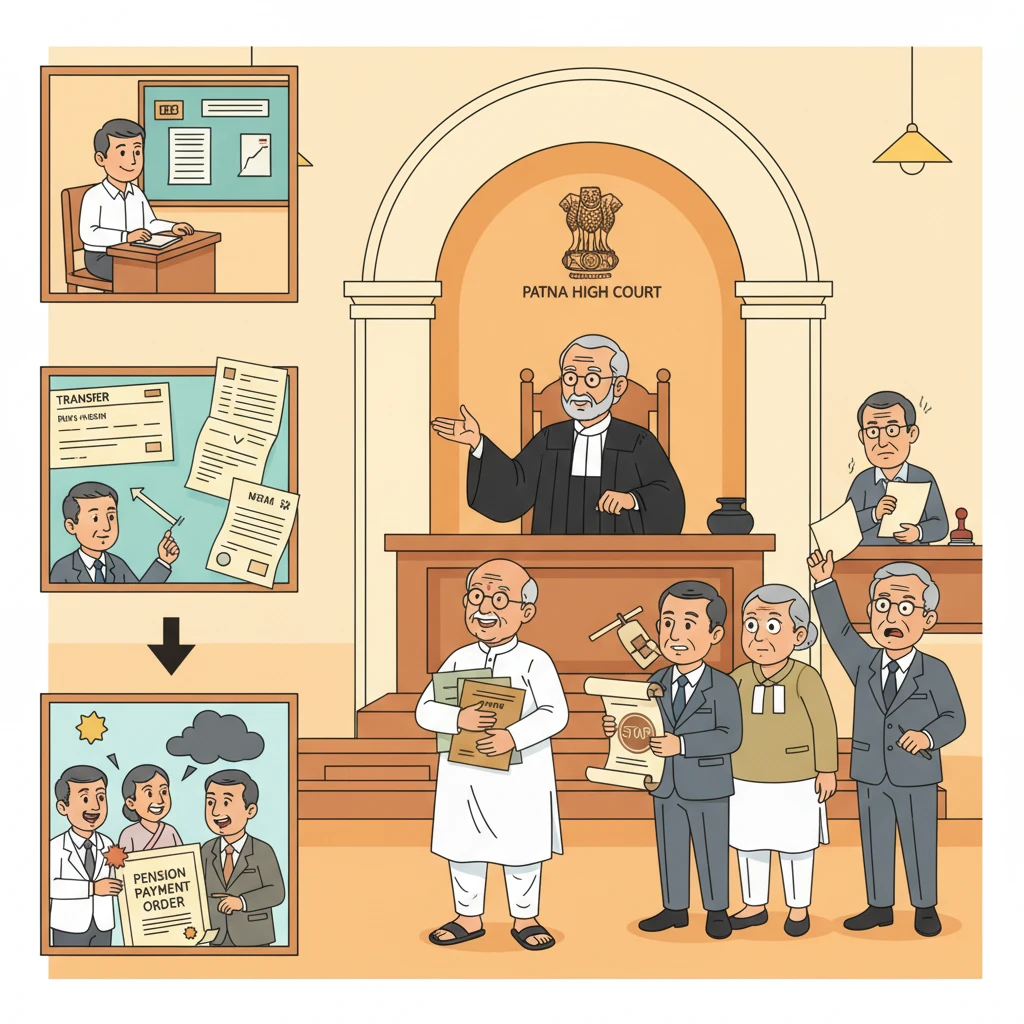
The petitioner was selected and appointed as a Lecturer in History in Maharani Adhirani Rameshwar Lata Sanskrit Mahavidyalaya, Darbhanga (MARLS College) on 14.07.1980 by the Secretary of the Managing Committee on a sanctioned and vacant post. He joined on 15.07.1980.
The Kameshwar Singh Darbhanga Sanskrit University (the University) provisionally approved his service from 15.07.1980 to 31.12.1981 by Memo No.3009 dated 16.09.1982. Later, by Memo No.59 dated 05.03.1983, his joining from 01.04.1981 to 31.12.1982 was approved, and Memo No.612 dated 15.04.1983 extended his service from 01.07.1983 till further orders.
Over the years, the University transferred him between various constituent colleges: first to Lalit Narayan Sanskrit Mahavidyalaya, Jaijaipatti, Darbhanga (Memo No.10299 dated 07.12.1999), then to Ramautar Gautam Sanskrit Mahavidyalaya, Ahilya Sthan, Darbhanga (Memo No.288/03 dated 17.01.2003, joining on 01.02.2003), and finally to Baba Saheb Ram Sanskrit Mahavidyalaya, Pachadhi, Darbhanga (Letter No.7868 dated 18.09.2009).
The Registrar, on the basis of the Syndicate’s Resolution No.05 dated 05.12.2009, issued Letter No.8363 dated 25.08.2010 confirming the petitioner’s service with effect from 01.04.1983. His pay was revised with annual increments from 1990 onwards and up to 2011, based on a Pay Fixation Form approved on 24.05.2012 by the Registrar, Pay Fixation Committee, Government Auditor, Finance Officer and relevant Section Officers.
By Memo No.8132 dated 01.06.2012, the University granted the Sixth Pay Revision to the petitioner and two other lecturers. Then, by Office Order dated 15.06.2013 (Letter No.3366), services of 20 lecturers, including the petitioner (at serial no. 7), were regularised from different dates. His service was regularised from 01.04.1983, on the basis of recommendations of a Selection Committee dated 27/28.10.2012 and Syndicate Resolution No.19 dated 15.12.2012.
By Memo No.882 dated 18.05.2016, the Registrar ordered that the petitioner would retire with effect from 31.07.2016 as Assistant Principal of Baba Saheb Ram Sanskrit Mahavidyalaya, after attaining 65 years. Thereafter, Pension Payment Order (PPO) No.539 dated 09.12.2016 was issued by Letter No.KSDS/A/c/12113/16 dated 16.12.2016. His pension was fixed at Rs.21,895/-, and with dearness allowance his monthly pension came to Rs.46,636/-, authenticated by the Finance Officer.
He received all post-retirement benefits and regular pension from August 2016 to September 2018. From October 2018, his monthly pension was stopped without any stated reason and without any show cause notice. This forced him to approach the Patna High Court in C.W.J.C. No.10892 of 2019 seeking resumption and arrears of pension.
In that earlier writ, the Court noted on 25.10.2019 that the petitioner’s appointment had been declared illegal without any proceedings or termination order and observed that the State had illegally held him guilty of obtaining appointment by fraud. The Court directed the State to file a better affidavit and show commencement of pension payments. A supplementary counter affidavit was filed, and during the proceedings, the Director, Higher Education issued Letter No.15/सी 2509//2019-2617 dated 13.11.2019 directing the Registrar to restart the petitioner’s pension. The writ was finally disposed of on 09.01.2020 after the State stated that the grievance had been redressed and pension would continue.
What the Court Examined and Decided
Despite the earlier direction, the Director, Higher Education issued Letter No.61 dated 10.01.2020 directing the petitioner to appear on 23.01.2020 with all appointment-related documents. The letter reached him on 16.01.2020. As he needed more time, he sent a representation by registered post on 18.01.2020 seeking one month’s time to appear with documents.
Because of indisposition, he could not appear personally, but on 18.02.2020 he sent another representation by registered post containing 18 documents related to his appointment, regularisation and retirement. Still, the Director issued Letter No.486 dated 28.02.2020 calling him again for personal appearance on 06.03.2020 with documents. This letter was received on 05.03.2020, yet he could not appear due to illness.
On 17.03.2020, the petitioner submitted another representation enclosing a photocopy of his earlier representation dated 18.02.2020, all 18 annexures and the postal receipt, through his advocate’s clerk, which was received in the Director’s office on 20.03.2020.
Subsequently, the Director issued a direction to the petitioner and 43 similarly placed persons to appear on 09.10.2020. The petitioner appeared through his advocate on that date, with all documents.
Ignoring these facts and the earlier High Court order, the Director passed Memo No.1304 dated 30.05.2022 disapproving the petitioner’s appointment and regularisation. The memo directed the University to take further steps in light of this decision. Acting on this, the University’s Registrar issued Letter No.646 dated 09.07.2022 declaring the petitioner’s service invalid and depriving him of all pensionary benefits, including monthly pension.
Faced with renewed stoppage of pension, the petitioner initiated M.J.C. No.1494 of 202 in C.W.J.C. No.10892 of 2019. A coordinate Bench directed the concerned authority to restart his pension. The present writ petition (C.W.J.C. No.9974 of 2022) challenged Memo No.1304 dated 30.05.2022 and Letter No.646 dated 09.07.2022, and sought directions not to withhold pension.
On behalf of the petitioner, it was argued that his appointment was on a sanctioned and vacant post after due selection process; the University had continuously treated his appointment as valid for decades—approving his service, confirming it from 01.04.1983, giving transfers, pay revisions, Sixth Pay benefits, regularisation and pension. It was submitted that the Director, Higher Education had exceeded his jurisdiction and had passed the impugned order without initiating any proper proceeding against him and in disregard of the earlier High Court order.
The State, in its counter affidavit, relied on Section 35 of the Bihar State Universities Act, 1976. That provision prohibits creation of posts or appointments involving financial liability without prior State approval, and declares that any appointment or promotion made contrary to the Act, Statutes, Rules or Regulations, or in an irregular or unauthorised manner, shall be invalid and terminable at any time, with expenditure recoverable as public demand from the officer who made such appointment.
Relying on a Division Bench judgment reported in 2001 (2) PLJR 817 (Dr. Shiv Narain Yadav & Ors. v. State of Bihar & Ors.), the State submitted that the only permissible mode of appointment of teachers of affiliated colleges is on recommendation of the Commission, and statutory provisions regarding mode of appointment cannot be bypassed by administrative instructions. It was argued that the petitioner, appointed on 14.07.1980 by the Governing Body of an affiliated unit as a temporary lecturer in History, had never been appointed under Section 57(A) of the Bihar State Universities Act on the recommendation of the Bihar College Service Commission. The college later became a constituent unit in 1982, but, according to the State, this did not cure the defect.
The State further contended that after the judgment in Dr. Shiv Narain Yadav, no regularisation of teachers could be made in such circumstances, yet the University regularised 20 teachers, including the petitioner, by Office Order dated 15.06.2013, which, it argued, was void ab initio. It was also stated that the University itself had accepted that continuation and regularisation of such services were not valid, which led to stoppage of pension.
The University, in its own counter affidavit, stated that the petitioner’s pension had been stopped on the Director’s direction. Significantly, however, the University did not deny that his services had been regularised by it on a sanctioned post.
The Court, after hearing both sides, examined not only the statutory provision but also the long chain of acts by the University acknowledging the petitioner as a validly appointed teacher: approval of his service from the early 1980s, confirmation from 01.04.1983, transfers among constituent colleges, pay fixation and increments over many years, grant of Sixth Pay Revision, regularisation pursuant to Selection Committee recommendation and Syndicate resolutions, retirement on superannuation and grant of full pension and pensionary benefits.
The Court referred to its earlier decision in Braj Kishor Singh & Ors. v. State of Bihar & Ors., 1997 (1) BLJR 625. Relying on this judgment, it held that where the post is already sanctioned, there is no requirement to obtain prior approval of the State Government for appointment. In such a situation, the appointee can be said to be legally appointed when the post was advertised and he was appointed after facing an interview, even if initially on daily wages. The Full Bench in Braj Kishor Singh (supra) had also held that “post facto” approval of the State Government is not required.
Applying this principle, the Court concluded that the petitioner’s appointment on a sanctioned post, after due selection through advertisement and interview, could not be invalidated years later by the Director’s unilateral order. Consequently, Memo No.1304 dated 03.05.2022 (noted in the judgment while disposing the writ) and Letter No.646 dated 09.07.2022 were set aside.
The Court directed the concerned authorities to pay the petitioner’s pension and all arrears, if any, within two months from the date of receipt or production of the order. It further clarified that if respondent nos. 2 (Director, Higher Education) and 4 (Vice-Chancellor of the University) failed to comply within the stipulated period, they would be held liable for non-compliance of the order. With these directions, the writ petition was allowed.
Why This Judgment Matters
This judgment is significant for teachers and employees of universities and affiliated colleges who face sudden stoppage of pension or retrospective questioning of their appointments after retirement.
The Patna High Court has reinforced that when a teacher is appointed on a sanctioned post after due selection, and the University has for decades treated that appointment as valid—by confirming services, granting pay revisions, regularisation, and pension—the State cannot later invalidate the appointment and cut off pension without a proper legal basis.
By relying on Braj Kishor Singh, the Court clarified that prior approval of the State Government is not necessary when the post itself is already sanctioned. This protects long-serving teachers from arbitrary decisions taken long after their retirement.
Practically, the decision ensures that pension, which is a vital source of livelihood for retired teachers, cannot be stopped casually by administrative orders. Authorities must respect earlier judicial directions and consistent institutional actions recognising an employee’s service.
Legal Issues and Answers
-
Issue: Could the Director, Higher Education, declare the petitioner’s long-standing appointment and regularisation invalid and thereby stop his pension, despite his appointment on a sanctioned post and decades of service recognised by the University?
Answer: No. The Patna High Court held that, in view of Braj Kishor Singh & Ors. v. State of Bihar & Ors., prior State approval was not required for appointment on an already sanctioned post. The petitioner’s appointment pursuant to advertisement and interview was legal, and the Director’s order and the University’s follow-up cancellation were set aside. -
Issue: Was there any legal basis to withhold the petitioner’s pension and pensionary benefits after his retirement in 2016 and prior High Court directions to continue pension?
Answer: No. The Court found no valid ground to stop pension, especially after the earlier writ (C.W.J.C. No.10892 of 2019) where the grievance had been redressed and pension ordered to be continued. It directed payment of full pension and arrears within two months.
Cases Cited by the Court
- Dr. Shiv Narain Yadav & Ors. v. State of Bihar & Ors., 2001 (2) PLJR 817 (relied upon by the State to argue about the mode of appointment of teachers of affiliated colleges).
- Braj Kishor Singh & Ors. v. State of Bihar & Ors., 1997 (1) BLJR 625 (relied upon by the Court to hold that no prior State approval is needed where the post is sanctioned and that post facto approval is not required).
Case Details
Case Number: Civil Writ Jurisdiction Case No. 9974 of 2022
Case Title: Manidhar Mishra v. The State of Bihar & Others
Citation: 2025 (2) PLJR 572
Court: High Court of Judicature at Patna
Coram: Hon’ble Mr. Justice Anjani Kumar Sharan
Date of Judgment: 25.02.2025
For the Petitioner: Mr. Kaushalesh Choudhary
For the State/Respondent Nos. 1 and 2: Mrs. Shilpa Singh (GA 12)
For the University: Mr. Awadhesh Pd. Singh, Mr. Binay Kumar Singh
Nature of the Case: Writ petition (civil) under Article 226 of the Constitution, challenging State and University orders invalidating appointment/regularisation and stopping pension.
Impugned Orders: Memo No.1304 dated 30.05.2022 issued by the Director, Higher Education, Education Department, Patna, Bihar; Letter No.646 dated 09.07.2022 issued by the Registrar, Kameshwar Singh Darbhanga Sanskrit University, Darbhanga.
Result: Writ petition allowed; impugned memo and letter set aside; direction to pay pension and arrears within two months; non-compliance to attract liability for respondent nos. 2 and 4.
Link to Judgment: Patna High Court Judgment in CWJC No. 9974 of 2022
If you found this explanation helpful and wish to stay informed about
how legal developments may affect your rights in Bihar,
you may consider following Samvida Law Associates for more updates.







